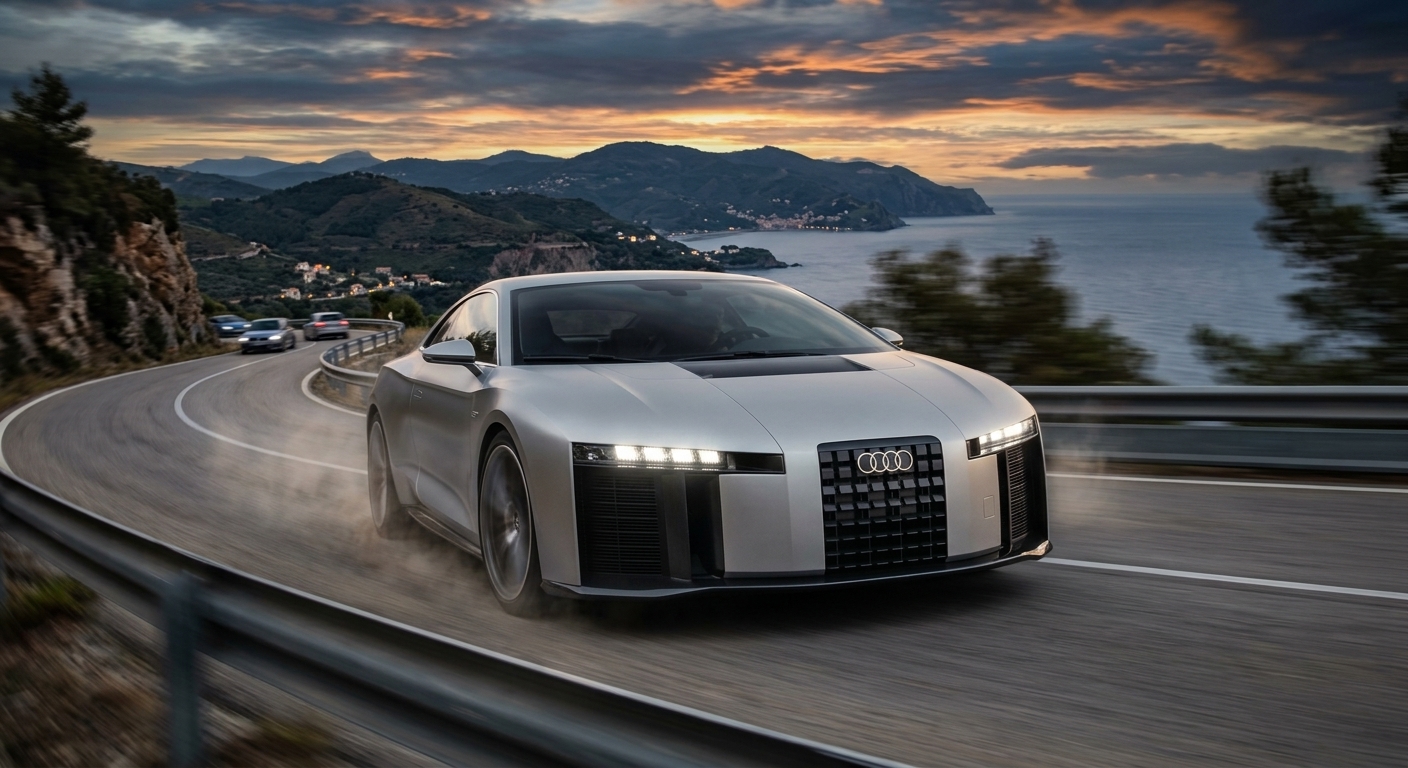
Audi’s Nuvolari is more than a limited-run, 1,001-PS supercar. For investors in Volkswagen AG (VOW3.DE) in Germany and (VWAGY) in the U.S. OTC market it is a conspicuous proof point that the premium brand is attempting to compress development cycles, elevate its design authority, and turn scarce engineering into brand heat. The 499-unit Nuvolari will not move the needle on Volkswagen Group revenue by itself. A boutique supercar rarely does; it is a halo, not a volume spreadsheet. But its 405-day journey from first sketch to drivable prototype offers a more investable message: Audi is trying to build at a pace more familiar to a software sprint than a traditional German automotive program.
The 405-Day Argument
Audi’s documentary depicts a tightly integrated development model: designers, engineers, aerodynamics specialists, component teams, and powertrain experts working in close proximity, with fast iteration from digital concept to clay model, testing mule, and running prototype. That matters because speed is not merely a stopwatch statistic in autos. It can improve capital efficiency, reduce the risk that a product looks old before it arrives, and allow manufacturers to respond more quickly to shifts in luxury demand, powertrain preferences, and competition—particularly from China’s rapidly moving vehicle industry. Audi says the Nuvolari reached a drivable prototype in 405 days, with cold-weather testing in Sweden, high-speed development at Nardò, and public-facing debuts in Antibes and Monaco. That is an unusually compressed timetable for a vehicle program carrying new materials, a hybrid powertrain, advanced all-wheel-drive technology, and the usual inconvenient requirement that a 1,000-horsepower car should not melt itself.
A Halo Car With Real Strategic Value
The Nuvolari combines a twin-turbo V8 and electrification, delivering 1,001 PS in Audi’s pre-production specification. Audi has capped production at 499 units worldwide, emphasizing scarcity over scale. For many, the relevant issue is not whether 499 affluent buyers can locate a tasteful garage. It is whether Audi can use such products to strengthen the broader premium portfolio.
A successful halo vehicle can do several things at once:
- Reassert Audi’s performance credentials after the R8 era.
- Demonstrate that electrification can complement, rather than dilute, emotional performance.
- Create a design and engineering “north star” for future high-volume Audi launches.
- Support pricing power and desirability across the brand, where the financial stakes are much larger than the Nuvolari’s production run.
- Generate global media attention without relying solely on the discounting machinery that has never improved anyone’s luxury aura.
The car is therefore best understood as a rolling brand laboratory with carbon fiber, aluminum architecture, active aerodynamics, and just enough theatre to prevent the PowerPoint department from taking all the credit.
Volkswagen Investors Own the Read-Through
Audi is not independently investable. It is wholly owned within Volkswagen Group, making Volkswagen AG the public-market route for investors seeking exposure to Audi’s premium-brand strategy. Volkswagen ordinary shares trade in Germany under VOW3.DE, while U.S. investors may encounter the ADR VWAGY. here’s a link to their annual report: annualreport2020.volkswagenag. Volkswagen Group’s 2025 figures underline why the Audi turnaround and product cadence matter. The group reported €321.9 billion in sales revenue, 9.0 million vehicle sales, €8.9 billion in operating result, and a 2.8% operating margin. Excluding special effects, operating result was €14.8 billion. European vehicle order intake rose roughly 13% year over year, while Automotive Division net cash flow reached €6.4 billion. Those figures describe a company with formidable global scale—but also one with meaningful room for margin repair. That is where a stronger Audi product machine becomes strategically important. Premium brands can carry more pricing power, richer mix, and greater customer loyalty than mass-market nameplates when the product is genuinely differentiated. In other words, Volkswagen does not need the Nuvolari to become a volume business. It needs the discipline behind the Nuvolari to migrate into the products that are.
The Hybrid Message Is Deliberately Broad
The Nuvolari’s powertrain is also a notable strategic signal. Rather than presenting a binary choice between internal-combustion nostalgia and battery-electric futurism, Audi is showcasing a high-output hybrid configuration that pairs traditional performance drama with electric capability. That flexibility could matter in a global vehicle market where regulations, infrastructure, consumer preferences, and trade policies do not move in neat formation. A multi-powertrain approach is more complicated to execute, but it can give a global manufacturer more options while consumer adoption patterns continue to vary region by region. Audi’s prototype specifications cite 1,001 PS, while third-party reporting has described a hybrid system centered on a 4.0-liter twin-turbo V8 with three electric motors. Final production specifications, timing, and market availability remain subject to change, and Audi notes that U.S. availability will be announced later.
The Case for VOW3.DE and VWAGY
The bullish interpretation is not that one exotic Audi will rescue Volkswagen Group’s earnings. That would be asking a 499-unit project to tow a €321.9 billion corporation, which is a job even quattro might decline. The more credible thesis is that the Nuvolari illustrates several qualities investors want to see from Audi and Volkswagen Group:
- Faster development: A 405-day sprint suggests management is pressing for shorter concept-to-prototype cycles.
- Premium-brand renewal: An extreme-performance flagship can restore attention around Audi’s design, engineering, and motorsport-adjacent identity.
- Technology transfer potential: Materials, software workflows, hybrid integration, thermal management, and active aerodynamics can inform future programs.
- Pricing-power ambition: Limited availability and deliberate craftsmanship reinforce Audi’s ability to operate above the commodity end of the market.
- A broader margin opportunity: With 2025 group operating margin at 2.8%, a higher-quality premium product mix could be meaningful if execution follows the prototype’s promise.
What To Watch
The Nuvolari story is encouraging, but the investment case ultimately depends on repeatability. Investors in VOW3.DE and VWAGY should monitor whether Audi translates the project’s urgency into regular production vehicles, not merely into an attractive documentary and a very expensive waiting list.
Key markers include:
- Audi’s next-generation launch cadence and delivery timing.
- Premium-brand pricing and mix, especially against German and Chinese competitors.
- Volkswagen Group operating-margin recovery and Automotive Division cash flow.
- Evidence that faster development reduces cost and improves software, quality, and launch execution.
- The group’s ability to balance battery-electric vehicles, hybrids, and combustion offerings by market.
Bottom Line
The Audi Nuvolari is a small-volume car with an outsized corporate message. It says Audi wants to move faster, look more distinctive, preserve performance heritage, and deploy electrification as an amplifier rather than an apology. For Volkswagen AG investors, that is the real attraction. The best outcome is not 499 sold-out supercars, though that would be pleasant. It is a premium brand that has rediscovered how to turn engineering speed, design confidence, and controlled scarcity into better products and, eventually, better economics.
The Sources
- Audi “The Audi Nuvolari in 405 Days”
- Audi USA “Introducing the Audi Nuvolari”
- Audi “405 Days to Audi Nuvolari: The Full Documentary”
- Volkswagen Group 2025 Annual Report and Full-Year Results
- Volkswagen Group 2025 Year-End Reporting of Group Companies
- Audi Financial Publications and Investor Information
- Volkswagen Group Financial Reports
- Volkswagen Group Audi Brand History
- Motor1 “Audi Built the Nuvolari Prototype in Just 405 Days”
- CarBuzz “How Audi Took Its Brand-New Nuvolari Supercar From Sketch to Driving Prototype”
Stay Updated with Vista Partners
Subscribe to receive market insights, investing ideas, and the latest updates directly in your inbox.