Anthropic’s march toward a trillion-dollar IPO has turned one investor’s bold $75 million bet into a $3 billion masterstroke—and crystallized a new playbook for riding the AI supercycle rather than just reading about it.
Anthropic’s Trillion-Dollar Moment
Anthropic has become the defining “next wave” AI listing, with private and shadow markets implying valuations brushing up against the $1 trillion mark ahead of its widely anticipated mega-IPO. Secondary pricing and structured proxies already treat the company less like a startup and more like a core AI infrastructure utility in waiting, even though its shares are still technically private.
Investors now mention Anthropic in the same breath as the most valuable private tech franchises on the planet, a rarefied club whose valuations start with a “1” followed by twelve zeros. That elite status brings a level of scrutiny usually reserved for central banks: every rumored funding round, every tweak to IPO timing, and every whisper about its latest model release is dissected as if it were a macro data print.
The Mega-IPO Everyone Is Gaming For
Anthropic’s debut is being cast as one of a small handful of “mega-IPOs” poised to reset the scoreboard for AI valuations in 2026. Commentators are already treating the deal like a high-stakes sporting event: syndicate speculation, allocation anxiety, and spirited debate over whether this is the must-own AI franchise of the decade or the crowning moment of peak exuberance.
In practice, the IPO may be less about discovering a fair price and more about rationing access to an asset class—frontier AI platforms—that many institutions now regard as strategic holdings. With so much price discovery already occurring in private and synthetic markets, the listing looks set to formalize a valuation that investors have been rehearsing for months.
Yasmin Razavi’s $75 Million to $3 Billion Saga
At the heart of the Anthropic story sits Spark Capital partner Yasmin Razavi, whose early conviction has morphed into the kind of position that turns a good career into a legendary one. Her roughly $75 million commitment into an earlier Anthropic round has ballooned into an estimated $3 billion stake on paper, transforming an aggressive check into a case study in timing, conviction, and calculated risk.
The investment was reportedly the largest in Spark Capital’s history, effectively a firm-wide vote that Anthropic would not just participate in the AI race but help define it. That call has since vaulted Razavi onto the upper tiers of the venture pantheon, the kind of investor whose name now appears in Midas-level conversations whenever AI riches are tallied.
The New AI Term Sheet: Revenue Optional
One of the more revealing aspects of Anthropic’s capital journey is how willingly investors funded it while revenue was still more hypothesis than line item. In the old growth-equity playbook, late-stage capital waited patiently for cohorts, contracts, and unit economics; in frontier AI, the underwriting has shifted toward compute access, research talent, model performance, and ecosystem gravity.
This capital intensity has turned balance sheets into competitive weapons: the ability to raise and deploy billions into infrastructure and model training is now a core moat. In that environment, traditional rules about valuation friction give way to a different logic: if only a handful of players can afford to compete at the frontier, scarcity, not spreadsheet elegance, dictates the clearing price.
From “Unsexy” Bet to Unignorable Franchise
Anthropic was not always the belle of the AI ball. Early on, directing giant checks into a still-unproven AI lab felt more contrarian than consensus, especially for anyone who remembered past hype cycles in machine learning. That perception gap—the uncomfortable space between “this might be huge” and “everyone agrees this is huge”—is precisely where venture multiples are born.
Today, Anthropic has crossed the line into unignorable franchise status: a name that will feature in benchmark discussions, CIO memos, and panel questions at every AI conference for the foreseeable future. The irony is that the outsize returns accrued not to those who waited for a fully polished story but to those willing to back an audacious ambition before the narrative was fully socially acceptable.
When Secondary Markets Become the Warm-Up Act
Anthropic’s ascent has played out not only in boardrooms but also on secondary platforms, tokenized vehicles, and other creative structures that allow investors to “trade the idea” before the ticker exists. These markets have been quick to plaster eye-popping implied valuations on the company, sometimes moving billions of dollars in perceived value with a few viral screenshots.
For seasoned investors, these secondary signals are useful, if imperfect, sentiment gauges—early looks at demand, liquidity, and positioning ahead of the IPO. For everyone else, they are a gentle reminder that screenshots are not a substitute for due diligence, and that pre-IPO prices can oscillate far more dramatically than the fundamentals they purport to represent.
What Makes Anthropic Investor-Magnetic
Anthropic and the Razavi trade illustrate a combination of traits that are particularly magnetic in this phase of the AI cycle.
It sits at the foundational layer of the stack, where successful platforms can effectively levy a “tax” on broad swaths of downstream AI activity rather than fight for a single niche.
It benefits from extreme scarcity: only a tiny handful of companies operate at comparable scale in model training, safety, and deployment, concentrating capital flows into a short list of names.
It offers a clean, high-impact narrative: “largest check into a future trillion-dollar AI platform” is a story that travels effortlessly across LP decks, conference stages, and business media headlines.
That combination—structural tailwind, scarcity premium, and a story even non-technical investors can tell over dinner—goes a long way toward explaining why the IPO is being treated as a market event, not just a corporate one. The listing will not simply reveal what Anthropic is worth; it will help define, for a time, what the entire AI infrastructure trade should cost.
The Question for Public Investors
By the time Anthropic rings the opening bell, the core question for public-market investors will not be whether AI is investable; that debate has been settled by the sheer volume of capital and compute already deployed. Instead, the question will be: at what price, and with what time horizon, does owning a foundational AI platform make sense in a diversified portfolio?
Whether the IPO prints at a few hundred billion or with a trillion-dollar handle, investors will be forced to make a familiar but high-stakes calculation: how much of the future is already discounted, and how much upside remains in owning the very infrastructure on which that future is being built. For those who missed the early private rounds, Anthropic’s mega listing may be the first—and possibly last—chance to get in near the ground floor of the AI skyscraper, fully aware that the elevator is already moving.
The Sources
Anthropic’s shadow IPO market and trillion-dollar signaling (Yahoo Finance) https://finance.yahoo.com/markets/article/anthropics-shadow-ipo-market-is-already-flashing-trillion-dollar-prices-141451664.htmlfinance.yahoo
Anthropic’s pre-IPO valuation hitting $1 trillion on Jupiter’s Prestocks, with Forge confirmation (BeInCrypto) https://beincrypto.com/anthropic-pre-ipo-valuation-1trillion-jupiter/beincrypto
Anthropic’s funding trajectory and $900 billion-plus round ahead of IPO (Forbes) https://www.forbes.com/sites/jonmarkman/2026/05/04/anthropics-900b-funding-round-set-to-surpass-openai/forbes
“What Anthropic Becoming Top Private AI Firm Means for Investors” (Investing.com analysis) https://www.investing.com/analysis/what-anthropic-becoming-top-private-ai-firm-means-for-investors-200681008investing
U.S. stocks extended their recent run of record-setting gains on Thursday, May 28, 2026, as investors leaned into AI and software leaders while weighing fresh data on inflation-sensitive consumer spending, a key GDP revision, and renewed Middle East tensions that kept oil and rates in focus.
Market recap: records with a risk premium
The S&P 500 and Nasdaq hovered near or at fresh record territory, helped by strength in large-cap technology and AI‑linked names, while the Dow lagged but held close to flat, but sill ticked up +.05%.
U.S. benchmarks briefly wavered around mid‑session as headlines pointed to ongoing but fragile ceasefire dynamics between the U.S. and Iran, before finishing with modest gains as traders bet that any deal to extend a truce could cap the recent oil spike that has left crude oil at $88.80/bbl.
Under the hood, AI software and infrastructure beneficiaries remained the leadership cohort, with mega‑cap platforms like Microsoft (MSFT, $426.99, +3.47%), Oracle (ORCL, $203.70, +6.67%) and Palantir (PLTR, $143.34, +8.17%) advanced, underscoring the market’s persistent preference for secular growth over cyclicals.
Macro lens: PCE, GDP revision, and the consumer
The latest read on the Fed’s preferred inflation gauge, core PCE, came in a touch softer than feared, reinforcing the narrative that inflation is cooling but not yet back to the Fed’s 2% target, keeping the market anchored to a “higher for longer, but not higher still” rate view.
At the same time, the government’s second estimate of Q1 GDP was revised down, signaling that growth is losing some momentum even as inflation remains sticky around the 3% zone the Street increasingly views as the realistic medium‑term regime.
Attention also stayed on U.S. consumer spending, where recent data and commentary have highlighted a more bifurcated backdrop: higher‑income households continue to spend on travel, experiences, and AI‑adjacent hardware and services, while lower‑income cohorts are retrenching, particularly in discretionary categories.
Why this matters for Fed expectations
The combination of softer‑than‑expected PCE, a downward GDP revision, and a still‑resilient labor market supports the case for the Fed to stay patient but not overtly hawkish, with futures still pricing a cautious easing path into 2027 rather than an imminent cutting cycle.
Equities responded by favoring long‑duration assets (growth and AI) while remaining selective in cyclicals that are more exposed to the late‑cycle consumer slowdown narrative.
Geopolitics and energy: Strait of Hormuz back in play
Oil traders spent the session repricing Middle East risk after reports of new U.S. strikes in Iran revived concerns about disruptions through the Strait of Hormuz, a critical chokepoint for global crude flows.
AI, tech, and IPO pipeline: Anthropic’s near‑$1T signal
In AI, Anthropic’s latest private funding round—raising roughly 65 billion dollars at about a 965 billion dollar post‑money valuation—pushed the company to the brink of a 1‑trillion‑dollar mark ahead of a widely anticipated IPO, crystallizing just how crowded the “AI core infrastructure” trade has become.
The round drew participation from both traditional growth‑equity funds and strategic chip and memory suppliers such as Samsung, SK Hynix, and Micron, underscoring how intertwined AI software, cloud infrastructure, and semiconductor capex cycles have become.
For public markets, Anthropic’s trajectory reinforces a familiar playbook: investors are using liquid AI proxies—hyperscalers, GPU suppliers, cloud data platforms, and select software names—as pre‑IPO vehicles for the broader AI theme while they wait for the formal listing window to open.
Sector‑level takeaways for tech and AI
Semiconductors and AI‑exposed hardware remain structural winners in the 2026 rally, with strategists now openly tying their 2027 S&P 500 targets to assumptions for mid‑20s earnings growth driven largely by AI investment and related productivity gains.
The software side of AI is more nuanced: while flagship platforms and data‑infrastructure plays have rerated substantially on robust demand, the broader software complex has seen more mixed earnings reactions, illustrated by strong moves in names like Snowflake (SNOW, $239.20, +36.48%) against softer prints for others such as Salesforce.
VP Watchlist Updates
Below is an update‑style snapshot on the VP Watchlist names for the week, focused on recent catalysts, positioning, and narrative rather than precise price moves.
Astera Labs, Inc. (ALAB, $349.17, +7.33%)
Astera Labs, Inc. (Nasdaq: ALAB), a leader in semiconductor-based connectivity solutions for rack-scale AI infrastructure, recently (May 5) announced preliminary financial results for the first quarter of fiscal year of 2026, ended March 31, 2026. they highlighted the following: Record quarterly revenue of $308.4 million, up 14% QoQ and up 93% year-over-year, Market-leading PCIe 6 AI fabric and signal conditioning portfolio delivered strong growth during Q1, & Now shipping newly announced Scorpio™ X-Series 320-lane AI Fabric switch and expanded Scorpio P-Series PCIe 6 switch family supporting 32 to 320 lanes.
Amwell announced (May 5) financial results for the first quarter ended Mar. 31, 2026.“Entering 2026, Amwell’s main focus was to consolidate our platform to fulfill the unmet needs of our Payer and Provider customers. The Technology-Enabled Care infrastructure we have developed to fill that gap in the market continues to gain traction as customers recognize its clear advantages: lower costs, better outcomes, stronger market share and an increased level of control and agility. Our platform is performing well and built to leverage the latest AI-powered innovations, positioning it as essential infrastructure for tech-enabled care delivery,” said Dr. Ido Schoenberg, Chairman and CEO of Amwell. “We are seeing powerful validation of the platform with significant pipeline growth and a number of meaningful renewals. With this momentum and the favorable regulatory tailwinds, Amwell is well-positioned for continued strong execution this year and to reach our goal of positive cash flow from operations in the fourth quarter.”
Eupraxia Pharmaceuticals (EPRX, $7.38, +2.79%)
Eupraxia Pharmaceuticals Inc. (EPRX), a clinical-stage biotechnology company leveraging its proprietary Diffusphere™ technology designed to optimize local, controlled drug delivery for applications with significant unmet need, announced (May 5) the first Eosinophilic Esophagitis Endoscopic Reference Score (EREFS) data from its ongoing Phase 1b/2a part of the RESOLVE trial evaluating EP-104GI for the treatment of eosinophilic esophagitis (“EoE”). These data were also presented at the ongoing Digestive Disease Week (“DDW”) conference in Chicago. “The EREFS is an important, validated visual index of severity of EoE disease in the esophagus of patients. It measures edema, rings and strictures and other visible markers of disease often associated with symptoms. Today’s data demonstrated improvement in two key outcomes with EP-104GI in the treatment of EoE: first, that a full injection protocol of 20 injections resulted in more pronounced improvement than a protocol with fewer injections and less coverage area within the esophagus; second, with the higher number of injections, a consistent response in both the inflammatory and fibrotic sub scores of EREFS was observed,” said Dr. James A. Helliwell, Chief Executive Officer of Eupraxia. “This EREFS data being reported at DDW is consistent with the improvements we have seen in EoE symptoms and tissue health (EoEHSS) and suggests improvement in inflammation, fibrosis and the associated narrowing of the esophagus.”
Eurpraxia announced on Friday, May 1, the appointment of Dr. Jeymi Tambiah as Chief Medical Officer (CMO) as well as the retirement of Dr. Mark Kowalski, Eupraxia’s current CMO. Dr. Jeymi Tambiah (MB ChB, FRCS, MS, FAPCR, FFPM), is a Board Certified Cardiothoracic Surgeon physician scientist who practiced at Guys and St Thomas’ Hospitals prior to entering the biopharmaceutical industry in 2008. Dr. Tambiah brings over 18 years of experience in clinical development, medical and regulatory strategy, and product commercialization across pharmaceutical and biotechnology organizations.
Eupraxia recently co-hosted a Tribe Public www.TribePublic.com, CEO Presentation & Q&A Webinar event, Wednesday, April 1 titled “Turning EOE Into a Once-a-Year Appointment.” The event featured James A. Helliwell, M.D., Co‑founder and CEO of Eupraxia Pharmaceuticals (NASDAQ: EPRX), who discusses the company’s precision drug‑delivery platform, its approach to Eosinophilic Esophagitis (EoE), and broader pipeline priorities, followed by a focused 5–10 minute Q&A. You may watch it now at this Youtube link.
Modular Medical (MODD, $5.15, +6.64%)
Modular Medical, Inc. (NASDAQ:MODD), a leader in innovative, patient-centric insulin delivery, saw (May 1) CEO Jeb Besser join Tribe Public’s members to unpack a simple question with big implications: what happens when an “almost‑pumper” market finally meets an FDA‑cleared device built for the rest of us, not just the superusers? Tribe Public hosted its CEO Presentation and Q&A Webinar, “From FDA Wins to Scaling Manufacturing – What Investors Should Watch,” on Friday, May 1, 2026, at 8:00 a.m. PT / 11:00 a.m. ET. In keeping with Tribe’s reputation for efficient programming, the session ran approximately 30 minutes, pairing a focused prepared talk with a 5–10 minute live Q&A segment that allowed investors to drill into timelines, capital needs, and commercial strategy. Besser’s formal remarks were framed under the title “From FDA Wins to Scaling Manufacturing – What Investors Should Watch,” setting the tone for a discussion that sat at the intersection of regulation, innovation, and recurring‑revenue hardware. By registering, attendees also joined Tribe Public’s membership base, ensuring they will receive future invitations to CEO briefings, sector spotlights, and investor wish‑list events.
Modular Medical announced (APRIL 19) the pricing of a registered direct offering consisting of 750,000 shares of the Company’s common stock at an offering price of $4.50 per share. The gross proceeds to the Company from the Offering are estimated to be approximately $3.4 million before deducting placement agent fees and other offering expenses. The Offering is expected to close on or about April 21, 2026, subject to the satisfaction of customary closing conditions.
Modular Medical’s latest regulatory milestone upgrades the narrative: the company has now (April 9) secured FDA 510(k) clearance for its Pivot tubeless insulin patch pump, moving from “launch‑ready” to “launch‑approved” in the heart of the fast‑growing diabesity market. The FDA has cleared Modular Medical’s Pivot patch pump as a tubeless, removable insulin delivery system, formally validating the device’s design and performance for commercial use in U.S. adults living with diabetes. The clearance converts what had been a Q1 2026 launch “subject to FDA response” into a tangible commercial pathway, giving the company permission to sell into an insulin pump market that has been estimated at roughly 8 billion dollars globally. Pivot is engineered as a simplified, two‑part patch pump with a 3‑milliliter removable reservoir, no need for battery recharging, and the ability to bolus without a dedicated controller, aiming squarely at patients who have stayed on multiple daily injections because traditional pumps felt too complex, cumbersome, or costly. By clearing Pivot, the FDA is effectively endorsing Modular Medical’s attempt to make advanced insulin delivery feel less like adopting a gadget and more like upgrading a daily habit.
The InterGroup Corporation (INTG, $41.16, +1.16%)
The InterGroup Corporation (NASDAQ: INTG) announced financial (May 11) results for the fiscal third quarter ended March 31, 2026. InterGroup is a diversified holding company with interests in hospitality (through its majority‑owned subsidiary Portsmouth Square, Inc.), real estate operations, and investment transactions. The discussion below is derived from the Company’s Quarterly Report on Form 10‑Q for the quarter ended March 31, 2026. Third Quarter Fiscal 2026 Highlights (Three Months Ended March 31, 2026 vs. 2025) are as follows:
Total revenues increased to $20.372 million from $16.824 million (+21%).
Income from operations increased to $4.260 million from $2.350 million (+81%).
GAAP net income was $0.595 million, compared to a GAAP net loss of $0.750 million in the prior‑year quarter.
Net income attributable to InterGroup was $0.457 million, or $0.21 per diluted share, compared to a net loss attributable to InterGroup of $0.578 million, or $0.27 per share, in the prior‑year quarter.
Hotel revenues increased to $16.497 million from $12.210 million (+35%). For additional context, Hotel revenues for the quarter ended March 31, 2026 exceeded the comparable pre‑pandemic quarter ended March 31, 2019 by approximately $1.028 million.
Real estate revenues were $3.875 million compared to $4.614 million in the prior‑year quarter (‑16%).
Net loss from investment transactions was $(0.342) million compared to $(1.379) million in the prior‑year quarter.
Volato Group, Inc. (SOAR, +10.38%) & M2i Global, Inc. (MTWO, +15.61%)
Nokia has quietly stitched together a new chapter in its comeback story—one that runs from American living rooms to Pentagon test ranges, and now straight through NVIDIA’s (NVDA) data centers. With NVIDIA’s billion‑dollar vote of confidence in the fall and another blockbuster NVIDIA earnings report due today, the old handset icon is suddenly speaking fluent AI.
Nokia announced (May 21) the launch of its AI Networking Innovation Lab, a new center designed to drive co-innovation with AI and cloud partners and accelerate the development of next-generation networking technologies for artificial intelligence (AI) infrastructure. Located within Nokia’s Sunnyvale, California facility, the lab serves as an innovation hub where Nokia will work across advanced AI networking technologies, architectures and ecosystems with a variety of partners to help shape the future of data center networking. AI workloads are fundamentally changing how data center networks must operate. The performance, scale, and precision required to support large-scale AI training and distributed, real-time inference place unprecedented demands on networking infrastructure. To address these challenges, Nokia is adopting a new approach to how technologies are integrated, tested, and deployed from the ground up for the AI era.
Nvidia’s First Quarter Fiscal 2027 earnings report crossed the tape Wednesday, May 20, and the immediate takeaway is that the AI engine is still running at full throttle, even if Wall Street was already leaning hard on the accelerator. The story today is less about whether Nvidia is growing and more about just how far into “infrastructure of AI” territory it has now ventured.
McDonald’s (MCD, $277.97)
Morgan Stanley (April 21) has adjusted its price target on McDonald’s (MCD) to $334, maintaining an Equal Weight stance on the stock. The firm’s analyst highlighted consumer strength heading into first-quarter results, noting that earnings quality will likely vary across the restaurant and food distribution landscape . While some operators may face headwinds, the underlying consumer backdrop remains robust, which could support McDonald’s performance as one of the industry’s quality players positioned to navigate the current environment .
Tesla (TSLA, $442.10, +.40%)
Tesla’s Q1 2026 performance underscored strong revenue growth and signs of margin stabilization, supported by continued investment in solar and AI initiatives. The narrative is further bolstered by Tesla’s stake in SpaceX, with anticipation building around a potential SpaceX IPO that could unlock additional shareholder value soon. However, elevated capital expenditure levels remain a key overhang, tempering investor enthusiasm despite these strategic advantages.
Serina Therapeutics (NYSE: SER, $1.95, +8.33%)
Serina Therapeutics, Inc. (“Serina” or the “Company”) (NYSE American: SER), a clinical-stage biotechnology company developing its proprietary POZ Platform™ drug optimization technology, reported (May 14) its financial results for the first quarter ended March 31, 2026, along with key business updates. The company highlighted the follow: Phase 1b Registrational Clinical Study of SER-252 Underway in Advanced Parkinson’s Disease; TFL data from the SAD study arm targeted for first half of 2027 & Closed $21.2 million private placement financing to support continued advancement of SER-252. “With our Phase 1b registrational study of SER-252 now underway and a strengthened balance sheet, Serina is entering an important execution phase as we work toward our first clinical data in patients with advanced Parkinson’s disease,” said Steve Ledger, Chief Executive Officer of Serina. “SER-252 represents the first clinical validation of our POZ Platform™, which is designed to optimize well-understood therapeutics by improving pharmacokinetics, tolerability and dosing profiles. We believe this approach has the potential to unlock meaningful value across multiple modalities, and we are building a pipeline and partnership strategy to fully leverage the breadth of the platform.”
BuzzFeed, Inc. (BZFD, $1.69)
BuzzFeed, Inc. (“BuzzFeed” or the “Company”) (Nasdaq: BZFD) today announced the closing of its previously announced transaction with Allen Family Digital, LLC, an affiliate of Byron Allen’s Family Office, under which Allen Family Digital, LLC acquired approximately 51% of the Company’s outstanding shares. Byron Allen has assumed the role of Chairman and Chief Executive Officer, and Jonah Peretti has transitioned to his newly created role as President of BuzzFeed AI. Under the terms of the agreement, Allen Family Digital acquired 40 million shares of BuzzFeed, Inc. common stock at a price of $3.00 per share, representing a total transaction value of $120 million for a total purchase price of $120 million. The transaction was funded with $20 million in cash at closing and a $100 million promissory note due five years from closing, accruing interest at 5% annually. BuzzFeed has used $12.5 million of the cash proceeds from the transaction to pay down existing indebtedness, materially strengthening the Company’s balance sheet and enhancing financial flexibility to support future growth initiatives. “Jonah is a great visionary and has done a phenomenal job. BuzzFeed and HuffPost have become two iconic global digital media brands with powerful audience reach and strong cultural importance,” said Byron Allen, Chairman and CEO of BuzzFeed. “Our vision is to build on the iconic foundation of BuzzFeed and HuffPost by expanding into free-streaming video, audio and user-generated content. As of this moment, with the power of AI, BuzzFeed is officially chasing YouTube to become another premier free-streaming video service.”
FMC Corporation (NYSE:FMC) reported (April 29) first quarter 2026 results above guidance with Adjusted EBITDA above high end of range, reaffirms full-year outlook. Their first quarter 2026 revenue of $759 million, down 4 percent versus first quarter 2025. First quarter 2026 revenue, excluding India, was $762 million, down 4 percent versus first quarter 2025, which included India. On a GAAP basis, the company reported a loss of $2.25 per diluted share in the first quarter, a decrease of $2.13 versus first quarter 2025. First quarter adjusted loss per diluted share of $0.23 was down 41 cents versus first quarter 2025. FMC Corporation also announced today that its board of directors declared a regular quarterly dividend of 8 cents per share (roughly 2.26%), payable on July 16, 2026, to shareholders of record as of the close of business on June 30, 2026.
GeoVax Labs, Inc. (GOVX, $2.40)
GeoVax Labs, Inc. (Nasdaq: GOVX), a clinical-stage biotechnology company developing immunotherapies and vaccines, announced (May 26) a strategic prioritization of its development portfolio to concentrate resources on its lead programs, GEO-MVA and Gedeptin(R), reflecting increasing clinical, regulatory, and market alignment across these programs. As part of this decision, the Company has elected to discontinue active development activities related to its GEO-CM04S1 COVID-19 vaccine candidate. This decision was not related to any safety concerns with the vaccine but reflects the continued evolution and contraction of the global COVID-19 vaccine market, and GeoVax’s focus on programs with clearer regulatory pathways, stronger demand visibility, and more immediate commercialization potential. GeoVax emphasized that portfolio prioritization is a standard and essential practice within the biotechnology industry, enabling companies to align resources with the highest-value opportunities as market conditions and scientific landscapes evolve.
Tribe Public’s CEO Presentation and Q&A Webinar Event titled “Ebola, Marburg, Hantavirus, Mpox and Beyond: Building a Resilient Infectious Disease Portfolio Preparedness Strategy” was held Thursday, May 28, 2026. David Dodd, Chairman and Chief Executive Officer of GeoVax Labs, Inc. (NASDAQ: GOVX) delivered a presentation titled “Ebola, Marburg, Hantavirus, Mpox and Beyond: Building a Resilient Infectious Disease Portfolio Preparedness Strategy” and was available for a Q&A session,
Wall Street’s risk-on crowd woke up to find a new cast of characters stealing the spotlight, as AI infrastructure, defense tech and next‑gen batteries turned today’s tape into a speculative showcase rather than a sleepy Thursday.
AI Data Cloud: Snowflake Becomes a Market Meteor
Snowflake (SNOW) is trading like a company that just discovered gravity is optional, with shares vaulting toward record territory on the back of blowout earnings and a turbo‑charged AI narrative. The company stunned the Street with stronger‑than‑expected fiscal first‑quarter results, raised guidance, and unveiled a roughly $6 billion commitment to deepen its partnership with Amazon’s AWS, positioning Snowflake as critical plumbing for the corporate AI gold rush.
Management highlighted that accelerating enterprise AI adoption is driving record product‑revenue growth and a sharp increase in “whale” customers, with 46 clients now spending more than $1 million over the last 12 months, up from 26 a year ago. For investors who once worried Snowflake was a pricey data warehouse, the market is now repricing it as an AI infrastructure toll road—today’s outsized move suggests that re‑rating is well underway.
Braiin Limited: Small‑Cap Neural Spark
Braiin Limited (BRAI) may not yet be a household name, but its chart is suddenly behaving like one, with the stock stacking a weekly gain north of 50% and adding a hefty move again today. Recent trading data show the shares have climbed more than 37% over the past month, even after a choppy year, putting the current price meaningfully above recent lows as momentum traders crowd into the name.
While formal catalysts remain thinner than a term sheet’s fine print, the setup fits the current market appetite for anything exposed to data, algorithms or “intelligent” systems, where thematic AI flows can ignite sharp reratings in smaller platforms. In a tape dominated by mega‑cap narratives, Braiin’s surge is a reminder that liquidity looking for the “next AI story” can make even modest news feel like a brain wave.
Ondas (ONDS): Drone Defense Meets Border Security
Ondas (ONDS) is flying higher on a potent mix of defense spending momentum and hard contracts that turn buzzwords like “autonomous systems” and “robotic demining” into actual revenue. The company recently completed a $175 million merger with defense contractor Mistral and secured an initial $10 million order as part of a $50 million demining tender under Israel’s $1.7 billion Eastern Border Security Barrier initiative.
Additional wins include about $68 million in initial orders under a $140 million multi‑year military engineering program, plus a strategic robotic demining role along roughly 500 kilometers of border terrain—work expected to spawn follow‑on orders above $50 million. Today’s surge comes as traders lean into a broader “drone dominance” and defense‑tech theme highlighted in early‑morning market commentary, turning Ondas into a high‑beta vehicle for investors betting that geopolitics will keep defense budgets—and advanced unmanned systems—on an upward path.
Unusual Machines (UMAC): Momentum With a Capital “M”
Unusual Machines Inc. (UMAC) is living up to its name, posting one of the day’s largest percentage gains with the stock up nearly 50% and trading around the high‑20s, according to top‑gainer screens. The move puts Unusual Machines firmly on the radar of momentum desks, with volume spiking as short‑term traders pile into the name in search of volatility and range.
The company sits at the intersection of robotics, autonomy and next‑gen hardware, a space that has become catnip for speculators riding the AI and automation wave across the industrial and defense stack. In a market where narrative often arrives after price, today’s outsized jump looks like a classic squeeze‑and‑chase pattern: the stock makes the gainers list, algorithms follow, and the feedback loop does the rest.
Amprius Technologies (AMPX): Batteries Back in the Buzz
Amprius Technologies (AMPX) has re‑entered the limelight as traders recycle into high‑energy‑density battery stories tied to drones, electric aviation and defense applications. The stock has appeared on prior “top gainers” rosters, and today’s move extends that pattern as risk‑on capital hunts for under‑owned names that can benefit from both electrification and military modernization themes.
With markets increasingly focused on how to power AI‑enabled devices at the edge—whether in the sky, on the battlefield or in mobility platforms—Amprius’ advanced battery profile offers a compelling narrative for investors looking past traditional EV plays. The result: when small‑ and mid‑cap AI and defense names break out, Amprius tends to get swept up in the rotation, and today is no exception.
ChronoScale (CHRN): Time in the Micro‑Cap Sun
ChronoScale (CHRN) is the sort of micro‑cap most investors only notice when it lands on a “biggest movers” list—and that’s exactly what is happening today as the stock joins the ranks of double‑digit gainers. Thin liquidity and a tight float can amplify even modest buying interest, giving ChronoScale the kind of intraday swings that attract day traders and quant screens alike.
While the company has yet to dominate headlines, its presence in the high‑volatility cohort, alongside other speculative technology and industrial names, makes it a useful barometer of risk appetite further out on the curve. In today’s tape, ChronoScale’s rally reads less like a single‑name story and more like a chapter in the broader narrative: investors are once again willing to pay up for growth, optionality and a bit of old‑fashioned small‑cap drama.
Honda shares rise despite loss; strategic shift on EVs – Deutsche Welle https://www.dw.com/en/honda-reports-first-loss-since-1957-as-it-waters-down-ev-strategy-but-shares-rise-on-2026-forecasts/a-7715dw
Honda shares rise after reporting operating loss – CNBC https://www.cnbc.com/2026/05/15/honda-shares-rise-even-after-company-reports-operating-losses-.htmlcnbc
General top gainers and movers lists (daily context) – Benzinga Movers https://www.benzinga.com/moversbenzinga
General top gainers and market movers (daily context) – Morningstar Movers https://www.morningstar.com/markets/moversmorningstar
On a day when investors were already primed for another round of AI‑driven fireworks, Snowflake (SNOW) stole the show and then rewrote the script. The cloud data platform not only raised its annual product revenue outlook but did so convincingly enough to send its shares sharply higher in after‑hours trading, reinforcing the market’s conviction that AI is no longer a story stock theme but a revenue line item.
Snowflake’s updated forecast for fiscal 2027 product revenue, lifting guidance into the mid‑$5 billion range, signaled that enterprises are not just experimenting with AI workloads—they are committing budgets to production‑grade data infrastructure. Management’s outlook for second‑quarter product revenue to come in above consensus estimates further underscored that this is not a one‑quarter blip but a demand curve that is bending upwards as AI use cases move from slide decks to deployment. In a tape already supported by strong mega‑cap tech earnings, Snowflake’s print added another data point to the thesis that AI spending is broadening beyond the usual suspects.
Snowflake: From Data Warehouse to AI Toll Road
The market’s exuberant reaction to Snowflake’s guidance shift was not just about a few extra basis points of growth—it was about narrative confirmation. Over recent years, Snowflake has built a reputation as a neutral, cloud‑agnostic data layer, and that positioning is now paying off as enterprises seek to orchestrate AI workloads across multiple clouds without recreating data silos. The company’s product revenue has compounded from the low billions to the mid‑single‑digit billions in just a few fiscal years, with fiscal 2025 revenue around $3.6 billion and growth near 30% year over year, making its latest guidance raise look more like an acceleration than a victory lap.
What changed is not Snowflake’s architecture but its role in the AI value chain. As enterprises train and deploy AI models, the bottleneck is increasingly high‑quality, well‑governed data, and Snowflake is effectively charging tolls on that traffic. Guidance pointing to quarterly product revenue north of $1.4 billion—above Street expectations—suggests customers are scaling workloads rather than pausing to “optimize spend,” a phrase that used to terrify high‑growth software shareholders. In other words, Snowflake is evolving from “nice‑to‑have cloud database” to “mission‑critical AI data backbone,” and the stock price is starting to reflect that upgrade.
Salesforce: Solid Business, Lukewarm Narrative
If Snowflake’s quarter was a master class in how to surf the AI wave, Salesforce’s (CRM) latest outlook played more like a cautious weather report. While the CRM pioneer continues to generate substantial revenue from its cloud and AI‑adjacent offerings, its guidance was characterized as lukewarm, raising questions about how quickly its extensive product portfolio can convert AI buzz into visible top‑line acceleration.
Salesforce has invested heavily in AI features—from Einstein‑powered analytics to tighter integrations across email, productivity, and CRM—but investors increasingly want to see AI as a distinct growth driver rather than a marketing adjective. The company’s mature scale and broad installed base are undeniable strengths, yet they also make incremental growth look more pedestrian compared with hyper‑growth data platforms riding greenfield AI demand. In a market rewarding clear AI operating leverage, “steady as she goes” guidance can feel less like prudence and more like opportunity cost.
AI, Earnings, and the Market’s New Sorting Hat
The broader backdrop to these results is a market that has learned to differentiate between AI storytellers and AI monetizers. Recent tech earnings have shown that indices like the Nasdaq‑100 are seeing much of their gains driven by actual earnings growth, with AI demand for chips, cloud capacity, and software workloads translating into higher profits rather than just multiple expansion. Investors are now probing a simple but unforgiving question: does AI show up in your revenue run‑rate, or only in your conference‑call vocabulary?
Research suggesting that AI investment already accounts for a significant portion of U.S. GDP growth has raised the stakes for public companies. If AI‑linked productivity can lift long‑run S&P 500 earnings growth by over a percentage point annually, as some estimates indicate, then stocks that visibly participate in that uplift could justify premium valuations, while laggards risk being quietly derated. With only a modest share of businesses actively using AI in production, according to recent census‑based data, the runway is long—but so is the market’s patience for vague AI roadmaps.
Investor Takeaways: Where the Smart Money Looks Next
For growth‑oriented investors, Snowflake’s guidance raise and share price surge reinforce three themes: data infrastructure is becoming the core plumbing of enterprise AI, AI workloads tend to concentrate on scalable, neutral platforms, and early‑mover economics are powerful when customers build mission‑critical systems on your stack. The company’s trajectory suggests that as AI adoption broadens beyond the largest tech platforms, specialized data and analytics providers could capture outsized budget share.
For more mature cloud leaders like Salesforce, the bar is shifting from integrating AI features to demonstrating that those features can reignite durable, above‑trend growth. Investors will increasingly scrutinize not just headline AI announcements but attach rates, upsell traction, and the degree to which AI reduces churn or expands wallet share. In a market where AI may lift long‑term earnings and justify higher equity valuations, the most compelling opportunities may lie in companies that, like Snowflake, already see AI reflected in booked revenue rather than in aspirational slideware.
The Sources
Snowflake raises annual product revenue forecast as enterprises ramp up AI workloads – U.S. News & World Reportmoney.usnews https://money.usnews.com/investing/news/articles/2026-05-27/snowflake-raises-annual-product-revenue-forecast-as-enterprises-ramp-up-ai-workloads
Snowflake raises annual product revenue forecast as enterprises ramp up AI workloads – Investing.com (similar coverage and additional detail)investing https://www.investing.com/news/stock-market-news/snowflake-raises-annual-product-revenue-forecast-as-enterprises-ramp-up-ai-workloads-3743390
Salesforce Outlook integration to be disrupted via new Microsoft initiative – SalesforceBensalesforceben https://www.salesforceben.com/salesforce-outlook-integration-to-be-disrupted-via-new-microsoft-initiative
Salesforce Outlook integration: A comprehensive guide – Astrecaastreca https://astreca.com/blog/salesforce-outlook-integration
Outlook integration vs Inbox vs Einstein Activity Capture – RTDynamicrtdynamic https://www.rtdynamic.com/blog/outlook-for-salesforce-integration-guide
AI is driving earnings and economic growth. Is it too much? – CFO Leadership Councilcfoleadership https://cfoleadership.com/ai-is-driving-earnings-and-economic-growth-is-it-too-much
How much could AI boost US stocks? – Goldman Sachs Researchgoldmansachs https://www.goldmansachs.com/insights/articles/how-much-could-ai-boost-us-stocks
AI spending vs. returns: What big tech earnings mean for the market – YouTube (Yahoo Finance)youtube https://www.youtube.com/watch?v=256YxiivI5o
Numbered references – The Writing Center, University of Wisconsin–Madison (guidance on numerical source lists)writing.wisc https://writing.wisc.edu/handbook/documentation/docnumreference
Vista Partners’ sister organization Tribe Public www.tribepublic.com is once again turning a high‑stakes public health story into a conversation, this time by putting hemorrhagic fevers and vaccine preparedness squarely on the calendar for May 28, 2026 at 8am pacific time via their Tribe Pubic CEO Presentation and Q&A webinar-based platform. The result is an event—and a narrative—that sits neatly at the intersection of science, capital markets, and the perennial investor question: “Who is actually building the fire extinguisher before the next fire?”
A Sister Organization Built For the Spotlight
Tribe Public, the San Francisco–based sister organization to Vista Partners, has carved out a niche as a kind of “idea exchange” for institutions, family offices, advisors, and sophisticated retail investors hunting for under‑followed stories with real scientific depth. Its complimentary CEO presentation and Q&A events, delivered globally via Zoom, are designed to give investors and consumers a direct, unfiltered access to management teams operating at the sharp end of innovation.
The upcoming session—“Ebola, Marburg, Hantavirus, Mpox and Beyond: Building a Resilient Infectious Disease Preparedness Strategy”—will be co-hosted by GeoVax Labs (NASDAQ: GOVX), a clinical‑stage biotech developing vaccines and immunotherapies for infectious diseases and cancer.
Why Ebola, Marburg, Hantavirus and Mpox Still Matter
The pathogens headlining this event are not newcomers to the risk matrix; they are repeat characters with unnerving résumés. Ebola and Marburg, closely related filoviruses, are notorious for causing severe hemorrhagic fever and high case‑fatality rates in outbreaks from central and eastern Africa. Hantaviruses, often spread through contact with rodent excreta, can trigger hantavirus pulmonary syndrome and hemorrhagic fever with renal syndrome. Mpox, which broke out globally in 2022, has since reminded policymakers that “niche” zoonoses can go from footnote to front page in one news cycle.
While prior waves of funding have tended to chase the last crisis—COVID here, Mpox there—the scientific and policy consensus has shifted toward platforms that can be rapidly adapted across multiple threats.
GeoVax’s Platform Pitch
GeoVax is advancing vaccine candidates based on a modified vaccinia Ankara (MVA) vector and other approaches designed to induce durable immune responses against a range of infectious threats, including Mpox and hemorrhagic fever viruses such as Ebola and Marburg.
Recent commentary on GeoVax has highlighted preclinical work across multiple filoviruses and the company’s push to position its programs within a broader global preparedness agenda. Tribe Public’s CEO forum gives management a chance to connect those scientific details to milestones investors actually model: regulatory catalysts, partnership potential, and non‑dilutive funding opportunities.
Inside the May 28 CEO Event
The webinar is scheduled for Thursday, May 28, 2026, at 8:00 a.m. Pacific / 11:00 a.m. Eastern, and is open on a complimentary basis to qualified investors and interested stakeholders. Attendees can register via the dedicated landing page at Ebola‑May‑2026.TribePublic.com and submit questions in advance to Tribe Public’s research team or live via Zoom chat during the session.
Tribe Public’s managing member will host and moderate the discussion, steering questions toward both the science and the strategy—why these indications, why now, and how GeoVax plans to convert vaccine R&D into shareholder value in a capital market that has turned decidedly more demanding with respect to data, timelines, and capital efficiency.
A Repeatable Investor Discovery Engine
This is not Tribe Public’s first outing with high‑consequence pathogens—and that repetition is, in itself, part of the thesis. Previous events have spotlighted GeoVax’s programs targeting COVID‑19 and Mpox, as well as other biotech CEOs focused on “fully engaging the human immune system to cure disease,” signaling an editorial bias toward platforms with multi‑indication potential.
The format is deliberately efficient. Tribe Public brings together management teams, institutional investors, family offices, RIAs, and sell‑side professionals who are hunting for what might be described, in classic Wall Street shorthand, as “asymmetric outcomes with real science attached.” For issuers, the reward is targeted exposure; for investors, it is the ability to interrogate the people making capital allocation decisions in real time.
Risk, Reward and the Preparedness Premium
For investors, infectious disease preparedness sits at the messy intersection of science, geopolitics, and budget cycles. Revenues often lag outbreaks, contracts can be concentrated, and valuations can swing with each headline. Yet the structural drivers—urbanization, climate‑driven shifts in vector habitats, and global mobility—continue to argue for sustained investment in broadly protective platforms.
Events like Tribe Public’s May 28 webinar do not remove that risk; they illuminate it. By putting a clinical‑stage company like GeoVax in a live Q&A with a live audience, Tribe is effectively turning due diligence into a public good: investors get transparency, management gets feedback, and the broader ecosystem gets a more informed conversation about which preparedness strategies may actually scale.
U.S. equity markets extended their powerful rally on Wednesday, with the S&P 500 closed at 7,520.36, +.02%, the Nasdaq Composite continuing to set fresh all-time highs as semiconductor stocks maintained their extraordinary momentum and oil prices retreated on diplomatic optimism closing at 26,674.73, +.07% and the Dow powered to a close of 50,644.28, +.36%. However, the small caps on the Russell 2000 retreated .02% to close at 2,919.94, but reminds up 17.65% YTD.
Semiconductor Surge Reaches Historic Milestones
The AI-driven semiconductor rally achieved remarkable new benchmarks as South Korean chipmaker SK Hynix surged over 11% in Asian trading, pushing its market capitalization past the $1 trillion threshold—just one day after Micron Technology (MU, $928.41, +3.63%) crossed the same landmark with a stunning 19% gain on Tuesday. This consecutive achievement underscores the relentless institutional demand for memory chip manufacturers positioned at the center of artificial intelligence infrastructure buildout.
The technology sector’s dominance has created a pronounced divergence within equity markets, with chip stocks and AI-related names driving nearly all gains while the broader market shows more muted performance. Tuesday’s session saw the S&P 500 and Nasdaq Composite achieve both intraday and closing records, surpassing previous highs set on May 14.
Energy Market Relief
Crude oil prices declined significantly on Wednesday, providing macro relief to inflation concerns and consumer spending outlooks. Brent crude futures retreated over 3% to approximately $96.50 per barrel after approaching $100 earlier in the week, while West Texas Intermediate fell 3.5% to around $90 per barrel. The pullback came as diplomatic negotiations between the U.S. and Iran showed signs of progress, with Tehran remaining engaged in discussions aimed at reopening the Strait of Hormuz despite earlier military tensions.
However, energy market fundamentals remain structurally challenged, with S&P Global forecasting Dated Brent crude to remain above $100 per barrel through the remainder of 2026 due to persistent supply disruptions related to the Middle East conflict.
Global Growth Downgrades Amid Persistent Inflation
The macroeconomic backdrop for 2026 has deteriorated significantly from earlier projections, with S&P Global slashing its annual global real GDP growth forecast to just 2.2%, down sharply from the 2.9% estimate made in February. Advanced economies are now expected to expand by only 1.5% annually over the next two years, while emerging markets maintain stronger momentum at approximately 4.0% growth.
The downward revisions reflect the compounding impacts of higher-for-longer energy prices, elevated inflation, and less accommodative monetary policy across major economies. The European Central Bank has added rate hikes to its 2026 policy path, contributing to projected quarter-over-quarter real GDP contractions in several of Europe’s largest economies.
Federal Reserve Policy Remains Restrictive
The Federal Reserve maintained its benchmark funds rate in the 3.5% to 3.75% range at its late April meeting, with market participants now expecting no changes through the remainder of 2026 and into 2027. Despite incoming Fed Chair Kevin Warsh’s expected preference for rate cuts, the central bank faces persistent inflation pressures that have stalled progress toward its 2% target.
Core inflation continues running at approximately 2.6% to 2.8% on an annual basis, with forecasters projecting headline CPI could reach 3.5% when April data is released, driven primarily by elevated energy costs and stubborn housing price increases. Some economists now warn that inflation could surprise to the upside and potentially exceed 4% by year-end, driven by lagged tariff effects, fiscal expansion, tighter labor markets, and drifting inflation expectations.
The 10-year Treasury yield retreated to below 4.47% on Wednesday from Tuesday’s close above 4.49%, reflecting modest safe-haven demand amid geopolitical uncertainty.
U.S. Economic Resilience Continues
Despite global headwinds, the U.S. economy has demonstrated notable resilience, with first-quarter 2026 real GDP growth accelerating to 2.0% annually after just 0.5% growth at the end of 2025. Robust business investment in equipment and intellectual property products—particularly AI-related capital expenditures—combined with steady household consumption growth remain the primary drivers of economic expansion.
The labor market has strengthened, with job growth picking up and unemployment remaining at or near full employment levels. Professional forecasters surveyed by the Philadelphia Federal Reserve have upgraded their annual-average GDP growth forecast for 2026 to 2.5%, up 0.7 percentage points from the previous survey.
VP Watchlist Updates
Below is an update‑style snapshot on the VP Watchlist names for the week, focused on recent catalysts, positioning, and narrative rather than precise price moves.
Astera Labs, Inc. (ALAB, $325.33, +2.07%)
Astera Labs, Inc. (Nasdaq: ALAB), a leader in semiconductor-based connectivity solutions for rack-scale AI infrastructure, recently (May 5) announced preliminary financial results for the first quarter of fiscal year of 2026, ended March 31, 2026. they highlighted the following: Record quarterly revenue of $308.4 million, up 14% QoQ and up 93% year-over-year, Market-leading PCIe 6 AI fabric and signal conditioning portfolio delivered strong growth during Q1, & Now shipping newly announced Scorpio™ X-Series 320-lane AI Fabric switch and expanded Scorpio P-Series PCIe 6 switch family supporting 32 to 320 lanes.
Amwell announced (May 5) financial results for the first quarter ended Mar. 31, 2026.“Entering 2026, Amwell’s main focus was to consolidate our platform to fulfill the unmet needs of our Payer and Provider customers. The Technology-Enabled Care infrastructure we have developed to fill that gap in the market continues to gain traction as customers recognize its clear advantages: lower costs, better outcomes, stronger market share and an increased level of control and agility. Our platform is performing well and built to leverage the latest AI-powered innovations, positioning it as essential infrastructure for tech-enabled care delivery,” said Dr. Ido Schoenberg, Chairman and CEO of Amwell. “We are seeing powerful validation of the platform with significant pipeline growth and a number of meaningful renewals. With this momentum and the favorable regulatory tailwinds, Amwell is well-positioned for continued strong execution this year and to reach our goal of positive cash flow from operations in the fourth quarter.”
Eupraxia Pharmaceuticals (EPRX, $7.18)
Eupraxia Pharmaceuticals Inc. (EPRX), a clinical-stage biotechnology company leveraging its proprietary Diffusphere™ technology designed to optimize local, controlled drug delivery for applications with significant unmet need, announced (May 5) the first Eosinophilic Esophagitis Endoscopic Reference Score (EREFS) data from its ongoing Phase 1b/2a part of the RESOLVE trial evaluating EP-104GI for the treatment of eosinophilic esophagitis (“EoE”). These data were also presented at the ongoing Digestive Disease Week (“DDW”) conference in Chicago. “The EREFS is an important, validated visual index of severity of EoE disease in the esophagus of patients. It measures edema, rings and strictures and other visible markers of disease often associated with symptoms. Today’s data demonstrated improvement in two key outcomes with EP-104GI in the treatment of EoE: first, that a full injection protocol of 20 injections resulted in more pronounced improvement than a protocol with fewer injections and less coverage area within the esophagus; second, with the higher number of injections, a consistent response in both the inflammatory and fibrotic sub scores of EREFS was observed,” said Dr. James A. Helliwell, Chief Executive Officer of Eupraxia. “This EREFS data being reported at DDW is consistent with the improvements we have seen in EoE symptoms and tissue health (EoEHSS) and suggests improvement in inflammation, fibrosis and the associated narrowing of the esophagus.”
Eurpraxia announced on Friday, May 1, the appointment of Dr. Jeymi Tambiah as Chief Medical Officer (CMO) as well as the retirement of Dr. Mark Kowalski, Eupraxia’s current CMO. Dr. Jeymi Tambiah (MB ChB, FRCS, MS, FAPCR, FFPM), is a Board Certified Cardiothoracic Surgeon physician scientist who practiced at Guys and St Thomas’ Hospitals prior to entering the biopharmaceutical industry in 2008. Dr. Tambiah brings over 18 years of experience in clinical development, medical and regulatory strategy, and product commercialization across pharmaceutical and biotechnology organizations.
Eupraxia recently co-hosted a Tribe Public www.TribePublic.com, CEO Presentation & Q&A Webinar event, Wednesday, April 1 titled “Turning EOE Into a Once-a-Year Appointment.” The event featured James A. Helliwell, M.D., Co‑founder and CEO of Eupraxia Pharmaceuticals (NASDAQ: EPRX), who discusses the company’s precision drug‑delivery platform, its approach to Eosinophilic Esophagitis (EoE), and broader pipeline priorities, followed by a focused 5–10 minute Q&A. You may watch it now at this Youtube link.
Modular Medical (MODD, $4.88)
Modular Medical, Inc. (NASDAQ:MODD), a leader in innovative, patient-centric insulin delivery, saw (May 1) CEO Jeb Besser join Tribe Public’s members to unpack a simple question with big implications: what happens when an “almost‑pumper” market finally meets an FDA‑cleared device built for the rest of us, not just the superusers? Tribe Public hosted its CEO Presentation and Q&A Webinar, “From FDA Wins to Scaling Manufacturing – What Investors Should Watch,” on Friday, May 1, 2026, at 8:00 a.m. PT / 11:00 a.m. ET. In keeping with Tribe’s reputation for efficient programming, the session ran approximately 30 minutes, pairing a focused prepared talk with a 5–10 minute live Q&A segment that allowed investors to drill into timelines, capital needs, and commercial strategy. Besser’s formal remarks were framed under the title “From FDA Wins to Scaling Manufacturing – What Investors Should Watch,” setting the tone for a discussion that sat at the intersection of regulation, innovation, and recurring‑revenue hardware. By registering, attendees also joined Tribe Public’s membership base, ensuring they will receive future invitations to CEO briefings, sector spotlights, and investor wish‑list events.
Modular Medical announced (APRIL 19) the pricing of a registered direct offering consisting of 750,000 shares of the Company’s common stock at an offering price of $4.50 per share. The gross proceeds to the Company from the Offering are estimated to be approximately $3.4 million before deducting placement agent fees and other offering expenses. The Offering is expected to close on or about April 21, 2026, subject to the satisfaction of customary closing conditions.
Modular Medical’s latest regulatory milestone upgrades the narrative: the company has now (April 9) secured FDA 510(k) clearance for its Pivot tubeless insulin patch pump, moving from “launch‑ready” to “launch‑approved” in the heart of the fast‑growing diabesity market. The FDA has cleared Modular Medical’s Pivot patch pump as a tubeless, removable insulin delivery system, formally validating the device’s design and performance for commercial use in U.S. adults living with diabetes. The clearance converts what had been a Q1 2026 launch “subject to FDA response” into a tangible commercial pathway, giving the company permission to sell into an insulin pump market that has been estimated at roughly 8 billion dollars globally. Pivot is engineered as a simplified, two‑part patch pump with a 3‑milliliter removable reservoir, no need for battery recharging, and the ability to bolus without a dedicated controller, aiming squarely at patients who have stayed on multiple daily injections because traditional pumps felt too complex, cumbersome, or costly. By clearing Pivot, the FDA is effectively endorsing Modular Medical’s attempt to make advanced insulin delivery feel less like adopting a gadget and more like upgrading a daily habit.
The InterGroup Corporation (INTG, $40.69, +.52%)
The InterGroup Corporation (NASDAQ: INTG) announced financial (May 11) results for the fiscal third quarter ended March 31, 2026. InterGroup is a diversified holding company with interests in hospitality (through its majority‑owned subsidiary Portsmouth Square, Inc.), real estate operations, and investment transactions. The discussion below is derived from the Company’s Quarterly Report on Form 10‑Q for the quarter ended March 31, 2026. Third Quarter Fiscal 2026 Highlights (Three Months Ended March 31, 2026 vs. 2025) are as follows:
Total revenues increased to $20.372 million from $16.824 million (+21%).
Income from operations increased to $4.260 million from $2.350 million (+81%).
GAAP net income was $0.595 million, compared to a GAAP net loss of $0.750 million in the prior‑year quarter.
Net income attributable to InterGroup was $0.457 million, or $0.21 per diluted share, compared to a net loss attributable to InterGroup of $0.578 million, or $0.27 per share, in the prior‑year quarter.
Hotel revenues increased to $16.497 million from $12.210 million (+35%). For additional context, Hotel revenues for the quarter ended March 31, 2026 exceeded the comparable pre‑pandemic quarter ended March 31, 2019 by approximately $1.028 million.
Real estate revenues were $3.875 million compared to $4.614 million in the prior‑year quarter (‑16%).
Net loss from investment transactions was $(0.342) million compared to $(1.379) million in the prior‑year quarter.
Volato Group, Inc. (SOAR) & M2i Global, Inc. (MTWO, +2.98%)
Nokia has quietly stitched together a new chapter in its comeback story—one that runs from American living rooms to Pentagon test ranges, and now straight through NVIDIA’s (NVDA) data centers. With NVIDIA’s billion‑dollar vote of confidence in the fall and another blockbuster NVIDIA earnings report due today, the old handset icon is suddenly speaking fluent AI.
Nokia announced (May 21) the launch of its AI Networking Innovation Lab, a new center designed to drive co-innovation with AI and cloud partners and accelerate the development of next-generation networking technologies for artificial intelligence (AI) infrastructure. Located within Nokia’s Sunnyvale, California facility, the lab serves as an innovation hub where Nokia will work across advanced AI networking technologies, architectures and ecosystems with a variety of partners to help shape the future of data center networking. AI workloads are fundamentally changing how data center networks must operate. The performance, scale, and precision required to support large-scale AI training and distributed, real-time inference place unprecedented demands on networking infrastructure. To address these challenges, Nokia is adopting a new approach to how technologies are integrated, tested, and deployed from the ground up for the AI era.
Nvidia’s First Quarter Fiscal 2027 earnings report crossed the tape Wednesday, May 20, and the immediate takeaway is that the AI engine is still running at full throttle, even if Wall Street was already leaning hard on the accelerator. The story today is less about whether Nvidia is growing and more about just how far into “infrastructure of AI” territory it has now ventured.
McDonald’s (MCD, $280.92, +.59%)
Morgan Stanley (April 21) has adjusted its price target on McDonald’s (MCD) to $334, maintaining an Equal Weight stance on the stock. The firm’s analyst highlighted consumer strength heading into first-quarter results, noting that earnings quality will likely vary across the restaurant and food distribution landscape . While some operators may face headwinds, the underlying consumer backdrop remains robust, which could support McDonald’s performance as one of the industry’s quality players positioned to navigate the current environment .
Tesla (TSLA, $440.36, +1.56%)
Tesla’s Q1 2026 performance underscored strong revenue growth and signs of margin stabilization, supported by continued investment in solar and AI initiatives. The narrative is further bolstered by Tesla’s stake in SpaceX, with anticipation building around a potential SpaceX IPO that could unlock additional shareholder value soon. However, elevated capital expenditure levels remain a key overhang, tempering investor enthusiasm despite these strategic advantages.
Serina Therapeutics (NYSE: SER, $1.80)
Serina Therapeutics, Inc. (“Serina” or the “Company”) (NYSE American: SER), a clinical-stage biotechnology company developing its proprietary POZ Platform™ drug optimization technology, reported (May 14) its financial results for the first quarter ended March 31, 2026, along with key business updates. The company highlighted the follow: Phase 1b Registrational Clinical Study of SER-252 Underway in Advanced Parkinson’s Disease; TFL data from the SAD study arm targeted for first half of 2027 & Closed $21.2 million private placement financing to support continued advancement of SER-252. “With our Phase 1b registrational study of SER-252 now underway and a strengthened balance sheet, Serina is entering an important execution phase as we work toward our first clinical data in patients with advanced Parkinson’s disease,” said Steve Ledger, Chief Executive Officer of Serina. “SER-252 represents the first clinical validation of our POZ Platform™, which is designed to optimize well-understood therapeutics by improving pharmacokinetics, tolerability and dosing profiles. We believe this approach has the potential to unlock meaningful value across multiple modalities, and we are building a pipeline and partnership strategy to fully leverage the breadth of the platform.”
BuzzFeed, Inc. (BZFD, $1.74)
BuzzFeed, Inc. (“BuzzFeed” or the “Company”) (Nasdaq: BZFD) today announced the closing of its previously announced transaction with Allen Family Digital, LLC, an affiliate of Byron Allen’s Family Office, under which Allen Family Digital, LLC acquired approximately 51% of the Company’s outstanding shares. Byron Allen has assumed the role of Chairman and Chief Executive Officer, and Jonah Peretti has transitioned to his newly created role as President of BuzzFeed AI. Under the terms of the agreement, Allen Family Digital acquired 40 million shares of BuzzFeed, Inc. common stock at a price of $3.00 per share, representing a total transaction value of $120 million for a total purchase price of $120 million. The transaction was funded with $20 million in cash at closing and a $100 million promissory note due five years from closing, accruing interest at 5% annually. BuzzFeed has used $12.5 million of the cash proceeds from the transaction to pay down existing indebtedness, materially strengthening the Company’s balance sheet and enhancing financial flexibility to support future growth initiatives. “Jonah is a great visionary and has done a phenomenal job. BuzzFeed and HuffPost have become two iconic global digital media brands with powerful audience reach and strong cultural importance,” said Byron Allen, Chairman and CEO of BuzzFeed. “Our vision is to build on the iconic foundation of BuzzFeed and HuffPost by expanding into free-streaming video, audio and user-generated content. As of this moment, with the power of AI, BuzzFeed is officially chasing YouTube to become another premier free-streaming video service.”
FMC Corporation (NYSE:FMC) reported (April 29) first quarter 2026 results above guidance with Adjusted EBITDA above high end of range, reaffirms full-year outlook. Their first quarter 2026 revenue of $759 million, down 4 percent versus first quarter 2025. First quarter 2026 revenue, excluding India, was $762 million, down 4 percent versus first quarter 2025, which included India. On a GAAP basis, the company reported a loss of $2.25 per diluted share in the first quarter, a decrease of $2.13 versus first quarter 2025. First quarter adjusted loss per diluted share of $0.23 was down 41 cents versus first quarter 2025. FMC Corporation also announced today that its board of directors declared a regular quarterly dividend of 8 cents per share (roughly 2.26%), payable on July 16, 2026, to shareholders of record as of the close of business on June 30, 2026.
GeoVax Labs, Inc. (GOVX, $2.67)
GeoVax Labs, Inc. (Nasdaq: GOVX), a clinical-stage biotechnology company developing immunotherapies and vaccines, announced (May 26) a strategic prioritization of its development portfolio to concentrate resources on its lead programs, GEO-MVA and Gedeptin(R), reflecting increasing clinical, regulatory, and market alignment across these programs. As part of this decision, the Company has elected to discontinue active development activities related to its GEO-CM04S1 COVID-19 vaccine candidate. This decision was not related to any safety concerns with the vaccine but reflects the continued evolution and contraction of the global COVID-19 vaccine market, and GeoVax’s focus on programs with clearer regulatory pathways, stronger demand visibility, and more immediate commercialization potential. GeoVax emphasized that portfolio prioritization is a standard and essential practice within the biotechnology industry, enabling companies to align resources with the highest-value opportunities as market conditions and scientific landscapes evolve.
Tribe Public’s Next CEO Presentation and Q&A Webinar Event titled “Ebola, Marburg, Hantavirus, Mpox and Beyond: Building a Resilient Infectious Disease Portfolio Preparedness Strategy” will be held Thursday, May 28, 2026 (8:00am PT / 11:00 am ET). David Dodd, Chairman and Chief Executive Officer of GeoVax Labs, Inc. (NASDAQ: GOVX) will deliver a presentation titled “Ebola, Marburg, Hantavirus, Mpox and Beyond: Building a Resilient Infectious Disease Portfolio Preparedness Strategy” and be available for a 5-10 minute Q&A session at the end of the presentation. Register at Ebola-May-2026.TribePublic.com. Please send in your questions for the CEO to email: research@tribepublic.com or via the zoom chat feature during the event.
The Sources
Wall Street Journal – Stock Market Today: Chip Stocks Pare Recent Gains; Oil Drops on Hopes of Mideast Deal — Live Updates https://www.wsj.com/livecoverage/stock-market-today-dow-sp-500-nasdaq-05-27-2026
CNBC – Dow rises 200 points to record as oil declines, but a pause in the chip rally weighs on the S&P 500: Live updates https://www.cnbc.com/2026/05/26/stock-market-today-live-updates.html
Investopedia – Stock Market Today: Major Indexes Rise as Oil Retreats on US-Iran Peace Deal Optimism; Dow Sets New All-Time High https://www.investopedia.com/stock-market-today-dow-jones-s-and-p-500-05272026-11984375
S&P Global Market Intelligence – Global Economic Outlook: May 2026 https://www.spglobal.com/market-intelligence/en/news-insights/research/2026/05/global-economic-outlook-may-2026
Moody’s – Global macro outlook 2026 executive summary https://www.moodys.com/web/en/us/insights/credit-risk/outlooks/macroeconomics-2026.html
HubSpot – SEO trends for 2026: How search and AI are changing https://blog.hubspot.com/marketing/evolution-of-search
Adobe Business Blog – SEO in 2026: How AI is reshaping the fundamentals https://business.adobe.com/blog/seo-in-2026-fundamentals
Semrush – 26 AI SEO Statistics for 2026 + Insights They Reveal https://www.semrush.com/blog/ai-seo-statistics/
AEO Engine – The State of AI Search in 2026: Complete Guide https://aeoengine.ai/blog/state-of-ai-search-complete-guide
Marketing Profs – AI Update, March 27, 2026: AI News and Views From the Past Week https://www.marketingprofs.com/opinions/2026/54473/ai-update-march-27-2026-ai-news-and-views-from-the-past-week
Bell Bank – Economic Outlook May 2026 https://bell.bank/business/insights/economic-outlook-may-2026
CNBC – Fed holds rates steady but with highest level of dissent https://www.cnbc.com/2026/04/29/fed-interest-rate-decision-april-2026.html
U.S. Department of the Treasury – Economic Policy Statements to TBAC: 2026 – 2nd Quarter https://home.treasury.gov/news/press-releases/sb0486
PIIE – The risk of higher US inflation in 2026 https://www.piie.com/blogs/realtime-economics/2026/risk-higher-us-inflation-2026
Philadelphia Federal Reserve – First Quarter 2026 Survey of Professional Forecasters https://www.philadelphiafed.org/surveys-and-data/real-time-data-research/spf-q1-2026
Exploding Topics – Future of SEO: 5 Key SEO Trends (2025 & 2026) https://explodingtopics.com/blog/future-of-seo
Trading Economics – United States Fed Funds Interest Rate https://tradingeconomics.com/united-states/interest-rate
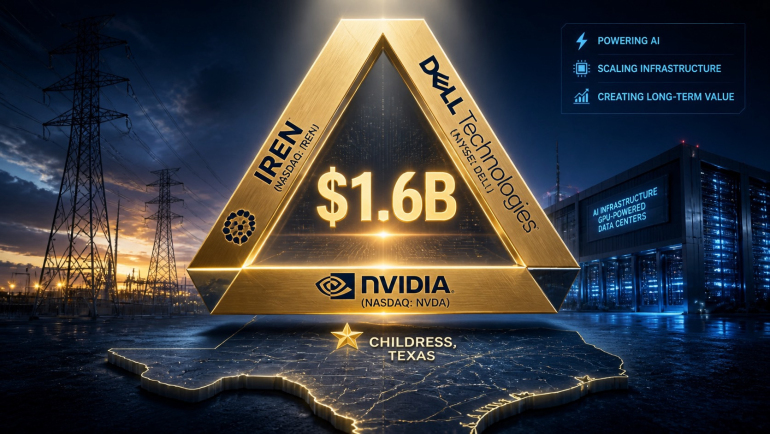
IREN’s $1.6 billion bet on Nvidia-powered Blackwell systems from Dell is less a simple capex line item and more a declaration that the AI infrastructure arms race has entered its Texas phase—with investors invited to watch from the 50-yard line.
IREN’s Big Swing: From Bitcoin Rigs to AI Run-Rate
Data center operator IREN Limited (NASDAQ: IREN) has agreed to buy Nvidia’s (NASDAQ: NVDA) air-cooled Blackwell systems from Dell Technologies (NYSE: DELL) for about $1.6 billion, locking in a massive hardware backbone for its AI cloud ambitions. The systems will be deployed at IREN’s campus in Childress, Texas, supporting a previously announced five-year managed services AI cloud contract valued at roughly $3.4 billion. Once the new Blackwell capacity is commissioned—targeted for early 2027—IREN expects annualized run-rate revenue to rise from about $3.7 billion to $4.4 billion, effectively turning a GPU order into a future revenue upgrade.
Structurally, the $1.6 billion purchase covers GPUs, servers, storage, networking gear, ancillary equipment, integration services, and warranties, with payments due after shipment rather than upfront—a cash-flow friendly feature in a capital-intensive race. IREN has unconditionally guaranteed its subsidiary’s obligations under the Dell agreement and is pursuing financing consistent with prior hardware deployments, signaling that leverage, not dilution, remains its preferred fuel. For investors, that combination—contract visibility, post-shipment terms, and defined revenue uplift—reads less like speculative AI story stock and more like a structured growth project with a clear commissioning calendar.
Dell, Nvidia, and the AI Rack-and-Stack Economy
Dell has rapidly positioned itself as a prime integrator of Nvidia’s Blackwell generation silicon, launching PowerEdge servers and rack-scale systems built on Nvidia’s GB200 platforms, Grace CPUs, and Blackwell GPUs to ride the AI infrastructure wave. By supplying IREN with air-cooled Blackwell systems, Dell is effectively leasing out its supply-chain prowess and integration expertise to a specialist data-center operator that already knows how to monetize high-density compute—first for mining, now for models. Nvidia, for its part, extends its reach without owning a single acre in Childress; the chips stay on NVDA’s income statement while IREN and Dell handle the concrete, cooling, and customers.
Air-cooled Blackwell systems may not be as glamorous as their liquid-cooled cousins, but they significantly boost performance versus prior generations and offer faster deployment into existing facilities, a practical edge when AI demand refuses to wait for new plumbing. Dell has already highlighted that its Blackwell-based servers can train AI models multiple times faster than previous platforms, underscoring why operators like IREN are willing to sign billion-dollar checks on tight timelines. In this three-way arrangement, NVDA supplies the compute, DELL supplies the systems, and IREN supplies the power, real estate, and the willingness to live with the electric bill.
Why This Deal Matters for the AI Infrastructure Trade
The IREN–DELL–NVDA triangle hits several themes that have come to define AI-led tech investing: scarce GPU supply, hyperscaler-like contracts moving into specialist hands, and the emergence of regional AI “zones” built around power and permitting. Fidelity and other strategists have flagged AI infrastructure as one of the defining sector themes for 2026, with capital flowing toward companies that can actually deploy and monetize high-performance compute, rather than simply talk about it on earnings calls. IREN’s Childress campus in Texas fits that narrative—leveraging abundant land and power access to stand up AI-ready data centers that can be stacked with Blackwell-class hardware on relatively short lead times.
From a numbers perspective, committing $1.6 billion in hardware to support a $3.4 billion contract that is expected to lift annualized run-rate revenue to $4.4 billion frames the project as a scaled, multi-year cash engine rather than a one-off speculative bet. For NVDA, deals like this help maintain a pipeline of demand beyond the hyperscalers, while for DELL they showcase the PowerEdge and Blackwell server franchises as high-margin, repeatable platforms. And for investors scanning tickers, IREN becomes a more direct play on AI infrastructure utilization, DELL on AI rack economics, and NVDA on the silicon royalty underlying it all.
The Subtle Humor in a Very Serious Capex Cycle
There is a quiet irony in watching a former crypto-centric operator turn into a key node in the AI compute grid: the same power and hardware disciplines honed on volatile blockchains now being repurposed for enterprise-grade inference and training workloads. Childress, Texas, once better known for cattle and high school football, is on track to host racks of Nvidia Blackwell GPUs fine-tuning large language models instead of red-zone offenses—a reminder that, in this cycle, geography is just latency with better barbecue. And in an environment where every boardroom deck promises “AI transformation,” the most tangible transformation may simply be this: who can get GPUs powered, cooled, and billing the fastest.
Yet underneath the levity, the discipline matters. Post-shipment payment terms, defined commissioning dates, and explicit revenue run-rate targets create the kind of disclosure institutional investors prefer over vague “AI adjacency.” For market participants who have sat through several hype cycles, the attraction here is not just the AI buzzwords but the industrial logic—TYX-meets-NVDA, if you will—of turning a $1.6 billion hardware outlay into a contracted, multi-year AI services stream.
The Sources
[1] IREN to buy Blackwell systems from Dell for about $1.6 billion https://finance.yahoo.com/sectors/technology/articles/iren-buy-blackwell-systems-dell-223601953.html [2] IREN to buy Blackwell systems from Dell for about $1.6 billion https://www.tradingview.com/news/reuters.com,2026:newsml_L6N42313Q:0-iren-to-buy-blackwell-systems-from-dell-for-about-1-6-billion/ [3] IREN Limited Secures $1.6 Billion Purchase Agreement with Dell for … https://www.quiverquant.com/news/IREN+Limited+Secures+$1.6+Billion+Purchase+Agreement+with+Dell+for+Blackwell+Systems+to+Support+AI+Cloud+Contract [4] IREN to buy Blackwell systems from Dell for about $1.6 billion https://www.moneycontrol.com/news/business/companies/iren-to-buy-blackwell-systems-from-dell-for-about-1-6-billion-13932157.html/amp [5] IREN) signs $1.6B Dell GPU pact to lift AI ARR – Stock Titan https://www.stocktitan.net/sec-filings/IREN/8-k-iren-ltd-reports-material-event-675eb20880e1.html [6] Dell unveils AI servers powered by Nvidia Blackwell Ultra chips https://www.techpartner.news/news/dell-unveils-ai-servers-powered-by-nvidia-blackwell-ultra-chips-617299 [7] Dell Technologies launches Nvidia Blackwell PowerEdge system … https://www.constellationr.com/insights/news/dell-technologies-launches-nvidia-blackwell-poweredge-system-new-rack-design [8] Dell Ready to Ship Servers With New Nvidia AI Chips – YouTube https://www.youtube.com/watch?v=CX8fCueUxuk [9] 2026 sector investing ideas | Fidelity https://www.fidelity.com/learning-center/trading-investing/sector-outlook-2026 [10] 2026 technology industry trends | Our Insights – Plante Moran https://www.plantemoran.com/explore-our-thinking/insight/2025/01/2025-tech-industry-trends [11] Tech Trends 2026 | Deloitte Insights https://www.deloitte.com/us/en/insights/topics/technology-management/tech-trends.html [12] IREN has entered into a $1.6bn purchase agreement with Dell for air … https://x.com/IREN_Ltd/status/2059392975684395100 [13] Three Rivers Databases: By Subject – CT State Libraries https://library.ctstate.edu/threerivers/databases [14] $IREN signed a $1.6B purchase agreement with $DELL for air … https://x.com/StockSavvyShay/status/2059383487027990571 [15] SEO | Digital Consulting Pros https://thisisdcp.com/category/seo/
Ferrari’s (RACE, $329.91, -5.26%) Luce debut may have sent the stock skidding, but for long‑term investors it looks more like a sharp chicane than a brick wall. The market’s cool first impression is colliding with a much warmer long‑run story about ultra‑luxury EVs, brand scarcity and design‑driven pricing power.
The Day Ferrari Spooked The Tape
Ferrari shares fell roughly 6–8% in Milan after the Luce, the marque’s first fully electric model, rolled into the spotlight. The move erased several billion euros in market value within hours as traders digested a €550,000 (about $640,000) family‑sized Ferrari that looked more like a rolling design manifesto than a track weapon.
Critics questioned whether a four‑door, five‑seat electric Ferrari was still “a real Ferrari,” and social media comparisons ranged from Honda Accord to luxury toaster, hardly the reception Maranello’s engineers envisioned. Investors, ever the efficient amplifiers of collective discomfort, marked the stock down on concern that the EV pivot could dilute the brand or misread demand at the very top of the market.
Meet Luce: Jony Ive’s €550,000 Lightning Bolt
Luce is Ferrari’s first fully electric production car, co‑designed with former Apple design chief Sir Jony Ive and his LoveFrom collective, with Marc Newson also involved. It is a four‑door, five‑seat EV positioned at the ultra‑luxury end of the spectrum, combining Ferrari chassis tuning with an interior and interface that lean more toward tactile controls and analog elegance than the typical screen‑heavy electric cockpit.
Performance still speaks fluent Ferrari: early specs indicate all‑wheel electric drive, 0–100 km/h around 2.5 seconds and a top speed north of 300 km/h, with a range of roughly 530 km. The starting price of about €550,000 is not just sticker shock; it is a statement that Ferrari intends to enter the EV era at the same altitude of exclusivity where it has long lived, rather than chasing volume.
Why The Market Flinched
The immediate reaction boiled down to three intertwined worries: aesthetics, identity and valuation. Critics and some owners balked at the Luce’s family‑friendly proportions and unconventional styling, arguing that it strays too far from the lithe two‑door silhouettes that built Ferrari’s mystique. That aesthetic discomfort bled into deeper questions about whether expanding into a larger, fully electric model risks softening the sharp edge of the brand just as global luxury EV demand is still proving itself.
Layered on top is a stock that was already trading at a rich premium, with some analyses flagging Ferrari as significantly above traditional fair‑value estimates ahead of the launch. When a high‑expectation story stock meets a polarizing new product, the result is often a fast repricing rather than a measured debate, and Luce’s debut followed that script almost to the tick.
The Long Game: Scarcity, Margins And A New Buyer
Strip away the noise and the Luce sits precisely where long‑term investors should be looking: the intersection of product mix, pricing power and brand scarcity. Ferrari has repeatedly shown that it can sell more expensive cars to a carefully curated clientele without flooding the market, and management has emphasized a strict cap on annual production, which implicitly limits Luce volumes as well.
In that context, a €550,000 electric flagship is less about chasing mass adoption and more about defending margins while future‑proofing the brand’s relevance with younger, tech‑native wealth. If Luce succeeds in drawing new customers into the ecosystem—buyers who then graduate into more traditional halo models—the initial backlash could age like many other infamous product‑launch panics that later looked like early entry points on a long, rising chart.
What Sophisticated Investors Should Watch Next
For investors, the Luce is a live stress test of Ferrari’s ability to stretch its brand into the electric era without tearing the fabric that makes it unique. The key signposts now are order books, pricing discipline and whether Ferrari can maintain waiting lists and residual values that validate its premium multiple even as it experiments with new body styles and drivetrains.
Volatility around this debut is unsurprising given the clash between heritage expectations and EV realities, but structurally nothing has changed about Ferrari’s core levers: disciplined supply, obsessive design and an owner base that tends to forgive the occasional controversial silhouette once the driving experience speaks for itself. For investors with a longer time horizon than a news cycle, Luce looks less like a betrayal of the brand and more like what Ferrari has always done—arrive late to a trend, charge more than anyone else and then let scarcity do the heavy lifting.
Judge Luce For Yourself
The Sources
[1] Ferrari (RACE) stock plunges 6% on Luce EV backlash — don’t panic! https://electrek.co/2026/05/26/ferrari-race-stock-plunge-luce-ev-mach-e-moment/ [2] Ferrari Luce EV Launch Puts Valuation And Execution In Sharp Focus https://finance.yahoo.com/news/ferrari-luce-ev-launch-puts-081525295.html [3] Critics give Ferrari Luce EV a cool response, shares fall – WTAQ https://wtaq.com/2026/05/26/critics-give-ferrari-luce-ev-a-cool-response-shares-fall/ [4] Ferrari Luce Puts Luxury EV Growth And Brand Scarcity To The Test https://www.sahmcapital.com/news/content/ferrari-luce-puts-luxury-ev-growth-and-brand-scarcity-to-the-test-2026-02-15 [5] Ferrari Unveils $640,000 Fully Electric Luce to Disappointing Reviews https://www.youtube.com/watch?v=AuKNq3eJzI8 [6] Ferrari shares plunge after launch of first EV – YouTube https://www.youtube.com/watch?v=DVxLbKnDA48 [7] Ferrari unveils their Luce EV with interior and interface design by … https://www.resetera.com/threads/ferrari-unveils-their-luce-ev-with-interior-and-interface-design-by-jony-ive-no-touchscreens.1429837/ [8] Ferrari Luce – Ferrari.com https://www.ferrari.com/en-EN/auto/ferrari-luce [9] Ferrari’s first EV sparks investor and social media backlash https://www.ft.com/content/17939c73-e747-4c95-a234-22ae966eb30c?syn-25a6b1a6=1 [10] Ferrari shares skid after unveiling its first fully electric car https://seekingalpha.com/news/4596691-ferrari-shares-skid-after-unveiling-its-first-fully-electric-car [11] The Luce Effect, the markets reaction today.. : r/Ferrari – Reddit https://www.reddit.com/r/Ferrari/comments/1tnzaq6/the_luce_effect_the_markets_reaction_today/ [12] Ferrari shares fell after the Italian super-car maker unveiled the Luce … https://www.facebook.com/bloombergbusiness/videos/ferrari-shares-fell-after-the-italian-super-car-maker-unveiled-the-luce-its-firs/1988367101778052/ [13] SEO | Digital Consulting Pros https://thisisdcp.com/category/seo/ [14] Writing and Editing For Digital Media (PDFDrive) PDF – Scribd https://www.scribd.com/document/479437428/Writing-and-Editing-for-Digital-Media-PDFDrive-pdf [15] From Concept to Reality: the Story of Ferrari Luce | Episode 1 https://www.youtube.com/watch?v=1s2WW-99GtI
Micron’s (MU, $895.88, +19.29%) leap into the $1 trillion club on Tuesday, May 26 doesn’t just crown a new AI-era champion; it reshapes a very exclusive guest list that already includes the biggest names in global markets.
Micron Takes Its Seat at the Mega‑Cap Table
On Tuesday, Micron Technology truly crossed the $1 trillion market value threshold for the first time, with intraday and closing trading putting its capitalization just over the line at roughly 1.01–1.02 trillion dollars. The surge caps a powerful rally driven by AI‑fueled demand for advanced memory and a Street narrative that now treats Micron less as a cyclical chip name and more as a core AI infrastructure provider.
With this move, Micron joins a rarefied group of trillion‑dollar companies and plants a “Made in America” flag squarely in the middle of the AI hardware stack. For investors, the symbolism is clear: memory is no longer the sidecar of the semiconductor cycle; it has become one of the main engines of the AI trade.
Inside the Trillion‑Dollar Club
The trillion‑dollar club remains dominated by U.S. tech and AI leaders, led by Nvidia (NVDA), Alphabet (GOOG), Apple (AAPL) and Microsoft (MSFT), each now worth multiple trillions on the back of explosive demand for chips, cloud and digital services. Amazon (AMZN), Meta Platforms (META) and Broadcom (AVGO) round out the U.S. mega‑cap technology cohort, with Taiwan Semiconductor Manufacturing (TSM) giving the group a critical non‑U.S. semiconductor pillar.
On the non‑pure‑tech side, Saudi Aramco anchors the energy sector, while Tesla, Berkshire Hathaway, Eli Lilly, Samsung and Walmart have all joined or brushed the trillion‑dollar line as the market has re‑rated everything from EVs to conglomerates to big‑box retail. Micron’s arrival adds a second dedicated memory‑and‑chips name alongside Nvidia and TSMC, tightening the club’s tilt toward the AI value chain and giving investors another way to own the plumbing of the data economy rather than just its glossy applications.
AI Turns “Memory” into Prime Real Estate
What pushed Micron over the line is the AI buildout’s voracious appetite for DRAM and high‑performance storage across data centers, autos and industrial systems.. As hyperscalers race to stand up new clusters and enterprises embed AI into everything from design tools to dashboards, each new workload quietly increases Micron’s addressable market, transforming bits into a strategically scarce asset.
Unlike some software names where AI is still more promise than profit, Micron’s revenue tap is tied to physical capacity, utilization and pricing—metrics that are already responding to tight supply and surging demand. That is why the market now talks about “memory shortages” in the same breath as AI growth, and why Micron’s valuation has migrated from mid‑cycle debate to trillion‑dollar conviction.
Made‑in‑America Memory as Policy and Profit
Micron’s trillion‑dollar status is being underwritten not just by investors, but by industrial policy. The company has begun producing its 1α (1‑alpha) DRAM node at its Manassas, Virginia fab—the most advanced DRAM manufactured in the United States—targeting long‑lifecycle uses from autos and defense to networking and medical gear.
That facility is part of a broader investment wave: more than 2 billion dollars committed to Virginia alone, thousands of direct and community jobs, and a national build‑out across New York and Idaho that is projected to create tens of thousands of roles as new fabs come online. Backed by a wider 200 billion dollar U.S. expansion plan and CHIPS‑aligned incentives, Micron is effectively turning its balance sheet into a domestic capacity roadmap for memory, packaging and R&D.
To ensure those clean rooms aren’t empty, Micron is putting over 325 million dollars into workforce development and community programs, funding semiconductor curricula, apprenticeships and STEM initiatives across Virginia, Idaho and New York. At Manassas, roughly one in ten employees are U.S. veterans, underscoring how tightly the company’s growth is now entwined with local communities and national‑security priorities.
What the Trillion Means for Portfolios
For portfolio managers, Micron’s arrival in the trillion‑dollar club is more than a headline; it forces a rethink of semiconductor exposure in AI‑heavy allocations. Alongside Nvidia, TSMC and Broadcom on the hardware side—and the platform giants like Alphabet, Microsoft, Apple, Amazon and Meta on the software and services side—Micron now stands as a key lever for expressing the “AI infrastructure” theme in large‑cap mandates.
Yes, memory pricing remains cyclical, and no trillion‑dollar badge can repeal the laws of supply and demand, but the context has changed: cycles are now playing out against a backdrop of secular AI growth and state‑backed reshoring. In that environment, Micron isn’t just joining the world’s biggest companies—it’s helping define what a modern mega‑cap looks like when data is the new oil and memory has quietly become some of the most valuable real estate in markets today.
SpaceX’s looming IPO has turned the already‑noisy Tesla–SpaceX merger chatter into a full‑blown Wall Street parlor game, and investors are happily anteing up to play.
A Rocket, A Roadster, And A Rumor
As SpaceX accelerates toward what could be the largest IPO in history, speculation about a future tie‑up with Tesla has gone from fringe theory to cocktail‑party staple. CNBC and others report that the confidential SpaceX filing and talk of a June Nasdaq debut have reignited merger chatter, especially as Musk’s rocket and satellite empire now carries a valuation that rivals—or in some scenarios eclipses—his electric vehicle and robotics flagship at Tesla (TSLA),
Wall Street Journal coverage notes that investors, fresh off digesting the SpaceX–xAI combination valued around 1.25 trillion dollars, are already gaming out the “ultimate alliance” between the rocket maker and Tesla. In classic Musk fashion, he has said the companies are “aligning” strategically while artfully dodging any direct confirmation of a merger, leaving the market to do what it does best: speculate with gusto.
The IPO That Launched A Thousand Models
SpaceX’s anticipated IPO is being framed as a once‑in‑a‑generation listing, with expectations it could set records for size and valuation. Reports suggest an accelerated timeline, with a possible June pricing and Nasdaq listing under a dedicated ticker, making SpaceX one of the most closely watched debuts since Saudi Aramco’s offering in 2019.
Analysts point out that bringing SpaceX to the public markets at a towering valuation not only crystallizes Musk’s wealth but also creates a more symmetric counterpart to Tesla, which could simplify any future combination. For investors, the IPO is effectively “Chapter One” in a broader capital markets saga: even if a merger never happens, the sheer scale of the deal, its AI angle via xAI, and the space‑data story give it gravitational pull across growth, tech, and thematic portfolios.marketwise+3
Why A Tesla–SpaceX Tie‑Up Tempts Wall Street
On paper, the synergies look like a futurist’s fever dream. A unified Musk vehicle would blend Tesla’s EV, battery, robotics, and energy infrastructure with SpaceX’s launch systems, satellite networks, and increasingly AI‑driven operations, creating a vertically integrated “transport‑and‑compute” platform from Earth’s surface to low Earth orbit.
Proponents argue that a merger could streamline governance, reduce conflicts of interest around Musk’s time and equity stakes, and centralize capital allocation across projects ranging from autonomous driving to space‑based data centers. Supportive long‑term shareholders, including high‑profile Tesla backers like Ron Baron, have expressed trust in Musk’s judgment on a potential combination, effectively giving him a long leash to pursue what they see as a once‑in‑a‑lifetime platform build.
The Risk: Destroying Value At Escape Velocity
For all the blue‑sky synergy slides investors might dream up, there is a less glamorous column on the spreadsheet—execution risk. One bearish analyst has warned that a poorly structured merger could wipe out hundreds of billions in shareholder value, arguing that mixing two very different capital structures, risk profiles, and investor bases could merit a “conglomerate discount” rather than a Musk premium.
Several commentators note that Tesla’s public‑market investors and SpaceX’s private backers do not necessarily share the same risk appetite, time horizon, or tolerance for launch mishaps and regulatory scrutiny. Even the betting markets, while acknowledging the chatter, still price a relatively low near‑term probability of a full Tesla–SpaceX merger, suggesting that informed traders see more noise than imminent action.
Betting Markets And Boardrooms
Prediction platforms have become an unlikely Greek chorus in this drama, assigning mid‑teens probabilities to a Tesla–SpaceX combination on specific timelines while giving much higher odds to Musk’s other moves, such as the integration of xAI with SpaceX and a mega‑IPO by year‑end. Those contracts have repriced with each new headline—from the xAI deal announcement to the leaked details of the confidential IPO filing—highlighting how sensitive expectations are to incremental news flow.
Behind the screens, reports suggest that SpaceX has at least explored merger options with Tesla and xAI at the urging of some investors, though sources characterize these talks as preliminary and far from a board‑blessed transaction. That gap—between structural feasibility and formal decision—creates the wide trading range of narratives investors are now arbitraging, from “inevitable Musk empire” to “perpetual what‑if.”
The AI Angle: Data Centers In The Sky
The SpaceX–xAI deal has added a very 2026 twist to the story: AI at orbital scale. With xAI now folded into SpaceX at a valuation reported around 1.25 trillion dollars, the combined entity is suddenly a contender not just in rockets and satellites, but in AI infrastructure that could leverage space‑based data centers and global connectivity.
That matters for Tesla investors because the company already holds a stake in this pre‑IPO complex, potentially giving Tesla exposure to the AI‑in‑space narrative even without a full corporate merger. For AI‑focused funds, the prospect of a Musk‑controlled triad—Tesla, SpaceX, xAI—offers a rare chance to bet on an integrated stack of vehicles, robots, satellites, and models under a single strategic umbrella, even if the entities remain formally separate.
What Investors Can Actually Do Today
For now, Tesla remains the only readily tradable proxy for this entire constellation on public markets, while SpaceX is preparing to graduate from the private rounds to a full‑fledged listing. Investors eyeing the story have a few practical levers: Tesla stock as the “Musk platform” proxy, pre‑IPO exposure via funds or secondary markets where available, and a careful watch on IPO documents for clues about capital allocation and corporate structure.
The key discipline is distinguishing narrative from term sheet. Betting markets and bullish op‑eds can make a merger feel inevitable, but the official filings, governance arrangements, and shareholder votes will tell you whether this remains a thought experiment or becomes the epoch‑shaping corporate combination some expect.
The Sources
CNBC – SpaceX–Tesla merger chatter reignites as Musk’s rocket company nears IPO https://www.cnbc.com/2026/05/26/spacex-tesla-merger-chatter-reignites-as-musk-rocket-company-nears-ipo.htmlyoutube
Wall Street Journal – SpaceX Isn’t Even Public Yet. Investors Are Already Abuzz About a Tesla Merger https://www.wsj.com/business/spacex-isnt-even-public-yet-and-investors-are-already-abuzz-about-a-tesla-merger-592b64f6wsj
MarketWise – 7 Reasons Why a SpaceX and Tesla Merger Could Happen https://marketwise.com/investing/is-elon-musk-secret-plan-to-merge-spacex-tesla-why-it-could-happen/marketwise
Kalshi – When will Tesla and SpaceX merge? Odds & Predictions https://kalshi.com/markets/kxcompanyactionmerger/company-merger/kxcompanyactionmerger-27kalshi
Stocktwits News – Analyst Warns SpaceX Merger Could Erase $750B In Value https://stocktwits.com/news-articles/markets/equity/tesla-stock-slips-premarket-analyst-warns-spacex-merger-could-erase-750b-valstocktwits
Stocktwits News – Ron Baron Throws Support Behind Elon Musk’s Potential Move https://stocktwits.com/news-articles/markets/equity/tesla-spacex-merger-ron-baron-throws-support-behind-elon-musk-potential-movestocktwits
Investopedia – SpaceX and xAI Have Merged. Now Investors Are Wondering What’s Next for Tesla (TSLA) https://www.investopedia.com/spacex-and-xai-have-merged-now-investors-are-wondering-what-s-next-for-tesla-tsla-11898333investopedia
WVTF – Elon Musk’s SpaceX IPO plans reveal blockbuster spending on rockets and AI https://www.wvtf.org/2026-05-20/elon-musks-spacex-ipo-plans-reveal-blockbuster-spending-on-rockets-and-aiwvtf