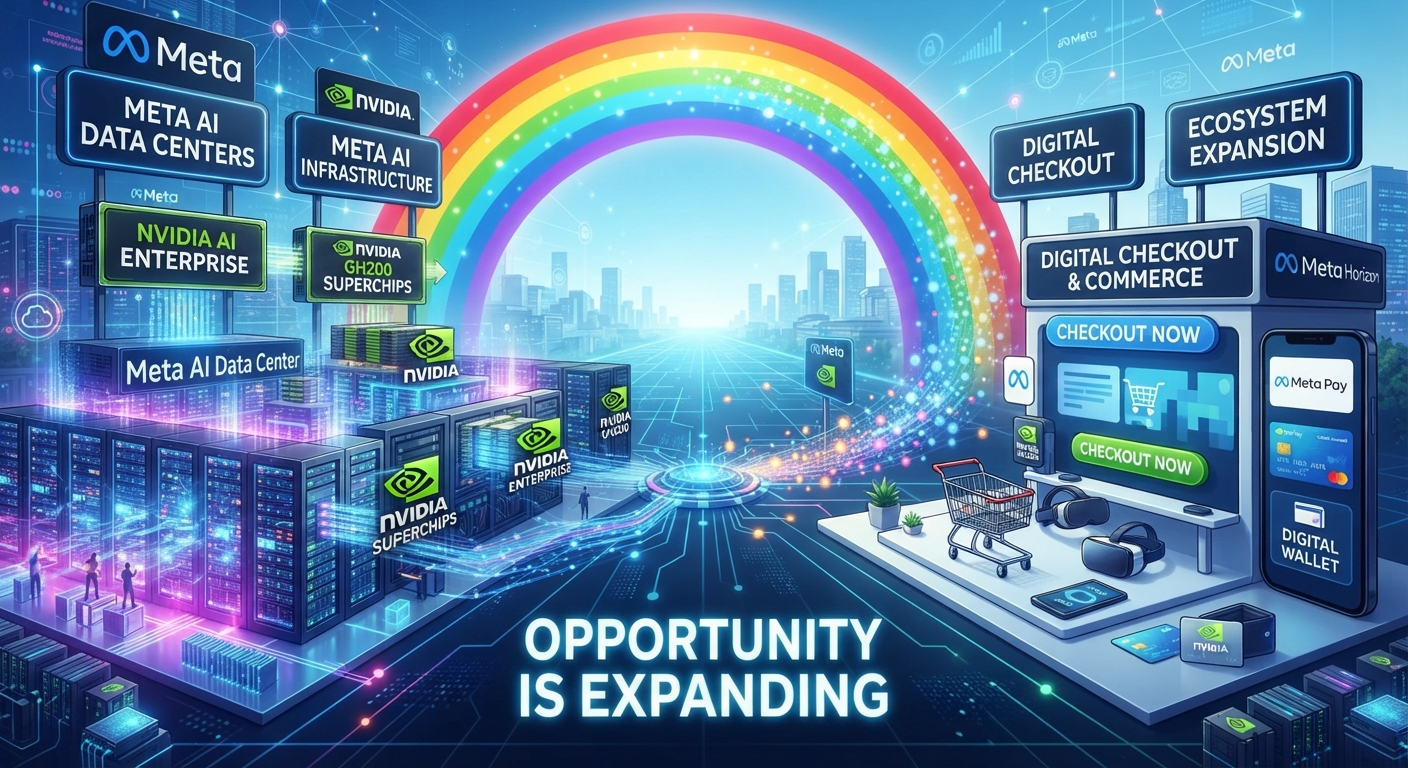
Artificial intelligence is increasingly becoming a two-part investment story: a massive physical buildout of data centers, power systems and cooling infrastructure, and a rapidly expanding commercial layer in which AI agents help consumers discover, compare and buy. For many, that is a notably broader opportunity than simply owning the chipmakers. NVIDIA Corp. (NASDAQ: NVDA) CEO Jensen Huang’s latest comments point to the industrial side of the equation, while Meta Platforms Inc. (NASDAQ: META) is making a case for the consumer and transaction side through its Muse AI agent. Together, they sketch an AI economy that does not stop at generating text or images; it builds facilities, consumes electricity, reorders supply chains and, increasingly, helps move merchandise from digital shelf to checkout. The elegant part for Wall Street is that AI may be developing two revenue engines at once: capital expenditure today and commerce volume tomorrow. The less elegant part is that both engines need a great deal of electricity, which is not exactly known for arriving overnight in a cloud-shaped package.
The AI Boom Gets Blue-Collar Boots
Huang argued that the U.S. AI infrastructure buildout could support roughly 1 million jobs as companies deploy an estimated 10 to 20 gigawatts of AI-related infrastructure annually. His point was larger than NVIDIA’s graphics-processing units: the AI data-center race requires construction labor, generation capacity, cooling equipment, pipefitters, electricians, network infrastructure and advanced manufacturing. That is a material shift in the market’s AI narrative. The first phase rewarded the companies supplying high-performance compute, most visibly NVIDIA (NASDAQ: NVDA)—but the next phase is creating a much wider ecosystem of beneficiaries. AI infrastructure requires:
- High-performance accelerators and networking systems from companies including NVIDIA (NASDAQ: NVDA), Advanced Micro Devices Inc. (NASDAQ: AMD), Broadcom Inc. (NASDAQ: AVGO) and Arista Networks Inc. (NYSE: ANET)
- Hyperscale cloud capacity from Microsoft Corp. (NASDAQ: MSFT), Alphabet Inc. (NASDAQ: GOOGL), Amazon.com Inc. (NASDAQ: AMZN), Meta Platforms Inc. (NASDAQ: META) and Oracle Corp. (NYSE: ORCL)
- Electrical equipment, grid modernization and power-management solutions from Eaton Corp. plc (NYSE: ETN), Vertiv Holdings Co. (NYSE: VRT), Schneider Electric SE (EPA: SU), GE Vernova Inc. (NYSE: GEV) and Hubbell Inc. (NYSE: HUBB)
- Data-center construction, engineering and real-estate capacity from companies such as Equinix Inc. (NASDAQ: EQIX), Digital Realty Trust Inc. (NYSE: DLR), Quanta Services Inc. (NYSE: PWR), AECOM (NYSE: ACM) and Jacobs Solutions Inc. (NYSE: J)
Huang’s underlying message is bullish for the broader industrial economy: AI may be becoming a modern infrastructure cycle rather than merely a software upgrade. In that formulation, the data center is not just a building full of servers. It is a small city with a very large electricity bill and very little patience for downtime.
Power Becomes the New Bottleneck
The AI investment cycle is also making power availability one of the market’s most consequential variables. The International Energy Agency projects that U.S. data-center electricity consumption could increase by around 240 terawatt-hours by 2030, a 130% rise from 2024 levels. The United States and China are expected to account for nearly 80% of global growth in data-center electricity demand through 2030. That places a brighter spotlight on utilities, grid operators, nuclear developers, natural-gas generation, renewable energy, battery storage and power-equipment suppliers. It also explains why cooling, transmission and backup-power businesses have become central to the AI conversation rather than footnotes in a server-rack brochure. For many, the key takeaway is that AI spending may continue to propagate downstream:
| AI spending layer | Potential market beneficiaries | Why it matters |
|---|---|---|
| Compute | NVIDIA (NASDAQ: NVDA), AMD (NASDAQ: AMD), Broadcom (NASDAQ: AVGO) | Training and inference require accelerated computing and high-speed networking |
| Cloud and platforms | Microsoft (NASDAQ: MSFT), Alphabet (NASDAQ: GOOGL), Amazon (NASDAQ: AMZN), Meta (NASDAQ: META), Oracle (NYSE: ORCL) | Hyperscalers finance and operate much of the capacity expansion |
| Cooling and electrical systems | Vertiv (NYSE: VRT), Eaton (NYSE: ETN), GE Vernova (NYSE: GEV), Hubbell (NYSE: HUBB) | AI racks require dense power delivery, thermal management and resiliency |
| Data-center real estate | Equinix (NASDAQ: EQIX), Digital Realty (NYSE: DLR) | Demand for specialized, powered capacity can support pricing and occupancy |
| Engineering and construction | Quanta Services (NYSE: PWR), AECOM (NYSE: ACM), Jacobs Solutions (NYSE: J) | New facilities require transmission, design, construction and interconnection work |
The strongest long-term beneficiaries may be the companies with scarce capabilities: reliable power access, transmission expertise, specialized cooling, data-center land with utility interconnection, and the ability to execute giant projects without discovering halfway through that the nearest substation is feeling emotionally unavailable.
Meta Turns AI Into a Shopping Channel
While the infrastructure buildout expands the supply side of AI, Meta is working on an equally important demand-side proposition: AI as a transaction interface. Meta’s Muse agent can search retail websites, surface products based on users’ instructions and prepare purchases for approval. The agent uses an approval-card model before checkout, while payment options include Link by Stripe and Shopify Shop Pay; PayPal Holdings Inc. (NASDAQ: PYPL) has also been announced as a payment provider, though CNBC reported that its availability had not yet begun. Meta has announced commerce and service partnerships involving Walmart Inc. (NYSE: WMT), Gap Inc. (NYSE: GAP), Wayfair Inc. (NYSE: W), Best Buy Co. Inc. (NYSE: BBY), Expedia Group Inc. (NASDAQ: EXPE), Instacart and Sephora, among others. The strategy potentially moves META beyond advertising-led discovery toward a more direct participation in transactions, with Mark Zuckerberg indicating that Meta intends to take a small fee from commerce conducted through Muse. That is strategically meaningful. Search engines monetized intent. Social platforms monetized attention. Agentic AI may seek to monetize completion. A user who asks an AI agent to find a winter coat, compare prices, confirm delivery timing and assemble a checkout is no longer merely browsing. That user is moving through a condensed commerce funnel. For META, the prize is not just a more useful assistant; it is a place in the economic path between consumer intent and payment authorization.
The Retail Opportunity Is Bigger Than a Chatbot
Muse also illustrates why agentic commerce could become a competitive battleground for retailers, marketplaces, payment companies and advertising platforms. The company that owns the agent may influence product discovery, merchant selection, promotional placement and, eventually, the payment flow. The opportunity spans several public companies:
- Meta Platforms (NASDAQ: META): Could expand AI monetization through transaction fees, ecosystem engagement and deeper commerce relationships.
- Walmart (NYSE: WMT): Gains access to a new AI-driven discovery channel while reinforcing its omnichannel retail scale.
- Best Buy (NYSE: BBY): Could benefit if AI agents improve product matching in complex, higher-consideration electronics purchases.
- Gap (NYSE: GAP): May gain another route for digital product discovery, recommendations and inventory-aware shopping.
- Wayfair (NYSE: W): Furniture and home goods are naturally suited to comparison, search and recommendation workflows.
- Expedia (NASDAQ: EXPE): AI-assisted travel planning can reduce friction in a category built on choice overload and the occasional seven-tab hotel-search spiral.
- Shopify (NYSE: SHOP): Its role in merchant enablement and checkout infrastructure positions it well if agent-driven shopping broadens across independent brands.
- Stripe: Although privately held, Stripe’s Link product matters because agentic checkout needs secure, low-friction payment rails.
- PayPal (NASDAQ: PYPL): Could benefit as AI-mediated shopping expands demand for familiar, trusted payment credentials and consumer protections.
The important qualifier: not every retailer will welcome an outside agent controlling customer discovery. Amazon.com Inc. (NASDAQ: AMZN), for example, has blocked Muse from making purchases on its platform, arguing that the service violates its terms of use. That friction is not a flaw in the investment thesis; it is evidence of its commercial importance. When the digital front door becomes valuable, owners tend to notice who is holding the keys,
A Bull Case: AI Becomes an Economic Stack
A bullish AI thesis is becoming more diversified and, arguably, more durable. It no longer depends solely on quarterly GPU demand or a handful of cloud-capex announcements. It now reaches across industrial production, grid investment, power equipment, data-center capacity, payment systems, retail conversion and consumer services. The emerging stack looks like this:
- Companies build more compute infrastructure.
- That infrastructure drives demand for power, cooling, networks and construction.
- Cloud platforms convert that capacity into AI products and services.
- AI agents become a new interface for consumer and business activity.
- Retailers, payment networks and marketplaces compete to participate in the resulting transaction flows.
NVIDIA (NASDAQ: NVDA) remains central to the compute layer, but the market’s investable opportunity is broadening. Meta (NASDAQ: META) is attempting to demonstrate that AI can become not just an expense category but a commercial gateway. Eaton (NYSE: ETN), Vertiv (NYSE: VRT), GE Vernova (NYSE: GEV), Equinix (NASDAQ: EQIX), Digital Realty (NYSE: DLR), Shopify (NYSE: SHOP), Walmart (NYSE: WMT) and PayPal (NASDAQ: PYPL) represent very different expressions of the same foundational trend: AI is moving from the data center into the real economy.
Risks Investors Should Respect
The story remains compelling, but it is not frictionless.
- Power constraints: Data-center construction may be delayed by utility interconnections, transmission capacity and generation availability.
- Capital-intensity risk: Hyperscalers are spending heavily, and investors will continue to scrutinize whether AI revenue scales fast enough to justify the expenditure.
- Regulatory and privacy exposure: Agentic commerce depends on consumer trust, data handling and clear authorization mechanisms.
- Retail resistance: Platforms and marketplaces may block agents that threaten their control over customer relationships or product-discovery economics.
- Valuation sensitivity: Several AI infrastructure beneficiaries already trade at elevated expectations, leaving less room for execution missteps.
- Dynamic-pricing concerns: CNBC reported that 59% of U.S. adults surveyed by Morning Consult identified price-gouging as a major concern in AI-driven dynamic pricing, underscoring why transparent pricing and consumer control will matter.
Bottom Line
The AI trade is evolving from a chip story into an infrastructure-and-commerce story. Huang’s vision of a reindustrializing America and Meta’s push into agentic shopping are different chapters of the same book: AI is becoming physical, transactional and economically embedded. For many, that means the opportunity set may be widening rather than narrowing. The winners will not only supply the intelligence. They may provide the electricity, the cooling, the real estate, the checkout button and, perhaps most importantly, the trusted route between a consumer’s request and a completed purchase.
The Sources
- Yahoo Finance: Jensen Huang Says AI Data-Center Push Could Create 1 Million U.S. Jobs
- CNBC: Meta’s Muse Can Shop and Check Out for YouHow It Works
- Yahoo Finance: NVIDIA CEO Jensen Huang Says AI Data-Center Buildout Could Create 1 Million Jobs
- International Energy Agency: Energy Demand From AI
- eMarketer: Meta Moves Muse Into Commerce With Retail Partnerships
- Yahoo Finance: Zuckerberg Says Meta’s Muse Will Remain Free for Most Users
- Yahoo Finance: Meta’s Zuckerberg Says Muse AI Agent Will Take a Small Fee From Transactions
- TechCrunch: Everything New Coming to Meta’s AI Agent Muse
- Crypto Briefing: Meta Integrates Walmart, Gap and Best Buy Into Muse AI Agent
- Meta Investor Relations
- NVIDIA Investor Relations
- Meta AI
Stay Updated with Vista Partners
Subscribe to receive market insights, investing ideas, and the latest updates directly in your inbox.