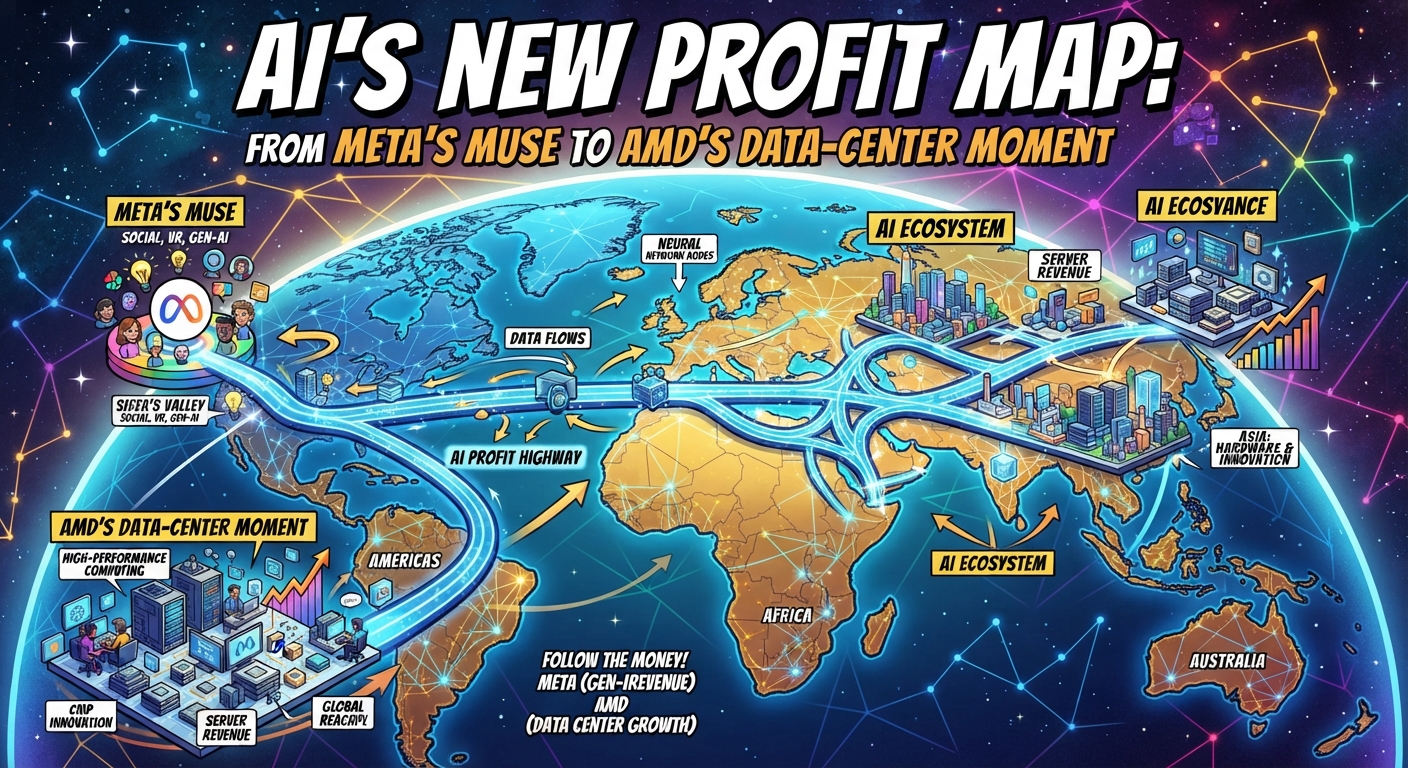
Wall Street’s AI trade is beginning to look less like a one-company coronation and more like an expanding commercial ecosystem. Meta Platforms (NASDAQ: META), Advanced Micro Devices (NASDAQ: AMD), Apple (NASDAQ: AAPL), Amwell (NYSE: AMWL) and LG Display (NYSE: LPL) each offer a different angle on the same powerful theme: AI is moving from a costly promise into products, infrastructure and services with clearer routes to revenue. The market’s latest message is refreshingly straightforward: investors still admire ambition, but they now prefer ambition that ships.
Meta’s Muse Turns AI Into a Consumer Event
Meta Platforms (NASDAQ: META) has given investors something the AI market has been seeking with the urgency of a trader hunting for a misplaced earnings model: visible consumer adoption. Meta’s new Muse AI agent surged to the top of Apple’s App Store and generated 2.8 million downloads across the U.S. and Canada during its first 12 days, according to Sensor Tower data cited by Yahoo Finance. The early download pace reportedly exceeded ChatGPT’s launch-period adoption in the same comparison, while U.S. daily downloads reached 264,000 on September 19. Meta shares rose 11.3% in one session on Monday, adding approximately $192 billion in market capitalization. That market response was not merely a vote for a popular application. It was a vote for a possible new business architecture. For years, investors have asked whether Meta’s enormous AI expenditure could produce returns beyond better ad targeting, content recommendations and engagement across Facebook, Instagram and WhatsApp. Muse gives the company a more tangible answer: a consumer-facing AI product that could ultimately support advertising, subscriptions, transactions or some combination of all three. A free app that becomes useful enough to be habitual is, in Silicon Valley, often the beginning of a very expensive lunch for competitors. The strategic appeal is substantial:
- Scale: Meta already operates some of the world’s largest consumer platforms, providing distribution that many AI startups would trade a data center for.
- Monetization optionality: If Muse increases time spent within Meta’s ecosystem, it may strengthen advertising economics; if it handles tasks or commerce, transaction and subscription opportunities may follow.
- Proof of AI return on investment: Strong adoption offers a visible counterpoint to the notion that AI capital spending is simply an elaborate exercise in buying very expensive optimism.
Meta is not guaranteed to translate downloads into durable revenue. Consumers can be fickle, and app-store rankings have a way of changing their minds faster than analysts revise a price target. But Muse gives Meta a credible consumer-AI narrative at a moment when the market is assigning a premium to evidence, not just eloquence.
AMD’s Trillion-Dollar Argument Is Built in Silicon
Advanced Micro Devices (NASDAQ: AMD) crossed the $1 trillion market-capitalization threshold after a sharp rally on Monday, supported by accelerating data-center revenue, improving profitability and a rapidly expanding AI-product roadmap. The milestone is noteworthy not simply because the number has twelve zeroes, but because AMD’s investment case is becoming more operationally complete. AMD reported record quarterly revenue of $11.5 billion, up 50% year over year, and non-GAAP earnings per share of $1.66, above the consensus estimate of approximately $1.61 cited in the report. Its Data Center segment generated $6.7 billion of revenue, more than doubling from the prior year, as demand increased for EPYC server processors and Instinct AI accelerators. The central bullish point is that AMD is no longer presenting itself merely as the alternative chip supplier. It is assembling a full AI infrastructure proposition:
- EPYC server CPUs provide the general-purpose compute foundation.
- Instinct AI accelerators target training and inference workloads.
- Helios rack-scale systems combine GPUs, CPUs, networking and software into an integrated system for large-scale AI deployment.
- The MI450 GPU series and sixth-generation EPYC Venice CPUs are intended to extend the company’s next-generation product cycle.
AMD’s partnership momentum also matters. Microsoft (NASDAQ: MSFT) is expected to deploy AMD Helios systems across Azure AI services beginning in the second half of 2026, according to the cited report. Separately, Anthropic, a private company, plans to deploy up to 2 gigawatts of AMD Instinct MI450 GPUs in Helios systems beginning in the first half of 2027; AMD also committed up to $5 billion in investment in Anthropic. Nvidia (NASDAQ: NVDA) remains the dominant force in AI infrastructure, but Wall Street has increasingly shown it can appreciate a well-equipped challenger. AMD’s appeal lies in the possibility of share gains during a period when customers are hungry for more compute capacity, more supply options and fewer reminders that a single vendor can set the menu price.
Apple Is Selling AI Economics, Not Just Hardware
Apple (NASDAQ: AAPL) is bringing a distinctly Apple-like argument to enterprise AI: buy the machine, reduce the meter running in someone else’s cloud. The company’s new Mac mini and Mac Studio systems are positioned for local AI workloads, including code generation and sophisticated business tasks. High-end configurations can approach $20,000, but Apple’s pitch is that an owned device can reduce recurring cloud-computing and “per-token” costs for appropriate workloads. Apple showed four Mac Studio computers linked together running a trillion-parameter AI model to identify and correct a graphics-coding bug. The systems relied on a single wall outlet, an engineering detail that may appeal to finance chiefs who have grown weary of treating every AI query as a tiny utility bill. The opportunity is not trivial. Apple’s unified memory architecture, developed initially to improve energy efficiency in its devices, also gives its machines useful characteristics for AI workloads. That approach puts Apple into a growing contest with Microsoft (NASDAQ: MSFT), Nvidia (NASDAQ: NVDA) and the broader Windows hardware ecosystem around local, or on-device, AI. Apple starts with a disadvantage in traditional enterprise desktops. IDC data cited by Reuters places Apple at roughly 4.6% of the enterprise desktop market versus 91.3% for Windows. Yet smaller starting positions can be useful when the addressable market is large and the product category is changing. For many, the important question is not whether Apple will suddenly become the dominant enterprise-computing supplier. It is whether localized AI becomes an additional reason for corporate customers to choose Macs, particularly where privacy, predictable costs, energy use and performance matter. If AI models increasingly sit beside workers rather than exclusively in distant data centers, Apple’s hardware-software integration becomes more than a design virtue. It becomes a commercial lever.
Amwell Brings AI-Era Infrastructure to Veterans’ Care
The AI and digital-transformation narrative is not confined to consumer apps and semiconductor fabs. Amwell (NYSE: AMWL) has announced that the U.S. Department of Veterans Affairs issued a letter of intent indicating its plan to use Amwell’s virtual-health platform as part of an effort to modernize digital-health infrastructure across the VA enterprise. The VA serves more than nine million veteran beneficiaries, and the contemplated deployment could support connected care, video consultations, care coordination, interoperability and secure virtual-health delivery. Amwell said the VA’s evaluation highlighted the platform’s scalability, cybersecurity compliance and integrated-care capabilities. This is a meaningful validation event for Amwell, especially because large health-care organizations and government systems do not casually rearrange their technology plumbing. The company’s opportunity lies in being a platform provider rather than simply a telehealth appointment vendor. That distinction matters: platforms can support multiple clinical programs, care settings and partners across an organization. Still, many should recognize the important qualification. The VA letter of intent is not a binding contract, and any final agreement remains subject to negotiation, federal procurement requirements and other conditions. The bullish case is therefore not “mission accomplished.” It is that Amwell has cleared an important strategic hurdle and may be positioned to participate in a long-term modernization agenda where digital access, interoperability and secure care delivery are no longer optional features.
LG Display Makes Speed a Serious Business
LG Display (NYSE: LPL) is demonstrating that the AI-and-digital-economy investment cycle has a physical layer, too. The company launched a 24.5-inch OLED panel designed specifically for esports, featuring a 720Hz refresh rate and a 0.02-millisecond response time. For non-gamers, 720Hz means the display refreshes 720 times per second. For competitive gamers, it means the difference between seeing an opponent’s movement and writing an earnest apology to one’s team afterward. LG Display’s panel has been used in ASUS’s new ROG Swift OLED PG259QWS Ace monitor, which was selected as the official esports monitor for the PGL CS2 Major Singapore 2026. ASUS is publicly traded in Taiwan, though it does not trade on a major U.S. exchange under a standard U.S. ticker. The company’s strategy targets the broader shift toward premium gaming hardware, where performance specifications can command greater value than commodity display pricing. LG Display’s OLED advantages, including individually lit pixels, high contrast and rapid response times, position it to benefit as esports, high-performance PCs and immersive entertainment continue to demand better visual technology. For LG Display, the investment proposition is not that every office worker suddenly needs a 720Hz monitor for quarterly budgeting. The case is that specialized, higher-value display categories can create a path to better product mix, differentiation and technological leadership.
The Bigger Investment Thesis
The common thread across Meta, AMD, Apple, Amwell and LG Display is that AI’s economic impact is broadening beyond model developers and headline-grabbing chip demand.
| Company | Ticker | Bullish Catalyst | Investor Relevance |
|---|---|---|---|
| Meta Platforms | NASDAQ: META | Muse’s rapid consumer adoption and potential monetization | Consumer AI can reinforce advertising, subscription and transaction opportunities |
| Advanced Micro Devices | NASDAQ: AMD | Data-center growth, Helios systems and major AI partnerships | A credible second large-scale AI-infrastructure supplier alongside Nvidia |
| Apple | NASDAQ: AAPL | Local AI computing through new Macs | Potential enterprise expansion and a lower-recurring-cost AI proposition |
| Microsoft | NASDAQ: MSFT | Azure AI deployments and Windows-based on-device AI | Beneficiary of both cloud AI and enterprise-device demand |
| Nvidia | NASDAQ: NVDA | Continued data-center AI leadership | Remains central to AI infrastructure even as competition expands |
| Amwell | NYSE: AMWL | VA letter of intent for virtual-health infrastructure | Potential validation of its SaaS health-care platform at national scale |
| LG Display | NYSE: LPL | 720Hz OLED panel for esports | Exposure to premium gaming-display demand and OLED adoption |
The most constructive reading of this market is not that every company mentioning AI deserves a ticker-tape parade. It is that the AI buildout is developing multiple investable layers: chips, servers, cloud platforms, local devices, consumer applications, specialized displays and digital health infrastructure. That breadth matters. A healthier technology cycle is not one where only a handful of companies prosper; it is one where the spending, productivity and user adoption spread outward. Meta’s consumer traction, AMD’s infrastructure gains, Apple’s local-computing strategy, Amwell’s public-sector opportunity and LG Display’s high-performance hardware push each point to a market that is finding more ways to turn AI from a capital-expenditure line item into a business model.
A Takeaway
The bullish AI thesis is evolving from a narrow hardware trade into a more complete economic story. Meta Platforms (NASDAQ: META) shows that consumer AI can move markets when adoption accelerates. Advanced Micro Devices (NASDAQ: AMD) illustrates how a challenger can gain credibility when products, revenue and large customer commitments align. Apple (NASDAQ: AAPL) is making a credible case that local AI may be as much an ownership-cost conversation as a performance contest. Amwell (NYSE: AMWL) and LG Display (NYSE: LPL) demonstrate that digital transformation can create opportunities far beyond the usual data-center suspects. Many should still separate signed contracts from letters of intent, real revenue from download enthusiasm, and AI capability from durable competitive advantage. But the current backdrop is distinctly encouraging: the technology sector is no longer selling only the dream of AI. Increasingly, it is selling products, systems and services that customers appear prepared to use, and, eventually, pay for.
The Sources
- Yahoo Finance “Why Muse Just Added Billions to Meta’s Market Cap”
- Yahoo Finance / Reuters “With New Macs, Apple Aims to Take on Microsoft, Nvidia in a Rush to Lower AI Costs”
- Yahoo Finance “Why AMD’s New $1 Trillion Valuation Makes Perfect Sense”
- Yahoo Finance “Amwell Receives Letter of Intent From Department of Veterans Affairs to Help Power Its Digital Health Infrastructure”
- Yahoo Finance “LG Display Launches 24.5-Inch 720Hz Gaming OLED Panel”
- Bloomberg “Meta’s New Muse AI App Tops Charts, Draws Strong Reviews”
- CNBC “How Meta’s Muse AI Agent Downloads Compare to ChatGPT, Claude and Grok”
- Yahoo Finance / Investing.com “Meta AI Agent ‘Muse’ Triggers Massive Tech Rally as Chips Surge”
- TechPartner.News “Microsoft Expands Strategic Partnership With AMD Across GPUs, CPUs and Networking on Azure”
- TheStreet “Bank of America Says Investors Get AMD Stock Wrong”
Still Want to Learn More Today?
Please read one our latest stories titled: “The New Premium Asset: Attention That Shows Up” at this link.

In an era when nearly every company can publish a deck, record a webcast and summon an algorithmic audience, the scarce asset is becoming more human: a room, or a virtual room, filled with people who actually care enough to listen, ask questions and return. That is the environment in which Tribe Public (www.TribePublic.com) is positioned to thrive: transforming investor and consumer interest into direct access to company leadership, one CEO conversation at a time. Read on..
Stay Updated with Vista Partners
Subscribe to receive market insights, investing ideas, and the latest updates directly in your inbox.