McDonald’s Corp. (NYSE: MCD), Similarweb Ltd. (NYSE: SMWB), and Amwell (NYSE: AMWL) are pursuing distinctly different strategies, but their direction points to one increasingly investable conclusion: companies that own meaningful customer interactions are finding new ways to monetize the data, workflow and attention surrounding them. The next growth engine may not always be another location, another subscription or another clinician visit. Sometimes it is the high-margin digital layer sitting quietly on top of the transaction. For many, the appeal is clear. Advertising, analytics and software-enabled care can potentially add recurring revenue streams without requiring a matching increase in steel, concrete, beef patties or waiting-room chairs. That is a proposition Wall Street has historically found difficult to dislike.
McDonald’s Sees More Than Burgers on the Menu
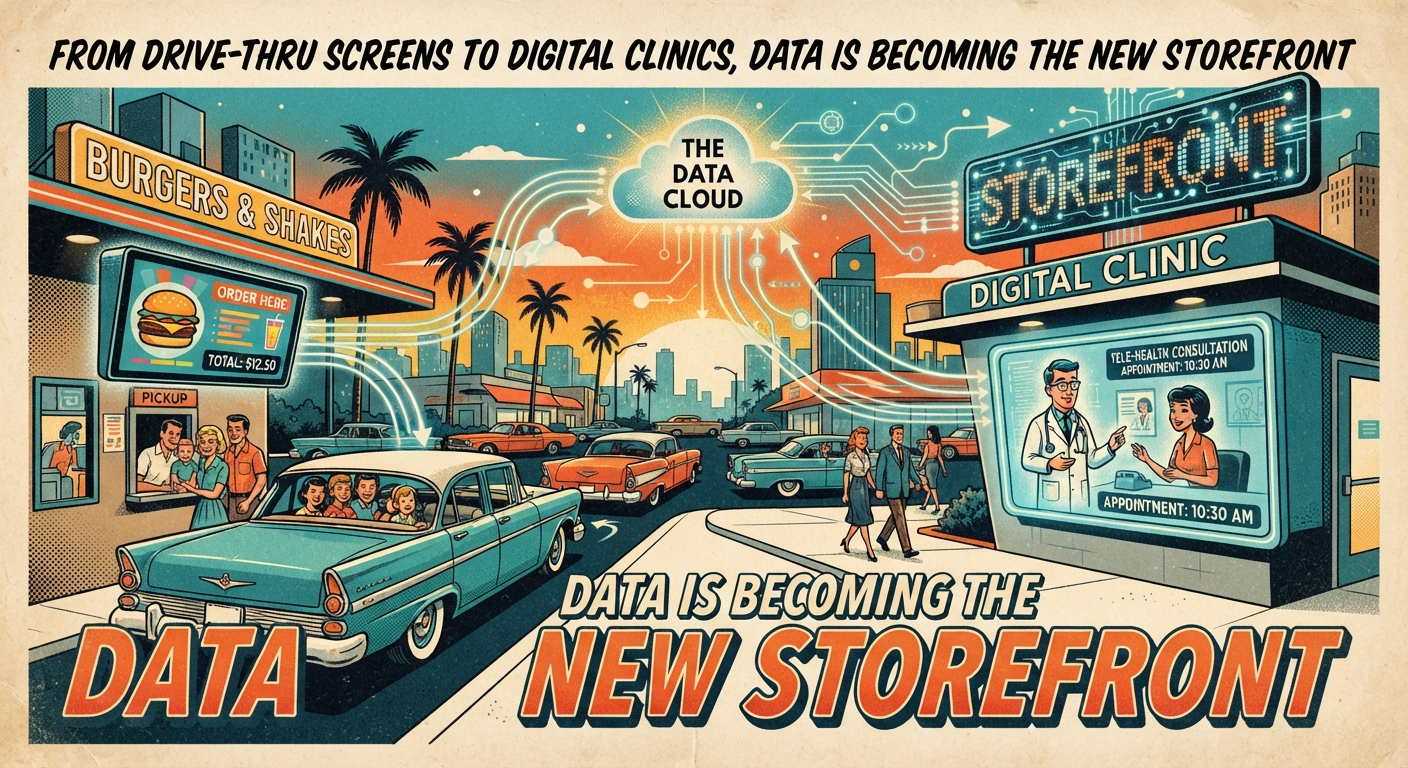
McDonald’s (NYSE: MCD) is testing advertising on digital drive-thru order boards at 450 company-operated U.S. restaurants and aims to build an in-house media network that could ultimately become a $1 billion business. The project remains early, and it has not yet expanded across the franchisee-operated locations that comprise most of McDonald’s roughly 14,000 U.S. restaurants. Still, the strategic logic is hard to miss: McDonald’s has enormous physical reach, strong digital engagement and millions of consumer decisions occurring at highly measurable moments every day. The company is effectively treating its restaurant footprint as a commerce-media asset. A customer who is already approaching a drive-thru is not a hypothetical audience. They are a person in motion, often hungry, generally decisive and, in the best possible sense for advertisers, within feet of making a purchase. McDonald’s is following the broader playbook established by Amazon.com Inc. (NASDAQ: AMZN) and Walmart Inc. (NYSE: WMT), whose media businesses have demonstrated how first-party commerce data can be converted into higher-margin advertising revenue. Amazon reported $68.6 billion in advertising-services sales during 2025, while Walmart said its U.S. Connect advertising business grew revenue 43% in its fiscal second quarter. McDonald’s does not need to become the next Amazon to create shareholder value. It merely needs to turn a modest slice of its unmatched consumer traffic into a durable advertising opportunity. For a company facing input-cost pressures and planning substantial restaurant investments, a revenue source with relatively limited incremental operating complexity has obvious appeal. The fries may still pay the bills, but the screens could increasingly help fund the remodel.
Similarweb Is Positioned for the AI Shopping Rewire
Similarweb (NYSE: SMWB) sits on the other side of the emerging commerce-media equation: it helps businesses understand how consumers find, compare and choose products online. The company’s 2026 ecommerce research argues that artificial-intelligence-driven discovery is becoming an influential part of the shopping journey, even if it has not displaced conventional search. Dedicated AI-platform referrals reportedly grew more than 200% over the prior year, yet shoppers still use search alongside AI in 89% of AI-assisted research journeys. In short, consumers are not replacing one digital tool with another; they are assembling a small committee of machines to help decide which sneakers, skincare products or espresso maker deserve their money. That matters because the brands that appear in an AI recommendation can enjoy an unusually strong advantage. Similarweb reported that, in some situations, AI-recommended brands held a two-to-one edge versus competitors. For retailers, advertisers and consumer brands, this changes the operating question from “How do we rank in search?” to something larger:
- How do we become visible in AI-generated recommendations?
- Which channels are producing high-intent shoppers rather than merely cheap clicks?
- How does app behavior compare with web behavior?
- What products and categories are gaining digital attention before sales data fully reveals the trend?
Similarweb’s digital-data platform is built for that rising complexity. Its report indicates that ecommerce website traffic increased 6.8% year over year, while ecommerce-app sessions grew at roughly 1.3 times the pace of web visits. It also found that 86.5% of U.S. consumers primarily shop through a smartphone or tablet. That is constructive terrain for Similarweb: more fragmented consumer journeys create more demand for measurement, competitive intelligence and marketing decisions rooted in observed behavior rather than executive instinct. Instinct remains useful, of course. But it has a tendency to arrive at the meeting wearing a blazer and carrying no data.
The Bigger Opportunity: AI Discovery Meets Monetizable Attention
The McDonald’s and Similarweb stories intersect at an important market shift: digital discovery is becoming more embedded in everyday commerce. McDonald’s can potentially monetize attention at the moment of purchase. Similarweb can help brands understand how consumers arrive at that moment, including the growing role of AI assistants, search engines, apps and online marketplaces. The opportunity is not limited to retail. It extends to restaurants, travel, healthcare, consumer technology, entertainment and virtually any business that controls a trusted customer relationship plus a meaningful digital touchpoint. For many, several themes stand out:
- First-party data is becoming more valuable as advertisers seek measurable, privacy-conscious ways to reach consumers.
- Retail and commerce media can offer higher-margin revenue than traditional product sales alone.
- AI is broadening the path to purchase rather than eliminating traditional search, creating a more complex but potentially richer market for analytics platforms.
- Mobile apps continue to capture an expanding share of commercial activity, increasing the value of companies that can measure and monetize app-based behavior.
The winners may be the businesses that can combine scale, customer trust and actionable data—not merely collect more dashboards than anyone else.
Amwell’s Bull Case Is Built Around Infrastructure
Amwell (NYSE: AMWL) presents a different version of the same strategic idea: turn a fragmented customer experience into a more unified, software-driven platform. The virtual-care company recently received Frost & Sullivan’s 2026 Technology Innovation Leadership Recognition in the U.S. technology-enabled care-platform industry. The evaluation highlighted Amwell’s effort to unify patient experiences, clinician workflows, care programs and partner solutions within a common architecture. That is more than a trophy-case development. Healthcare has accumulated digital tools the way suburban garages accumulate extension cords: each may have a purpose, but the overall arrangement can become difficult to manage. Virtual visits, remote monitoring, chronic-condition programs, digital therapeutics and care navigation services can create disconnected patient journeys and administrative friction when they operate as separate point solutions. Amwell’s platform strategy aims to make those components more connected. If the company can successfully reduce fragmentation for health plans, providers and public-sector customers, it could strengthen its relevance as healthcare organizations look for scalable infrastructure rather than another standalone application. The potentially larger catalyst is Amwell’s recently announced letter of intent from the U.S. Department of Veterans Affairs. The VA indicated an intent to use Amwell’s virtual-health platform as part of efforts to modernize its digital-health infrastructure, with the platform expected to support connected care and broaden access for more than nine million Veteran beneficiaries. The announcement followed a VA evaluation that cited Amwell’s capabilities in scalable video consultations, interoperability, cybersecurity compliance and integrated care delivery. For a company operating in a competitive and often volatile telehealth market, validation from one of the country’s largest healthcare systems is strategically meaningful. A federal relationship of this scope can underscore product credibility, enterprise readiness and the importance of secure, interoperable care technology.
The Fine Print Matters
The investment case requires discipline, not pom-poms. McDonald’s advertising-network ambitions are still in pilot mode, and a broader franchisee rollout, advertiser demand and customer experience will determine whether the concept earns its way from clever initiative to material profit center. The company’s stated $1 billion potential is an aspiration, not a booked revenue line. Similarweb’s research findings are based on proprietary digital estimates and methodology, which the company itself notes should not be treated as an infallible representation of all online activity. Still, the directional message is compelling: AI-assisted discovery is becoming commercially relevant, and businesses need better ways to measure it. Amwell’s VA letter of intent is expressly nonbinding. Any definitive agreement remains subject to negotiation, federal procurement requirements and other conditions. Amwell also identifies material risks including contract-conversion uncertainty, procurement challenges, market volatility, competition, privacy obligations and cybersecurity exposure. Those caveats are not reasons to ignore the opportunity. They are reminders that in the public markets, even excellent stories must eventually report earnings.
Why Many More Are Paying Attention
McDonald’s (NYSE: MCD), Similarweb (NYSE: SMWB) and Amwell (NYSE: AMWL) illustrate a broader market shift toward businesses that extract more value from the customer relationship after the initial interaction. McDonald’s is looking to convert its physical traffic and digital ordering surfaces into a media asset. Similarweb is supplying the analytical intelligence companies need to compete in an AI-shaped shopping environment. Amwell is positioning its platform as connective tissue for an increasingly digital healthcare system. Different sectors. Different risk profiles. One increasingly familiar formula:
Customer relationship + digital infrastructure + data = new monetization potential
That formula will not eliminate execution risk, competitive pressure or valuation debate. But it does help explain why investors are focusing on companies that can transform customer attention, behavior and workflow into scalable revenue. In the next phase of digital commerce and digital care, the most valuable real estate may not be the store, the website or the hospital. It may be the platform that owns the moment in between.
Public Companies Mentioned
| Company | Ticker | Strategic angle |
|---|---|---|
| McDonald’s Corp. | NYSE: MCD | Developing a commerce-media network around restaurant and drive-thru customer interactions |
| Similarweb Ltd. | NYSE: SMWB | Digital intelligence and measurement for AI, search, app and ecommerce behavior |
| Amwell | NYSE: AMWL | Technology-enabled healthcare platform and potential VA digital-health opportunity |
| Amazon.com Inc. | NASDAQ: AMZN | Established benchmark for high-scale commerce-media monetization |
| Walmart Inc. | NYSE: WMT | Retail-media benchmark through Walmart Connect |
The Sources
- CNBC: Why McDonald’s Is Following Walmart and Amazon Into the Advertising Business
- Yahoo Finance: Similarweb State of Ecommerce 2026 Report Details How AI Is Changing the Shopper Journey
- Yahoo Finance: Similarweb Announces Second Quarter 2026 Results
- Yahoo Finance: Amwell Receives Frost & Sullivan’s 2026 Technology Innovation Leadership Recognition for Addressing Healthcare Fragmentation
- Yahoo Finance: Amwell Receives Letter of Intent From the Department of Veterans Affairs to Help Power Its Digital Health Infrastructure
- Similarweb Investor Relations: State of Ecommerce 2026 Report Details How AI Is Changing the Shopper Journey
- Marketing Dive: Inside McDonald’s New Marketing Model as It Enters the Media Network Fray
- Healthcare Dive: Veterans Affairs Taps Amwell for Telehealth Revamp
- Similarweb: 2026 State of Ecommerce Report
- Amwell Investor Relations: Amwell Receives Letter of Intent From Department of Veterans Affairs to Help Power Its Digital Health Infrastructure
Stay Updated with Vista Partners
Subscribe to receive market insights, investing ideas, and the latest updates directly in your inbox.