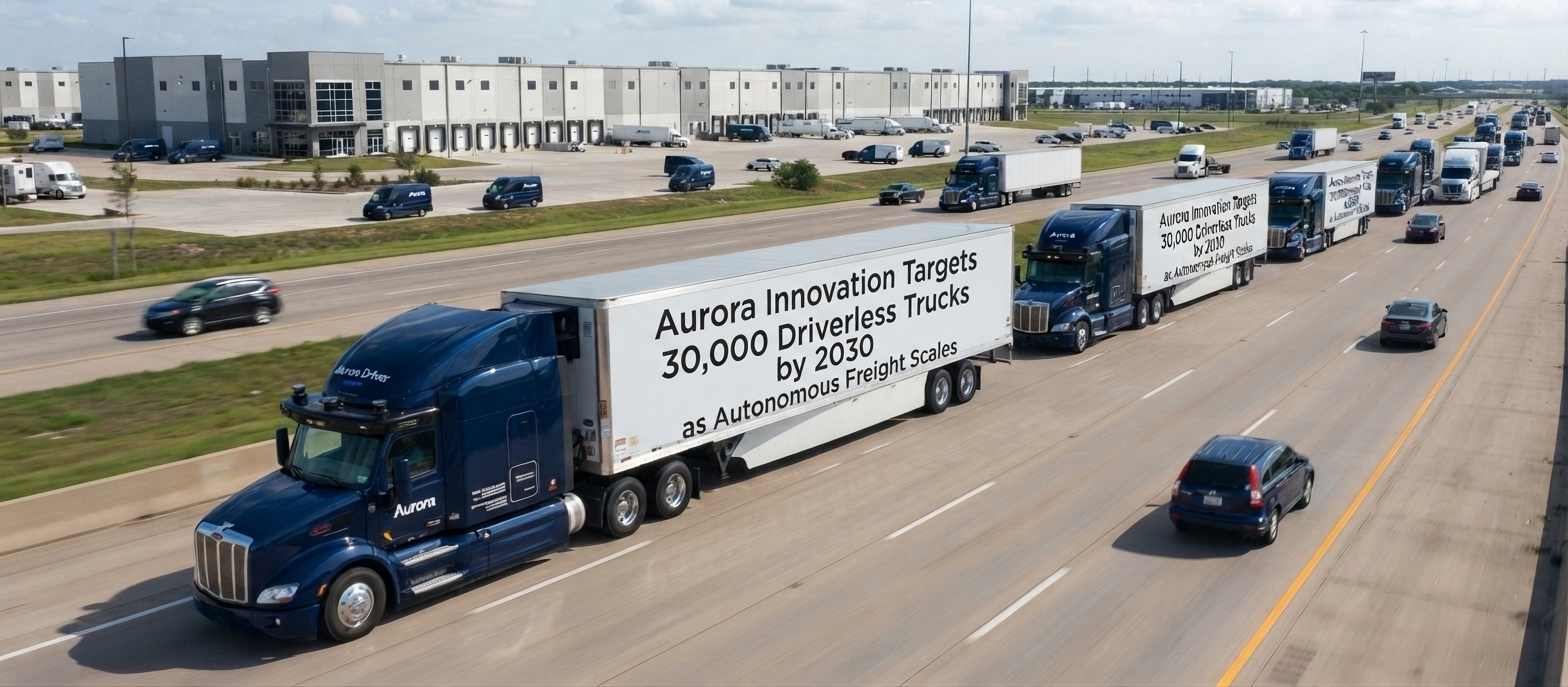
Aurora Innovation, Inc. (NASDAQ: AUR) is no longer asking investors to imagine a future in which a Class 8 truck can move freight without a driver. On the Texas highway between Houston and Dallas, it is doing precisely that, commercially, repeatedly and, most importantly, uneventfully. That last point may sound unglamorous, but in trucking, uneventful is the champagne of operational excellence. Aurora’s driverless runs suggest autonomous freight is moving from a grand technology demonstration toward a potentially formidable logistics business: one built around higher asset utilization, lower labor cost exposure, software-like unit economics and an urgent need for capacity across America’s freight corridors.
The Empty Driver’s Seat Is Becoming an Economic Argument
A CNBC ride-along with Aurora founder and CEO Chris Urmson documented a fully autonomous freight trip on Interstate 45, with no human seated behind the wheel. The company is operating driverless routes in Texas, including the Houston–Dallas corridor and the Fort Worth–El Paso corridor, while commercializing its Aurora Driver platform with freight customers. The bullish argument is straightforward: a conventional truck is an expensive asset that spends too much time resting, because the human operator, quite reasonably, must rest. A driverless truck does not replace the need for people throughout the freight ecosystem, but it can potentially keep a truck moving for more hours per day on well-defined highway routes. Aurora says its autonomous trucks can create customer savings through:
- Higher truck utilization, with driverless trucks able to operate beyond human hours-of-service limits.
- Reduced driver-related cost exposure, including wages, benefits and recruitment pressure.
- Potential insurance and fuel-efficiency gains.
- More predictable freight movement across high-volume lanes.
- A scalable software-and-services revenue model rather than a one-time vehicle sale.
Morgan Stanley (MS) analyst Ravi Shankar estimated in the CNBC segment that an autonomous fleet could be nearly 7.5 times as profitable as a comparable human-driven fleet today. Bank of America (BAC) has separately estimated Aurora’s service could cost roughly $0.85 per mile, versus approximately $1.30 per mile for human-driver wages and benefits alone, before indirect labor costs. Those estimates should be treated as analyst assumptions rather than guaranteed outcomes, but they explain why the market is taking a closer look at autonomous trucking.
From Twenty Trucks to a Much Bigger Addressable Market
Aurora has roughly 20 driverless trucks operating today and says it is fully allocated to exit 2026 with 200 driverless trucks operating through its Transport-as-a-Service, or TaaS, agreements. The company’s stated 2030 ambition is more ambitious still: over 30,000 driverless trucks in operation, producing a multibillion-dollar revenue stream and “SaaS-like” gross margins in its Driver-as-a-Service, or DaaS, mode. That is a large leap, but it identifies the core investment question. Aurora is not valued on today’s modest revenue base; it is being valued on whether autonomous freight can compound from dozens of trucks to hundreds, then thousands, with favorable incremental economics. Aurora’s recent milestones make that pathway more concrete:
- The company says it has safely completed more than 500,000 driverless miles since commercial launch.
- Aurora Driver-powered trucks used by customers including McLane and Werner are averaging an annualized rate of more than 225,000 miles per year—more than twice the utilization of a traditional truck, according to the company.
- Aurora targets a 20-truck-per-week production rate beginning in October through Roush upfitting.
- Its second-generation hardware kit is designed for a one-million-mile operating life and is intended to reduce cost by more than half versus the prior system.
- Hirschbach plans to own and operate 500 Aurora-powered trucks beginning with deliveries scheduled for 2027 under a DaaS arrangement.
For many, the attraction is not simply that an autonomous truck avoids a driver’s seat. It is that one software platform may earn recurring revenue across a widening installed base. Put differently: the cab is still there, but the economic model increasingly resembles a subscription.
The Partnership Stack Makes the Story Intriguing
Autonomous trucking needs more than sensors, maps and very clever code. It needs manufacturers that can integrate systems into production, fleet operators that can deploy them, freight networks that can fill the trailers, and service organizations that can keep the machines earning their keep. Aurora has assembled an ecosystem that includes PACCAR Inc. (NASDAQ: PCAR), Volvo Group (OTCPK: VOLVY), NVIDIA Corp. (NASDAQ: NVDA), Uber Technologies Inc. (NYSE: UBER), FedEx Corp. (NYSE: FDX), Ryder System Inc. (NYSE: R), Schneider National Inc. (NYSE: SNDR), Werner Enterprises Inc. (NASDAQ: WERN), Toyota Motor Corp. (NYSE: TM) and other transportation partners. That matters because large-scale autonomy will be won as much through industrial execution as through artificial intelligence. Volvo is already integrating Aurora’s technology alongside production of the Volvo VNL Autonomous platform, with driverless operations planned for the first quarter of 2027. Aurora and PACCAR are working toward a scalable future launch involving Aurora’s third-generation hardware kit on PACCAR’s autonomy-enabled truck platform. The prize is substantial: factory-level integration has the potential to lower installation cost, shorten deployment cycles and turn a technology project into something much closer to fleet procurement.The sector’s expanding public-market cast also gives investors several ways to follow the theme. Alongside Aurora Innovation (NASDAQ: AUR), Kodiak AI, Inc. (NASDAQ: KDK) is another public autonomous-trucking name focused on its Kodiak Driver platform and Driver-as-a-Service offerings.
Tesla’s Robotaxi Momentum Keeps Autonomy in Focus
The autonomy investment narrative extends beyond freight. Tesla Inc. (NASDAQ: TSLA) is reportedly preparing to expand Robotaxi service toward 24/7 operations with its FSD v15 software, according to comments attributed to Tesla Vice President of AI Ashok Elluswamy. The report says Tesla is targeting a next-generation FSD architecture, with a claimed 10-billion-parameter neural network and a broader commercial Robotaxi rollout following validation. Tesla’s passenger-vehicle strategy and Aurora’s freight-first strategy differ in important ways. Robotaxis must navigate dense, highly variable city environments, while long-haul autonomous trucking can initially focus on repeatable, high-volume highway corridors. That distinction may give freight a cleaner early path to commercialization: fewer unpredictable left turns, more time on divided highways, and a business customer with an immediate economic reason to care. Still, the broader implication is constructive. Tesla’s robotaxi push keeps capital, talent, regulatory attention and public awareness concentrated on autonomy. Aurora does not need to win the passenger-robotaxi race to benefit from the market’s growing acceptance that software-driven vehicles can become commercial assets rather than permanent science projects.
The Road to 2028 Is Not a Straight Line
The bullish case deserves a properly fastened seatbelt. Aurora remains early in its revenue ramp and is not yet free-cash-flow positive. The company reported approximately $1.2 billion in cash and short-term investments at the end of the second quarter of 2026, while management continues to target positive free cash flow in 2028. The principal risks are clear:
- Aurora must demonstrate that driverless operations can scale safely across more routes, weather conditions and freight scenarios.
- Hardware supply, manufacturing throughput and fleet service capacity must expand without wrecking unit economics.
- Customer adoption may be deliberate, especially where deliveries require complex loading docks, congested streets, customer-service interaction or unusual cargo handling.
- Regulatory acceptance, insurance availability and public confidence will remain decisive.
- The company could require additional capital before reaching positive free cash flow.
- Larger technology and transportation players may intensify competition as autonomous freight proves commercially viable.
Human drivers also do more than steer. As uShip CEO Shawn Wu noted in the CNBC report, they provide judgment, customer service, protection and a practical backstop at difficult docks and in congested environments. The first durable autonomous freight model is therefore more likely to automate the long, repeatable highway middle-mile than to eliminate every human task surrounding freight movement.
Why Aurora Could Be A Magnet To Many
Aurora’s upside case rests on a rare combination: a large, entrenched industry; a tangible labor-and-utilization problem; early commercial operations; recognizable industrial partners; and a business model that could eventually turn vehicle miles into recurring software and service revenue. The U.S. freight market is enormous, and the company sees a vast pool of potential vehicles to convert over time. What Aurora has now is not merely a compelling presentation deck. It has trucks hauling real cargo on real public roads, without a person behind the wheel. For Aurora Innovation (NASDAQ: AUR) shareholders, the key catalyst is no longer whether autonomous trucking can leave the lab. It has. The more consequential question is whether Aurora can turn its 20-truck operation into a repeatable industrial machine, 200 trucks, then thousands, while steadily narrowing the gap to its 2028 free-cash-flow target. If that execution arrives, the driverless truck may become one of Wall Street’s more unusual compounders: a logistics asset whose most productive employee never asks for a coffee break, a hotel room or a day off.
The Sources
- CNBC “Autonomous trucking company Aurora looks to accelerate toward profitability”
- CNBC YouTube “Exclusive: Ride-Along Inside Aurora’s Self-Driving Semitruck”
- Aurora Innovation 2026 Analyst and Investor Day: 2030 Vision to Scale to 30,000 Driverless Trucks
- Aurora Innovation Investor Relations
- Aurora Innovation Second Quarter 2026 Results
- Aurora Innovation Company Information and Partner Ecosystem
- Aurora Innovation 2025 Annual Report / Form 10-K
- Aurora Innovation Goldman Sachs Conference Discussion on Scaling Driverless Trucking
- Not a Tesla App “Tesla Robotaxis to Get FSD V15, Start 24/7 Rides Next Month”
- Kodiak AI, Inc. (NASDAQ: KDK) Company and Stock Overview
- Kodiak AI, Inc. (NASDAQ: KDK) StockTitan Company Overview
Stay Updated with Vista Partners
Subscribe to receive market insights, investing ideas, and the latest updates directly in your inbox.