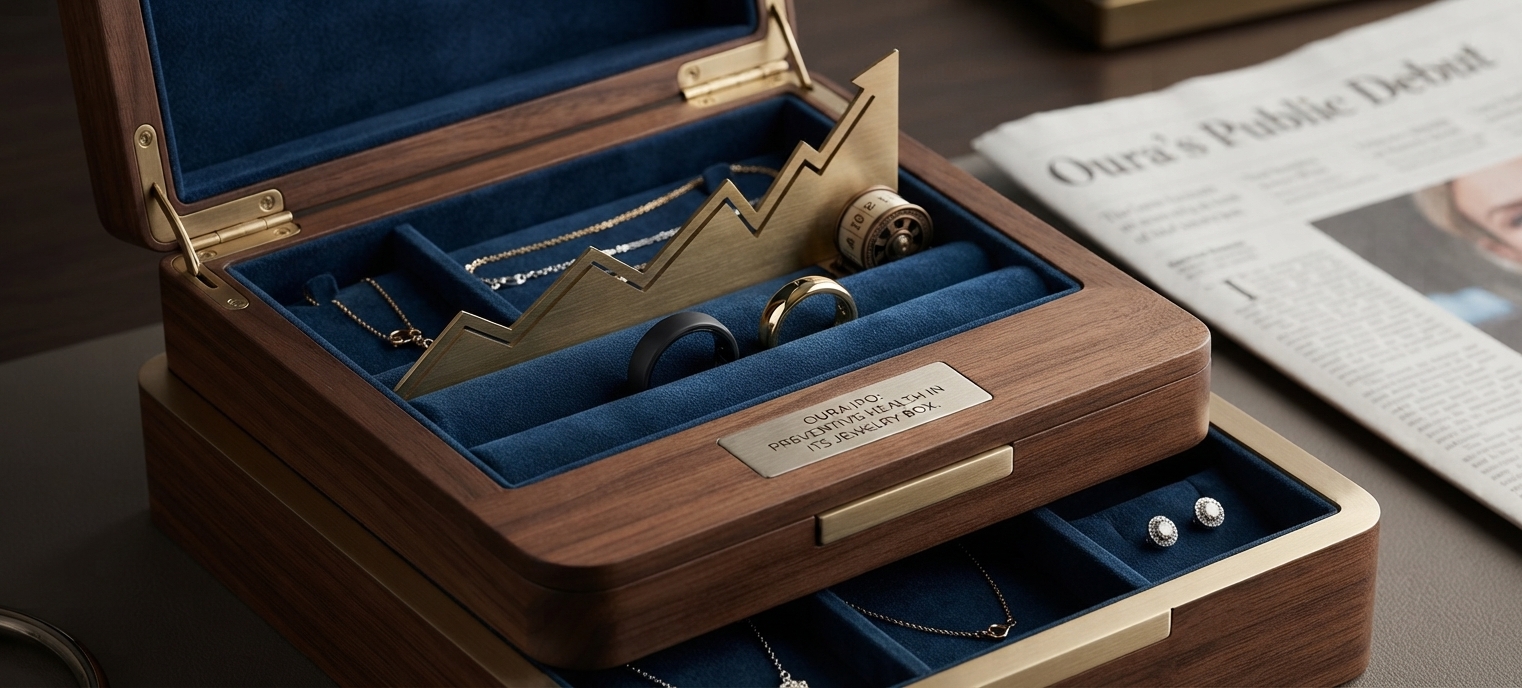
Oura’s proposed Nasdaq debut under OURA is shaping up as more than another wearable-device listing. It is a high-growth health-intelligence story built around a deceptively simple object: a screenless ring that turns sleep, stress, activity, heart health, metabolic health, and women’s health data into an expanding subscription relationship. The company plans to offer 50 million shares at $40 to $44 each, implying gross deal proceeds of roughly $2.0 billion to $2.2 billion. At the midpoint, Oura would carry a fully diluted valuation near $14.9 billion—a formidable vote of confidence in the notion that the next major health platform may sit on a finger rather than glare from a wrist.
The Ring Is the Doorway
Oura’s consumer proposition is unusually elegant: sell a premium, unobtrusive sensor platform once, then deepen the customer relationship through software, data interpretation, and recurring membership revenue. Its Oura Ring 5 is designed to continuously track more than 50 health metrics, including sleep, readiness, activity, stress, heart-health signals, and women’s-health data. The absence of a display is not merely aesthetic minimalism; it is a strategic feature. Consumers receive a health companion without receiving another rectangular authority figure demanding attention every seven minutes. The company says the ring is purpose-built to take advantage of the finger’s physiological signal quality for photoplethysmography, or PPG, measurement. That product design has helped Oura position itself in the rising category of “quiet technology,” devices that collect meaningful information in the background rather than competing for the user’s attention. For many, that matters: a device people can comfortably wear overnight and throughout the day is more likely to generate the consistent data streams that strengthen user engagement and subscription retention.
A Hardware Business With SaaS Aspirations
Oura’s IPO appeal rests on the blend of consumer hardware scale and high-margin membership revenue. During the first nine months of fiscal 2026, the company generated approximately $1.21 billion in revenue, with $974 million, or 80%, from hardware and $240.5 million, or 20%, from memberships. Membership revenue more than doubled year over year and carried an 89% gross margin, according to reporting on the company’s updated filing. That is the crux of the bullish case. The ring may be the product consumers buy; the membership is increasingly the economic engine investors will watch.
| Oura operating metric | What it suggests for investors |
|---|---|
| $1.4 billion revenue for the 12 months ended June 30, 2026 | A consumer-health platform already operating at substantial scale |
| 5.0 million paid members as of June 30 | A large installed base for recurring software-like revenue |
| Approximately 85% 12-month paid-member retention | Evidence that the service may remain useful after the novelty of the hardware purchase |
| $240.5 million membership revenue in the first nine months of fiscal 2026 | Rapidly expanding recurring-revenue contribution |
| 89% membership gross margin | Potential operating leverage as membership becomes a larger revenue mix |
| Expected 5.7 million paid members by fiscal year-end | Management sees 96% year-over-year member growth, driven primarily by Oura Ring 5 sales |
The opportunity is not that Oura is already a pure software company, it plainly is not, with hardware still accounting for most revenue. The opportunity is that each successful ring sale can create a higher-margin, recurring digital-health relationship. In Wall Street terms, it is a hardware-led customer-acquisition model with a subscription tail. In human terms, the ring gets invited into the bedroom, and the app earns the right to stay there.
Growth Is Wearing Well
Oura reported 5 million paid members as of June 30, 2026, up 100% from a year earlier across 56 markets. More recently, the company updated its S-1 to say it expects to finish fiscal 2026 with approximately 5.7 million paid members, a 96% year-over-year increase. The pace is meaningful because it suggests Oura is not simply selling individual devices into a one-time gadget cycle. The business is expanding its membership base while moving through direct-to-consumer channels, roughly 8,400 retail doors, employers, government organizations, and healthcare partners. That multiplatform distribution approach gives the company several routes to customer acquisition beyond the expensive digital-advertising treadmill that has worn down many consumer brands. The addressable narrative also reaches well beyond step counting. Oura’s platform is organized around preventive and personalized health behavior: sleep quality, recovery, stress, cardiovascular signals, metabolic health, and women’s health. Those are recurring concerns, not seasonal accessories. A consumer may stop admiring a new smartwatch after a month; sleep, however, has a stubborn habit of returning every evening.
The IPO’s Bullish Read-Through
The proposed deal consists of 13.5 million newly issued shares from Oura and 36.5 million shares sold by existing shareholders. The company would not receive proceeds from the secondary shares, meaning the offering is substantially a liquidity event for early backers rather than a conventional growth-capital raise. That feature warrants careful reading, but it does not automatically weaken the investment case. In fact, it can be interpreted as evidence that Oura has reached a level of financial maturity where it is able to enter public markets without relying on the IPO as an emergency cash infusion. TechCrunch reported that, at the $42 midpoint, Oura expects roughly $532.6 million in net primary proceeds, with most of that earmarked for tax obligations associated with employee share grants that vest at the IPO. The bullish interpretation is straightforward:
- The company is monetizing a product category it helped define.
- The membership model is scaling faster and earning much higher gross margins than hardware.
- Paid-member growth remains exceptionally strong heading into the offering.
- Retention suggests users see durable value in the health insights.
- Oura has room to extend its platform through healthcare, research, employer wellness, and partner ecosystems.
- The company has attracted cornerstone interest from Eli Lilly (LLY) and Dragoneer Investment Group, which together indicated interest in approximately $400 million of the offering, or about 19% of the deal.
Eli Lilly’s participation is particularly notable for the strategic symbolism. It does not turn Oura into a pharmaceutical company, nor should investors mistake wellness data for a clinical outcome. But it reinforces the market’s growing interest in technologies that can help individuals observe, understand, and potentially improve health behaviors between doctor visits.
Competitive Risks, Properly Sized
No serious IPO story is complete without a few sensible caveats, preferably before the confetti reaches the trading floor. Oura competes in a crowded and well-capitalized health-wearables landscape that includes Apple (AAPL), Samsung Electronics (005930.KS), Fitbit through Alphabet (GOOGL), and privately held competitors such as Whoop and RingConn. Apple and Samsung have vast hardware ecosystems, global distribution, and the financial capacity to compete aggressively if smart rings become a strategically important category. Oura also remains meaningfully exposed to hardware execution. With 80% of revenue still coming from hardware in the first nine months of fiscal 2026, manufacturing, inventory, supply-chain management, product-cycle demand, and pricing discipline remain central variables. And while a roughly 85% 12-month paid-member retention rate is encouraging, investors should watch whether that figure holds as Oura reaches a broader, less early-adopter customer base. Subscription momentum is the premium feature in this valuation story; sustained retention is the battery that keeps it powered. Still, the competitive backdrop may be less alarming than it first appears. The strongest consumer technology franchises often win not by inventing every category but by making a specific behavior habitual. Oura’s emerging habit is daily health interpretation, not merely device ownership. That distinction could prove valuable.
Why OURA Could Catch Wall Street’s Attention
Oura is approaching public markets with the ingredients investors typically seek in a consumer-technology IPO: rapid growth, a recognizable category-leading product, an expanding recurring-revenue layer, favorable subscription economics, international distribution, and a platform narrative tied to preventive health. The proposed ticker, OURA, offers investors a direct public-market way to follow the smart-ring category. Its central investment proposition is not that everyone suddenly needs another wearable. It is that millions of people increasingly want health data without a distracting screen, guidance without a white coat, and a device that can work quietly while they sleep. If Oura can continue converting ring buyers into long-lived members, preserve its retention profile, and responsibly expand its health-intelligence ecosystem, the company could make the smart ring one of the market’s more intriguing intersections of consumer technology, subscription software, and preventive health. For now, the bull case comes down to a compact equation: a premium device, worn continuously, generating recurring data, supporting recurring revenue. Wall Street has certainly financed stranger ideas, some of them involved dogs, blank-check companies, or both. Oura, by comparison, has the rare advantage of already having its product on millions of fingers.
The Sources
- Yahoo Finance “Oura publicly files for initial public offering, looks to raise $2.2 billion”
Read the article - ŌURA / Business Wire “ŌURA Announces Launch of Initial Public Offering”
Read the company announcement - Renaissance Capital “Smart ring maker Oura sets terms for $2.1 billion IPO”
Read the IPO analysis - TechCrunch “Oura’s $2.2B IPO is mostly a payday for existing shareholders”
Read the article - Startup Fortune “Oura Files for a Nasdaq IPO That Could Value the Ring Maker Near $16 Billion”
Read the article - U.S. Securities and Exchange Commission ŌURA Form S-1 Registration Statement
Search SEC EDGAR filings for ŌURA - Cosmopolitan UK “I Tested the Oura Ring 5 for 3 Months Here’s Whether It Beats the Gen 4”
Read the Oura Ring 5 review - The Irish Times “Oura Ring 5 Review: A Slimmed-Down Health Tracker That Feels More Like Jewellery”
Read the review - Men’s Health “Not All Smart Rings Are Great Fitness Trackers: Here Are the 5 Our Editors Trust”
Read the smart-ring comparison - Oura Official Website and Health-Intelligence Platform
Visit Oura
Stay Updated with Vista Partners
Subscribe to receive market insights, investing ideas, and the latest updates directly in your inbox.