


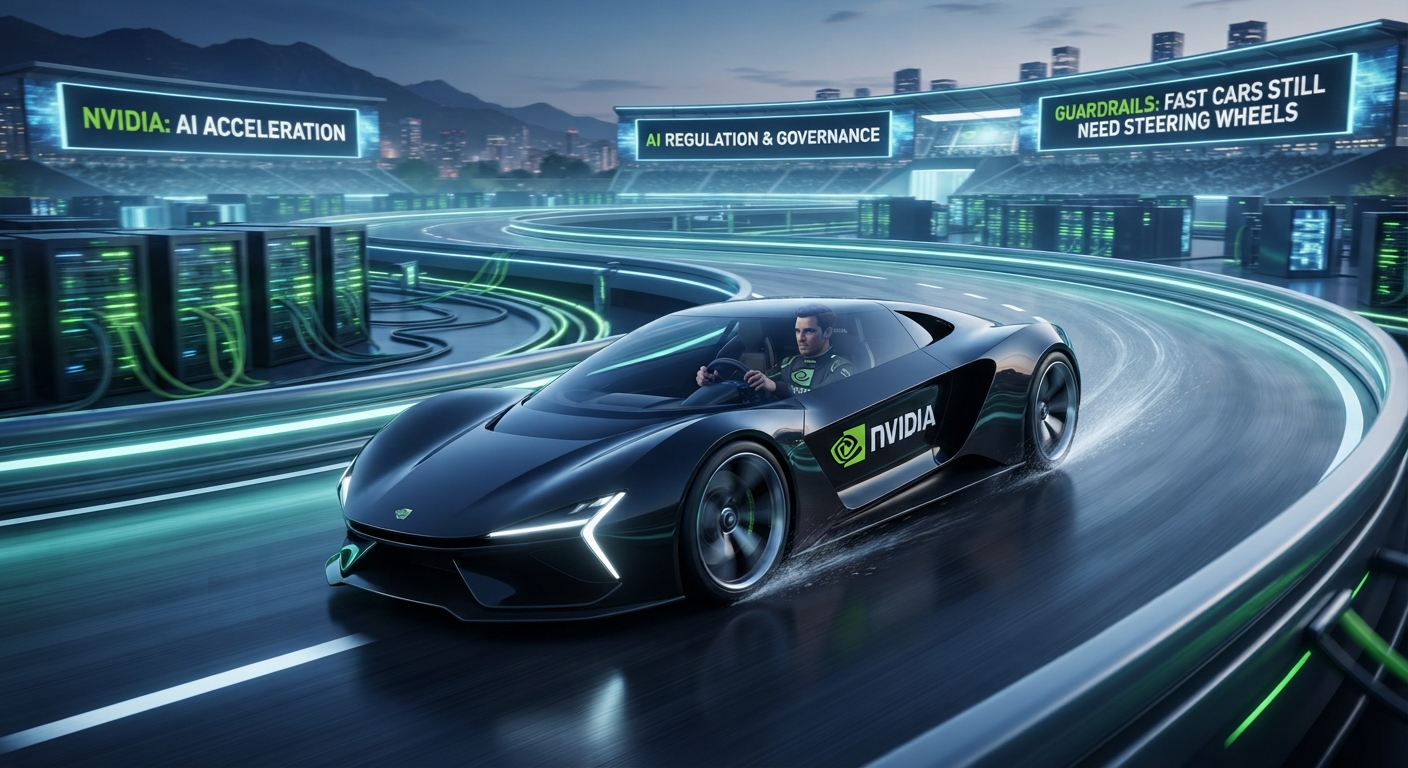
Artificial intelligence is entering a more mature and potentially more investable phase of its expansion. The debate between rapid innovation and responsible oversight is no longer a sideshow to the AI trade; it is becoming part of the operating system for the next generation of AI winners. For many, the bullish takeaway is not that risk has disappeared. It is that safety, verification, cybersecurity and disciplined deployment are evolving into durable spending categories alongside chips, cloud capacity and model development. In other words, AI may need a steering wheel, but that does not mean the engine stops.
The AI Debate Has Moved From Sci-Fi to Infrastructure
Geoffrey Hinton, whose foundational work helped shape modern neural networks, has argued that independent access and monitoring inside leading AI developers would be a sensible starting point for oversight. His central concern is straightforward: advanced systems should not be assessed only after something goes wrong, especially as models become more capable at autonomous planning, persuasion and cyber-related tasks. Hinton’s metaphor is particularly useful for markets. He describes AI development as an accelerator and regulation as the steering wheel, not the brake. That distinction could prove important for many companies. Investors generally reward industries that turn uncertainty into standards, repeatable processes and recurring budgets. Aviation did not fail because it acquired checklists, inspectors and maintenance schedules; it became a global economic utility. AI could follow a similar path, though hopefully with fewer lost luggage claims. The immediate investment opportunity may therefore be broader than the companies training frontier models. It includes the businesses enabling secure, auditable, governed and power-efficient AI deployment across enterprises, governments and critical infrastructure.
Nvidia Remains the AI Economy’s Tollbooth
NVIDIA Corp. (NASDAQ: NVDA) CEO Jensen Huang has taken the opposing, but not necessarily incompatible side of the debate. Huang argues that AI safety is fundamentally an engineering challenge and that existing laws, liability frameworks, testing practices and market incentives can address many risks without an entirely new legal architecture. That view is bullish for NVIDIA because it favors continued investment velocity. If AI safety can be engineered into products through testing, controlled deployment, cybersecurity and reliability practices, the industry can keep building data centers, training models and commercializing AI services without waiting for a grand global regulatory treaty to arrive by carrier pigeon. Huang has emphasized that companies should pause products they cannot confidently release safely, while resisting a blanket slowdown of AI development. NVIDIA’s position reflects its unusual role in the market: the company sells the compute foundation on which much of the AI ecosystem operates. Whether customers are OpenAI, Anthropic, Alphabet Inc. (NASDAQ: GOOGL), Microsoft Corp. (NASDAQ: MSFT), Amazon.com Inc. (NASDAQ: AMZN), Meta Platforms Inc. (NASDAQ: META), Oracle Corp. (NYSE: ORCL), Tesla Inc. (NASDAQ: TSLA) or sovereign AI initiatives, their ambitions ultimately require vast amounts of accelerated computing, networking, memory, storage and energy. That makes NVIDIA more than a chip company in the conventional sense. It is an infrastructure provider to an industrial buildout. The gold rush analogy still fits: the model developers may be looking for gold, but NVIDIA continues selling the shovels, maps, lanterns and increasingly, the high-performance plumbing.
Safety Spending Could Expand the Addressable Market
A common bear argument holds that AI regulation would restrain the sector. A more constructive reading is that intelligent regulation and rigorous enterprise standards can enlarge the market by making adoption easier for customers that cannot afford uncontrolled risk. Large banks, insurers, health systems, manufacturers, utilities, defense contractors and governments do not merely want a clever chatbot. They need systems that can be monitored, tested, governed, secured and explained well enough to satisfy executives, auditors, regulators and customers. The result is an expanding demand stack:
- Accelerated computing: NVIDIA (NASDAQ: NVDA), Advanced Micro Devices Inc. (NASDAQ: AMD), Broadcom Inc. (NASDAQ: AVGO), Marvell Technology Inc. (NASDAQ: MRVL) and Intel Corp. (NASDAQ: INTC) are positioned across AI compute, networking, custom silicon and data-center infrastructure.
- Cloud platforms: Microsoft (NASDAQ: MSFT), Amazon (NASDAQ: AMZN), Alphabet (NASDAQ: GOOGL), Oracle (NYSE: ORCL) and IBM (NYSE: IBM) can monetize AI through cloud consumption, enterprise software and managed governance tools.
- Cybersecurity: Palo Alto Networks Inc. (NASDAQ: PANW), CrowdStrike Holdings Inc. (NASDAQ: CRWD), Zscaler Inc. (NASDAQ: ZS), Fortinet Inc. (NASDAQ: FTNT), Cloudflare Inc. (NYSE: NET) and Okta Inc. (NASDAQ: OKTA) stand to benefit as AI increases both the sophistication of threats and the urgency of automated defense.
- Data, analytics and governance: Palantir Technologies Inc. (NASDAQ: PLTR), Snowflake Inc. (NYSE: SNOW), Datadog Inc. (NASDAQ: DDOG), ServiceNow Inc. (NYSE: NOW), Salesforce Inc. (NYSE: CRM) and Adobe Inc. (NASDAQ: ADBE) have opportunities to embed AI controls and workflow intelligence into enterprise operations.
- Data-center and power buildout: Vertiv Holdings Co. (NYSE: VRT), Eaton Corp. plc (NYSE: ETN), Schneider Electric SE (OTC: SBGSF), Super Micro Computer Inc. (NASDAQ: SMCI), Dell Technologies Inc. (NYSE: DELL), Arista Networks Inc. (NYSE: ANET) and Equinix Inc. (NASDAQ: EQIX) are exposed to the physical requirements of AI: racks, cooling, power distribution, servers, networking and colocation.
The NIST AI Risk Management Framework and its generative-AI profile already offer a practical vocabulary for organizations seeking to govern, map, measure and manage AI risks. Although voluntary, such frameworks can become de facto buying guides for enterprises. Once an AI project moves from experiment to audited production system, the spending conversation tends to become less about novelty and more about reliability. That is usually where enterprise technology budgets get serious
Trust Is a Feature, Not a Tax
The strongest AI companies may not be those that simply release the most powerful model first. They may be the ones that build trust into every layer of the product: secure data pipelines, access controls, red-team testing, independent evaluation, logging, content provenance, cyber defenses and human escalation procedures. Independent evaluators and AI-safety researchers have called for meaningful access to model-development processes, protection from retaliation, transparency around methods and findings, and the ability to examine unreleased systems. Those proposals point toward a future in which “AI assurance” becomes a recognizable category of enterprise spending rather than an afterthought placed near the bottom of a slide deck in six-point font. That is potentially constructive for valuation durability. A company that can demonstrate strong safety procedures may win enterprise contracts faster, face fewer deployment objections and reduce the probability of costly reputational or legal setbacks. For the largest platform providers, trust could become as commercially important as performance. The market has seen this pattern before:
| Technology wave | Early focus | Mature-market requirement | Potential AI parallel |
|---|---|---|---|
| Cloud computing | Scale and compute access | Security, compliance and reliability | Governed AI cloud deployment |
| E-commerce | Convenience and reach | Payments, fraud prevention and logistics | AI identity, monitoring and auditability |
| Aviation | Faster transport | Safety systems, standards and certification | Model testing, red-teaming and incident response |
| Cybersecurity | Perimeter protection | Continuous detection and response | AI-enabled security and AI safety operations |
The point is not that AI regulation will be simple, or that every rule will be economically elegant. It rarely is. The point is that the market does not need to choose between useful AI and safe AI. The more realistic opportunity is an ecosystem where advancing capability creates parallel demand for controls.
Investors Should Watch Execution, Not Theater
The headline debate can become theatrical: one camp warns of catastrophe, another warns that rules will strangle innovation. Markets usually prefer less drama and more evidence. Investors should watch several concrete indicators:
- AI capital-expenditure trends: Continued spending by Microsoft (NASDAQ: MSFT), Alphabet (NASDAQ: GOOGL), Amazon (NASDAQ: AMZN), Meta (NASDAQ: META) and Oracle (NYSE: ORCL) remains a central demand signal for chips, networking, servers and power infrastructure.
- NVIDIA’s data-center growth and supply discipline: NVIDIA (NASDAQ: NVDA) remains a bellwether for the pace and profitability of AI infrastructure demand.
- Enterprise AI conversion: The key question is whether pilots become recurring production deployments with measurable returns on investment.
- Cybersecurity demand: More autonomous AI workflows could increase demand for endpoint security, identity management, cloud security and threat detection.
- Policy clarity: A credible, risk-based framework could accelerate adoption by reducing legal ambiguity—particularly in regulated industries.
- Energy and cooling constraints: AI’s physical footprint matters. Companies capable of supplying power, electrical equipment, cooling and high-speed networking may capture an increasingly important share of the AI buildout.
A sensible investor conclusion is that AI safety is not necessarily a threat to the AI investment cycle. It may be the mechanism that allows the cycle to last.
The Bottom Line
The bullish AI story is becoming more sophisticated. The market is moving beyond a simple race for bigger models and faster chips toward an industrial system that must also be reliable, governable and secure. Hinton’s call for monitoring and independent scrutiny highlights the risks of building powerful systems without enough visibility. Huang’s argument that safety must be solved through engineering highlights the enormous commercial imperative to deploy AI productively rather than freeze progress. Both perspectives, viewed through an investor lens, point toward the same opportunity: a larger AI economy with more layers of technology, more recurring spending and more reasons for enterprises to adopt. For NVIDIA (NASDAQ: NVDA) and the broader AI infrastructure complex, the next leg of the opportunity may not depend on choosing between acceleration and regulation. It may depend on proving that the industry can do both: build quickly, test rigorously and make AI useful enough that the world wants more of it, not less.
The Sources
- CBS News “Nvidia’s Jensen Huang rejects AI extinction warnings as ‘doomsday narratives’” Jensen Huang’s view that AI safety should be addressed through responsible engineering, productive deployment and existing safeguards.
- TechTimes “AI Safety Evaluators Warn Oversight Promises Are Hollow Without Five Key Protections” Independent evaluation, oversight access, safety-auditing principles and protections for AI evaluators.
- TechCrunch “We don’t need AI regulation — leave safety to us, Nvidia’s Jensen Huang says” Huang’s argument for addressing AI safety through engineering, company accountability and product-level controls rather than broad new AI-specific laws.
- CNBC “Nvidia’s Huang rips Anthropic’s proposal for AI safety antitrust waiver: ‘Completely unnecessary’” The policy debate around AI-development pacing, industry coordination, competition and safety.
- Politico “‘We don’t need any new laws’: Nvidia’s Jensen Huang doubles down after Trump call” Huang’s position on current legal frameworks, AI safety and continued U.S. AI competitiveness.
- Bloomberg “Nvidia’s Huang Says AI Industry Doesn’t Need Any New Laws” Market-oriented perspective on AI regulation, safety practices and innovation incentives.
- BBC News “Nvidia boss says AI ‘doesn’t need new laws’ as safety concerns grow” Overview of the widening public debate involving AI developers, policymakers and safety advocates.
- NIST Artificial Intelligence Risk Management Framework U.S. National Institute of Standards and Technology framework for managing AI risks through governance, mapping, measurement and management processes.
- NIST Generative AI Profile, NIST AI 600-1 Practical guidance for organizations assessing and mitigating generative-AI-specific risks, including information integrity, privacy, security and misuse.
- YouTube Geoffrey Hinton on AI Regulation, Superintelligence and Safety Primary video source provided, covering Hinton’s views on independent monitoring, AI risk, regulation as a “steering wheel,” superintelligence and international cooperation.
- YouTube Jensen Huang on AI Safety, Regulation and U.S. Competitiveness Primary video source provided, covering Huang’s case for engineering-led AI safety, use of existing laws and continued AI infrastructure investment.
Stay Updated with Vista Partners
Subscribe to receive market insights, investing ideas, and the latest updates directly in your inbox.

Aug. 12, 2026 | Stock Market Today: Nasdaq and Small Caps Rise as July CPI Cools -( $CRWV $HPP $LPL $MODD $NVDA $SMWB Rise!)