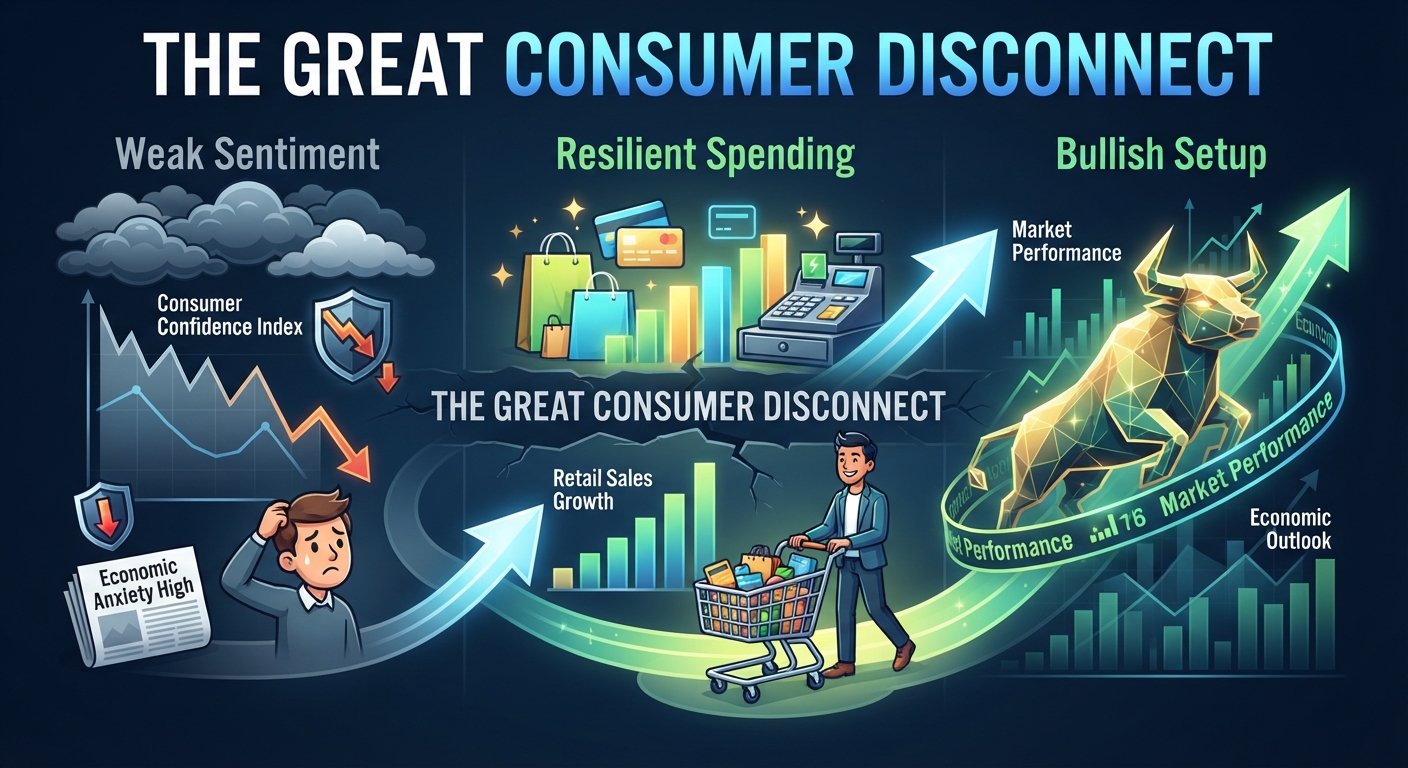
Consumer sentiment is undeniably bruised, inflation anxieties remain inconveniently durable, and Americans are not exactly composing love letters to the economy. Yet the widening gap between how households feel and what the hard data say may be creating a more constructive backdrop for disciplined investors than the headlines suggest.
The latest consumer-confidence figures offer little cheer at first glance. The University of Michigan’s preliminary September Consumer Sentiment Index fell to 47.8 from 51.7 in August, a 7.5% monthly decline and 13.2% year-over-year drop. One-year inflation expectations rose to 4.6%, while the expectations component slid to 45.8. Those are not figures that inspire a victory lap at the mall. But investors should distinguish between a troubled national mood and a collapsing economy. Goldman Sachs Group Inc. (NYSE: GS) argues that weak sentiment increasingly reflects a broader decline in reported happiness and trust, not merely a deterioration in consumers’ financial circumstances. That may sound less like a traditional macroeconomic indicator and more like an observation from a dinner party that went on too long, but it matters: sentiment may be telling a less precise story about future spending and a more precise story about public unease.
The Bearish Mood Meets a More Resilient Reality
The central investment question is not whether Americans are worried. They plainly are. The more useful question is whether that worry is translating into the kind of demand destruction that would justify treating every weak sentiment print as a recession warning. So far, the answer appears more nuanced. Goldman economist Joseph Briggs contends that low reported economic sentiment may reflect a “downbeat assessment of the state of the world” rather than a clean judgment on economic conditions. In other words, respondents may be answering a question about their household finances while mentally pricing in geopolitics, inflation, institutional distrust, social stress and whatever else appeared on their phones before breakfast. That distinction is important because GDP growth, equity-market performance and other conventional measures of economic activity have held up better than sentiment. If consumer surveys are increasingly influenced by non-economic discontent, they may become a noisier guide to the actual trajectory of household spending, corporate revenue and earnings. For many, that is not an invitation to ignore consumers. It is an invitation to become more selective about which consumer signals deserve the loudest megaphone.
Inflation Is Still the Villain, But Not the Only One
Kelly Evans’ inflation commentary makes the other half of the case. Inflation remains an economic and political irritant, particularly when households confront energy, food and everyday-service costs. Yet she highlights a critical distinction: persistent, self-reinforcing inflation typically comes from excessive demand and money growth, not every temporary supply-side shock. That does not make higher prices pleasant. A household does not care whether a painful gasoline bill came from a supply shock or a macroeconomic textbook; it still has to be paid. But for markets and policymakers, the distinction is consequential. If price pressure is being driven partly by energy, tariffs or other supply disruptions rather than an economy running recklessly hot, the investment implications differ:
- The consumer may feel squeezed without necessarily abandoning discretionary spending wholesale.
- The Federal Reserve’s policy trade-offs become more complicated, but not automatically more hawkish.
- Companies with pricing power, loyal customers, efficient supply chains and premium positioning can remain comparatively well insulated.
- Financial markets may be able to look through temporary cost shocks faster than consumer-survey respondents can.
The market, after all, is often accused of being detached from Main Street. In this case, it may simply be asking whether Main Street’s bad mood will show up in next quarter’s receipts.
The Happiness Gap Could Be an Opportunity
Goldman’s observation is unusually useful because it identifies a potential measurement problem. According to the analysis cited by CNBC, the share of Americans describing themselves as “very happy” fell to 23% in 2024 from 31% in 2016, while the share reporting they were “not too happy” increased to 20% from 13%. Broader happiness declined more sharply than reported financial satisfaction, suggesting economic pessimism may be carrying emotional baggage from outside the balance sheet. That is not a trivial sociological footnote. It could alter how many interpret low-confidence readings. A sentiment number near historic lows normally implies consumers are preparing to retreat, preserve cash and reduce spending. But if the reading also captures declining institutional trust, political strain and generalized cultural fatigue, it may overstate the risk of an immediate economic collapse. The consumer may be unhappy, skeptical and one bad push notification away from uninstalling every news app, while still booking trips, replacing devices, dining out selectively and paying bills. The result may be a market environment that rewards fundamental analysis over emotional extrapolation.
Where Investors May Find Leverage
A cautious bullish case does not require declaring the consumer invincible. It requires recognizing that uneven demand often creates winners rather than a uniform economic washout.
| Investor theme | Why it may matter | Examples of public companies |
|---|---|---|
| Premium consumer resilience | Higher-income customers can remain active even when broad sentiment is weak, favoring brands with loyalty and differentiated products | Amazon.com Inc. (NASDAQ: AMZN), Costco Wholesale Corp. (NASDAQ: COST), Lululemon Athletica Inc. (NASDAQ: LULU), Apple Inc. (NASDAQ: AAPL) |
| Value and necessity | Consumers under pressure often trade down, consolidate purchases or prioritize routine spending | Walmart Inc. (NYSE: WMT), The Kroger Co. (NYSE: KR), Dollar General Corp. (NYSE: DG), Target Corp. (NYSE: TGT) |
| Pricing power | Companies able to protect margins without materially damaging demand may outperform in a choppy inflation environment | Procter & Gamble Co. (NYSE: PG), Coca-Cola Co. (NYSE: KO), PepsiCo Inc. (NASDAQ: PEP), McDonald’s Corp. (NYSE: MCD) |
| Payments and transaction volume | Continued consumption can support firms that monetize the flow of commerce rather than a single product category | Visa Inc. (NYSE: V), Mastercard Inc. (NYSE: MA), American Express Co. (NYSE: AXP), PayPal Holdings Inc. (NASDAQ: PYPL) |
| Productivity spending | Businesses confronting cost pressure may continue to fund software, automation and AI tools that improve operating leverage | Microsoft Corp. (NASDAQ: MSFT), Nvidia Corp. (NASDAQ: NVDA), Oracle Corp. (NYSE: ORCL), ServiceNow Inc. (NYSE: NOW) |
This is not a claim that all of these stocks will advance, nor that weak sentiment is inherently bullish. Valuation, earnings execution, competition and interest rates still matter, an unfashionable observation, perhaps, but Wall Street has survived on such inconveniences for generations. The more practical point is that an opportunity may reside in the dispersion: companies serving resilient consumers, providing value, preserving margins or selling productivity can perform well even when survey respondents describe the economy as though it personally canceled their weekend plans.
A Better Test Than the Headline Number
The University of Michigan data show an important split beneath the headline: current economic conditions declined only 1.9% in September, while expectations fell 11.1%. That pattern is revealing. Consumers are not saying conditions are excellent, but they are particularly concerned about what comes next. Markets should take that concern seriously, especially with year-ahead inflation expectations rising to 4.6%. Yet expectations are also where narratives, politics, news cycles and uncertainty exert their greatest influence. Many should monitor whether skepticism becomes behavior. The crucial evidence will be found in:
- Retail sales and real consumption trends.
- Corporate commentary on traffic, unit volumes and customer trade-down behavior.
- Credit-card delinquencies and payment trends.
- Labor-market conditions, wage growth and jobless claims.
- Inflation data, especially services and core measures.
- Earnings guidance from consumer-exposed companies such as Walmart (NYSE: WMT), Costco (NASDAQ: COST), Amazon (NASDAQ: AMZN), Target (NYSE: TGT) and American Express (NYSE: AXP).
If those indicators deteriorate in concert, the bearish case strengthens. If they remain resilient while sentiment stays depressed, the market may conclude that consumers are unhappy, but not inactive.
The Bull Case: Low Expectations Leave Room for Surprise
The bullish interpretation of today’s consumer gloom is not that pessimism is pleasant. It is that pessimism can lower the bar. When sentiment is already weak, many investors, executives and analysts have adjusted their expectations toward caution. Companies that merely maintain demand, defend margins or issue stable guidance can look better than feared. A consumer economy that avoids a sharp retrenchment could therefore produce a string of upside surprises relative to an unusually dour narrative. Goldman Sachs (NYSE: GS) may be onto something important: consumer sentiment no longer appears to be a pure referendum on the economy. It is increasingly a referendum on the national temperament. For many, that makes the present moment less a reason for blanket retreat than a case for discriminating ownership. Buy businesses, not moods. Favor balance sheets, durable demand, pricing power and management teams that can convert an anxious consumer into a repeat customer. Americans may not be thrilled with the economic weather. But markets do not require happiness; they require activity, adaptation and the occasional upside surprise. On that standard, the consumer may be more investable than the sentiment surveys suggest.
The Sources
- CNBC Goldman Sachs blames ‘lower happiness’ for struggling consumer sentiment
- CNBC Kelly Evans: A Fed hike would underscore how poorly we still understand inflation
- University of Michigan Surveys of Consumers Preliminary September 2026 Results
- CNBC Consumer outlook plunges in September as inflation outlook worsens
- Reuters U.S. consumer sentiment deteriorates in September as inflation expectations rise
- The Wall Street Journal Consumer Sentiment Is Lower in September, per Michigan Survey
- Trading Economics United States Michigan Consumer Sentiment
- University of Michigan Surveys of Consumers Data Portal
Stay Updated with Vista Partners
Subscribe to receive market insights, investing ideas, and the latest updates directly in your inbox.