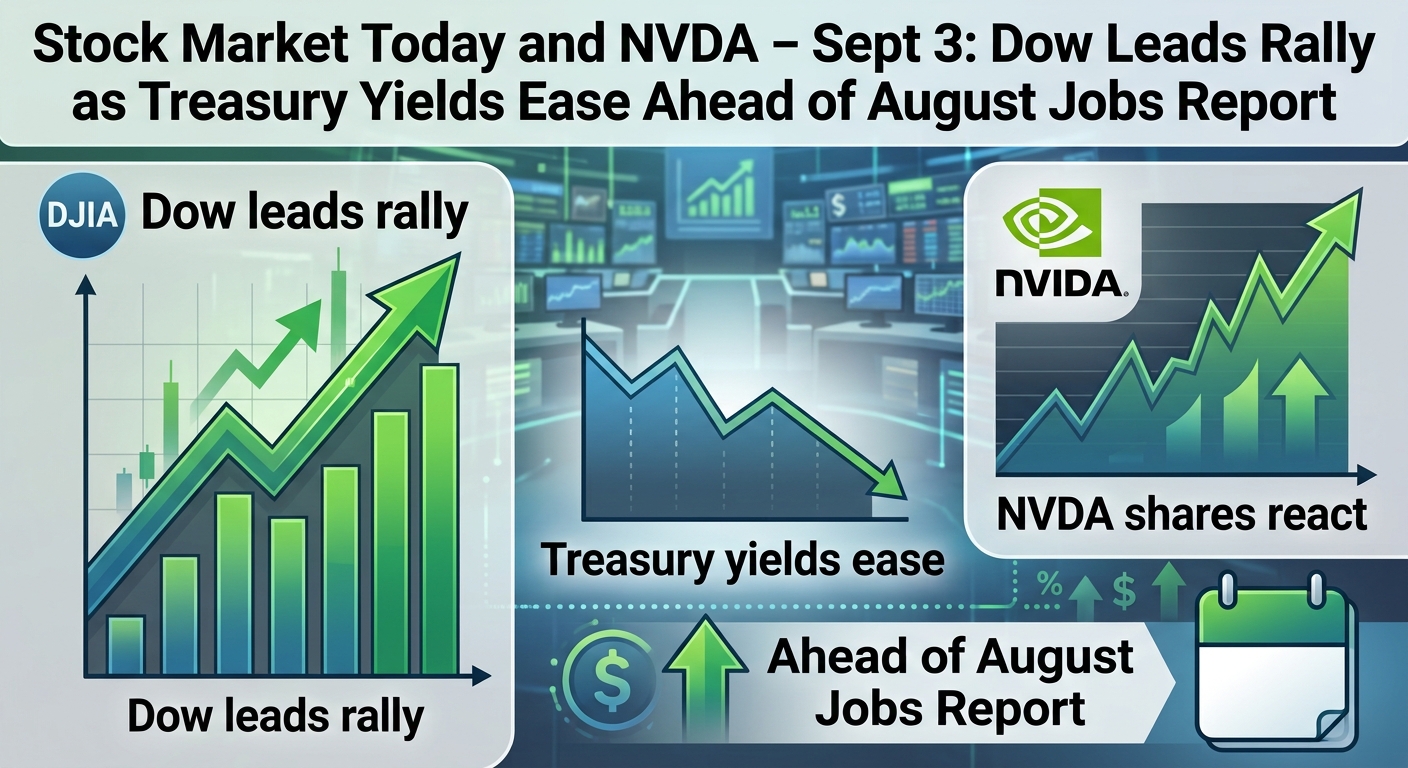
U.S. stocks finished sharply higher Thursday, September 3, 2026, as investors welcomed a pullback in Treasury yields, reassessed the interest-rate outlook, and positioned for Friday’s closely watched August employment report. The rally followed a three-session market decline, though elevated oil prices and Middle East uncertainty remained meaningful macro risks.
U.S. Market Close
| Index / Asset | Close | Daily Change | Daily % Change |
|---|---|---|---|
| S&P 500 | 7,747.71 | +81.11 | +1.06% |
| Dow Jones Industrial Average | 53,686.11 | +624.16 | +1.18% |
| Nasdaq Composite | 26,584.06 | +366.23 | +1.40% |
| Russell 2000 | 2,968.27 | +15.10 | +0.51% |
| Cboe Volatility Index (VIX) | 14.30 | -0.90 | -5.92% |
| Gold | $4,518.10 | +$103.50 | +2.34% |
| Bitcoin (BTC-USD) | $81,498.24 | +$4,120.13 | +5.32% |
| WTI Crude Oil | $91.71 | +$0.70 | +0.77% |
The Dow Jones Industrial Average led the major benchmarks, rising 624.16 points, while the Nasdaq Composite outperformed on a percentage basis with a 1.40% gain. The S&P 500 added 1.06%, signaling a broad return of risk appetite, although the smaller-company Russell 2000 lagged with a more modest 0.51% advance. The sharp drop in the VIX to 14.30 suggested that near-term equity-market stress eased materially during the session. At the same time, gains in gold, Bitcoin, and crude oil showed that investors were not abandoning hedges against inflation, geopolitical uncertainty, or currency-related risk.
What Drove Markets Higher
The central catalyst was relief in the bond market. Treasury yields retreated after moving sharply higher earlier in the week, reducing immediate pressure on equity valuations and interest-rate-sensitive areas of the market. The 10-year Treasury yield fell roughly 4 basis points to 4.74% during Thursday’s session. Many also responded to commentary from Federal Reserve Governor Christopher Waller indicating that underlying price pressures showed signs of improvement. That rhetoric helped reinforce expectations that the Federal Reserve may not need to tighten policy further if inflation continues to cool, even as yields remain elevated by recent standards. Thursday’s rally should be viewed in context: it followed a difficult stretch in which rising yields and renewed U.S.-Iran hostilities had pushed the major averages into a three-day losing streak. The preceding session already showed early signs of stabilization, with the Dow gaining nearly 300 points and the S&P 500 and Nasdaq each rising about 0.5%.
Macroeconomic Report Commentary
Economic data painted a nuanced picture of a labor market that is cooling but not collapsing, an outcome that may be constructive for equities if it helps moderate inflation without derailing growth.
- Initial jobless claims: New claims for unemployment benefits rose to 206,000 for the week ended August 29, slightly above the 205,000 estimate and the prior week’s 203,000 reading. The increase is small, but it supports the view that labor-market momentum has become less overheated.
- Challenger job cuts: U.S. employers announced just under 53,000 layoffs in August, the lowest August total since 2022. Year-to-date layoff announcements were down 41% from 2025, though hiring has remained comparatively restrained, a “low-hire, low-fire” environment.
- Services activity: The final August S&P Global services PMI was expected at 56.8, while the ISM services index was expected at 54.1. Readings above 50 generally indicate expansion, underscoring that the services economy remains in growth mode. The important subcomponents for markets are prices paid, new orders, and employment, because they influence the inflation and Fed-policy outlook.
The message for many is clear: the economy appears resilient enough to support earnings and risk assets, but not so strong that it necessarily requires more restrictive Fed policy. That balance is supportive for stocks, but fragile. Friday’s August payrolls report will determine whether markets extend this rate-relief rally or resume worrying about growth, inflation, or both.
Corporate and Sector Highlights
Artificial intelligence, semiconductors, cloud software, and consumer earnings remained key market narratives.
- NVIDIA (NVDA) rose after announcing plans to acquire open-AI platform Hugging Face for approximately $13 billion, with closing expected in 2027. The move reinforces NVIDIA’s effort to deepen its position across AI infrastructure, development tools, and the open-source AI ecosystem.
- Broadcom (AVGO) delivered quarterly results that exceeded expectations, supported by continued AI-related demand, but shares initially weakened as investors looked for an even larger beat-and-raise profile from one of the market’s most closely watched AI beneficiaries.
- Snowflake (SNOW, $356.47, +16.55%)) remained in focus following an AI-demand-driven earnings narrative, highlighting ongoing investor interest in companies benefiting from enterprise data, cloud migration, and generative-AI workloads.
- Lululemon Athletica (LULU) missed Q2 CY29026 after the market closed and is down -17% in aftermarket trading and DocuSign (DOCU) posted better than expected Q2 CY2026 earnings and is up +7% in the aftermarket.
Oil, Gold and Geopolitical Risk
Despite the equity-market rebound, crude oil remained elevated. West Texas Intermediate crude traded near $91 per barrel after rising sharply over the previous three sessions, while Brent held near the mid-$90s. The move reflects continued concern that renewed conflict involving the U.S. and Iran could disrupt energy flows in and around the Persian Gulf and Strait of Hormuz. Gold’s 2.34% advance to $4,518.10 and Bitcoin’s 5.32% rise to $81,498.24 point to continued demand for alternative stores of value and higher-beta liquidity trades. Although equities rallied, investors were still paying close attention to geopolitical risk, inflation exposure, and the direction of long-term yields.
A Takeaway
Thursday’s session was a convincing risk-on rebound: the Dow surged, the Nasdaq led, volatility fell, and Treasury yields eased. Yet the market’s next move depends heavily on whether Friday’s payrolls report confirms a cooling-but-stable labor market. For many, the near-term framework remains:
- A moderate jobs report could reinforce expectations for a less restrictive Fed and extend the equity rebound.
- An overly strong report, particularly with firm wage growth, could reignite concerns about inflation and higher-for-longer rates.
- A materially weak report could shift attention from inflation risk toward economic-growth risk.
- Persistent crude-oil strength and escalation in the Middle East remain potential sources of renewed inflation pressure and market volatility.
Thursday’s close improved the market’s technical and sentiment backdrop, but the combination of labor data, bond yields, AI-sector earnings expectations, and geopolitics means investors should expect volatility to remain event-driven into the end of the week.
VP Watchlist Updates
Amwell® (NYSE: AMWL)
Amwell® (NYSE: AMWL), a leading provider of a comprehensive SaaS-based software platform for technology-enabled healthcare, closed at $13.25, +3.27%). Amwell® (NYSE: AMWL) announced (Aug. 4) financial results for the second quarter ended June 30, 2026. Dr. Ido Schoenberg, Chairman and CEO of Amwell stated, “The DHA’s intent to make Amwell a prime contractor is a powerful endorsement of our platform and our people. With subscription revenue now approaching half our total revenue, independently validated behavioral clinical outcomes, no debt, and positive cash flows from operations projected for the fourth quarter this year, we have never been better positioned to lead the era of AI-powered care.”
Amwell Second Quarter 2026 Highlights:
- Recorded Total Revenue of $52.0 million at the top end of the previously provided financial guidance range for Q2
- Achieved subscription revenue of $25.7 million
- Recorded Amwell Medical Group (“AMG”) visit revenue of $24.4 million
- Reported gross margin of 53%
- Net loss was ($9.6) million, compared to ($10.3) million in the first quarter of 2026, continuously moving from quarter to quarter in a favorable trajectory
- Adjusted EBITDA of ($1.2) million compared to ($3.1) million in the first quarter of 2026
- Total visits on the platform were 0.8 million.
Financial Outlook
The Company is significantly improving Adjusted EBITDA, reaffirming its AMG visit guidance, and raising the low end of its 2026 revenue outlook:
- Revenue in the range of $200 million to $205 million increased from $195 million to $205 million
- AMG visits between 1.32 million and 1.37 million
- Adjusted EBITDA in the range between ($9) million to ($7) million increased from ($16) million to ($12) million.
The Company also provided financial guidance for Q3 2026 Revenue and adjusted EBITDA:
- Q3 revenue in the range of $46 million to $48 million
- Q3 adjusted EBITDA expected to in the range of ($5) million to ($3) million.
The Company also reiterated its objective to achieve positive cash flow from operations in the fourth quarter of 2026.
Hudson Pacific Properties (NYSE: HPP)
Hudson Pacific Properties (NYSE: HPP, $12.74) is a real estate investment trust serving dynamic tech and media tenants in global epicenters for these synergistic, converging and secular growth industries. Hudson Pacific’s unique and high-barrier tech and media focus leverages a full-service, end-to-end value creation platform forged through deep strategic relationships and niche expertise across identifying, acquiring, transforming and developing properties into world-class amenitized, collaborative and sustainable office and studio space. HPP turned in a quarter ( Aug. 5) that suggests the office malaise is not over, but it may finally be meeting resistance. Revenue came in above Wall Street’s expectations, occupancy moved higher for a fourth straight quarter, and management raised full-year guidance — a combination that does not make for a triumphant victory lap, but it does make for a more credible turnaround narrative. Learn more.
Eupraxia Pharmaceuticals Inc. (EPRX)
Eupraxia Pharmaceuticals Inc. (EPRX, $7.50, +.67%), a clinical-stage biotechnology company leveraging its proprietary Diffusphere™ technology designed to optimize local, controlled drug delivery for applications with significant unmet need, announced (Aug. 13) positive results from a new analysis of the RESOLVE study examining the effect of EP-104GI on symptom severity, including for the first time an analysis of the effect of EP-104GI on odynophagia (pain when swallowing). This is important because odynophagia scoring is a component of Dysphagia Symptom Questionnaire (DSQ), a commonly used patient reported outcome used in pivotal clinical trials in EoE patients.
Modular Medical, Inc. (NASDAQ: MODD)
Modular Medical, Inc. (NASDAQ: MODD, $3.42), a commercial-stage medical device company preparing for the commercial launch of its next-generation Pivot™ tubeless patch pump, announced (September 3) that the U.S. Food & Drug Administration (FDA) has cleared a set of software enhancements to its Pivot insulin delivery system, further expanding the system’s functionality and providing users with greater flexibility and customization options in bolus dosing, an enhanced user-interface (UI), and other software upgrades.
MODD will be co-hosting a Tribe Public’s CEO Presentation and Q&A Webinar Event titled “The Road To Revenue: Modular Medical’s Strategy For Launching Pivot,” which will be held Friday, September 4, 2026 (8:30am PT / 11:30 am ET). Modular Medical, Inc (NASDAQ: MODD) Chief Executive Officer, Jeb Besser, will deliver a presentation titled “The Road To Revenue: Modular Medical’s Strategy For Launching Pivot” and be available for a 5-10 minute Q&A session at the end of the presentation. REGISTER TODAY at: PivotLaunch.TribePublic.com.

MODD announced (Aug. 3) plans to initiate the first phase of commercialization of its Pivot tubeless patch pump across five strategically selected U.S. markets beginning in October 2026. The initial rollout will include Atlanta, Cincinnati/Lexington, Dallas, Houston, and Philadelphia, representing a foundational step in the Company’s capital efficient commercialization strategy with its mission to expand access to simplified insulin delivery solutions for all people living with diabetes.
MODD recently (July 22) announced the formation of its Pivot Innovation Council, a cross-functional group of leading clinicians and healthcare experts established to help guide the company’s clinical and commercial strategy. Diabetes care expert Robert Gabbay, MD, PhD, FACP was appointed as chair of the Pivot Innovation Council. The council will provide insights on target patient populations, support optimization of clinical workflows, inform evidence-generation initiatives, and help refine the Pivot product roadmap and go-to-market approach, as the Company continues to scale its differentiated offering.
Similarweb Ltd. (NYSE: SMWB)
Similarweb Ltd. (NYSE: SMWB) delivered the sort of second-quarter report investors tend to enjoy: revenue and profitability exceeded guidance, full-year expectations moved higher, and AI demand translated into contracts rather than merely conference-call poetry. SMWB closed at $8.89, +1.46%. Learn More.
LG Display Co., Ltd. (LPL)
LG Display Co., Ltd. (NYSE: LPL, $3.25) has spent the last few years doing something many hardware companies talk about but few execute well: turning a technology pivot into a full‑blown business transformation that everyday investors can actually follow. Instead of chasing commoditized LCD TV panels in a race to the bottom, LPL is leaning into Gaming OLED, CES‑worthy innovation, and premium automotive displays – and the press trail tells a surprisingly investor‑friendly story.
Yatsen Group (NYSE: YSG)
Yatsen Group (NYSE: YSG, $2.37), a leading China-based beauty group, delivered the sort of quarter that can make a turnaround investor sit up straighter: reported revenue grew, its strategically important skincare operation accelerated sharply, and the company is increasingly built around clinical and premium brands rather than a pure color-cosmetics play. The results are not yet a victory lap, losses widened and third-quarter guidance is cautious, but YSG’s transformation is beginning to look less like a cosmetic touch-up and more like a genuine renovation.
YSG announced (July 8) a landmark collaboration to bring its flagship brand, Perfect Diary, to Sephora in China. This partnership integrates Yatsen’s rigorous scientific infrastructure with the world’s leading prestige beauty retailer, marking a significant milestone in Yatsen’s continuing evolution into a global beauty technology powerhouse.
Doximity, Inc. (NYSE:DOCS)
Doximity (NYSE: DOCS, $27.10, +2.96%) is the leading digital platform for U.S. medical professionals. The company’s network members include more than 85% of U.S. physicians across all specialties and practice areas. Doximity provides its verified clinical membership with digital tools built for medicine, enabling them to collaborate with colleagues, stay current on medical news and research, manage their careers and on-call schedules, streamline documentation and administrative paperwork, and conduct virtual patient visits.
Doximity, Inc. (NYSE: DOCS) announced (Aug. 6) results of its fiscal 2027 first quarter ended June 30, 2026. Jeff Tangney, co-founder and CEO of Doximity, “We’re proud that our clinical AI assistant, Doximity Ask, was the top-performing U.S.-based model in the NOHARM benchmark while we delivered another quarter of record engagement. In Q1 we had accelerated revenue growth along with workflow active prescriber growth of more than 30% year-over-year and AI Search query growth of over 25% quarter-over-quarter.”
Fiscal 2027 First Quarter Financial Highlights
All comparisons, unless otherwise noted, are to the three months ended June 30, 2025.
- Revenue: Revenue of $156.6 million, versus $145.9 million, an increase of 7% year-over-year.
- Net income and non-GAAP net income: Net income of $24.3 million, versus $53.3 million, representing a margin of 15.5%, versus 36.5%. Non-GAAP net income of $55.0 million, versus $71.9 million, representing a margin of 35.1%, versus 49.2%.
- Adjusted EBITDA: Adjusted EBITDA of $74.8 million, versus $79.8 million, a decrease of 6% year-over-year, representing adjusted EBITDA margins of 47.7%, versus 54.7%.
- Diluted net income per share and non-GAAP diluted net income per share: Diluted net income per share was $0.13, versus $0.27, while non-GAAP diluted net income per share was $0.29, versus $0.36.
- Operating cash flow and free cash flow: Operating cash flow of $42.0 million, versus $62.1 million, a decrease of 32% year-over-year, and free cash flow of $39.6 million, versus $60.1 million, a decrease of 34% year-over-year.
Financial Outlook
Doximity is providing guidance for its fiscal second quarter ending September 30, 2026 as follows:
- Revenue between $170 million and $171 million.
- Adjusted EBITDA between $80.5 million and $81.5 million.
Doximity is updating guidance for its fiscal year ending March 31, 2027 as follows:
- Revenue between $671 million and $681 million.
- Adjusted EBITDA between $309 million and $329 million.
Sable Offshore Corp. (SOC)
Sable Offshore Corp. (NYSE: SOC, $4.72) has moved from the awkward “pre-revenue restoration project” phase into something much more recognizable to Wall Street: a company selling meaningful volumes of oil, generating operating cash flow, and building momentum into a potentially larger 2027 earnings base. The second-quarter report on Monday was not a polished victory lap—midstream bottlenecks and one-time costs made sure of that—but it offered something potentially more valuable: proof that the Santa Ynez Unit restart is translating into barrels, revenue, and operational traction. Learn more.
T1 Energy Inc. (NYSE: TE)
T1 Energy Inc. (NYSE: TE, $4.54, +6.32%) offers a different type of growth story: one rooted in domestic production, trade-policy tailwinds and execution on solar manufacturing capacity. T1 reported second-quarter net sales of $250.1 million, produced 935 megawatts of solar modules at its G1_Dallas facility and generated adjusted EBITDA of $10.7 million. The company also monetized $39.1 million of 2025 Section 45X tax credits and ended the quarter with $156.4 million in cash, cash equivalents and restricted cash, including $79.1 million unrestricted. The headline loss should not be ignored: T1 reported a $36.9 million net loss from continuing operations, while its adjusted EBITDA benefited from $24.4 million in tariff refunds recognized in cost of sales. Yet the more interesting investor question is whether the company is creating a viable U.S. solar-manufacturing platform at a time when supply-chain security and domestic energy capacity carry unusually high strategic value. The company expects its first solar cells from a planned 2.1-gigawatt manufacturing facility in the first quarter of 2027. With 3 gigawatts of firm contracts, a 641-megawatt offtake agreement with Clearway and 2026 output expected toward the upper end of its 3.1-to-4.2-gigawatt range, T1’s story is increasingly about turning production capacity into contracted revenue. For investors, TE is less a conventional earnings multiple story than an execution-and-optionality story. If domestic solar demand remains durable and manufacturing milestones stay on schedule, the market may ultimately value the company less like a troubled commodity producer and more like a strategically positioned industrial platform.
Nvidia (NVDA, $228.45, +1.80%)
NVDA announced plans (Sept. 3) to acquire open-AI platform Hugging Face for approximately $13 billion, with closing expected in 2027. The move reinforces NVIDIA’s effort to deepen its position across AI infrastructure, development tools, and the open-source AI ecosystem. Learn More.
Nvidia once again delivered (Wed., August 26) results that made Wall Street’s estimates look rather conservative. After the bell on Wednesday, NVIDIA, for its fiscal second quarter, the AI-chip leader reported adjusted earnings of $2.22 per share, ahead of the $2.10 consensus forecast, while revenue reached $96.22 billion, comfortably above expectations of $92.17 billion. The performance underscores Nvidia’s central role in the global AI buildout, where demand for its computing hardware continues to turn ambitious data-center plans into exceptionally large purchase orders. In short: the company remains one of the market’s preferred ways to bet on artificial intelligence, and, judging by the numbers, the machines are still very much hungry.
Exodus Movement, Inc. (EXOD, $7.30, +1.96%)
Exodus Movement, Inc. (NYSE American: EXOD) offers investors an increasingly unusual combination: a publicly traded software company positioned at the intersection of crypto adoption, self-custody, consumer finance and digital-asset infrastructure. In a sector accustomed to grand promises and occasionally vanishing balance sheets, Exodus sells a more practical proposition—help users securely manage, swap, stake and spend digital assets without handing over the keys. That model is gaining relevance as cryptocurrency moves beyond the speculative trading screen and toward everyday financial utility. Exodus is not trying to become a bank in a hoodie; it is building the user-friendly front door to a self-custodial digital-asset economy.
The Sources
- Yahoo Finance Stock Market Today: Dow, S&P 500, Nasdaq Rise as Yields Fall and Investors Weigh Middle East Tensions
- CNBC Stock Futures Are Little Changed After Major Averages Snap Three-Day Losing Streaks: Live Updates
- Yahoo Finance Thursday, September 3, 2026 Market and Economic Calendar
- Trading Economics United States Stock Market Index: Quote, Chart and Historical Data
- The Wall Street Journal Stock Market Today: Treasury Yields Retreat on Fed Commentary
- Federal Reserve H.15: Selected Interest Rates, Daily Release
- U.S. Bureau of Labor Statistics September 2026 Schedule of Selected Economic Releases
- Institute for Supply Management Report Release Date Calendar
- Investing.com ISM Services PMI, Jobless Claims and Services PMI Preview
- Trading Economics Gold Price, Chart, Historical Data and News
Disclosure: This market commentary is for informational and educational purposes only and does not constitute investment advice, an offer, or a solicitation to buy or sell securities. Past performance is not indicative of future results.
Stay Updated with Vista Partners
Subscribe to receive market insights, investing ideas, and the latest updates directly in your inbox.