


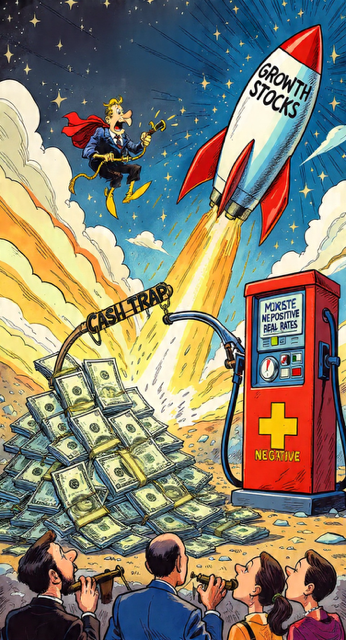
Negative real interest rates, an AI‑driven productivity boom, and a government that may once again lean on “financial repression” could be setting the stage for a multi‑year equity run in select corners of the market. In such a regime, cash may not be the safe harbor many assume; instead, it could become the slow leak in the portfolio, while certain risk assets potentially emerge as unexpected beneficiaries.
If Financial Repression Returns, Savers May Pay the Bill
With U.S. public debt hovering near post‑war levels, policymakers might face a limited menu of options to manage the burden: faster growth, austerity, default, or the gentler path of inflating the debt away. History suggests that after World War II, governments favored the last approach, using a mix of capped nominal yields and steady inflation to gradually reduce debt‑to‑GDP.
If a similar playbook were to return, investors could experience an environment where official rates sit below the inflation rate for prolonged periods, nudging real yields into negative territory. That outcome would not guarantee a repeat of the post‑war experience, but it would rhyme with a regime in which patient savers effectively subsidize sovereign balance sheets.
Negative Real Rates: How Capital Might React
Research on past negative real‑rate episodes indicates that risk assets have often done better than traditional “safe” havens, especially early in the cycle. In several historical cases, emerging markets, U.S. small caps, international equities and growth‑oriented strategies saw stronger average monthly returns than bonds and cash during the initial phase of negative real rates.
This does not mean they must outperform in every future cycle, but it does suggest a behavioral pattern: when investors realize their purchasing power is eroding in cash and conservative fixed income, they tend to reach for assets with higher nominal upside. If a new repression regime takes shape, a similar migration into quality growth and nimble small caps could unfold — though timing, magnitude and winners would likely differ from past episodes.
The AI Productivity Shock: A Potential Disinflationary Shield
Overlaying today’s macro picture is a technological twist that could alter the usual inflation calculus: artificial intelligence. Some former and current policymakers have argued that AI may act as a significant disinflationary force, raising productivity in a way that partially offsets the inflation pressure from running the economy hot.
If that thesis proves even partially correct, AI could give central banks more room to tolerate modestly negative real rates without triggering runaway inflation. For corporations, AI may function as a supply‑side shock, automating expensive processes and allowing firms to protect margins even as input prices fluctuate. For consumers and small businesses, AI tools might become personal deflation engines, helping them find cheaper products, better financing and more efficient ways to work. None of this is guaranteed, but the combination of AI‑driven efficiency and debt‑driven policy incentives could be unusually supportive of select equity themes.
From Cash Trap to Possible Capital Migration
In a world where real yields drift below zero, cash and near‑cash instruments can morph from comfort blankets into slow‑burn liabilities. If inflation modestly outpaces nominal yields, holding large idle balances becomes less a prudent choice and more a pre‑committed real loss.
Should investors come to view this environment as durable rather than temporary, some portion of the trillions parked in money‑market funds and bank deposits could start looking for more productive homes. That shift might not happen overnight, and volatility could be substantial, but history suggests that when the opportunity cost of staying on the sidelines becomes too obvious, capital tends to move — often first into quality growth, then into broader risk.
Where the Next Winners Could Emerge
If this emerging regime does play out — negative or low real rates, AI‑enabled productivity and a long‑horizon push to manage debt through nominal growth — several areas could stand out. U.S. small‑cap and growth equities, along with select international and emerging‑market exposures, have historically shown leverage to early‑cycle liquidity and risk‑on flows. That pattern may or may not repeat, but it offers a useful starting framework.
At the same time, the AI build‑out is already straining infrastructure. High‑end compute, data centers, networking and the software stack that orchestrates it all could remain in structural demand if enterprises and governments continue to pour capital into AI capabilities. Behind the scenes, power generation — particularly reliable baseload and independent producers — may quietly become indispensable partners to hyperscale operators as electricity demand from AI workloads grows. If that dynamic persists, energy providers and AI infrastructure players could form an underappreciated backbone of any future bull market in a repression‑lite world.
A Probabilistic Playbook, Not a Crystal Ball
None of this guarantees a straight‑line bull run, and it certainly does not eliminate the risk of policy error, geopolitical shocks or plain old valuation fatigue. What it does offer is a probabilistic framework: if governments lean on inflation and negative real rates to manage debt, and if AI meaningfully boosts productivity without igniting runaway prices, then a particular mix of assets could be positioned to benefit.
For investors, the task is not to assume this outcome is inevitable, but to weigh it as a serious scenario and decide how much of the portfolio, if any, should be aligned with it. The repression‑plus‑AI regime may or may not fully materialize — but if it does, those who thought in advance about small caps, quality growth, AI infrastructure and power might find themselves on the right side of a very long tape.
The Sources
- Derek Horstmeyer, “Which Investments Do Best When Real Interest Rates Are Negative?” – The Wall Street Journal / George Mason University overview
https://www.gmu.edu/news/2022-05/which-investments-do-best-when-real-interest-rates-are-negative - Derek Horstmeyer, “WSJ: What Do Negative Real Interest Rates Do to Your Portfolio?” – extended discussion
https://www.linkedin.com/pulse/wsj-what-do-negative-real-interest-rates-your-derek-horstmeyer - Channelchek, “Asset Classes that Perform Best and Worst with Negative Real Interest Rates” – summary of Horstmeyer’s findings
https://www.channelchek.com/news-channel/asset_classes_that_perform_best_and_worst_with_negative_real_interest_rates - Research Shorts, “WSJ: What Do Negative Real Interest Rates Do to Your Portfolio?” – data breakdown by cycle halves
https://researchshorts.com/wsj-what-do-negative-real-interest-rates-do-to-your-portfolio-3c8f63f94688 - Carmen Reinhart & M. Belen Sbrancia, “Financial Repression Redux” – IMF Finance & Development
https://www.imf.org/external/pubs/ft/fandd/2011/06/reinhart.htm - VoxEU / CEPR, “Financial Repression: Then and Now” – historical perspective on post‑war debt reduction
https://cepr.org/voxeu/columns/financial-repression-then-and-now - World Economic Forum, “What Is Financial Repression – and Should Countries Embrace It as a Tool to Manage Debt?”
https://www.weforum.org/stories/2025/03/financial-repression-debt-management - Deutsche Bundesbank Research Brief, “Financial Repression as an ‘Easy Way’ Out of Debt?”
https://www.bundesbank.de/en/publications/research/research-brief/2024-70-financial-repression-765512 - BlackRock, “Financial Repression Past and Future” – thematic note
https://www.blackrock.com/institutions/en-us/insights/thought-leadership/fiscal-repression - Derek Horstmeyer, “If Interest Rates Are Peaking, What Investments Are Likely to Do Best?” – small‑cap and growth angle
https://business.gmu.edu/news/2023-11/if-interest-rates-are-peaking-what-investments-are-likely-do-best - Ben Carlson, “Is the Small Cap Premium Dead?” – long‑run small‑cap vs. large‑cap performance
https://awealthofcommonsense.com/2024/06/is-the-small-cap-premium-dead - CFA Institute / Enterprising Investor, “Small Caps vs. Large Caps: The Cycle That’s About to Turn”
https://rpc.cfainstitute.org/blogs/enterprising-investor/2025/small-caps-vs-large-caps-the-cycle-thats-about-to-turn - Kenneth Rogoff et al., “The Real Interest Rate Decline in Long Historical Perspective” – NBER summary
https://www.nber.org/digest/202212/real-interest-rate-decline-long-historical-perspective - Reuters, “Kevin Warsh Has a Point on AI and Inflation” – AI as a disinflationary force
https://www.reuters.com/commentary/breakingviews/kevin-warsh-has-point-ai-inflation-2026-03-04 - Cato Institute, “Kevin Warsh Is Right About Fed Reform — but His Inflation Solution Is a Trap” – critique but good Warsh quotes
https://www.cato.org/commentary/kevin-warsh-right-about-fed-reform-inflation-solution-trap - Brookings, “Machines of Mind: How Generative AI Will Power the Coming Productivity Boom”
https://www.brookings.edu/articles/machines-of-mind-how-generative-ai-will-power-the-coming-productivity-boom - Vanguard, “AI’s Impact on Productivity and the Workforce”
https://corporate.vanguard.com/content/corporatesite/us/en/corp/articles/ai-impact-productivity-and-workforce.html - Penn Wharton Budget Model, “The Projected Impact of Generative AI on Future Productivity Growth”
https://budgetmodel.wharton.upenn.edu/p/2025-09-08-the-projected-impact-of-generative-ai-on-future-productivity-growth - Reuters, “Central Banks Have a Real Rate Problem” – current context for real rates
https://www.reuters.com/commentary/reuters-open-interest/central-banks-have-real-rate-problem-2026-05-18 - Federal Reserve, “FOMC Minutes – April 29–30, 2026” – policy stance and rate path
https://www.federalreserve.gov/monetarypolicy/fomcminutes20260429.htm
Stay Updated with Vista Partners
Subscribe to receive market insights, investing ideas, and the latest updates directly in your inbox.
From Drive-Thru Screens to Digital Clinics, Data Is Becoming the New Storefront -( $AMWL $AMZN $MCD $SMWB $WMT