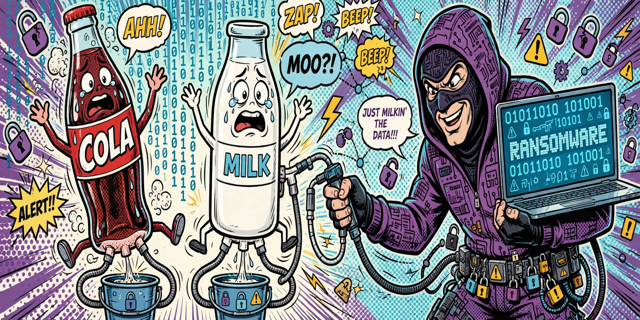
Wall Street just got a reminder that in 2026, “moat” now means firewalls, backups, and incident response plans as much as pricing power and brand equity. In a week where dairy tanks went quiet and industrial control systems hummed nervously, the investing thesis is increasingly simple: cyber risk is now a core factor in cash flows, valuations, and national security.
When Ransomware Meets a Billion-Dollar Brand
The Coca-Cola Company (NYSE: KO) disclosed that its wholly owned dairy unit, fairlife, LLC, temporarily suspended U.S. production after a ransomware event led to unauthorized access to portions of its systems, including production-related systems. Product quality and safety reportedly remain intact, but U.S. operations are offline while Canada continues to churn out ultra-filtered milk as usual—an oddly modern version of “the plant across the border is fine.”In a filing, Coca-Cola acknowledged it has not yet determined whether the incident is “reasonably likely to materially affect” the company, a phrase that reads like legalese but should sound to investors like “watch this space for margin noise and working-capital friction.” Historically, ransomware events in food and beverage have translated into weeks-long production disruptions, logistics snarls, and the kind of empty shelves consumers notice—and analysts model.
Cyber Risk: From IT Line Item to Core Investment Theme
Huntress data suggests approximately 600 million cyberattacks occur worldwide each day, with 54% of surveyed U.S. organizations reporting a malware incident and 44% suffering phishing or spearphishing over a recent 12‑month period. Financial gain is the primary suspected motive, followed by data theft—ironically making corporate networks one of the most reliable “growth markets” in the world. The most common attack modalities—malware (including ransomware), phishing and social engineering, network‑level assaults such as DDoS, and credential‑based attacks like stuffing and spraying—now read like a standard risk factors list in SEC filings. For boards and CIOs, the pivot is clear: cyber defense has migrated from “insurance policy” status to capital allocation priority, influencing where incremental dollars go between capex, buybacks, and dividends.
Iran, Industrial Systems, and the New Geopolitical Beta
Federal advisories and media reporting point to Iran‑linked threat actors escalating cyber operations against U.S. critical infrastructure, with successful disruptions at multiple oil, gas, and water sites that in some cases forced facilities back to manual operations. These campaigns often target internet‑accessible programmable logic controllers and SCADA displays, the digital nerve centers that quietly keep water clean and energy flowing. U.S. agencies have warned that the objective is explicitly to generate “disruptive effects within the United States,” a description that should make any portfolio manager mentally translate “operational interruption” into “EPS volatility” and “higher risk premia for exposed sectors.” For investors, state‑linked cyber activity adds a new dimension of geopolitical beta, where exposure isn’t just to oil prices or sanctions but to the resilience—or fragility—of industrial software stacks.
The Investor Lens: Winners, Losers, and Pricing Cyber Resilience
For consumer staples names like KO, near‑term questions will focus on revenue impact from suspended fairlife production, cost inflation from remediation, and any acceleration in cyber‑capex and insurance spend. Longer term, the market will increasingly differentiate between companies that treat cyber as an operational discipline versus a PR exercise, rewarding those with visible investments in detection, response, backups, segmentation, and third‑party risk management. On the other side of the trade, cybersecurity vendors—especially those in managed endpoint detection and response (EDR), identity protection, industrial control security, and incident‑response services—are benefiting from a secular tailwind, as organizations scramble to address threats ranging from ransomware to AI‑powered phishing and deepfake social engineering. The fairlife incident is likely to be another slide in the boardroom deck that pushes budgets toward managed EDR, multi‑factor authentication, industrial network monitoring, and cyber insurance, all of which translate into multi‑year revenue visibility for sector leaders.
From “Black Swan” to Base Case: Positioning Portfolios
The Huntress taxonomy of 36 common attack types—from ransomware and infostealers to supply‑chain compromises and watering‑hole attacks—underscores that cyber incidents are no longer rare, idiosyncratic shocks but part of the base case operating environment. Most attacks still begin with a vulnerability: unpatched software, weak authentication, human error, or poor network segmentation, which means that cyber “alpha” for corporates is largely earned through mundane, repeatable best practices rather than shiny silver bullets.
For investors, practical portfolio implications include:
- Favoring companies with transparent cyber governance, regular disclosure, and tested business continuity plans, especially in consumer staples, healthcare, financials, and industrials.
- Treating repeat or opaque cyber incidents as a governance red flag that can justify valuation discounts or tighter risk limits.
- Leaning into cybersecurity and infrastructure‑protection names as structural beneficiaries of both criminal and nation‑state activity, while remaining selective on valuation given intense competition and rapid technology cycles.
The fairlife ransomware episode won’t be the last time an everyday product vanishes from U.S. shelves because someone, somewhere, clicked the wrong link or left a system exposed. The investable takeaway is straightforward: in an era where Iran‑linked actors can nudge industrial sites offline and criminal groups can pause a billion‑dollar dairy brand, cyber resilience isn’t just an IT concern—it’s a core pillar of any credible investment narrative.
The Sources
[1] US warns of Iran-affiliated cyber-attacks on critical infrastructure across country https://www.theguardian.com/world/2026/apr/07/iran-cyberattacks-infrastructure
[2] Coca-Cola says fairlife halts US production after cyber attack https://www.reuters.com/business/coca-cola-says-fairlife-halts-us-production-after-cyber-attack-2026-07-16/
[3] Iran-linked hackers have disrupted multiple US industrial sites https://www.cnn.com/2026/04/07/politics/iran-linked-hackers-disrupt-us-industrial-sites
[4] Coca-Cola suspends U.S. production of billion-dollar brand after cyberattack https://www.ajc.com/business/2026/07/coca-cola-suspends-us-production-of-billion-dollar-brand-after-cyberattack/
[5] Coca-Cola suspended production at its Fairlife dairy after a ransomware attack https://finance.yahoo.com/technology/articles/coca-cola-suspended-production-fairlife-212231500.html
[6] The Coca-Cola Company Announces Technology Disruption … https://investors.coca-colacompany.com/news-events/press-releases/detail/1166/the-coca-cola-company-announces-technology-disruption-involving-fairlife-operations
[7] Coca-Cola Halts fairlife U.S. Production After Cyber Incident https://www.morningstar.com/news/dow-jones/202607169162/coca-cola-halts-fairlife-us-production-after-cyber-incident-update
[8] Iranian hackers’ targeting of US critical infrastructure has … https://www.reuters.com/world/middle-east/iranian-hackers-targeting-us-critical-infrastructure-has-escalated-since-start-2026-04-07/
[9] The Iranian Cyber Threat to U.S. Critical Infrastructure https://www.csis.org/analysis/iranian-cyber-threat-us-critical-infrastructure
[10] 10 Major Cyberattacks And Data Breaches In 2026 (So Far) – CRN https://www.crn.com/news/security/2026/10-major-cyberattacks-and-data-breaches-in-2026-so-far
[11] Iranian Cyber Actors May Target Vulnerable US Networks and … https://www.cisa.gov/sites/default/files/2025-06/joint-fact-sheet-Iranian-cyber-actors-may-target-vulnerable-US-networks-and-entities-of-interest-508c-1.pdf
[12] Top 10 Most Dangerous Cyber Attacks of 2026 (Explained & Visualized) https://www.youtube.com/watch?v=7ZEb80DRmqw
[13] Top 10 Common Cyber Attacks in 2026 and How to Prevent … https://factosecure.com/top-10-common-cyber-attacks-in-2026-and-how-to-prevent-them/
[14] 9. Code Injection Attacks https://cybersecuritynews.com/cyber-attacks-2026/
[15] Coca-Cola’s fairlife Pauses U.S. Production https://www.stocktitan.net/news/KO/the-coca-cola-company-announces-technology-disruption-involving-xrheubwqimy1.html
Stay Updated with Vista Partners
Subscribe to receive market insights, investing ideas, and the latest updates directly in your inbox.