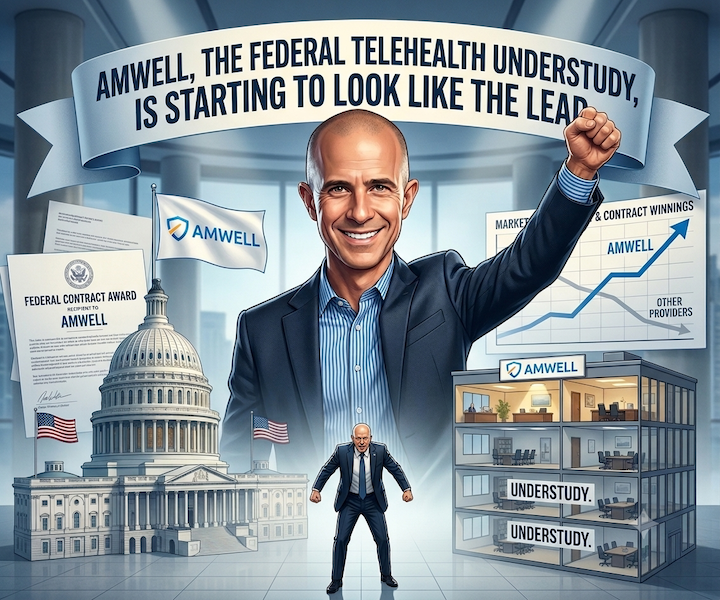
Amwell (NYSE: AMWL) is trying to do something rare in healthcare technology: become more interesting by becoming less dramatic. After years of telehealth hype, backlash, and normalization, the company’s latest setup suggests a business leaning into discipline, enterprise relevance, and just enough growth to keep investors from looking for the remote control.
A better kind of telehealth story
The basic shape of the Amwell thesis is improving. Management has guided to 2026 revenue of $195 million to $205 million, with second-quarter revenue expected in the $48 million to $52 million range, and has said it expects positive cash flow from operations in the fourth quarter of 2026. That is not a fireworks forecast, but it does point to a company becoming easier to underwrite. And in telehealth, easier to underwrite is often the first step toward easier to own. The market has already moved from pandemic exuberance to a more adult conversation about utilization, reimbursement, and operating discipline.
The government piece is real
What gives Amwell additional texture is its work with the U.S. government. Through a partnership with Leidos, the company has been helping power the Defense Health Agency’s Digital First initiative for the Military Health System, which serves approximately 9.6 million beneficiaries. That matters because this is not a pilot project dressed up in press-release language. It is a large federal healthcare ecosystem where security, reliability, and workflow integration are the ticket to entry. Amwell’s platform has already been deployed across the global Department of Defense enterprise, as well as to the U.S. Military Entrance Processing Command and the U.S. Coast Guard.
Why investors should care
Government business does more than add color to the slide deck. It validates the platform in a highly regulated environment, supports the enterprise credibility narrative, and gives Amwell exposure to a customer base with meaningful scale and recurring needs. There is also an important renewal and expansion angle. The company has already secured an extension of its Digital First contract, and management has indicated that previously excluded behavioral health and automated care programs were well received and could be added back in a future contract cycle if budget conditions improve. In other words, the federal relationship is not just alive; it has room to broaden if the politics and the pricing line up. That is the kind of optionality Wall Street likes, even if it prefers to pretend it discovered it later.
The backdrop still helps
The broader telehealth market remains constructive, with industry estimates pointing to continued growth in digital care adoption. That does not mean every telehealth company wins. It does mean the category is still relevant enough that disciplined operators can build durable franchises if they pair product usefulness with operational restraint. Amwell is increasingly trying to position itself in that camp. The market may no longer reward telehealth for existing, but it may still reward telehealth companies that prove they can serve payers, providers, and government systems without burning through capital like it is an untaxed subsidy.
Leadership

Amwell is currently led by sole CEO Ido Schoenberg, who has been at the helm of the telehealth company since his brother and former co-CEO, Roy Schoenberg, transitioned to the board and later took on a role at Amazon (AMZN). Ido Schoenberg serves as the Chairman and CEO of Amwell and oversees the company’s corporate strategy. Since co-founding the company in 2006, with Roy Schoenberg, Ido has led its strategic direction, growing Amwell to become one of the largest digital care enablement companies in the world. Ido has a lengthy track record of successfully leading technology companies in the healthcare field. In 1996, together with Phyllis Gotlib, he co-founded iMDSoft, a provider of enterprise software that automates hospital critical care units. He grew the company into a market leader with a large multi-national install base in the U.S., Europe, and East Asia. In 2001, Ido joined CareKey Inc. as Chief Executive Officer and took the company through its acquisition by the TriZetto group. Ido served as TriZetto’s Chief Business Strategy Officer until his departure in the summer of 2006. Ido received his MD from the Sackler School of Medicine.
The bottom line
Amwell’s investment case is becoming more coherent. The company has a clearer path toward cash flow, a meaningful federal healthcare footprint, and a telehealth market that remains structurally alive. That combination does not guarantee a re-rating, but it does make the stock easier to underwrite than it was when telehealth itself had to do all the heavy lifting. In short, AMWL is no longer just asking investors to believe in virtual care. It is asking them to believe in execution, enterprise scale, and a government relationship that can renew, expand, and potentially deepen over time — which, in Washington and on Wall Street, is a fairly respectable way to earn attention.
The Sources
- Amwell® Announces Results for the Second Quarter 2026
- Amwell® to report second quarter 2026 operating results
- Amwell wins military health contract extension
- Amwell set to continue to enable U.S. Defense Health Agency healthcare teams to deliver connected and seamless in-person and virtual care for the Military Health System
- U.S. Defense Health Agency selects Amwell and Leidos
- Amwell scores major deal with Defense Health Agency, but posts $629M loss in 2023
- Amwell: Your Partner in Care Delivery
- American Well – Multiples.vc – Public Comps and Valuation Multiples
- Telehealth Services in the US Industry Analysis, 2026
- Telehealth Market (2026 – 2033)
Stay Updated with Vista Partners
Subscribe to receive market insights, investing ideas, and the latest updates directly in your inbox.