


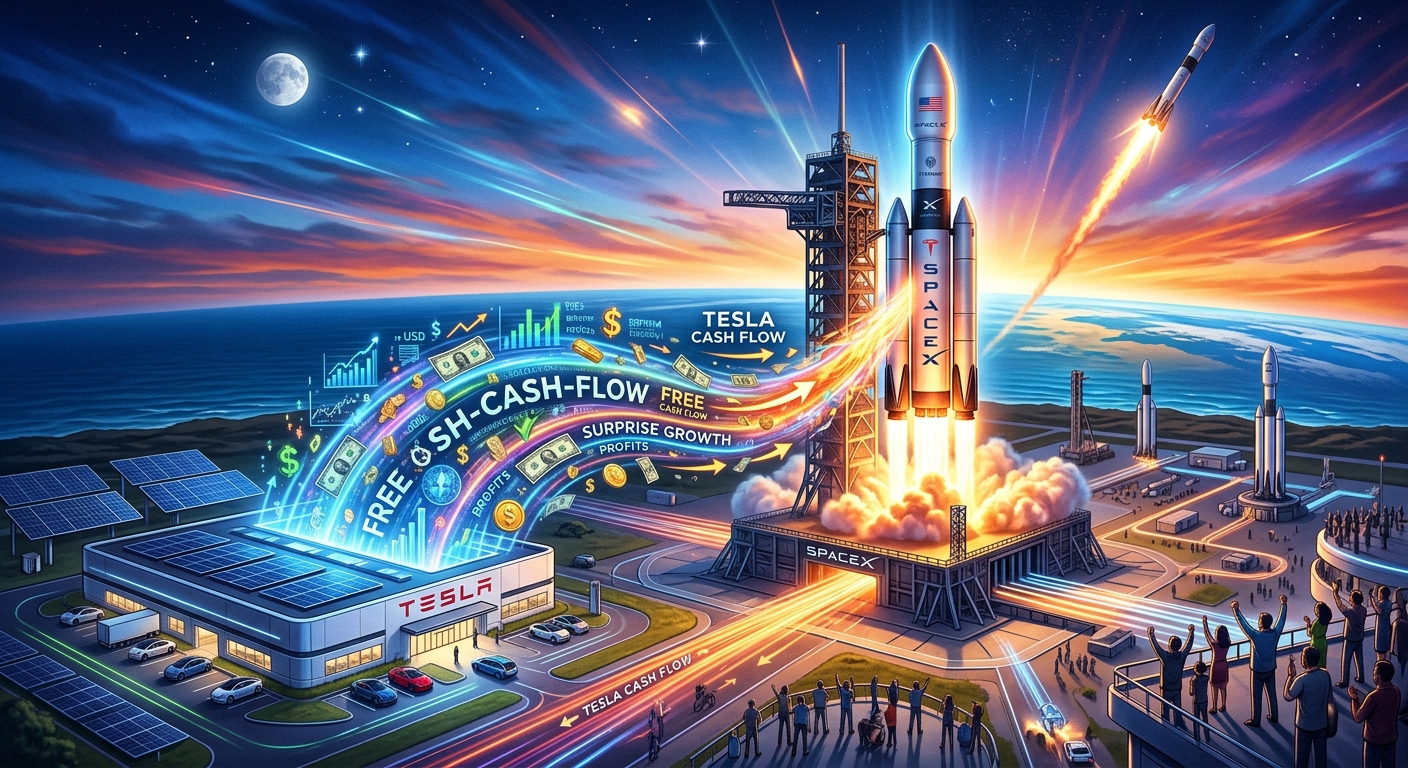
Better-than-expected earnings, positive free cash flow and formal merger discussions give investors more than another Elon Musk headline to consider.
Tesla (TSLA) has given investors something more useful than a spectacular promise: a quarter that generated cash when Wall Street expected it to consume billions. Alongside that financial surprise, SpaceX (SPCX) has delivered a sharp revenue increase and confirmed that independent committees are exploring a combination of the two companies. The result is a more substantive bullish narrative, built on operating results as well as strategic possibility. The investment case rests on execution. Tesla’s improving cash performance provides breathing room for its artificial intelligence, robotics and autonomous-driving ambitions. SpaceX’s expanding communications and AI businesses offer a potential strategic counterpart. A merger remains uncertain, but many no longer have to rely entirely on speculation to explain why the companies might fit together. For once, the balance sheet has arrived at the party before the robot.
Tesla’s Q3 Earnings: The Cash Surprise Matters Most
Tesla reported third-quarter 2026 revenue of $28.05 billion and adjusted earnings of 48 cents per share. Against the Bloomberg consensus cited by Yahoo Finance, adjusted earnings exceeded the 44-cent forecast, while revenue narrowly missed the $28.13 billion estimate. Adjusted EBITDA reached $3.90 billion, ahead of the expected $3.66 billion. Revenue deserves a qualification. Different analyst surveys produced different benchmarks: Reuters cited an LSEG estimate of $27.88 billion, making the same reported revenue a modest beat. The cleaner conclusion is that Tesla exceeded adjusted earnings expectations while revenue remained approximately flat, rather than that it delivered a sweeping sales breakout. The more consequential surprise came below the income statement:
- Free cash flow reached $1.53 billion, compared with an expected outflow of $4.92 billion.
- Capital expenditures totaled $4.732 billion, versus an estimated $7.96 billion.
- Vehicle deliveries reached 486,532, above the Bloomberg consensus of approximately 463,000.[finance.yahoo]
That represents roughly a $6.45 billion improvement over the cited free-cash-flow expectation. It does not mean Tesla’s cash generation suddenly became stronger than a year earlier. Free cash flow declined 62% year over year, according to CNBC. It means the quarter was considerably less financially demanding than investors had prepared for. That distinction matters. A company pursuing several expensive technological frontiers benefits when its existing operations help finance the journey.
Lower Spending Buys Time, Not a Free Pass
The bullish interpretation of Tesla’s spending performance is straightforward: the company preserved more financial flexibility than anticipated while continuing to advance major projects. The cautious interpretation is equally important. One quarter of lower-than-expected capital expenditure does not establish that the full investment program will cost less. Tesla has guided to more than $25 billion in capital spending for 2026, supporting AI computing, Optimus production, Cybercab development and the Terafab semiconductor initiative with SpaceX. Investors still need to distinguish durable capital efficiency from spending that simply moves into a later quarter. Nor did the adjusted earnings beat erase pressure on reported profitability. Axios reported that net income fell 43% to $787 million. The quarter therefore supports a bullish argument about resilience and investment capacity, not a claim that every financial measure has turned upward. Wall Street can appreciate ambition. It generally appreciates ambition more when the checking account participates.
Optimus, FSD and Energy Broaden the Tesla Investment Case
Tesla’s opportunity extends beyond selling more vehicles, although the automotive business remains essential to funding and validating that broader strategy. The company said initial Optimus production had begun at its Fremont factory and described its current manufacturing process as suitable for a commercial product, while acknowledging that hardware and manufacturing would continue to evolve. That is a manufacturing milestone, not proof of profitable mass adoption. Still, it moves the discussion beyond demonstration videos toward production capability. Tesla also reported 1.74 million active Full Self-Driving subscriptions. That subscriber base gives investors a measurable indicator of customer adoption, even though subscriptions alone do not establish fully autonomous capability or future robotaxi economics. Energy storage offers another tangible operating measure. Third-quarter deployments reached 13.7 gigawatt-hours, compared with 12.5 gigawatt-hours a year earlier and 13.5 gigawatt-hours in the preceding quarter. The figures show expanding deployment volume, although many should not confuse that growth with an automatic improvement in revenue or profitability. The strongest bullish framing is therefore not that Tesla has already completed its transformation. It is that investors have several distinct milestones to evaluate, rather than a single wager on vehicle demand.
SpaceX Brings Its Own Earnings Momentum
SpaceX is entering the merger discussion with substantial operating momentum of its own. The company reported third-quarter revenue of $14.6 billion, up 161%, and quarterly profit of $4.4 billion, according to Associated Press reporting carried by 6abc. Growth in satellite communications and artificial intelligence helped underpin the result. Yahoo Finance reported that AI now accounts for nearly half of SpaceX’s revenue. That business mix changes the strategic conversation: a potential combination would connect more than an electric-vehicle manufacturer and a launch provider. It would bring together businesses pursuing AI computing, communications infrastructure, robotics, transportation and energy systems. Many responded positively to SpaceX’s results and merger commentary, sending its shares approximately 8% higher in extended trading, Reuters reported. Yahoo Finance subsequently described a sharp opening advance that separated SpaceX from a much weaker recent performance among newer space stocks. The enthusiasm has an expensive companion. SpaceX’s planned fourth-quarter capital expenditure of $35 billion to $40 billion underscores how much funding its ambitions require. Yahoo Finance also cited a $63 billion backlog, but backlog is not cash available for immediate spending..
Why a Tesla-SpaceX Merger Could Make Strategic Sense
The industrial logic is more compelling than the novelty of placing rockets and robotaxis beneath one corporate roof. A Reuters explainer identified several potential connections:
- Starlink could provide communications links for autonomous systems and future Optimus robots.
- Tesla’s batteries and energy-storage products could help support SpaceX’s growing power requirements.
- Terafab already provides a shared semiconductor and AI-computing initiative tied to both companies’ ambitions.
These are potential operating connections, not disclosed merger synergies with agreed financial targets. Neither company has presented transaction terms or a quantified integration plan in the cited reporting. Nevertheless, the strategic thesis is understandable. AI systems require computing capacity and power. Connected machines require communications. Robotics requires manufacturing expertise. A combined organization could attempt to coordinate those capabilities more closely. The operative word is “could.” Corporate scale does not automatically produce better returns, and a compelling industrial diagram is not a substitute for an attractive exchange ratio.
What Musk Actually Said About the Merger
In the WSJ News video, Elon Musk said both companies had formed special committees of independent directors to consider a potential transaction at shareholders’ request. He said his conflicts prevented him from participating in those committee discussions. Asked whether a merger would be a good idea, Musk answered, “Yes.” He also explicitly rejected the suggestion that a transaction was certain. The committees had not agreed on terms, and there was no guarantee they would do so. Musk further said the Tesla side would require support representing 50% of all shares, not merely the shares voted. CNBC separately reported that description of the voting hurdle. Investors should treat it as Musk’s stated requirement, rather than a substitute for the definitive legal and voting provisions of any eventual proposal. The distinction is critical: formal discussions are a development worth valuing, but they are not a signed agreement.
The Terms Must Work for Shareholders
A transaction could consolidate Musk’s interests in rockets, electric vehicles and artificial intelligence into a business worth well over $3 trillion, according to The New York Times. At that scale, the central question is not whether the combination would attract attention. It is whether shareholders would receive an attractive economic bargain. Any proposal would need to be judged on ownership allocation, dilution, governance, capital requirements and credible operating benefits. Reuters reported that discussions could result in SpaceX acquiring Tesla, citing a person familiar with the matter, but no agreed structure has been announced. A strategically appealing combination can still be a poor investment at the wrong price. Many should reserve their applause for the terms, not merely the seating arrangement.
The Case Does Not Require a Merger
The most durable investment argument starts with the businesses already operating. Tesla generated positive free cash flow, exceeded adjusted earnings expectations and reported progress in robotics, software subscriptions and energy-storage deployments. SpaceX delivered rapid revenue growth and substantial quarterly profit. Those developments give many operating evidence to assess independently of a deal. Risks remain substantial. Tesla faces automotive demand pressure and regulatory scrutiny of Cybercab, including questions from the National Highway Traffic Safety Administration about its compliance with federal safety standards. Both companies are pursuing capital-intensive expansion, and merger discussions may end without an agreement. The bullish opportunity is that improving execution could support the companies’ ambitions before any corporate combination occurs. A well-structured merger might strengthen that opportunity. It should not be asked to manufacture it. For many, that is a more attractive proposition than buying a rumor and hoping the accountants eventually discover a business underneath.
The Sources
- Yahoo Finance: Tesla reports Q3 earnings beat, positive free cash flow, and better-than-expected capex
- Reuters: Musk says SpaceX-Tesla merger is “a good idea” as companies form deal committees
- Associated Press via 6abc: Elon Musk’s SpaceX reports 161% increase in revenue as he hints at possible merger with Tesla
- Reuters via U.S. News & World Report: Explainer: Why Would Musk Merge SpaceX and Tesla?
- Reuters: Tesla posts surprise positive cash flow on lower-than-expected AI spending
- Yahoo Finance: Tesla beats Q3 estimates as services surge
- CNBC: Tesla Q3 2026 earnings report
- Axios: Tesla revenue flat as Elon Musk eyes possible SpaceX deal
- InvestingLive: Tesla Q3 earnings beat as margins and cash flow surprise, revenue narrowly misses
- Yahoo Finance: SpaceX’s record opening gap leaves the space-stock rout behind, here are the levels bulls need to hold
- WSJ News via YouTube: Musk Says SpaceX and Tesla Formed Committees to Discuss Potential Merger
- CNBC: Musk says Tesla and SpaceX formed special committees to discuss merger
- The New York Times: Elon Musk Says SpaceX and Tesla Are Exploring a Merger
Stay Updated with Vista Partners
Subscribe to receive market insights, investing ideas, and the latest updates directly in your inbox.

