Thursday, October 22, 2026 | U.S. Market Close
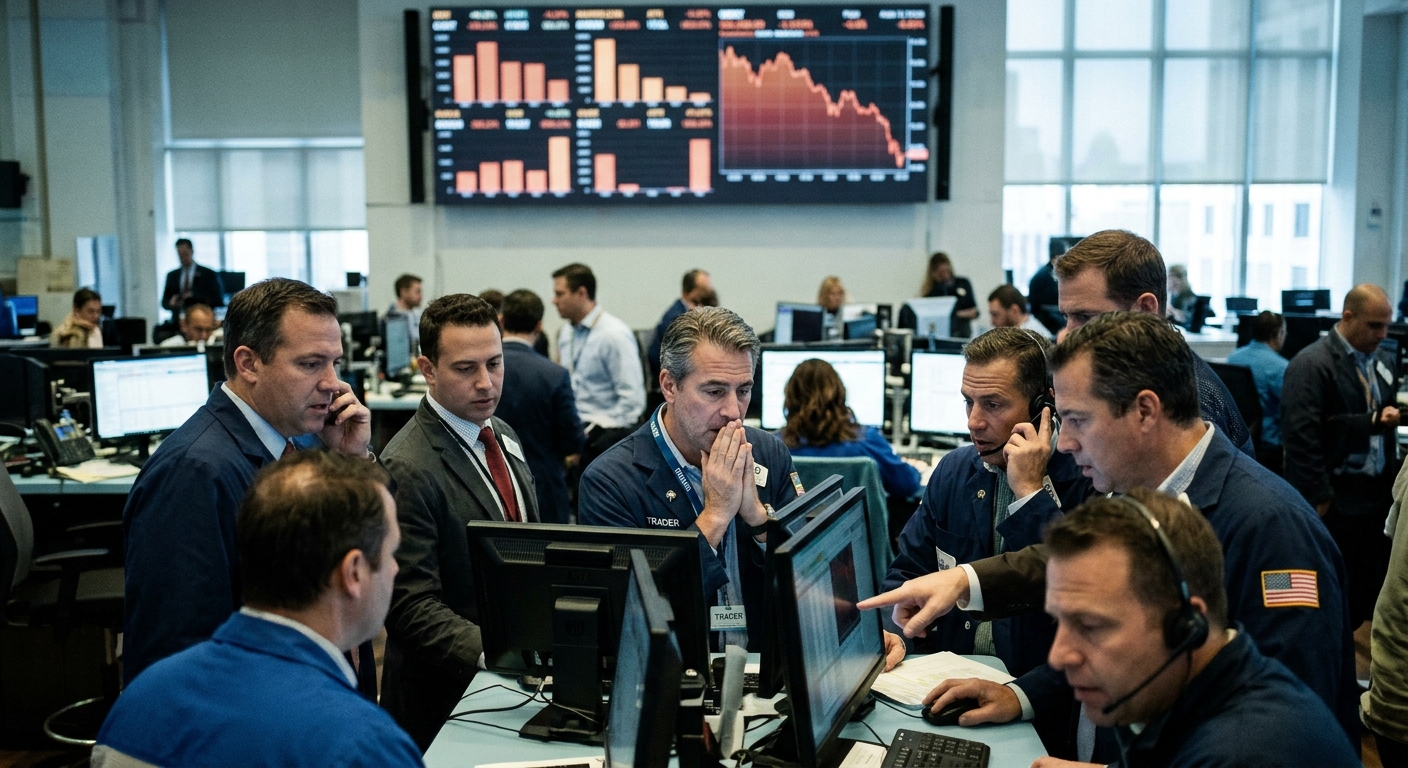
U.S. stocks finished sharply divided Thursday as concerns about artificial intelligence spending, semiconductor supply constraints and rising oil prices weighed on technology shares. The Nasdaq Composite dropped 2.60% and the S&P 500 lost 1.21%, while the Dow Jones Industrial Average and Russell 2000 managed modest gains. The session looked less like a wholesale retreat from equities than a reassessment of the AI trade’s financing costs and earnings expectations. Many sought protection in Treasuries while parts of the market outside technology held their ground, leaving Wall Street enthusiastic about AI’s possibilities but increasingly interested in who pays the invoice.
Closing Market Performance
| Index | Closing level | Point change | Daily performance |
|---|---|---|---|
| S&P 500 | 7,663.43 | -93.74 | -1.21% |
| Dow Jones Industrial Average | 52,867.98 | +11.89 | +0.02% |
| Nasdaq Composite | 26,008.86 | -694.00 | -2.60% |
| Russell 2000 | 2,784.03 | +3.01 | +0.11% |
The contrast between the Nasdaq’s decline and the resilience of the Dow and Russell suggested investors were distinguishing expensive AI exposure from the broader economy. Lower Treasury yields provided some support for rate-sensitive shares, even as technology valuations came under pressure.
AI Spending Faces Scrutiny
Meta Platforms (NASDAQ: META) became a focal point of the debate after reporting third-quarter revenue of $64.60 billion, up 26% from a year earlier. The company narrowed its 2026 capital-expenditure outlook to $135 billion to $145 billion, raising the lower end from $130 billion while leaving the upper end unchanged. Its earnings release also showed quarterly capital expenditures of $34.91 billion and negative free cash flow of $2.12 billion. Those figures illustrate the central valuation question: strong revenue growth can coexist with substantial near-term cash demands. Meta Platforms (NASDAQ: META) also approved a new nonvoting Class C share structure, with a planned one-for-one stock dividend that would have the pricing effect of a two-for-one split. This is a future corporate action, not a split that took effect Thursday. Bill Ackman supplied the bullish counterargument in his CNBC interview, defending Meta Platforms (NASDAQ: META) as undervalued and emphasizing its financial strength. His position highlights the distinction between a difficult trading session and a deteriorating long-term business, although his assessment remains an investment opinion rather than a guaranteed outcome.
Semiconductor Constraints Add Pressure
Lam Research (NASDAQ: LRCX) reported September-quarter revenue of $8.22 billion and non-GAAP earnings of $2.20 per share. Its December-quarter revenue outlook called for $8.6 billion, plus or minus $400 million, despite management identifying near-term supply constraints. The earnings beat did not prevent a sharp share-price decline, underscoring how demanding semiconductor expectations have become. The market’s concern extended beyond current demand to whether equipment availability, financing and customer spending can sustain the anticipated pace of expansion. This distinction matters for the AI investment cycle: supply constraints can delay recognized revenue without necessarily signaling that demand has disappeared. At the same time, many cannot treat strong demand as equivalent to immediate cash flow, particularly when the infrastructure supporting that demand requires substantial financing.
Tesla’s Robotics Reality Check
Tesla (NASDAQ: TSLA) reported adjusted quarterly earnings of $0.48 per share on revenue of $28.05 billion, but many remained focused on its spending plans and the commercialization timetable for new businesses. The company reduced its annual capital-expenditure forecast while continuing to pursue robotics and autonomous transportation. Elon Musk’s discussion of Optimus emphasized the need for robots to learn through repeated real-world practice rather than relying on an existing training-data advantage comparable with the vehicle fleet. External business deliveries are expected toward the end of 2027, making the timetable a management expectation rather than an established revenue stream. For many, the practical issue is the gap between an attractive technological opportunity and a scalable, profitable product. Thursday’s reaction suggested that patience for that gap is becoming more sensitive to spending levels and execution milestones.
Macroeconomic Report: Employment Holds Up
The day’s principal economic release offered reassurance about layoffs, but a less decisive signal about hiring. Initial unemployment claims fell by 6,000 to a seasonally adjusted 194,000 for the week ended October 17, below the 200,000 expected by economists surveyed by Reuters.
| Economic indicator | Latest reading | Interpretation |
|---|---|---|
| Initial jobless claims | 194,000, down 6,000 | Layoffs remain limited. |
| Four-week claims average | 197,750 | The underlying layoff trend remains subdued. |
| Continuing claims | 1.728 million, up 25,000 | Workers receiving benefits may still face challenges finding another position. |
The combination supports a low-hire, low-fire interpretation rather than an unqualified employment boom. Employers appear reluctant to shed existing workers, but low initial claims alone do not establish that hiring is accelerating broadly. Macroeconomic commentary: This is an uncomfortable mix for monetary policy. Employment stability reduces the urgency for economic support, while persistent energy-price pressure complicates the inflation outlook; neither condition makes a simple case for easier financial conditions.
Bonds Rally, Oil Climbs
The 10-year Treasury yield moved lower to 4.953%, down 0.193 percentage point, or 19.3 basis points. Treasuries attracted protection-seeking investors even as oil prices increased, suggesting that concerns about risk assets outweighed the immediate inflation implications of the energy rally. Falling government yields should not automatically be interpreted as cheaper financing for every AI company, since corporate credit spreads and lender risk appetite also matter. Oil’s message extended beyond the current session. Many also examined increases in contracts for delivery next year, highlighting the possibility that energy costs remain elevated longer than previously anticipated. nMacroeconomic commentary: Prolonged expensive oil would create a more difficult backdrop than a brief price spike. Higher energy costs can squeeze household purchasing power and business margins, while making inflation’s return toward target less straightforward.
Cross-Asset Market Readings
| Asset | Screenshot reading | Displayed change |
|---|---|---|
| 10-year Treasury yield | 4.953% | -19.3 basis points |
| Cboe Volatility Index | 19.03 | +2.35, or +14.09% |
| Gold | $4,038.80 | -$111.20, or -2.68% |
| Bitcoin | $81,216.56 | -$3,396.48, or -4.01% |
| Crude oil, December 2026 | $99.06 | +$1.91, or +1.97% |
The simultaneous declines in gold and Bitcoin also showed why “safe haven” is not a universal description of every asset sometimes marketed as an alternative to stocks. In this session, Treasuries offered a clearer expression of demand for protection.
Moderna Reprices Clinical Expectations
Moderna (NASDAQ: MRNA) plunged more than 25% during afternoon trading after the apparent early disclosure of melanoma-study data involving its personalized cancer treatment with Merck (NYSE: MRK). That percentage describes an intraday reading, not a verified closing return. Reports pointed to a 42% reduction in the relative risk of recurrence or death for the combination with Keytruda versus Keytruda alone. The earlier study’s reported 49% reduction came from a different trial, so the figures should not be treated as a direct head-to-head comparison or evidence that the later study failed. The investment lesson is that favorable clinical findings and favorable stock performance are not interchangeable. A company’s valuation can already anticipate results strong enough that an apparently positive disclosure still triggers disappointment.
Musk’s Investment And Election Stakes
CNBC reported that Musk invested approximately $1 billion in Skydance (NYSE: SKYD), citing a person familiar with the transaction. The report placed the investment within the media company’s broader effort to raise equity while integrating its businesses and reducing costs. Separately, reporting on Musk’s approximately $366 million in political spending highlighted the importance of the midterm elections to his business interests. That figure covers the election cycle beginning in January 2025, not spending undertaken Thursday alone. For Tesla (NASDAQ: TSLA) and SpaceX (NASDAQ: SPCX), the relevant investor considerations include regulation, government procurement and oversight. Those are material policy exposures, but they should not be presented as proven causes of a particular day’s share-price movement.
What Many Are Watching
The next test is whether technology earnings can demonstrate cash generation and credible spending discipline alongside growth. Treasury yields below 5% may offer some valuation relief, but Thursday’s trading showed that lower government borrowing costs alone cannot resolve concerns about AI financing and investment returns. Many also face the Federal Reserve’s October 27–28 meeting, with the policy decision scheduled for October 28. The combination of limited layoffs, uneven hiring and elevated energy costs makes the central bank’s interpretation of inflation and growth especially important.
Today’s VP Watchlist Corporate Updates
Amwell® (NYSE: AMWL)
Amwell® (NYSE: AMWL), a leading provider of a comprehensive SaaS-based software platform for technology-enabled healthcare, closed at $14.19, +1.57%.
AMWL announced (Sept 8) announced the Department of Veterans Affairs (VA) has declared its intent for the Company to deploy its virtual health platform within the VA enterprise and help power the modernization of the VA’s digital health infrastructure. The VA anticipates the Amwell platform will support a broad range of clinical services, enhance care coordination, and improve access for our Veterans across the VA enterprise. The Letter of Intent follows a comprehensive evaluation process by the VA, in which it determined that Amwell’s virtual health platform aligns with the Department’s strategic objectives to expand access to high-quality, secure, and reliable virtual care services for Veterans nationwide through the VA’s current electronic health record modernization efforts. Specifically, the capabilities Amwell demonstrated in scalable video consultations, interoperability, cybersecurity compliance, and support for integrated care delivery were significant factors in this determination.
Amwell® has received Frost & Sullivan’s 2026 United States Technology Innovation Leadership Recognition in the Technology-Enabled Care Platforms Industry. The recognition validates Amwell’s ability to address healthcare fragmentation through a unified platform that orchestrates consumer experiences, clinician workflows, care programs, and partner solutions.
The Company also reiterated recently its objective to achieve positive cash flow from operations in the fourth quarter of 2026.
Serina Therapeutics (NYSE: SER)
Serina Theraeuptics (NYSE: SER, $1.76) is a clinical-stage biotechnology company developing a pipeline of wholly owned drug product candidates to treat neurological diseases and other indications. Serina’s POZ PlatformTM provides the potential to improve the integrated efficacy and safety profile of multiple modalities including small molecules, RNA-based therapeutics and antibody-based drug conjugates (ADCs). Serina is headquartered in Huntsville, Alabama on the campus of the HudsonAlpha Institute of Biotechnology.
On Thursday, September 24, 2026, Serina CEO Steve Ledger discussed discuss Serina’s programs’ progress during Tribe Public’s “A New Approach to Advanced Parkinson’s Disease: Serina Discusses SER-252’s Clinical Progress”webinar, followed by a live Q&A. You may view it below.
SER announced (Sept. 9) that the independent Safety Monitoring Committee (SMC) has completed its blinded review of Cohort 1 of the ongoing Phase 1b registrational study of SER-252 in patients with advanced Parkinson’s disease and recommended that the study advance to Cohort 2. Cohort 1 evaluated the lowest dose level in the single-ascending-dose portion of the study. In addition to supporting continued dose escalation, blinded Cohort 1 observations showed a pharmacokinetic profile consistent with the sustained apomorphine exposure SER-252 is designed to provide and included sustained periods of improvement in motor function in individual patients on exploratory clinical measures.
Eupraxia Pharmaceuticals Inc. (EPRX)
Eupraxia Pharmaceuticals Inc. (EPRX, $7.59), a clinical-stage biotechnology company leveraging its proprietary Diffusphere™ technology designed to optimize local, controlled drug delivery for applications with significant unmet need, announced (Oct. 15) that the ongoing RESOLVE study evaluating the safety and efficacy of EP-104GI for the treatment of Eosinophilic Esophagitis (“EoE”) has reached its enrollment target. “This is a significant milestone for the RESOLVE trial and the development of EP-104GI as a potential treatment option in EoE” said Dr. James Helliwell, Chief Executive Officer of Eupraxia. “We look forward to our interim analysis in December where we will be reporting on symptoms, histologic findings and safety in the first 60 patients in Phase 2b to reach 6 months. Data will also be available on the patients at 3, 9- and 12-month timepoints giving a fulsome interim look at the RESOLVE Trial”.
Modular Medical, Inc. (NASDAQ: MODD)
Modular Medical, Inc. (NASDAQ: MODD, $1.91), a commercial-stage medical device company preparing for the full commercial launch of its next-generation Pivot™ tubeless patch pump, announced (October 15) the launch of two innovative digital education resources designed to assist people living with diabetes build familiarity and confidence with insulin therapy ahead of formal training on the Pivot insulin delivery system. Developed in partnership with Relevate Health Games, the new tools use game-based technology to walk patients through the skills needed for insulin pump therapy. The resources are designed to help reduce barriers to adoption by allowing prospective users to become familiar with pump therapy before beginning formal onboarding. The first educational module gives users a virtual, hands-on walkthrough of the Pivot insulin delivery system. In approximately 15 minutes, users can visualize how to unpack the system, prepare and apply the pump, and understand the basic operational functions. The Pivot module was first previewed at the ADCES 2025 Annual Conference in August 2025. Healthcare providers may also use the platform to gauge a patient’s interest in pump therapy and ability to navigate basic operational tasks associated with insulin delivery devices. The experience offers clinicians valuable insight into patient engagement, learning readiness, and willingness to transition from multiple daily injections to a more advanced insulin delivery approach.
MODD announced (September 4) that it has secured a contract with a national U.S. pharmacy benefit manager (PBM) in the United States. Pursuant to the contract, the Company’s Pivot insulin delivery system is now available through the national PBM. The Company believes the engagement with this national PBM represents a significant step forward in broadening patient access to the Company’s Pivot tubeless patch pump and will further validate the Pivot pump as an accessible therapeutic option for people living with diabetes.
MODD announced (September 3) that the U.S. Food & Drug Administration (FDA) has cleared a set of software enhancements to its Pivot insulin delivery system, further expanding the system’s functionality and providing users with greater flexibility and customization options in bolus dosing, an enhanced user-interface (UI), and other software upgrades.
MODD CEO, Jeb Besser, co-hosted a Tribe Public’s CEO Presentation and Q&A Webinar Event titled “The Road To Revenue: Modular Medical’s Strategy For Launching Pivot,” that was held Friday, September 4, 2026.. You may watch the event video below now if you missed it below now.
Doximity, Inc. (NYSE:DOCS)
Doximity (NYSE: DOCS, $33.68, +.30%) is the leading digital platform for U.S. medical professionals. The company’s network members include more than 85% of U.S. physicians across all specialties and practice areas. Doximity provides its verified clinical membership with digital tools built for medicine, enabling them to collaborate with colleagues, stay current on medical news and research, manage their careers and on-call schedules, streamline documentation and administrative paperwork, and conduct virtual patient visits.
Doximity and Wolters Kluwer Health, announced (Oct. 20) that UpToDate’s trusted, evidence-based, clinical content will be accessible directly within Doximity’s fast-growing AI clinical decision support tool, Ask.
DOCS announced (Oct. 13) it has extended its 13-year partnership with U.S. News & World Report, the nation’s most trusted source of independent healthcare information, rankings and guidance to help patients identify the best care for their needs.
Nvidia (NVDA, $212.21, -4.40%)
NVIDIA Corp. (NASDAQ: NVDA), at its GTC event in Berlin on Wednesday, the company unveiled its DSX POD, a reference design for an AI data center packed into a box about the size of a standard shipping container. According to Nvidia, the Vera Rubin-powered DSX PODs will arrive on site, ready to be plugged into the power, cooling, and networking infrastructure, reducing deployment time from six months to 14 days. The company said DSX PODs won’t replace traditional data centers, but will serve as a means to start running AI applications before brick-and-mortar facilities are ready.
The Sources
- CNBC: Stock Market Closing Coverage for October 22, 2026
- Yahoo Finance: October 22 Market Coverage, Technology Shares and AI Spending Concerns
- Meta Platforms (META): Third-Quarter 2026 Financial Results
- CNBC: Bill Ackman Discusses Meta Platforms (META) and Markets
- Yahoo Finance: Chip Stocks Fall as Lam Research (LRCX) Cites Supply Chain Constraints
- Yahoo Finance: Lam Research (LRCX) Reports Results for the Quarter Ended September 27, 2026
- Yahoo Finance: Tesla (TSLA) CEO Elon Musk Discusses Optimus Robot Training
- Reuters via Yahoo Finance: U.S. Weekly Jobless Claims Near 57-Year Lows
- CNBC: Treasury Yields Retreat as Investors Seek Safety
- Yahoo Finance: Rising 2027 Oil Futures and the Outlook for Energy Prices
- Yahoo Finance: Moderna (MRNA) Shares Decline Following Early Melanoma Trial Data Disclosure
- CNBC: Elon Musk’s Investment in Skydance (SKYD)
- CNBC: Election Stakes for Tesla (TSLA), SpaceX (SPCX) and Elon Musk
- Federal Reserve: FOMC Meeting Calendars and Policy Information
Stay Updated with Vista Partners
Subscribe to receive market insights, investing ideas, and the latest updates directly in your inbox.