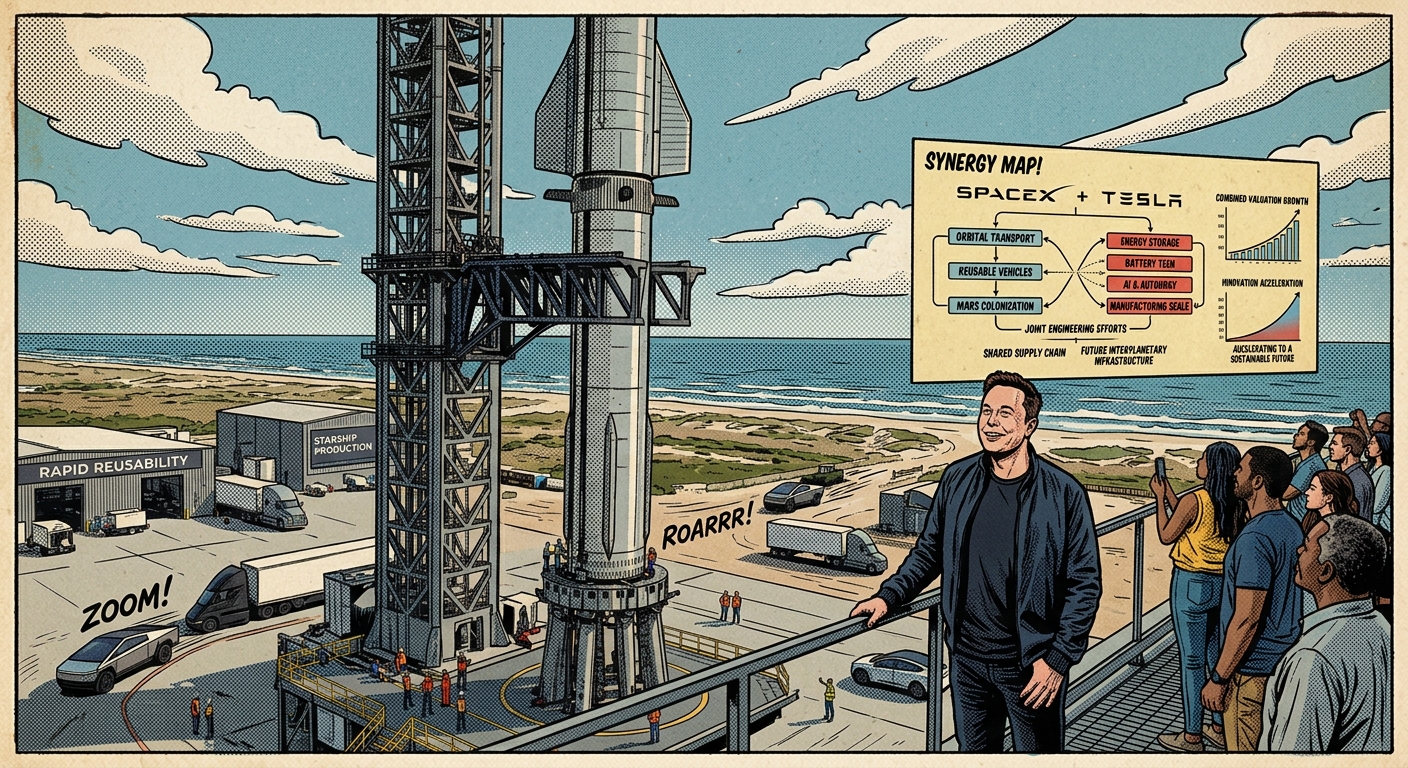
A Rocket Comes Home, and the Business Case Gets Bigger
SpaceX (NASDAQ: SPCX) has given many a compelling reason to look beyond the launchpad and toward the income statement. On November 14, the company caught its Starship upper stage with the launch tower’s giant mechanical arms after an orbital mission that deployed 26 next-generation Starlink satellites. The recovery marked a major advance toward a fully reusable launch system, potentially strengthening SpaceX’s position in both space transportation and satellite broadband. Rockets have traditionally been expensive one-way tickets. SpaceX is working on the return policy. The achievement arrives at a consequential moment. Elon Musk’s ambition to combine SpaceX with Tesla (NASDAQ: TSLA) has moved beyond an occasional thought experiment. Bloomberg reported on November 12 that merger negotiations were progressing and that an announcement could come as soon as December, citing people familiar with the matter. That is a reported possibility, not a completed transaction. The bullish connection is straightforward: Starship could make the infrastructure behind SpaceX’s businesses more economical, while a Tesla combination could place a broader collection of manufacturing, energy and artificial-intelligence capabilities under one roof. Those are separate propositions. The first just received an unusually dramatic demonstration.
What Starship Flight 15 Actually Accomplished
The distinction that matters is what SpaceX recovered. Starship consists of the Super Heavy booster and the Starship spacecraft above it. SpaceX had previously caught boosters. This milestone involved catching the upper stage after it returned from orbit, a substantially different challenge involving atmospheric reentry and a precisely controlled approach to the tower. In the supplied broadcast above, SpaceX’s team identified the vehicle as Ship 42 and confirmed that all 26 Starlink V3 satellites had been deployed, were communicating and were beginning to raise their orbits. The celebration was exuberant, but the payload update was arguably the most commercially important sentence in the room. There is an important qualification: the booster catch was aborted. Flight 15 therefore did not demonstrate recovery of both stages on the same mission, much less routine, low-cost reuse of the complete system. What it demonstrated was a critical capability needed to get there. That distinction strengthens the analysis rather than weakening it. A successful catch is evidence of engineering progress. Rapid turnaround, repeated flights and attractive operating costs remain the next tests. Many do not need to pretend the finish line has been crossed to recognize that a significant obstacle has been cleared.
Why Starship Reusability Could Change Launch Economics
The central promise of Starship is not simply that it is large. It is that its expensive hardware is designed to return, fly again and spread manufacturing costs across multiple missions. SpaceX describes both Starship and Super Heavy as designed to return to the launch site for tower catches, with the eventual objective of rapid turnaround without refurbishment. That remains a design ambition, not an operating standard established by one recovery. The economic logic is nevertheless powerful. If SpaceX can repeatedly recover the vehicle, limit inspection and repair costs, and shorten the interval between flights, it could reduce the effective cost of delivering each kilogram to orbit. The catch matters because upper-stage recovery addresses hardware that conventional launch systems generally do not bring home for reuse. SpaceX’s registration statement frames Starship’s expected performance, launch cadence, reusability and cost efficiencies as important to its future development, while also identifying the risks associated with achieving them. The opportunity and the execution burden are inseparable. The next commercially meaningful question is therefore not whether the tower can catch a ship. It is how often the company can repeat the maneuver and what the ship needs before flying again. The applause was immediate. The maintenance bill will provide the more revealing review.
Starlink Gives Starship Something More Valuable Than Applause
Starship’s advantage is particularly interesting because SpaceX does not have to wait for an entirely new customer category to justify using it. It already operates Starlink. According to SpaceX’s Flight 15 mission materials, each Starlink V3 satellite is designed to add approximately one terabit per second of capacity. The company says a deployment of 26 represents approximately the capacity added by 10 Falcon 9 launches carrying Starlink V2 Mini satellites. That comparison concerns network capacity, not an assertion that Starship already costs one-tenth as much to operate. SpaceX’s SEC-filed third-quarter earnings release makes a similar comparison for Flight 14, which delivered 26 V3 satellites and represented approximately 10 times the downlink capacity of a Falcon 9 Starlink launch. This creates a potentially attractive cycle:
- Starship deploys larger, more capable satellites.
- Those satellites expand Starlink’s available network capacity.
- Additional capacity can support subscriber growth and commercial services.
- Recurring connectivity revenue can help support further infrastructure development.
SpaceX’s third-quarter Form 10-Q explains the underlying structure: the Space business supplies launch capabilities, while Connectivity generates revenue from Starlink services and terminal sales. It also notes that substantial launch capacity is allocated internally to Connectivity. That last point deserves attention. An internal satellite deployment should not be mistaken for an equivalent amount of third-party launch revenue. Its economic value emerges through the services the deployed infrastructure can subsequently support. SpaceX is not merely transporting cargo. It is building the network that sells the connection.
The Financial Foundation Is Already Substantial
The Starship story would be easier to dismiss as a distant engineering wager if the surrounding businesses were not already producing substantial revenue. SpaceX reported third-quarter 2026 revenue of $14.6 billion, up 161% from a year earlier, and income from operations of $2.8 billion. Those are consolidated results across its businesses, not revenue or profit attributable to Starship alone. The connectivity figures provide a more direct link to the launch milestone:
- Starlink ended the quarter with 13.6 million consumer subscribers, compared with 7.2 million a year earlier.
- Consumer monthly average revenue per user reached $69, up from $66 in the second quarter.
- Connectivity income from operations increased 99% year over year to $2.4 billion.
- More than 3,800 aircraft were equipped with Starlink at quarter-end.
The progression matters. SpaceX had reported 12 million Starlink subscribers at the end of the second quarter. Its second-quarter Form 10-Q attributed connectivity growth to an expanding consumer, enterprise and government customer base. Together, these figures make Starship’s capacity expansion more tangible. The company is adding infrastructure to a network with demonstrated demand, rather than launching capacity and hoping a business model eventually answers the phone. More capacity does not guarantee higher margins. Pricing, utilization, satellite replacement costs and capital spending still matter. But the existence of a sizable recurring-revenue business gives the engineering program a commercial context that many ambitious space projects lack.
Elon Musk’s Tesla Combination Has a Strategic Logic
Musk’s wish to unite SpaceX and Tesla is best understood as an attempt to consolidate overlapping industrial and AI ambitions, rather than simply attach a rocket company to an automobile manufacturer. Bloomberg’s reporting describes advancing negotiations over a combination of the two companies. Its subsequent analysis identifies potential synergies across expensive initiatives including robotics and orbital data centers.There are already documented business relationships. Tesla’s amended 2025 annual report states that it recognized approximately $143.3 million of revenue from SpaceX in 2025, primarily from vehicle sales, and incurred approximately $11.4 million of expenses under commercial, licensing and support agreements with SpaceX. Those transactions establish existing commercial ties, not proof that a merger would create equivalent incremental value. The same filing describes Tesla’s expansion in energy storage and its development of AI-related capabilities. It also confirms that xAI Holdings became a SpaceX subsidiary in February 2026, illustrating that SpaceX’s corporate scope already extends beyond rockets and satellite broadband. The potential strategic fit is therefore broader than cars meeting spacecraft:
- Tesla brings manufacturing experience, energy-storage capabilities and physical-AI development.
- SpaceX brings launch infrastructure, satellite connectivity and an expanding AI business.
- A combination could, in principle, coordinate capital spending, engineering resources and infrastructure development across those activities.
That is a plausible industrial thesis. It is not yet a quantified merger-synergy forecast. A corporate umbrella can coordinate businesses. It cannot repeal the need for each project to earn an adequate return.
Why Starship Could Make the Merger Discussion More Interesting
The Starship catch does not establish that a Tesla merger is necessary. SpaceX can benefit from better launch economics without changing its corporate structure. What the milestone does is make SpaceX’s underlying capabilities more consequential. Its third-quarter filing describes three operating segments: Space, Connectivity and Super Intelligence. The launch business supports the satellite network today, and the company expects to allocate substantial launch capacity to its AI-related activities in the future. That gives Starship a role beyond selling rides to external customers. It could become infrastructure supporting multiple businesses inside the same organization. The capital requirements are equally consequential. Bloomberg reported that SpaceX intends to develop computing facilities in Arizona and Texas involving $74 billion of planned spending. Those projects underscore both the scale of the opportunity and the need to distinguish ambitious investment plans from realized returns. For many, the strongest argument for a combination is not simply that Musk runs both companies. It is that energy, manufacturing, connectivity and computing may increasingly need to be developed together. The strongest counterargument is equally practical: shareholders need evidence that combining ownership creates more value than cooperation already can. Any proposed exchange ratio, governance structure and allocation of capital would matter enormously. A spectacular rocket recovery should not serve as a substitute for reading the transaction documents.
The Next Catalysts Are Measurable
The bullish case now has a clearer set of checkpoints. First, SpaceX needs repeated upper-stage recoveries. One success establishes capability; a series establishes consistency. Second, it needs to demonstrate economical reflight. Inspection requirements, heat-shield durability, refurbishment expense and turnaround time will determine how much value recovery actually creates. Third, Starlink needs to convert added capacity into productive service. Subscriber growth, enterprise adoption and the economics of serving those customers will reveal whether greater launch capability is translating into stronger financial performance. Finally, Starship must continue advancing capabilities beyond Earth-orbit deployment. SpaceX’s lunar architecture relies on orbital propellant depots and tanker vehicles, making in-space refilling a separate and essential development challenge. Catching a spacecraft is not the same as completing that architecture. These are not reasons to discount the achievement. They are the milestones that could turn a celebrated demonstration into a durable operating advantage.
A Bigger Business Case, Delivered Back to the Tower
The most persuasive bullish interpretation of Starship Flight 15 is not that space transportation has suddenly become cheap or routine. It is that SpaceX has demonstrated another capability required to make it so, while deploying infrastructure for a connectivity business that already serves millions of customers. That combination is what gives the milestone financial significance: engineering progress linked to an existing commercial engine. A Tesla combination could expand the strategic canvas, but it remains a separate transaction question with its own valuation and governance tests. The standalone SpaceX thesis does not require a merger announcement to make the catch meaningful. For decades, the defining image of a rocket business was a vehicle disappearing into the sky. SpaceX’s more interesting proposition is what happens when the expensive part comes back.
The Sources
- SpaceX: Starship Flight 15 mission overview, satellite capacity and recovery objectives
- Supplied video: Ship 42 tower catch and SpaceX team commentary
- Bloomberg Opinion: “The US Needs Musk and SpaceX, for Better and Worse,” November 15, 2026
- SpaceX: Starship vehicle architecture and reusability objectives
- SEC.gov: Space Exploration Technologies Corp., Form S-1
- SEC.gov: SpaceX third-quarter 2026 earnings release
- SEC.gov: SpaceX Form 10-Q for the quarter ended September 30, 2026
- SEC.gov: SpaceX second-quarter 2026 earnings release
- SEC.gov: SpaceX Form 10-Q for the quarter ended June 30, 2026
- Bloomberg: “SpaceX and Tesla Talks on Record Merger Are Said to Progress,” November 12, 2026
- SEC.gov: Tesla amended 2025 annual report, including SpaceX transactions and related-company relationships
- Bloomberg: “SpaceX’s S&P 500 Bid Gets New Life as Musk Pitches Tesla Merger,” November 14, 2026
- Bloomberg: “SpaceX Plans $74 Billion Computing Centers in Arizona, Texas,” November 12, 2026
- SpaceX: Mission Moon, Human Landing System and in-space refilling architecture
Stay Updated with Vista Partners
Subscribe to receive market insights, investing ideas, and the latest updates directly in your inbox.