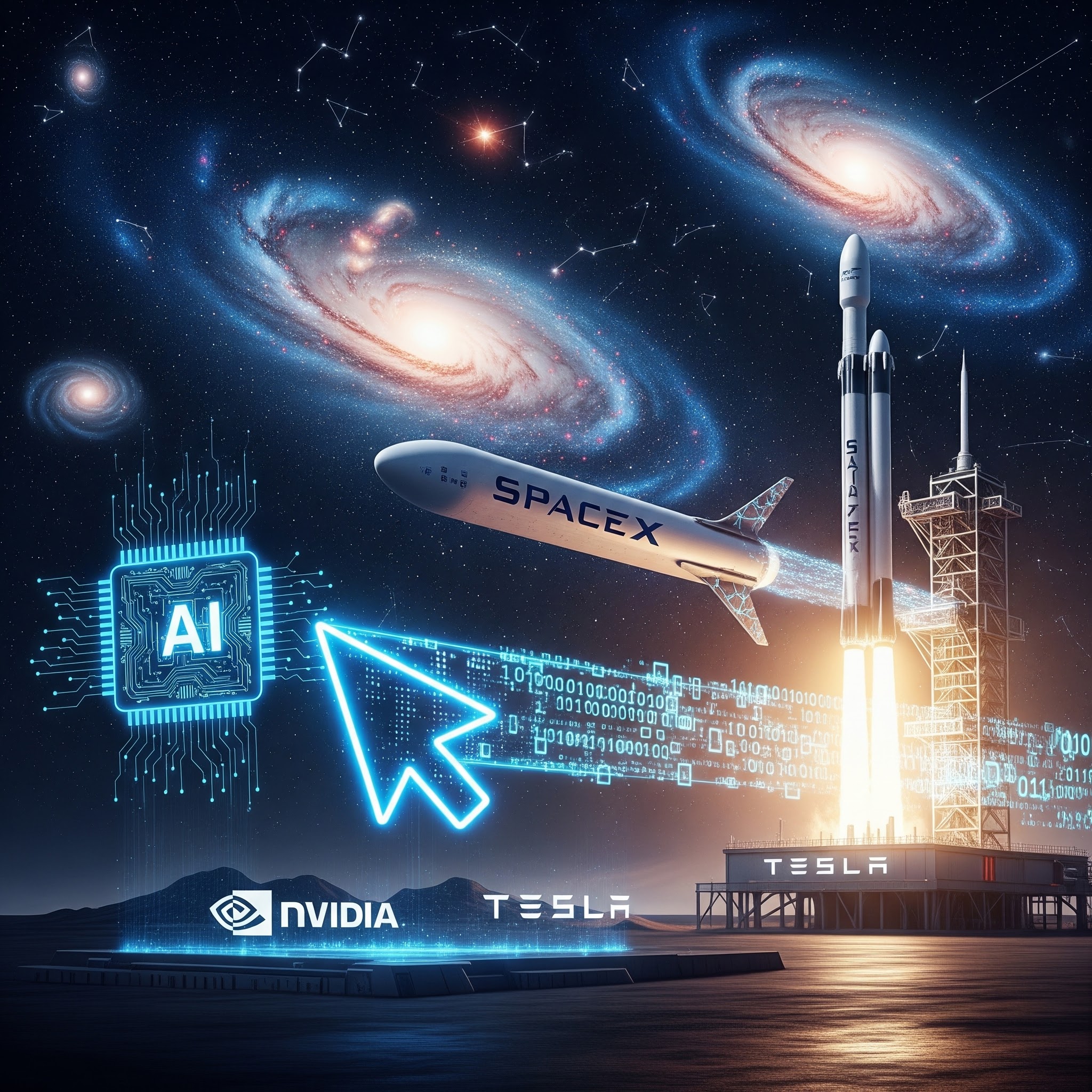
SpaceX (SPCX) is quietly rewriting the script for “space stock” stories, turning its latest AI bet on Cursor into a bid to sit at the same strategic table as NVIDIA (NVDA) and Tesla (TSLA) in the race to own the picks-and-shovels of the intelligence age. For investors, the message is simple enough: rockets, robots, and reasoning machines are converging into one Musk-centric capital market narrative—whether your mandate says “AI,” “space,” or “autonomy.”
SpaceX’s $60 Billion AI Chess Move
SpaceX has secured an option to acquire AI coding startup Cursor for up to $60 billion later this year, or alternatively pay $10 billion for joint AI development work if it walks away from a full buyout. Cursor, built by San Francisco startup Anysphere, specializes in AI-assisted coding tools designed to accelerate software development and broader knowledge work. The deal structure is unusual but revealing: either SpaceX folds Cursor directly into its ecosystem at a venture-capital-defying valuation, or it effectively pre-pays a decade’s worth of AI R&D to jump‑start its own model-building ambitions. In either outcome, SpaceX isn’t just renting AI—it is attempting to vertically integrate the brains behind its rockets, satellites, and software stacks at IPO scale.
From Rockets to Reasoning Engines
SpaceX has framed the partnership as a push to develop “the world’s best coding and knowledge-work AI,” leveraging Cursor’s developer-first product and SpaceX’s Colossus training supercomputer. Colossus has been described as offering effective compute on the order of one million high-end GPUs, a signal that SpaceX intends to operate at the same data-center gravity as leading AI labs rather than as a niche aerospace shop. That matters because SpaceX is preparing for one of the largest IPOs in history, with recent reports suggesting a valuation north of a trillion dollars as it steps toward public markets. Casting itself as a full-stack AI and infrastructure company, not merely a launch provider, gives the story arc that modern IPO buyers crave: recurring software and AI economics riding alongside Starlink bandwidth and launch cadence.
The Musk AI Triangle: SpaceX, Tesla, xAI
The Cursor option does not live in a vacuum; it slots into a broader Musk ecosystem where data, chips, and models are increasingly shared across SpaceX, Tesla, and xAI. Musk has already merged xAI into the SpaceX orbit in prior transactions, positioning the group as both a major cloud-scale training shop and a client of its own models across autonomy, robotics, and user-facing applications. Musk has said that Tesla, SpaceX, and xAI will continue buying large volumes of NVIDIA GPUs through 2026 to support expanding AI workloads, from self-driving to model training. That tri-party demand for high-end silicon effectively channels investor attention into a tight cluster of tickers—NVDA on the hardware side and TSLA on the applied AI and robotics side—while SpaceX readies its own symbol for public listing..
NVIDIA: Arms Dealer to the Musk Empire
NVIDIA (NVDA) sits in the enviable position of supplying the computational fuel for Musk’s AI ambitions, even as its own roadmap pushes further into automotive and robotics stacks. The company already dominates data-center AI training hardware, and Tesla has signaled that, despite its work on in‑house chips, it will keep using NVIDIA platforms where they remain the most efficient choice. Recent commentary notes that Tesla is pursuing a “dual approach,” deploying its own silicon where cost-effective while still purchasing NVIDIA hardware for heavy AI training workloads tied to autonomy and robotics. For investors, that means Musk’s aggressive AI capex is more a “both/and” than an “either/or”: Tesla’s quest for self-reliance does not preclude NVDA from collecting a meaningful share of the AI infrastructure spend.
Tesla: From EV Story to AI and Robotics Platform
Tesla (TSLA) has been busy reframing itself from a pure electric vehicle manufacturer into a platform for autonomy, robotics, and AI services. Its most recent strategic updates highlight expanding production of the Optimus humanoid robot and continued build‑out of a robotaxi business, even as core automotive metrics occasionally come in mixed against analyst expectations. That pivot is capital-intensive: training and deploying autonomous systems at scale requires massive data pipelines and compute, much of which still flows through NVIDIA’s hardware. The irony for investors is pleasant enough—Tesla’s push into advanced AI potentially supports both TSLA’s future revenue streams and NVDA’s order book, while SpaceX’s Cursor deal hints at sharing some of that AI muscle across orbital and terrestrial use cases.
Why SpaceX’s AI Bet Is Investor-Magnetic
SpaceX’s Cursor option offers several hooks that naturally draw capital-market attention, even before a formal ticker appears on screens:
- It reframes SpaceX as an AI-native infrastructure company, not just a launch provider, aligning its narrative with the market’s most rewarded theme
- The asymmetric deal structure—$10 billion for joint work or $60 billion for a full acquisition—signals confidence and urgency, while still giving SpaceX flexibility around timing and integration.
- It deepens the synergy between SpaceX, Tesla (TSLA), xAI, and NVIDIA (NVDA), effectively creating a Musk-led AI complex that spans chips, models, robots, and satellites.
For investors building AI exposure, the practical implication is straightforward: NVDA remains a core beneficiary of the ecosystem’s thirst for compute; TSLA is morphing into a leveraged play on real‑world AI and robotics; and a future SpaceX listing could serve as an infrastructure‑plus‑AI satellite in that same orbit. Put differently, the market is being offered a chance to own not just the apps of AI, but the launchpads, robots, and silicon that make the whole system run.
The Sources
- Yahoo Finance – “With Cursor Deal, SpaceX Aims to Become an AI Contender” (original article you provided)
- The Wall Street Journal – “SpaceX Secures Option to Buy AI Startup Cursor for $60 Billion”
- New York Times – Coverage of SpaceX’s Cursor and xAI-related AI ambitions and valuation context
- Example article: “SpaceX Strikes Deal With Cursor for $60 Billion”
- https://www.nytimes.com/2026/04/21/business/spacex-cursor-deal.html
- Cursor Blog – “Cursor partners with SpaceX on model training” (technical + strategic framing)
- Analysis article – “SpaceX’s $60 Billion Cursor Deal: What It Signals for AI”
- Market/News Brief – “SpaceX Eyes $60B Deal to Acquire AI Coding Startup Cursor”
- Video explainer – “SpaceX’s $60B AI Move: The Cursor Deal Explained” (useful for narrative flavor)
- NVIDIA–Tesla AI relationship (chips, AI capex) – “Tesla’s Latest Report and Strategic Shift: What It Means for NVIDIA”
- Tesla vs NVIDIA in self-driving – “Clash of Self-Driving Technologies: Tesla vs. Nvidia (January 2026)”
- Musk on continued NVIDIA purchases for Tesla, SpaceX, xAI
- Example coverage: “Tesla to continue purchasing NVIDIA chips for AI…”
- https://www.linkedin.com/posts/techdogs-inc_musk-expands-his-tech-empire-tesla-bets-big-activity-7440750109010862080-xkqG
- SpaceX IPO context – “SpaceX IPO: 8 Things To Know Before It Goes Public”
- SpaceX market-debut video coverage (for color and quotes) – “SpaceX’s stock market debut a test of investor appetite…”
Stay Updated with Vista Partners
Subscribe to receive market insights, investing ideas, and the latest updates directly in your inbox.