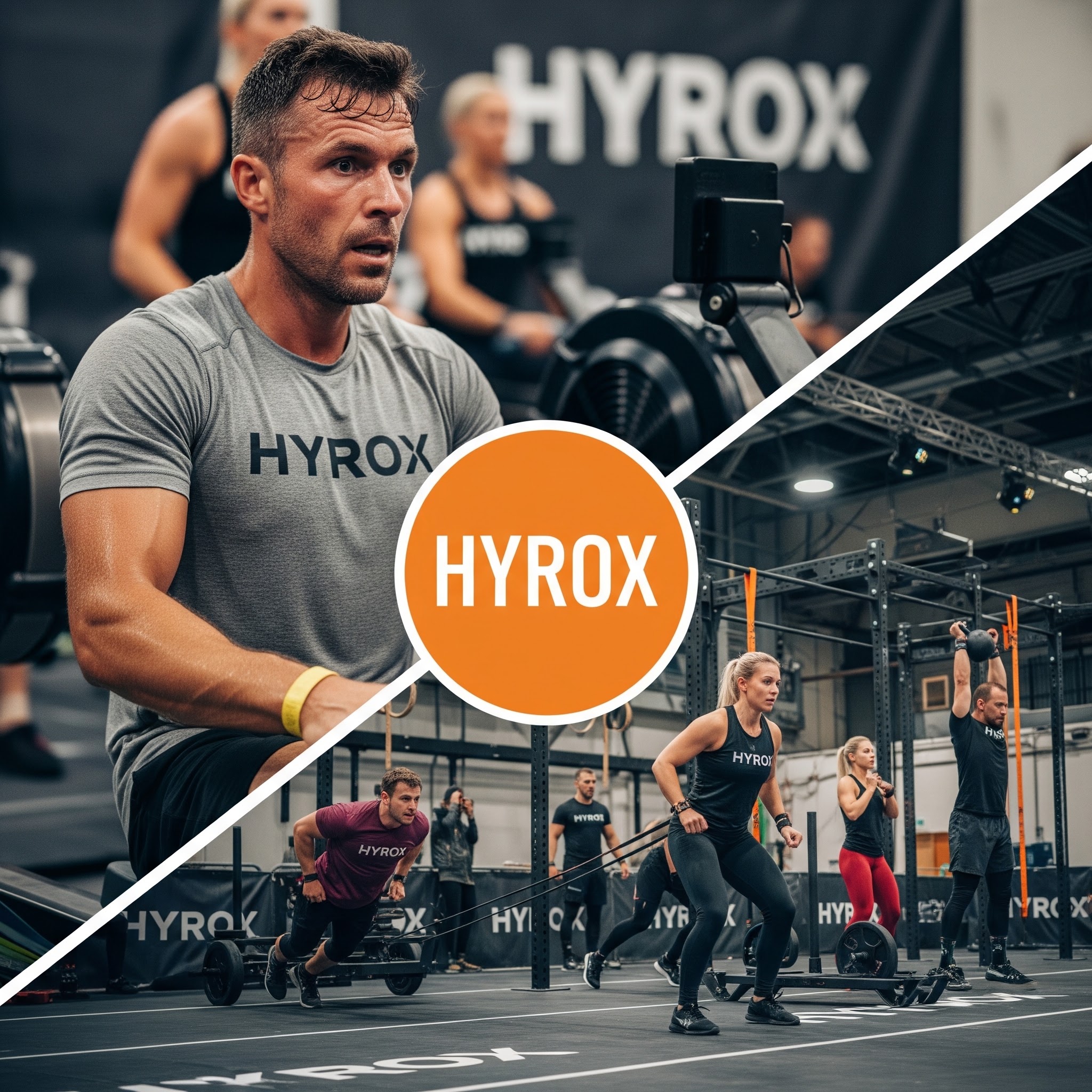
When Hamburg lost its bid to host the 2024 Olympic Games, most locals simply turned off the TV and went back to their treadmills; Moritz Fürste decided to redesign the treadmill economy instead. A triple Olympic medalist in field hockey, Fürste left his first career searching for a “second arena” big enough to match the emotional voltage of winning gold in Beijing and London and bronze in Rio.
That second arena became HYROX, the standardized indoor “hybrid racing” format that fuses 8 kilometers of running with eight punishing functional workout stations in the same sequence across every city in the world. In 2026, HYROX expects to generate roughly 270 million dollars in revenue, host 121 events across 34 countries, and welcome about 1.5 million participants—a growth curve that would make many SaaS founders reach for an ice bath.
The Product: A Marathon For People Who Actually Go to the Gym
HYROX started from a simple market flaw: millions of people treat “fitness” as their primary sport, yet their training had no standardized, globally comparable competition to point toward. You could run a marathon without ever seeing the inside of a gym, but there was no mass-participation event that mirrored the interval circuits, sled pushes, and rower sprints the global membership base was already doing every week.
The solution was disarmingly literal: eight one‑kilometer runs, each followed by a functional station—SkiErg, sled push, sled pull, burpee broad jumps, rowing, farmer’s carry, sandbag lunges, and wall balls—executed in that same order in large indoor venues from Hamburg to Abu Dhabi. This uniformity lets an everyday office worker in New York compare their HYROX time directly to a teacher in London or a firefighter in Dubai, complete with global rankings and world records, giving the sport the statistical backbone of a marathon and the spectacle of a prize fight..
The Founder’s Bet: All‑In, With No Plan B
For all its later polish, HYROX did not begin with institutional capital and performance dashboards; it began with Fürste borrowing “more money than [he] ever knew exists” from friends, family, and banks and then doing the one thing most financial advisors warn against: going all in without a plan B. At the first Hamburg event in 2017, just 650 athletes showed up, and the Olympic champion found himself emceeing the race while the team “did everything” from operations to crowd control.
What he saw that day was less a flawless product than a powerful signal: the raw joy of non‑professional athletes finally being treated like professionals, walking into an arena with big screens, sound systems, and production values that looked more NBC primetime than local 5K. From that moment, Fürste says he never seriously doubted HYROX would work, even if his financing strategy—by his own admission—belongs in the “do not try this at home” category of entrepreneurial folklore.
COVID, Scarcity, and the Art of Not Opening Gyms
If HYROX was built for mass participation, the COVID lockdowns were the existential plot twist the business did not need yet somehow used. With live events shut down, the company leaned into digital activations, online competitions, and relentless community communication, investing in brand while revenue temporarily evaporated.
The payoff came in 2022 when a post‑pandemic London race became HYROX’s first truly sold‑out event, confirmation that the community built during the shutdown had not just survived—it was ready to over‑correct to the upside. Since then, the company has leaned into scarcity as a feature, not a bug: London, New York, and other major markets now routinely sell out fast, with Fürste noting that 55,000 tickets for New York HYROX in 2026 were snapped up in about an hour, and internal debates wondered if even 80,000 would have cleared.
The most contrarian decision, however, may be what HYROX chose not to do: become a gym chain. Instead of competing with the existing ecosystem, HYROX built a network of roughly 16,000 affiliated gyms that pay licensing fees for programming, branding, and priority access to race entries, turning the places people already train into a distributed sales and evangelism network. The logic is crisp: opening 100 branded gyms might look good on a pitch deck, but aligning thousands of independent gyms around a shared race calendar is how you build a sport.
A Revenue Engine Disguised as a Sport
By 2026, HYROX has evolved into what public‑market investors would recognize as a diversified, high‑margin event platform—if they can get past the wall balls. The company runs four core revenue streams: ticketing, merchandise, sponsorships, and gym licenses.
Athlete and spectator ticketing still drives the majority of the top line—historically around 80%—with average pricing near 120 to 150 dollars per entry depending on geography, plus paid add‑ons like professional photo packages. Branded merchandise, co‑created with Puma, contributes roughly the mid‑teens of revenue, with on‑site and online sales turning race weekends into moving retail pop‑ups. Sponsorships add another 10 to 15 percent as global brands look for a way to stand next to a sport that is younger, fitter, and more Instagram‑native than traditional endurance races. And gym licensing, at around 10 percent of revenue today, offers a recurring, high‑margin layer that scales with every new city added to the race calendar.
Crucially, this entire engine has been built with almost no top‑of‑funnel paid advertising. Fürste argues that HYROX is too “explanatory” a product for cold social media ads and that dollars are better spent activating insiders: coaches, gyms, athletes, and smaller creators whose audiences actually believe they train for the race they promote. In practice, that means a local coach with 4,000 followers and 2,000 members can sell 100 race entries with a single authentic post, while a conventional influencer campaign with celebrities sold “not a single ticket.”
The Olympic Loop: From Hamburg’s No to Brisbane 2032
The irony at the heart of HYROX is almost too on‑the‑nose for a screenwriter: a business born from Hamburg’s failed Olympic bid may now help define a new Olympic discipline. Fürste believes hybrid racing—the broader sport HYROX helped popularize—is on a credible path to Olympic inclusion within the next decade, even if HYROX itself remains the qualifying circuit rather than the branded event on the schedule.
To get there, the sport has quietly been built to Olympic spec from day one: standardized rules, identical event formats, global rankings, and a clear pyramid from elite competitors to mass‑participation weekend warriors. HYROX is already working with World Triathlon, the IOC’s ecosystem, and national sports organizations to explore how its races could sit on the pathway toward an eventual hybrid racing medal—an outcome that would close Fürste’s personal loop from Olympic champion to Olympic qualifier architect.
For investors, the Olympic ambition does more than add romance; it institutionalizes the sport. A discipline with global rankings, qualifying standards, and national teams behaves more like an asset class than a fad. It attracts long‑cycle sponsors, national federation funding, and media partners who want to own the narrative of a category from its formative years.
Investor Takeaway: The “Every Body” Flywheel
HYROX’s rise from a 650‑person proof of concept to a projected 270 million dollars in revenue rests on a flywheel that blends event economics, community behavior, and old‑fashioned scarcity. Each new city unlocks a cluster of affiliated gyms; each gym seeds a local community; each sold‑out race deepens the waiting list and justifies higher pricing, better merchandising, and more premium experiential layers—from training camps to fitness‑travel “experiences.”
If you abstract away the sweat, HYROX looks uncannily like a global, standardized, subscription‑adjacent consumer platform: recurring participation, multiple revenue streams per user, network effects across gyms and cities, and a brand moat built on authenticity rather than paid reach. It may be marketed as “The World Series of Fitness Racing,” but to a certain kind of investor it reads like something else—a case study in how to turn the world’s biggest informal sport, everyday fitness, into a structured, scalable asset that can run, lift, and compound at the same time.
Learn More Here
The Sources
Here’s a numbered list of the key sources behind the HYROX / Moritz Fürste story, optimized so you can quickly reuse them in content, show notes, or a reference block.
- CNBC Make It – “He Risked Everything on HYROX. Now It’s a Global Sport With 1 Million Annual Participants” (video)
https://www.youtube.com/watch?v=rom-IBD0QpY - CNBC – “Hyrox co-founder Moritz Furste on growth outlook: We will be a global sport” (interview clip)
https://www.youtube.com/watch?v=m5CWwi1_tYI - SBO Financial – “HYROX: How Fitness Racing Became a $140M Beast” (business teardown)
https://sbo.financial/blog/financial-teardowns/the-business-of-hyrox-how-fitness-racing-became-a-140m-beast/ - Forbes Australia – “How Hyrox turned everyday gym training into a $130m juggernaut”
https://www.forbes.com.au/life/wellness/how-hyrox-turned-everyday-gym-training-into-a-130-million-juggernaut/ - HYROX Official – “The Fitness Competition for Every Body” (global overview and positioning)
https://hyrox.com - HYROX Official – “About Fitness Race” (race format and structure)
https://hyroxus.com/about-fitness-race/ - HYROX Official – “The Global Footprint” (events, countries, expansion snapshot)
https://hyrox.co.in/global-footprint/ - Wikipedia – “Hyrox” (background and standardized format)
https://en.wikipedia.org/wiki/Hyrox - Olympics.com – Athlete profile “Moritz FURSTE”
https://www.olympics.com/en/athletes/moritz-furste - Wikipedia – “Moritz Fürste” (Olympic medals and hockey career)
https://en.wikipedia.org/wiki/Moritz_F%C3%BCrste - FIH (International Hockey Federation) – “Olympic Reflections: Germany’s Fürste re-lives comeback for the ages”
http://www.fih.ch/news/olympic-reflections-germany-s-fuerste-re-lives-comeback-for-the-ages/ - BOXROX / BOXROX Media social posts – HYROX revenue and expansion quotes from CNBC interview
Example: https://x.com/BOXROX/status/2065449086870823064
Stay Updated with Vista Partners
Subscribe to receive market insights, investing ideas, and the latest updates directly in your inbox.