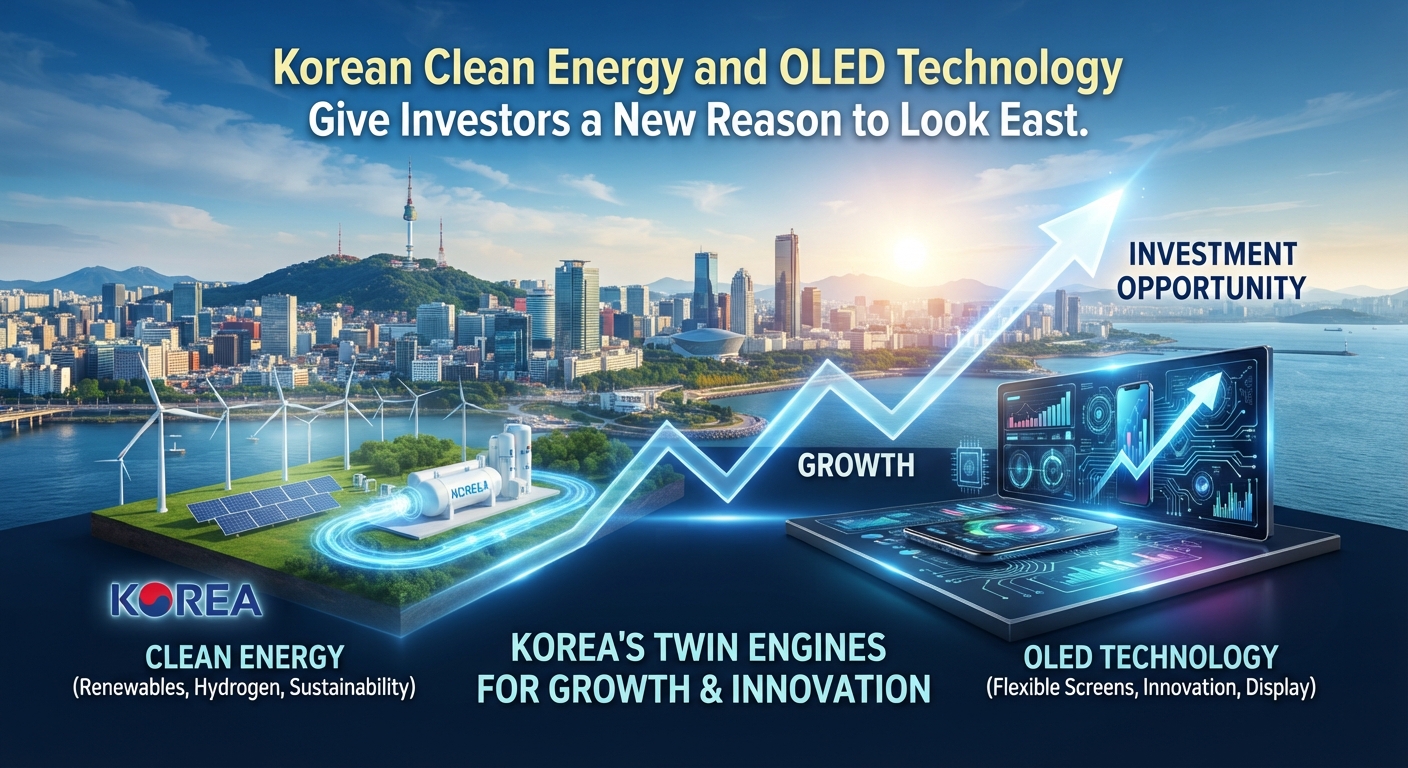
South Korea’s technology champions are gaining renewed investor attention as Washington’s tougher stance on Chinese solar imports strengthens the strategic appeal of Korean supply chains, and LG Display Co., Ltd. (NYSE: LPL; KRX: 034220) raises the performance bar in gaming OLEDs. The common thread is not merely “Korea Inc.” enthusiasm; it is a market increasingly willing to reward companies that sit at the intersection of industrial policy, premium technology and hard-to-replicate manufacturing expertise.
Solar Policy Turns Into a Competitive Moat
Shares of Hanwha Solutions Corp. (KRX: 009830) and OCI Holdings Co., Ltd. (KRX: 010060) climbed more than 8% as investors focused on expectations that U.S. restrictions aimed at Chinese solar products could remain in place ahead of a Trump-Xi summit. The move reflects a straightforward proposition: when the world’s largest clean-energy market makes low-cost Chinese supply less economically attractive, manufacturers with credible non-Chinese capacity become more strategically valuable. The U.S. measures reported in August include import restrictions and minimum-price provisions for solar-related products, including polysilicon, ingots, wafers, cells and modules. The reported policy framework sets minimum import prices of $21 per kilogram for polysilicon, $100 per kilogram for ingots and wafers, $0.22 per watt for solar cells and $0.38 per watt for solar modules, along with a 15% tariff on several downstream product categories. For Hanwha Solutions and OCI Holdings, the investment case is less about a single day’s share-price move than about the possibility of a more durable reset in the economics of dependable solar supply. A solar module may look uncomplicated from a distance, silicon, glass, metal and sunshine have all had fairly long careers, but the industrial base behind it is not. Trade policy can alter relative pricing, supply-chain security and customer purchasing behavior with unusual speed. That is especially relevant for developers and buyers seeking long-lived energy assets rather than merely the cheapest item on a procurement spreadsheet.
Hanwha and OCI: Why the Market Is Paying Attention
Hanwha Solutions is one of South Korea’s most recognizable solar names, while OCI Holdings has meaningful exposure to the polysilicon side of the renewable-energy value chain. In a more protected U.S. market, companies with local or allied-country manufacturing exposure could enjoy improved competitive positioning against solar supply chains that depend heavily on Chinese production. The key bullish logic has several layers:
- Potentially firmer pricing: Import floors and tariffs can limit the deflationary pressure created by ultra-low-priced overseas supply, offering a healthier pricing backdrop for compliant producers.
- Strategic supply-chain relevance: U.S. buyers may place more value on traceability, delivery certainty and politically durable sourcing—traits that have become important enough to warrant their own boardroom slide.
- AI-era electricity demand: The expansion of artificial intelligence infrastructure, data centers and advanced manufacturing is broadening the long-term conversation around U.S. power generation. Solar is not the only answer, but it is firmly part of the answer.
- Policy optionality: If U.S. restrictions remain durable, Korean solar manufacturers could have a clearer runway to invest, contract and compete in North America.
There are risks, naturally. Solar policy can evolve, pricing remains volatile, Chinese capacity is formidable, and a protected market does not automatically create strong margins. Still, the market’s reaction suggests many see an increasingly valuable option embedded in Korean solar equities: the chance to serve a U.S. market that wants clean power without placing all its supply-chain eggs in one very large basket.
LG Display Brings Serious Speed to OLED
While solar investors assess trade architecture, LG Display is pursuing a more fluorescent form of competitive advantage. The company has launched a 24.5-inch gaming OLED panel designed for esports, featuring a claimed 720Hz refresh rate and 0.02-millisecond response time. LG Display says the panel is the first OLED developed specifically for esports-oriented monitors. The panel operates at Full HD resolution, 1,920 by 1,080 pixels, and is intended to reduce motion blur and ghosting in fast-moving games such as first-person shooters and racing titles. A 720Hz refresh rate means the display can update up to 720 times each second, which is about as close as a monitor can come to drinking espresso. LG Display attributes the capability to a proprietary driving algorithm designed to sustain ultra-high refresh performance at Full HD resolution. The company has started mass production, shifting the announcement from laboratory theater toward a genuine commercial opportunity.
ASUS Provides an Important Commercial Proof Point
LG Display’s new panel is set to appear in the ASUS ROG Swift OLED PG259QWS Ace, a product from ASUS (TWSE: 2357). The monitor has also been selected as the official display for the PGL CS2 Major Singapore 2026, providing a high-profile esports setting for the technology. That matters because advanced display innovation is most valuable when it clears three hurdles:
- It has a genuine technical advantage.
- A major equipment brand is willing to ship it.
- End users have a demanding reason to care.
LG Display’s panel checks each box. The technical claims are ambitious; ASUS is the initial monitor partner; and esports players are among the least forgiving customers in consumer electronics. In that market, latency is not a feature-comparison bullet point. It is a personality trait. The broader opportunity is that gaming monitors may offer a premium-growth lane for OLED adoption. LG Display already competes across televisions, IT devices, automotive displays and mobile-oriented applications; a successful push into esports could extend OLED’s relevance into a category where visual quality, responsiveness and brand differentiation all command a higher premium than the average office monitor.
The Read-Through
South Korea’s solar and display sectors tell different stories, but both point toward a market theme with staying power: strategic technology manufacturing is becoming more investable when it is aligned with policy, end-market demand and production know-how.
| Company | Ticker | Investor catalyst | Core consideration |
|---|---|---|---|
| Hanwha Solutions Corp. | KRX: 009830 | Expectations that U.S. restrictions on Chinese solar products could persist, improving the competitive outlook for allied suppliers | Solar margins and policy outcomes remain highly cyclical |
| OCI Holdings Co., Ltd. | KRX: 010060 | Potential advantage from tighter U.S. solar trade conditions and strategic polysilicon relevance | Commodity prices and global solar oversupply can pressure results |
| LG Display Co., Ltd. | NYSE: LPL; KRX: 034220 | Commercial rollout of a 24.5-inch 720Hz esports OLED panel and premium gaming-display exposure | Consumer-electronics demand and display pricing remain competitive |
| ASUS | TWSE: 2357 | Early adoption of LG Display’s panel in the ROG Swift OLED PG259QWS Ace | Product execution and high-end gaming demand drive the benefit |
For many, the story is not that every Korean technology and clean-energy stock has suddenly become a one-way trade. It is that the market is beginning to assign greater value to differentiated supply chains and specialized manufacturing platforms at a time when industrial policy and technological performance are both carrying more weight. Hanwha Solutions (KRX: 009830) and OCI Holdings (KRX: 010060) offer exposure to a potentially more favorable U.S. solar trade environment. LG Display (NYSE: LPL; KRX: 034220) offers a separate but complementary route into premium hardware demand, where OLED leadership and esports credibility may help defend value in a notoriously competitive display business. The sun, it turns out, is not the only thing shining on Korean industry. The screen is moving rather quickly, too.
The Sources
Seoul Economic Daily —LG Display mass-produces world’s first 720Hz Gaming OLED panel
CNBC Korean solar stocks jump as curbs on China expected to stay in place
Yahoo Finance LG Display launches 24.5-inch 720Hz Gaming OLED Panel
PR Newswire LG Display Launches 24.5-Inch 720Hz Gaming OLED Panel
Digital Trends LG’s 720Hz Full HD OLED esports panel is coming to an ASUS monitor
The Korea Economic Daily U.S. solar tariffs curb Chinese dumping and boost Hanwha’s solar prospects
The Korea Herald LG Display launches world’s first 24.5-inch 720Hz gaming OLED panel
Learn More Now
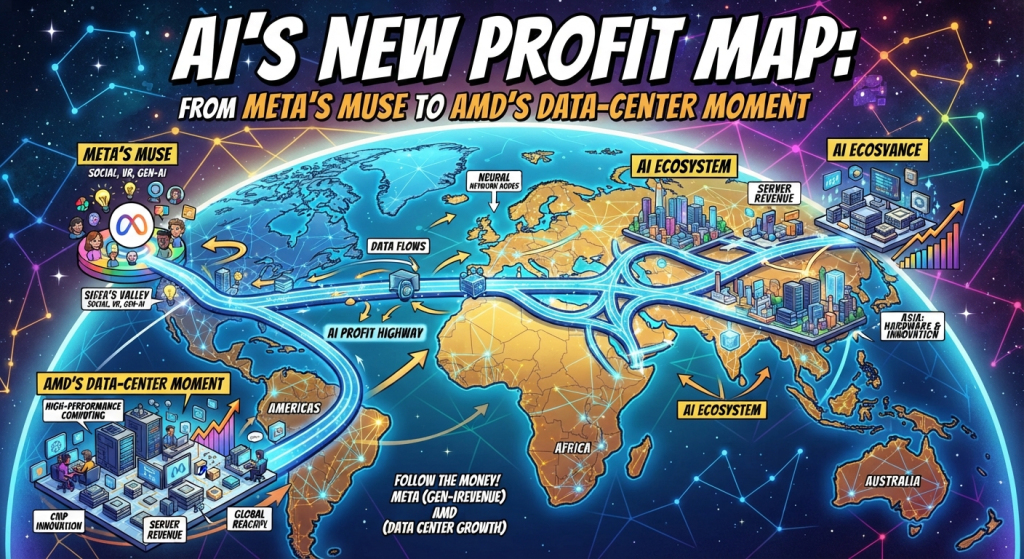
AI’s New Profit Map: From Meta’s Muse to AMD’s Data-Center Moment -( $AAPL $AMD $AMWL $LPL $META $MSFT $NVDA ).
Wall Street’s AI trade is beginning to look less like a one-company coronation and more like an expanding commercial ecosystem. Meta Platforms (NASDAQ: META), Advanced Micro Devices (NASDAQ: AMD), Apple (NASDAQ: AAPL), Amwell (NYSE: AMWL) and LG Display (NYSE: LPL) each offer a different angle on the same powerful theme: AI is moving from a costly promise into products, infrastructure and services with clearer routes to revenue. The market’s latest message is refreshingly straightforward: investors still admire ambition, but they now prefer ambition that ships. Read the rest of the story.
Stay Updated with Vista Partners
Subscribe to receive market insights, investing ideas, and the latest updates directly in your inbox.