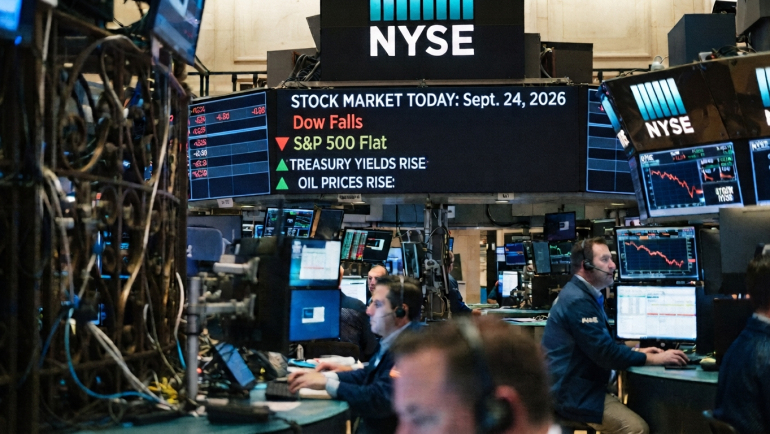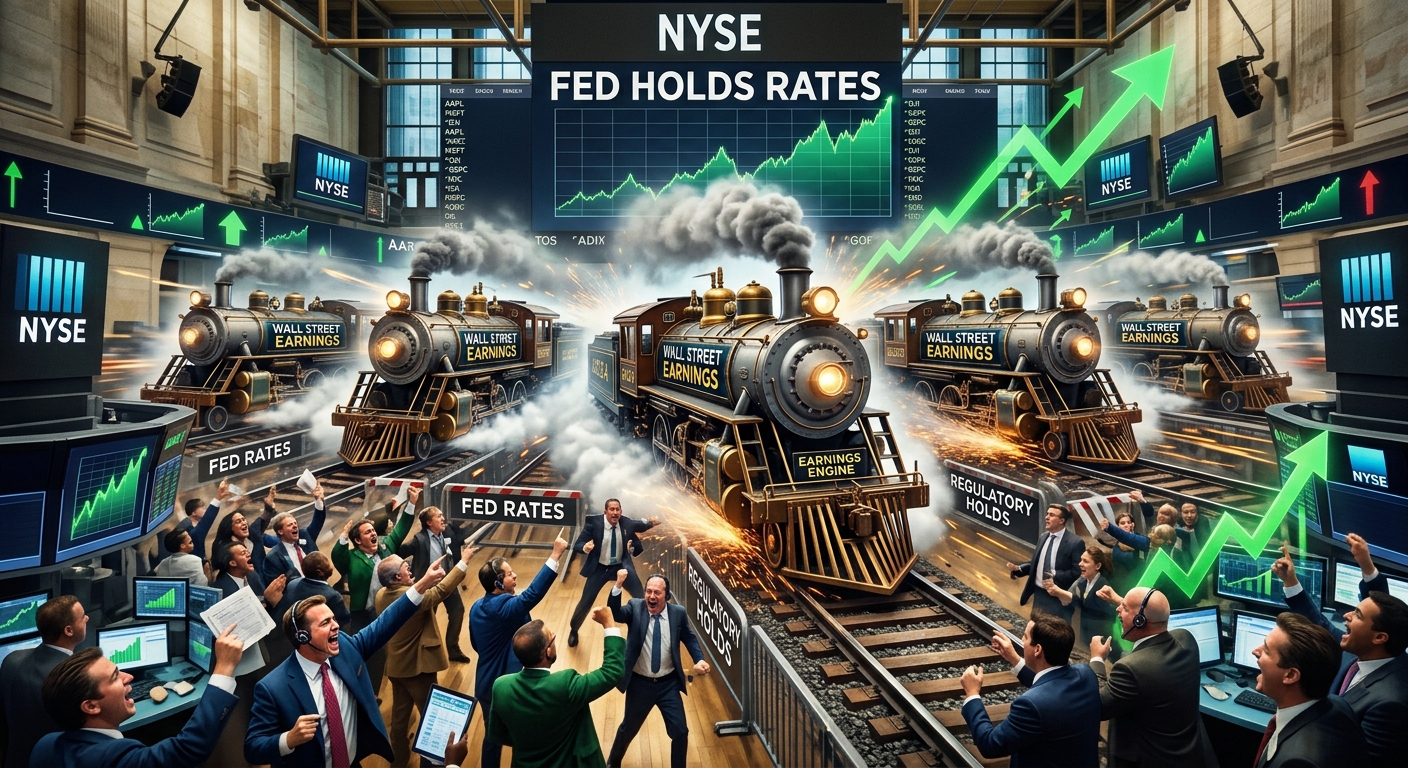
The October decision leaves borrowing costs unchanged and the inflation fight unfinished. The opportunity may be in cash-rich businesses that can grow without waiting for cheaper money.
The Federal Reserve held its benchmark interest-rate target at 3.75% to 4% on Wednesday, pausing after September’s increase while keeping its inflation-fighting posture intact. The decision under Chairman Kevin Warsh was not unanimous: Governor Lisa Cook and Cleveland Fed President Beth Hammack preferred another quarter-point increase, so to 10-2. For many on Wall Street, the constructive takeaway is not that easy money has returned. It is that the latest meeting did not add another increase to corporate America’s financing bill. That distinction creates an opening for a more durable investment argument. Companies with strong cash generation, commercially useful products and the ability to finance their own expansion do not need the central bank to become their business partner. The market’s next chapter may belong less to the anticipation of rate cuts and more to the delivery of earnings. In other words, quality has another opportunity to make itself useful.
What the Fed Decided, and Why It Matters
The October hold follows the Fed’s September 16 decision to raise its target range by a quarter percentage point to 3.75% to 4%. That earlier increase received a unanimous 12-to-0 vote, according to the official policy statement. Wednesday’s decision left that range intact, but the two dissents underscored an important limitation: policymakers have not reached a comfortable consensus that inflation is headed back under control. Post-decision reporting indicated that another increase at the December meeting remained widely expected. For many, the key distinction is between a pause and a pivot. A pause leaves the current policy setting unchanged. A pivot would imply a more meaningful change in direction. October delivered the former, not a promise of the latter. The bullish interpretation is narrower, and more credible, than a declaration that monetary restraint is over. Businesses now have another interval in which to demonstrate that demand, margins and cash flow can withstand the existing rate environment. That is hardly a champagne shower. For companies built to operate without one, it may be enough.
Inflation Remains the Obstacle, but Its Composition Matters
The Fed’s caution has a clear economic foundation. The Bureau of Labor Statistics reported that consumer prices rose 0.6% in September and 3.7% over the preceding 12 months. Core inflation, which excludes food and energy, increased 0.3% during the month and 2.6% from a year earlier. The gap between headline and core inflation is important. The September release showed energy prices up 20.4% over 12 months, compared with a 2.5% increase in food prices. Inflation is not moving uniformly across the economy, which complicates both monetary policy and corporate planning. The constructive scenario is that those pressures eventually ease without requiring a materially more damaging tightening cycle. That remains a scenario, not an accomplished fact. If elevated costs spread more broadly or prove persistent, the Fed could raise rates again. The strongest bullish investment thesis therefore cannot depend on immediate relief from the central bank. It must begin with businesses capable of generating acceptable returns under the conditions that actually exist. Hope is useful in a portfolio. It should not be responsible for the interest payments.
Why the Fed Pause Favors a Closer Look at Cash Flow
A restrictive rate environment changes the hierarchy of corporate virtues. Revenue growth still matters. But for many, the more revealing questions concern how much capital that growth consumes, how much cash it produces and whether the next expansion requires another trip to the debt market. Microsoft (NASDAQ: MSFT) provides a substantial historical example. In its fiscal 2025 Form 10-K filed with the Securities and Exchange Commission, the company reported $136.2 billion in cash from operations, up $17.6 billion from the previous year. Microsoft attributed the increase primarily to greater cash received from customers, partially offset by higher payments to suppliers, employees and tax authorities. Operating cash flow is not free cash flow. Capital expenditures still need to be deducted before assessing the cash available for other purposes. Nevertheless, substantial internally generated cash offers a financing advantage. It gives a company more flexibility to invest, absorb unexpected costs and evaluate opportunities without making every strategic decision contingent on borrowing terms. That does not establish that Microsoft shares are attractive at any price. It establishes why cash generation deserves a prominent place in the valuation discussion. A current assessment of Microsoft should also incorporate its subsequent quarterly and annual disclosures, rather than treating fiscal 2025 figures as a substitute for updated results. The company maintains access to those reports through its investor-relations filings page.
NVIDIA Shows Why the AI Investment Cycle Matters Beyond the Fed
Artificial intelligence offers another reason to avoid treating the entire stock market as a wager on the next interest-rate decision. In an earnings release furnished to the SEC, NVIDIA (NASDAQ: NVDA) reported fiscal 2026 revenue of $215.9 billion, a 65% increase from the previous year. Fourth-quarter revenue reached $68.1 billion, up 73% year over year. The fiscal year ended January 25, 2026. Those historical results establish that the AI investment cycle has already generated substantial reported revenue. It is not merely a collection of ambitious presentations and unusually confident vocabulary. They do not prove that growth will continue indefinitely. Nor do they settle questions about future margins, competition, customer returns or valuation. NVIDIA’s SEC filing history includes a subsequent quarterly report for the period ended July 26, 2026. Any assessment of the shares after the October Fed decision should incorporate those later disclosures rather than rely exclusively on annual figures. Still, the underlying relationship is important. If customers continue to fund computing projects that produce economic value, suppliers can have a growth engine that extends beyond the timing of the next rate move. Post-decision economic reporting also identified AI infrastructure investment as a source of resilience, even as higher borrowing costs weigh more heavily on other parts of the economy. That resilience comes with a complication: intensive construction and equipment demand can itself contribute to price pressures. AI is therefore neither an exemption from economics nor simply another victim of interest rates. It is a powerful investment cycle whose benefits must eventually justify its costs. The server racks may be impressive. The return on investment still needs to show up for work.
The Opportunity Is Selective Growth, Not a Blanket Risk Rally
Wednesday’s decision does not make every growth stock equally attractive. The more compelling framework separates companies that can fund expansion from companies that need financial markets to keep funding it for them. A selective bullish approach focuses on several characteristics:
- Operating cash flow that supports the investment plan.
- Customer demand tied to measurable economic value.
- Manageable refinancing needs.
- Margins that can withstand higher input costs.
- A valuation that allows for imperfect execution.
These are analytical criteria, not guarantees of outperformance. They also help explain why a Fed pause can matter without becoming the entire investment thesis. The absence of an additional rate increase creates a cleaner opportunity to evaluate operating progress, but it does not repair a weak business model. The federal funds target should not be confused with every company’s actual borrowing cost. The Fed describes the federal funds rate as the rate at which depository institutions lend reserve balances to one another overnight. Corporate financing conditions also depend on market rates, creditworthiness and the terms of individual obligations. The central bank can hold steady while a particular borrower still encounters a more demanding lender.
December Becomes the Next Major Policy Checkpoint
The Fed’s official calendar lists its final scheduled 2026 meeting for December 8 and 9. That meeting is also scheduled to include a Summary of Economic Projections, providing another framework for assessing policymakers’ expectations. The October decision therefore creates an interval for new evidence rather than closing the policy debate. For many, the next question is whether subsequent inflation and economic data support another increase, a longer pause or a different outlook. Cook’s and Hammack’s preference for tighter policy makes clear that the argument for acting again remains active inside the committee. Market-based probabilities can help track how those expectations evolve, but they should not be mistaken for promises. CME Group (NASDAQ: CME) explains that its FedWatch tool derives probabilities for policy outcomes from 30-day federal funds futures prices. Those estimates reflect market pricing rather than a commitment from policymakers. The practical lesson is to stress-test the business thesis against more than one December outcome. A company worth owning should ideally have a better answer to “What happens next?” than “We are waiting for the Fed.”
What Could Derail the Bullish Case?
The first risk is persistent inflation. September’s consumer-price figures leave policymakers with a substantive reason to remain cautious, and another increase could make financing conditions more demanding. The second is valuation. Strong business performance and disappointing stock returns can coexist when the purchase price assumes too much future growth. Microsoft’s historical operating cash generation and NVIDIA’s reported revenue expansion are evidence of operating achievements, not proof that either stock is inexpensive. The third is uneven economic resilience. Post-decision reporting described continued strength in AI investment and spending by higher-income households, alongside greater pressure on lower- and middle-income consumers. A durable bullish case must account for those differences rather than assume every customer and industry has the same financial cushion. Finally, heavy investment must eventually produce adequate returns. If customers fail to earn enough value from new infrastructure, future spending could weaken even if the technology itself remains strategically important. The appropriate response is not to abandon growth. It is to distinguish productive growth from growth that remains dependent on generous assumptions.
A Bottom Line: Consider Owning Businesses That Can Deliver
The Fed’s October hold presents a more useful assignment than predicting an imminent return to cheap money. Find businesses that can grow while money still has a meaningful price. Microsoft (NASDAQ: MSFT) illustrates the importance of substantial internally generated cash. NVIDIA (NASDAQ: NVDA) illustrates the scale of revenue already produced by the AI investment cycle. Their historical results provide concrete foundations for analysis, while subsequent filings, competitive developments and valuation determine how persuasive the current investment case remains. The opportunity is not that the Fed has made investing easy. It is that a pause allows corporate execution to reclaim some attention from monetary-policy speculation. For many, that is a constructive development. A portfolio built on durable demand, financing resilience and credible earnings does not require the central bank to become unexpectedly generous. It requires companies to keep doing the work.
The Sources
- Federal Reserve decision coverage, October 28, 2026
NPR / WXXI News: “Fed Holds Interest Rates Steady Even as Inflation Remains Stubborn.”
https://www.wxxinews.org/npr-news/2026-10-28/fed-holds-interest-rates-steady-even-as-inflation-remains-stubborn - Federal Reserve decision and dissenting votes, October 28, 2026
Washington Examiner: “Fed Holds Interest Rates Steady Before Elections, With Two Dissents.”
https://www.washingtonexaminer.com/policy/finance-and-economy/4782688/fed-interest-rates-highly-anticipated-election-meeting/ - Federal Reserve policy statement, September 16, 2026
Official statement documenting the preceding rate decision.
https://www.federalreserve.gov/newsevents/pressreleases/monetary20260916a.htm - Consumer Price Index overview
U.S. Bureau of Labor Statistics: CPI data, inflation measures and release information.
https://www.bls.gov/cpi/ - Consumer Price Index release
U.S. Bureau of Labor Statistics: CPI news release PDF. This is a rolling link, so its contents may change when a subsequent report is published.
https://www.bls.gov/news.release/pdf/cpi.pdf - Microsoft (NASDAQ: MSFT), fiscal 2025 Form 10-K
SEC.gov filing containing annual financial statements and operating cash-flow disclosures.
https://www.sec.gov/Archives/edgar/data/789019/000095017025100235/msft-20250630.htm - Microsoft (NASDAQ: MSFT), SEC filings
Company-maintained access to quarterly and annual regulatory reports.
https://www.microsoft.com/en-us/investor/sec-filings - NVIDIA (NASDAQ: NVDA), fourth-quarter and fiscal 2026 results
Earnings release furnished to the SEC as Exhibit 99.1.
https://www.sec.gov/Archives/edgar/data/1045810/000104581026000019/q4fy26pr.htm - NVIDIA (NASDAQ: NVDA), SEC EDGAR filing history
Official SEC company page for annual reports, quarterly reports and other disclosures.
https://www.sec.gov/edgar/browse/?CIK=0001045810 - Federal Reserve, Federal Open Market Committee overview
Background on the committee and the federal funds rate.
https://www.federalreserve.gov/monetarypolicy/fomc.htm[ - Federal Reserve, FOMC meeting calendars and information
Official meeting dates and links to policy statements, minutes and economic projections.
https://www.federalreserve.gov/monetarypolicy/fomccalendars.htm - CME Group (NASDAQ: CME), FedWatch tool methodology
User guide explaining how federal funds futures prices inform policy-rate probabilities. The version consulted is in Japanese.
https://www.cmegroup.com/ja/tools-information/quikstrike/cme-fedwatch-tool-user-guide.html
Stay Updated with Vista Partners
Subscribe to receive market insights, investing ideas, and the latest updates directly in your inbox.