U.S. stocks rallied sharply Monday, November 23, 2026, with the Nasdaq Composite advancing 6.28% and the S&P 500 gaining 4.64% in the supplied market snapshot. Nvidia (NASDAQ: NVDA) helped drive the technology rebound after its board reinstated Jensen Huang as chief executive, reversing a leadership change that had unsettled the artificial intelligence sector. The Dow Jones Industrial Average climbed 1,475.30 points, while the Russell 2000 rose 3.16%, showing that buying extended beyond the largest technology companies. However, the cross-asset picture remained mixed: gold surged, the 10-year Treasury yield held near 4.92%, and January 2027 crude oil futures declined more than 4%. For many, the central question is whether Monday’s rebound marks the beginning of a sustained recovery or a powerful relief rally after last week’s selling. The latest Federal Reserve statement and consumer-spending data suggest that inflation and interest rates remain important constraints, even as enthusiasm for AI-linked businesses returns.
Stock Market Performance: S&P 500, Dow, Nasdaq and Russell 2000
| Index or asset | Latest supplied reading | Change | Percentage change |
|---|---|---|---|
| S&P 500 | 7,230.94 | +320.55 | +4.64% |
| Dow Jones Industrial Average | 49,622.63 | +1,475.30 | +3.06% |
| Nasdaq Composite | 24,038.83 | +1,421.10 | +6.28% |
| Russell 2000 | 2,663.30 | +81.51 | +3.16% |
| Cboe Volatility Index, or VIX | 27.39 | -8.50 | -23.67% |
| 10-year Treasury yield | 4.9200% | +0.008 percentage point | +0.16% relative change |
| Gold, quoted contract unspecified | $3,642.60 | +$127.20 | +3.62% |
| Crude oil, January 2027 futures | $80.03 | -$3.38 | -4.05% |
| Bitcoin, U.S. dollars | $61,088.37 | +$266.07 | +0.44% |
Technology led the advance by a substantial margin, but gains in small-cap stocks and the Dow indicated broader participation. The sharp decline in the VIX also pointed to reduced demand for near-term market protection relative to the preceding session. These readings suggest a meaningful improvement in sentiment, although a single session cannot establish that the preceding correction has ended.
Why Stocks Rallied: Nvidia Leadership News Revives the AI Trade
Nvidia (NASDAQ: NVDA), accounting for roughly 6% of the S&P 500 index was the session’s most prominent corporate catalyst. The company’s board announced that Huang would return immediately as chief executive and president, while Colette Kress would continue as chief financial officer after serving as interim CEO. Shares rose more than 30% during the session, according to the supplied coverage. That move should not be confused with a verified closing return. The board said the decision followed discussions with Huang and input from senior U.S. government officials. President Donald Trump also said he had communicated with the board about Huang’s return. At the same time, the board’s independent investigation remained ongoing, leaving governance and regulatory questions unresolved. The market significance reaches beyond one executive appointment. Nvidia (NASDAQ: NVDA) occupies a central position in the AI infrastructure supply chain, so uncertainty about its leadership can affect expectations for product execution, customer commitments and spending throughout the industry. Monday’s reaction suggests that many viewed Huang’s return as reducing an immediate operational risk, rather than resolving every outstanding issue. The rebound followed a difficult week in which the three major U.S. stock averages had entered correction territory. That backdrop matters: strong buying after a steep decline can reflect both renewed confidence and the reversal of defensive positioning. Further gains would need support from earnings, business spending and a more stable policy outlook.
Macroeconomic Commentary: A Stock Rally Without a Bond-Market Breakthrough
The most important qualification to Monday’s equity surge was the behavior of Treasury yields. The supplied screenshot showed the 10-year yield at 4.92%, slightly higher on the session rather than falling alongside a broad easing in financing conditions. That combination makes the rally different from one driven primarily by expectations for lower interest rates. Technology shares rebounded sharply, but the long-term borrowing-cost backdrop offered little immediate relief. The distinction is particularly relevant to capital-intensive AI infrastructure businesses.
The Federal Reserve Still Faces Elevated Inflation
At its October 28 meeting, the Federal Reserve maintained the federal funds target range at 3.75% to 4.00%. The committee described economic activity as expanding strongly, domestic spending as resilient and inflation as elevated. Two policymakers dissented in favor of a quarter-point rate increase. The statement provides an important counterweight to Monday’s enthusiasm. A recovery in share prices does not, by itself, establish that inflation is cooling or that monetary easing is approaching. Dallas Fed President Lorie Logan reinforced that concern in a November 10 speech. She argued that policy needed to become more restrictive and said her outlook called for at least two additional quarter-point rate increases. Those remarks represented her individual assessment, not a new decision by the full committee. For many, the resulting tension is straightforward: AI-related earnings opportunities can support equities, while persistent inflation can keep the cost of financing those opportunities elevated.
Consumer Spending Is Growing, but Inflation Is Absorbing Much of the Increase
The latest available Bureau of Economic Analysis report showed September personal income rising 0.2% and nominal personal consumption expenditures increasing 0.5%. After inflation, however, consumption rose less than 0.1%. The personal saving rate stood at 3.8%. The distinction between nominal and real spending is critical. Households spent more dollars, but the increase in the volume of goods and services purchased was much smaller. September’s PCE price index rose 0.5% from the previous month and 3.6% from a year earlier. Excluding food and energy, prices increased 0.3% monthly and 3.1% annually. Those figures show why a strong stock-market rebound does not remove the Federal Reserve’s inflation problem.
Monday’s Economic Calendar Requires Careful Interpretation
The official release calendar scheduled the October Chicago Fed National Activity Index and the November Chicago Fed Survey of Economic Conditions for Monday. The broader Federal Reserve economic calendar also listed those releases.The National Activity Index measures overall economic activity and related inflationary pressure. A reading of zero corresponds to historical trend growth, while positive and negative readings indicate above-trend and below-trend activity, respectively. The material reviewed here did not establish a verified November 23 result, so no unconfirmed reading is used in this report.
Gold Surges as Oil Falls: A Mixed Message From Other Markets
Gold advanced 3.62% to $3,642.60, even as stocks rallied. Bitcoin rose a more modest 0.44% to $61,088.37. The simultaneous strength in equities and gold complicates any claim that markets had uniformly abandoned defensive positioning. January 2027 crude oil futures fell 4.05% to $80.03 per barrel. Sustained lower energy prices could ease some household and business expenses, but one session’s decline is not enough to establish a lasting improvement in inflation, however note that a traditionally acceptable global range for oil in the $60-$80/bbl has almost been achieved. Energy remains an important link between geopolitical developments, operating costs and monetary policy. In her recent remarks, Dallas fed Logan emphasized that energy-price pressures had contributed to inflation, while also warning that price increases extended beyond energy into broader service categories. Monday’s cross-asset message was therefore more nuanced than a simple return to optimism: stocks recovered sharply, but gold remained strong and Treasury yields stayed elevated.
Biotech Spotlight: Kymera Therapeutics Reports Positive KT-621 Results
Outside technology, Kymera Therapeutics (NASDAQ: KYMR) announced positive results from its BROADEN2 Phase 2b trial of KT-621, an investigational once-daily oral STAT6 degrader for moderate to severe atopic dermatitis. The company reported that the study met its primary and secondary endpoints across all dose groups at Week 16. The randomized, placebo-controlled trial enrolled 244 adults and adolescents. In the middle-dose group:
- Mean Eczema Area and Severity Index, or EASI, scores declined 72%, compared with 27% for placebo.
- An improvement of at least 75% in EASI scores occurred in 62% of participants, compared with 22% receiving placebo.
- Clear or almost-clear skin was reported in 38%, compared with 11% receiving placebo.
The commercial question is whether an oral therapy can eventually deliver compelling disease control with acceptable long-term safety. The announcement supports further development, but it does not establish regulatory approval or superiority to existing therapies. Kymera Therapeutics (NASDAQ: KYMR) described the 16-week safety profile as favorable, while reporting conjunctivitis among treated participants. The company plans to begin its first Phase 3 atopic dermatitis trial by mid-2027, subject to regulatory alignment. Results from a separate Phase 2b asthma study are expected in late 2027.
What to Watch Next: PCE Inflation, AI Earnings and Holiday Trading
The next scheduled Personal Income and Outlays report arrives Wednesday, November 25, at 8:30 a.m. Eastern. It will provide October consumer-spending and PCE inflation figures, making it a key test of whether price pressure is easing or remaining stubborn. The Federal Reserve’s October meeting minutes were released November 18, providing additional context for the policy debate ahead of the next decision. Together, incoming inflation data and policymakers’ assessments will help determine whether Monday’s renewed appetite for growth stocks can coexist with the interest-rate outlook. Corporate earnings will also test the AI recovery. Hewlett Packard Enterprise (NYSE: HPE) reported after Monday’s close, confirming Revenue of $14.5 billion, up 50% from the prior-year period, & Dell Technologies (NYSE: DELL) after Tuesday’s close. Their results and commentary may help clarify whether AI infrastructure demand is translating into durable revenue, margins and cash flow. The trading week is shortened by Thanksgiving, with U.S. stock markets closed Thursday and the regular session ending at 1 p.m. Eastern on Friday. That leaves a compressed window for many to assess economic releases and corporate updates, Monday’s rebound demonstrated how quickly sentiment toward AI-linked stocks can change. Whether that recovery lasts will depend less on the size of one day’s advance than on the interaction between corporate execution, persistent inflation and the cost of capital.
Updates From the VP Watchlist
Amwell® (NYSE: AMWL)
Amwell® (NYSE: AMWL), a leading provider of technology-enabled care, closed at $11.20, +4.19%. Amwell reported after the close Nov. 3 the company’s Third Quarter 2026 Highlights: Recorded Total Revenue of $49.0 million, exceeding the previously provided financial guidance range for Q3, Achieved subscription revenue of $23.9 million, Recorded Amwell Medical Group (“AMG”) visit revenue of $23.7 million, Reported gross margin of 53%, Net loss was ($11.0) million, compared to ($9.6) million in the second quarter of 2026, Adjusted EBITDA of ($3.6) million compared to ($1.2) million in the second quarter of 2026, & Total visits on the platform were 0.8 million. Financial Outlook: The Company is raising its 2026 revenue outlook, and adjusted EBITDA outlook, and reaffirming its AMG visit guidance., Revenue in the range of $204 million to $206 million increased from $200 million to $205 million. AMG visits between 1.32 million and 1.37 million Adjusted EBITDA in the range between ($8) million to ($7) million increased from ($9) million to ($7) million.
The Company also provided financial guidance for Q4 2026 Revenue and adjusted EBITDA:
- Q4 revenue in the range of $48 million to $50 million
- Q4 adjusted EBITDA expected to in the range of $0 million to $1 million.
The Company also reiterated its objective to achieve positive cash flow from operations in the fourth quarter of 2026.
Serina Therapeutics (NYSE: SER)
Serina Theraeuptics (NYSE: SER, $1.38, +23.21%) is a clinical-stage biotechnology company developing a pipeline of wholly owned drug product candidates to treat neurological diseases and other indications. Serina’s POZ PlatformTM provides the potential to improve the integrated efficacy and safety profile of multiple modalities including small molecules, RNA-based therapeutics and antibody-based drug conjugates (ADCs). Serina is headquartered in Huntsville, Alabama on the campus of the HudsonAlpha Institute of Biotechnology.
On Thursday, November 12, Serina reported its financial results for the third quarter ended September 30, 2026, along with key business updates. Steve Ledger, Chief Executive Officer of Serina stated, “We are excited about the achievement of important clinical milestones for SER-252 in Parkinson’s disease, advancing from the initial evaluation of our lowest-dose cohort into the next stage of dose escalation. Importantly, the blinded pharmacokinetic observations from Cohort 1 showed the sustained drug exposure SER-252 was designed to achieve, and the independent Safety Monitoring Committee recommended proceeding with continued development. Dosing in Cohort 2 is currently underway and focuses on demonstrating SER-252’s potential as a differentiated treatment option for patients with advanced Parkinson’s disease to improve the significant challenge of consistent symptom control.”
On Thursday, September 24, 2026, Serina CEO Steve Ledger discussed discuss Serina’s programs’ progress during Tribe Public’s “A New Approach to Advanced Parkinson’s Disease: Serina Discusses SER-252’s Clinical Progress”webinar, followed by a live Q&A. You may view it below.
Eupraxia Pharmaceuticals Inc. (EPRX)
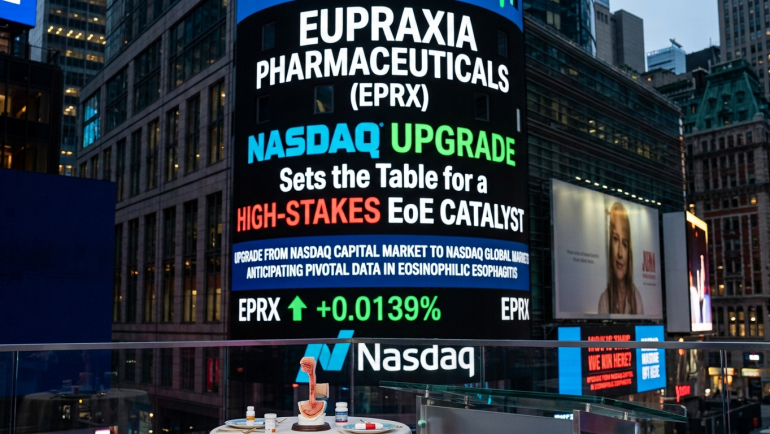
Eupraxia Pharmaceuticals Inc. (EPRX, $5.89, +1.55%), a clinical-stage biotechnology company leveraging its proprietary Diffusphere™ technology designed to optimize local, controlled drug delivery for applications with significant unmet need, today, ( Nov. 10), announced its financial results for the third quarter of 2026. Dr. James A. Helliwell, Chief Executive Officer of Eupraxia stated, “We remain on track to report interim results from the Phase 2b portion of the RESOLVE trial in December, and were pleased to announce in mid-October that we had reached our target enrollment of 120 patients. We are very encouraged by the Phase 1b/2a data from the open-label portion of the RESOLVE trial that was reported this quarter, which includes 36- and 52-week data from our highest dosing cohorts. We believe this data provides further evidence of the observed durable treatment effects of EP-104GI in EoE patients, seen in previous cohorts. In total, we have observed 64% of patients remaining in clinical remission over this 52-week period in addition to clinically meaningful histologic improvements. With cash runway into the second half of 2028, we believe we remain well funded to execute on our upcoming milestones for our EoE program.”
EPRX gained a significant new Wall Street endorsement Monday as RBC Capital Markets initiated coverage with an Outperform rating, a Speculative Risk designation and a $14 price target. The research makes a bullish case for EP-104GI, the company’s investigational treatment for eosinophilic esophagitis, ahead of an expected December clinical readout. Against the $6.89 reference price in RBC’s report, the target implies approximately 103% upside, not a forecast of where shares must trade. The attraction is unusually straightforward for biotechnology: take a familiar anti-inflammatory medicine, deliver it precisely into diseased tissue and attempt to make its benefits last long enough to change the treatment routine. If that approach succeeds, Eupraxia would offer more than another prescription for a chronic disease. It could offer a different calendar. RBC analyst Douglas Miehm’s November 9 initiation argues that EP-104GI could occupy a differentiated position in eosinophilic esophagitis, commonly called EoE, through localized delivery and the potential for once-yearly administration. The next major test is whether encouraging early results translate into convincing evidence against a vehicle control in the Phase 2b RESOLVE study.
EPRX announced (Oct. 15) that the ongoing RESOLVE study evaluating the safety and efficacy of EP-104GI for the treatment of Eosinophilic Esophagitis (“EoE”) has reached its enrollment target. “This is a significant milestone for the RESOLVE trial and the development of EP-104GI as a potential treatment option in EoE” said Dr. James Helliwell, Chief Executive Officer of Eupraxia. “We look forward to our interim analysis in December where we will be reporting on symptoms, histologic findings and safety in the first 60 patients in Phase 2b to reach 6 months. Data will also be available on the patients at 3, 9- and 12-month timepoints giving a fulsome interim look at the RESOLVE Trial”.
Modular Medical, Inc. (NASDAQ: MODD)
Modular Medical, Inc. (NASDAQ: MODD, $1.57), a commercial-stage medical device company preparing for the full commercial launch of its next-generation Pivot™ tubeless patch pump, is pursuing a different proposition: make insulin delivery less demanding for the people who must manage it every day. On November 19, Modular Medical announced that it has entered into agreements with the remaining two of the nation’s three largest pharmacy benefit managers (“PBMs”) for its Pivot tubeless patch pump. With these agreements, Modular Medical has now entered into agreements with all three of the nation’s largest PBMs, whose networks collectively cover more than 182 million lives and process approximately 80% of U.S. prescription claims.1 Coverage for any individual patient remains subject to the formulary decisions and benefit design of the applicable health plan or plan sponsor.
New patient research announced November 9 gives that strategy a persuasive commercial foundation. In a three-phase study conducted with Thrivable involving more than 540 people with Type 1 or Type 2 diabetes, approximately nine out of 10 surveyed multiple daily injection users said they would consider a simpler insulin delivery option. In the final-phase survey of 303 participants, 48.5% expressed strong interest in the company’s Pivot tubeless patch pump. The distinction matters. General enthusiasm for something easier is not the same as product-specific interest, and neither is a prescription. Still, the findings suggest Modular Medical is addressing a recognizable problem rather than inventing one for the benefit of a presentation deck. For many following MODD, the emerging opportunity centers on one word: simplicity. The company has already moved beyond the purely developmental stage. Its annual report documents U.S. Food and Drug Administration clearance for Pivot in April 2026, followed by commercial availability and initial patient shipments in June. The question now is whether a differentiated product, improving access and more focused patient education can turn that regulatory foundation into a repeatable commercial business.
MODD announced (Oct. 27) that it has received a positive decision from its notified body regarding certification of its quality management system under ISO 13485:2016. The notified body is designated under the European Union Medical Device Regulation (“MDR”).
Alphabet (NASDAQ: GOOGL $282.10, +6.34%)
Alphabet (NASDAQ: GOOGL, GOOG) is confronting an expensive paradox: Artificial intelligence is bringing more activity to Google while making the economics of that activity harder to predict. Yet the latest results offer a more constructive interpretation than a simple obituary for search. Third-quarter revenue increased 25% to $127.6 billion. Operating income climbed 30% to $40.6 billion. Google Cloud revenue more than doubled. Those are unusual credentials for a company supposedly being escorted toward technological irrelevance. At the close on Thursday, Alphabet shares traded at $283.82, following a 12.64% decline, many are clearly demanding more proof and fewer architectural renderings of future data centers. That skepticism is understandable. But the opportunity lies in distinguishing a difficult transition in monetization from a collapse in demand. Google’s problem is not that people have stopped asking questions. According to management, its year-over-year search-query growth reached its highest rate in five years during the third quarter. The more consequential question is how quickly Google can turn its expanding AI audience into attractive, durable cash flow. Wall Street has little patience for a renovation when the contractor’s estimate begins with a trillion.
Space Exploration Technologies Corp. (SPCX, $134.35, +4.35%)
SpaceX-related coverage is orbiting three themes: a possible combination with Tesla, an expanding AI infrastructure footprint, and robust Starlink demand, because apparently conquering one industry at a time is inefficient. Reported third-quarter revenue totaled $14.6 billion, while management projected first-quarter 2027 revenue of $33 billion–$37 billion, a range with little apparent interest in remaining earthbound.
The Sources
- U.S. market updates for November 23, 2026
- Nvidia (NASDAQ: NVDA): Jensen Huang reinstatement and intraday share reaction
- Nvidia (NASDAQ: NVDA): Board announcement, government involvement and market reaction
- Kymera Therapeutics (NASDAQ: KYMR): BROADEN2 Phase 2b results announcement
- Federal Reserve: October 28, 2026, monetary policy statement
- Bureau of Economic Analysis: Personal Income and Outlays, September 2026
- Federal Reserve Bank of Dallas: Lorie Logan’s economic and monetary policy outlook, November 10, 2026
- Federal Reserve Bank of St. Louis: Economic release calendar
- Federal Reserve Bank of Chicago: Official data release calendar
- Federal Reserve Bank of Chicago: National Activity Index methodology and current-data page
- Federal Reserve: FOMC meeting calendar and minutes release dates
Stay Updated with Vista Partners
Subscribe to receive market insights, investing ideas, and the latest updates directly in your inbox.