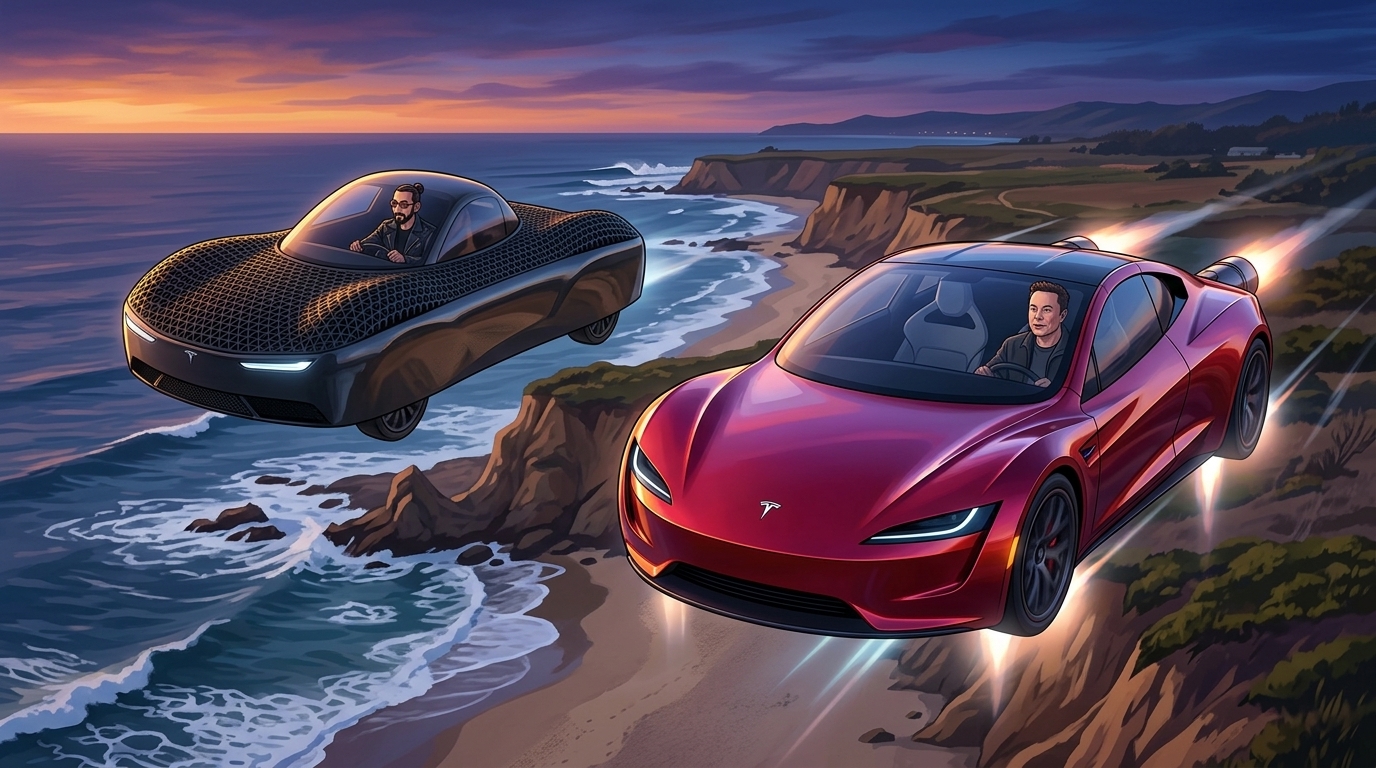
California has spent decades trying to solve traffic. Alef Aeronautics would prefer to rise above the discussion. In Half Moon Bay, the flying-car developer has demonstrated something more persuasive than a glossy rendering: a brief passenger-carrying lift into the air. The video below documents a roughly 15-second airborne experience, offering a modest but tangible advance for an idea that has spent much of its existence waiting for engineering to catch up with imagination.
Meanwhile, Tesla (TSLA) has unveiled a new Roadster demonstration featuring compressed-air propulsion and airborne maneuvers. The two efforts pursue different versions of the same compelling proposition: the boundary between automobiles and aircraft is becoming a place for serious engineering rather than merely ambitious screenwriting.
For many watching the next transportation frontier, the bullish case is not that tomorrow’s commute will require an altitude assignment. It is that working demonstrations, premium product strategies and increasingly substantive ties between automotive and aerospace businesses are giving an old dream a more credible commercial foundation.
Alef’s Flying Car Moves Beyond the Rendering
Alef’s appeal begins with its ambition to combine familiar road transportation with vertical takeoff. The company describes its vehicle as designed to drive on streets, lift vertically and travel above obstacles. Its published history says a full-size prototype first flew in 2019, following four years of research and development. The recent passenger demonstration adds a human dimension to that development history. The above video shows the lightweight, mesh-bodied vehicle and explains how the open structure allows air to reach propellers within the body. It is an unconventional silhouette, but conventional styling has rarely been the first priority when persuading a car to leave the ground. The distinction matters. A rendering demonstrates design intent. A controlled flight demonstrates a measure of technical execution. Neither establishes a scalable business, but the latter gives engineers, prospective customers and potential financial backers something more substantial to evaluate. Alef’s expected price is $299,999, according to its reservation page. General-queue reservations require $150, while priority reservations require $1,500. That positions the proposed product as a premium purchase, not an immediate replacement for the family crossover. Commercially, that can be a sensible starting point. The bullish interpretation is that Alef does not initially need to win the entire automobile market. It needs to establish that a smaller group of customers will pay meaningfully for a capability ordinary cars cannot provide.
Reservations Show Interest, Not Recognized Revenue
Alef’s press page highlights a company-reported figure of 3,600 preorders with a stated value of approximately $1 billion. That is an attention-getting indication of interest, but its meaning depends on the reservation terms. Those terms are explicit: deposits are refundable before a purchase agreement is signed, neither party is obligated to complete a vehicle transaction, and reservations do not guarantee pricing, a production slot or a delivery date. Announced features can also change. The constructive reading is straightforward. Alef has attracted an audience willing to put down money for a proposed flying car. The next value-creating step is converting that enthusiasm into completed, approved and economically viable deliveries. A reservation queue is a promising opening chapter. It is not yet an income statement.
Tesla’s Flying Roadster Gives the Category a Powerful Spotlight
Tesla’s new Roadster brings a different commercial strategy to the conversation: extreme performance paired with aerospace-derived technology. The above October video describes a demonstration at a SpaceX test site in Texas, with compressed-air thrusters supporting airborne maneuvers. It also reports Tesla’s acceleration claim of approximately one second from zero to 60 miles per hour and a production target of 2028. These remain company claims and targets, not established customer-delivery results. The product distinctions deserve particular attention. The video describes a two-seat road version, a thruster-equipped version and a single-seat flying version that is not permitted on public roads and would be offered by invitation. It reports reservation amounts of $50,000 for the road car and $250,000 for the thruster version, without identifying final purchase prices. Calling every version a street-legal flying car would therefore outrun the evidence. A controlled airborne maneuver is also not equivalent to sustained, practical aerial transportation. Still, the strategic opportunity is appealing. A spectacular flagship can serve as a technology showcase and a source of brand attention even before it becomes a meaningful contributor to revenue. For Tesla, the Roadster offers a way to reconnect electric propulsion with aspiration, performance and engineering theater. Most automakers promise an engaging driving experience. Tesla is exploring whether the engagement should include gravity.
Tesla and SpaceX Already Share More Than a Chief Executive
The strongest business connection between Tesla and SpaceX (SPCX) is not a stunt. It is documented capital and commercial activity. Tesla’s amended annual filing states that its planned investment in xAI became an investment in SpaceX following SpaceX’s acquisition of xAI Holdings. Tesla completed approximately $2 billion of purchases of SpaceX Class A common stock on March 12, 2026. Tesla’s first-quarter filing describes that holding as less than 1% of SpaceX. It also reports $87 million of revenue from SpaceX’s purchases of Megapack energy-storage products during the quarter. By the end of the second quarter, Tesla reported $405 million of first-half revenue from SpaceX’s Megapack purchases, including $318 million in the second quarter alone. These are recognized product revenues, a more substantial connection than shared branding or overlapping ambition. The relationship also extends into proposed semiconductor manufacturing. Tesla’s first-quarter update describes a SpaceX partnership aimed at developing a very large chip-manufacturing operation, beginning with a Tesla-owned research fab at its Texas campus. That remains an execution-intensive undertaking, but it illustrates how the collaboration reaches beyond vehicles and rockets. For many, this is the more durable bullish theme: energy storage, computing infrastructure and advanced manufacturing can create business opportunities whether or not flying cars become a mainstream transportation category.
Could Tesla and SpaceX Merge?
A potential Tesla-SpaceX combination is more than an abstract talking point in the available filings. SpaceX’s third-quarter Form 10-Q explicitly identifies the evaluation of a potential combination with Tesla. The same filing cautions that there is uncertainty over whether discussions will continue, whether an agreement will be reached and whether a transaction will ultimately occur. That distinction is essential. An evaluation is not a signed merger agreement, and an attractive strategic narrative does not establish acceptable transaction terms. The potential industrial logic is nevertheless easy to understand. The companies already have an equity relationship, energy-storage transactions and a stated semiconductor collaboration. A combination could, in principle, bring more of those activities under one corporate structure. Whether that would create value would depend on valuation, governance, financing, integration and the treatment of each company’s shareholders. A merger is therefore best viewed as a possible catalyst, not the foundation of the bullish thesis. The existing commercial relationship already gives many something concrete to assess.
The Next Breakthrough Is Repeatability
The central challenge for flying cars is no longer simply producing a memorable moment. In the supplied Alef report, San Jose State aviation instructor Scott Miller questions how quickly a vehicle can become sufficiently practical and durable for both road and air use. Alef’s press materials also describe its FAA authorization in the context of testing, which should not be confused with unrestricted commercial operation. That leaves a clear sequence of milestones: repeatable flight performance, appropriate operating approvals, manufacturable designs, reliable deliveries and sustainable economics. For Alef, progress means turning a striking technical demonstration into a deliverable product. For Tesla, it means translating the Roadster’s performance promises into production. For Tesla and SpaceX together, the larger opportunity may lie in the less photogenic work of supplying energy systems, developing computing capacity and improving manufacturing. The bullish case does not require declaring the traffic jam obsolete. It requires recognizing that several previously separate engineering disciplines are beginning to produce visible, testable results. Flying cars have finally become interesting enough to demand more than applause. They deserve close attention to the next set of milestones.
The Sources
- CBS Evening News, “Taking a ride in a flying car,” November 16, 2026, supplied video and transcriptyoutu
- ABC News, “Elon Musk unveils Tesla’s new Roadster, and it can fly,” October 16, 2026, supplied video and transcript.youtu
- Alef Aeronautics, official vehicle-development overview.alef
- Alef Aeronautics, “History of Alef,” including prototype development and flight history.alef
- Alef Aeronautics, official preorder page, expected pricing and reservation amounts.alef
- Alef Aeronautics, press and news page, including company-reported preorder interest and testing announcements.alef
- Alef Aeronautics, “Preorder Terms and Conditions,” including refundability, purchase obligations and delivery limitations.alef
- SEC.gov, Tesla Form 10-K/A for the year ended December 31, 2025, including related-party transactions and the SpaceX equity investment.sec
- SEC.gov, Tesla Form 10-Q for the quarter ended March 31, 2026, including SpaceX ownership and Megapack transactions.sec
- SEC.gov, Tesla Form 10-Q for the quarter ended June 30, 2026, including first-half SpaceX commercial activity.sec
- SEC.gov, Tesla first-quarter 2026 update, Exhibit 99.1, including the stated semiconductor-manufacturing partnership.sec
- SEC.gov, Space Exploration Technologies Corp. Form 10-Q for the quarter ended September 30, 2026, including its trading symbol and evaluation of a potential Tesla combination.sec
Stay Updated with Vista Partners
Subscribe to receive market insights, investing ideas, and the latest updates directly in your inbox.