Flight 15 Puts the Economics of Reusable Rockets in Focus
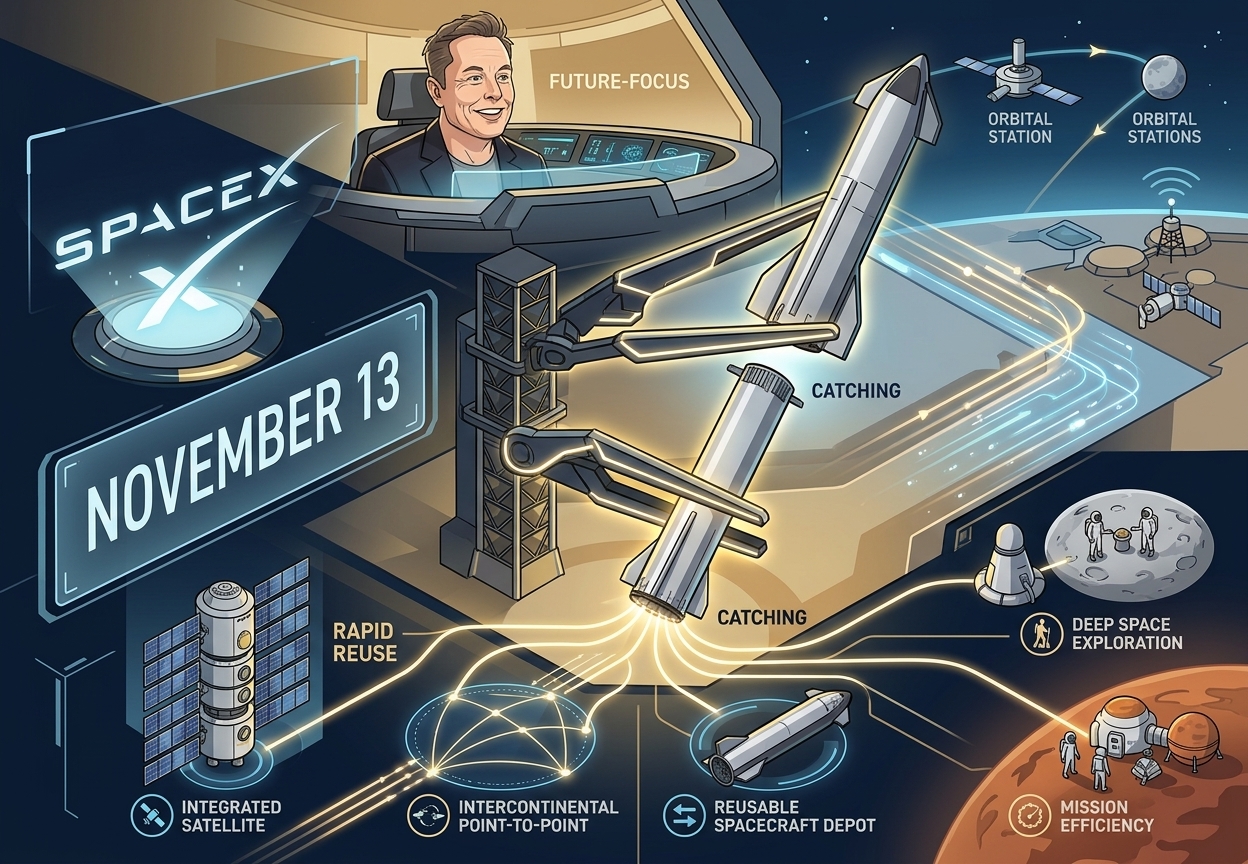
SpaceX (NASDAQ: SPCX) is preparing for a test that could bring its most ambitious rocket closer to becoming its most consequential business asset. Starship Flight 15 is targeting a November 13 launch from Starbase, Texas, with plans to deploy 26 next-generation Starlink satellites and attempt something the company has never accomplished: recovering both the Super Heavy booster and the Starship upper stage at the launch site on the same mission. The launch window opens at 5:45 p.m. Eastern, pending regulatory approval and operational readiness. For many following SpaceX stock, the attraction is not simply the prospect of two enormous vehicles returning to mechanical arms. It is the possibility that SpaceX can turn more of its launch hardware from an expensive manufacturing requirement into a repeatedly productive asset. That distinction separates a memorable engineering demonstration from a potentially powerful economic advantage. The spectacle may command the screen. The cost structure deserves the closer look. There is also an important timing detail: the “double catch” is not scheduled as a single Friday-night performance. Super Heavy’s catch is planned roughly six and a half minutes after liftoff, while Starship’s return is targeted more than 22 hours into the mission. A successful flight would therefore require both an impressive opening act and an unusually demanding encore.
Why Starship Reusability Matters for SpaceX Stock
The bullish case for Starship rests on a straightforward proposition: recovering both stages could reduce the amount of major flight hardware SpaceX must build for each successive mission. Flight 15 is designed to move that proposition forward. SpaceX says three earlier-generation Super Heavy boosters have already been caught, with two demonstrating successful reflights. This mission would introduce a catch attempt for the V3 booster while pursuing the first return and tower catch of the Starship upper stage. Those are separate technical milestones with a shared commercial purpose. Booster recovery preserves the first stage. Upper-stage recovery could extend that approach to the spacecraft that reaches orbit. Still, recovery is not the same as rapid reuse, and rapid reuse is not automatically low-cost reuse. The next economic questions concern inspection requirements, refurbishment, hardware life and turnaround time. SpaceX’s third-quarter SEC filing identifies recovery, reuse milestones and launch cadence as forward-looking development objectives rather than completed business outcomes. That leaves a meaningful runway for progress. A successful catch would not settle every question about Starship’s economics, but it could remove an important uncertainty from a program whose value depends on repetition. In this business, the truly elegant landing is the one that eventually makes the next departure less expensive.
Starlink V3 Gives Flight 15 an Immediate Commercial Purpose
The most tangible commercial objective aboard Flight 15 is its planned deployment of 26 Starlink V3 satellites. According to SpaceX, each satellite is designed to add one terabit per second of network capacity. The company estimates that the full Flight 15 payload represents approximately the capacity delivered by 10 Falcon 9 launches carrying Starlink V2 Mini satellites. After deployment, orbit raising and on-orbit checks, the satellites could begin serving customers within a few weeks. That comparison explains why Starship matters beyond launch-market prestige. A rocket capable of deploying substantially more communications capacity per mission could help SpaceX expand its network with fewer launches for a given amount of added capacity. Capacity, however, is not revenue by itself. Geography, customer demand, service pricing, ground infrastructure and network utilization determine how effectively those satellites become productive commercial assets. SpaceX’s operating figures nevertheless show a substantial customer base awaiting further network expansion. Its third-quarter Form 10-Q reported 13.6 million Starlink consumer subscribers at September 30, 2026, compared with 7.2 million a year earlier. Connectivity revenue increased 69.5% year over year in the quarter, supported by consumer growth and enterprise and government business. The relationship is the heart of the bullish thesis: Starship can expand the infrastructure supporting an already growing connectivity operation, rather than depending entirely on customers who have yet to appear.
The Financial Story Is Becoming More Substantial
SpaceX’s third-quarter results give the launch narrative a financial foundation. For the three months ended September 30, 2026, the company reported consolidated revenue of $14.575 billion, operating income of $2.791 billion and net income of $4.404 billion. Those figures describe the consolidated company, not Starlink alone, and net income also reflected nonoperating items and a tax benefit. The connectivity business provides a more focused view of the opportunity tied to Starlink deployment. Its third-quarter revenue growth included an additional $1.135 billion from consumer subscribers and $1.016 billion from enterprise and government business, with aircraft activations a principal contributor to the latter increase. The expansion was already visible in the preceding quarter. SpaceX’s second-quarter filing reported connectivity revenue growth of 65.8%, driven by subscriber additions and growth across government, aviation, maritime and other enterprise business. There is a useful qualification beneath those growth rates. Third-quarter consumer average revenue per user declined 16.9% year over year as SpaceX expanded internationally and introduced lower-priced plans. That is not necessarily an obstacle to the bull case. Lower prices can widen the addressable market. But they raise the importance of efficient capacity deployment and disciplined service economics. Starship’s promise becomes more commercially relevant when the network is adding customers while collecting less revenue per consumer on average.
Flight 15 Builds on a Measurable Development Sequence
Starship’s latest mission is not beginning from a blank launchpad. On Flight 13 in July, SpaceX deployed 20 Starlink V3 satellites on a test trajectory. Those satellites were expected to reenter shortly after deployment, making the mission a demonstration of deployment systems and communications rather than a lasting addition to the operating constellation. Starship subsequently completed a controlled ocean splashdown. Flight 14 in September advanced the program to orbit and deployed 26 Starlink V3 satellites as a meaningful orbital payload. Flight 15 now seeks to combine another operational satellite deployment with recovery of both stages. The sequence matters because it separates distinct accomplishments: releasing satellites, placing useful payloads in orbit and recovering the vehicles that deliver them. SpaceX’s SEC-filed June materials had identified orbital payload delivery in the second half of 2026 as a development objective. The subsequent missions provide concrete milestones against that earlier roadmap. For many evaluating the company, that progression offers a more useful framework than treating each launch as a binary referendum on the entire enterprise.
A Large Capital Base Supports an Expensive Ambition
SpaceX entered public markets with considerable financial resources. Its June IPO pricing announcement set an offering price of $135 per share and identified SPCX as the trading symbol. The subsequent closing announcement reported approximately $85.7 billion in gross proceeds, including the underwriters’ exercised option, with trading having begun June 12. By September 30, the company reported $51.294 billion in cash and cash equivalents and $38.561 billion in marketable securities. Those balances should not be confused with surplus cash available solely for Starship, since SpaceX has significant obligations and competing investment requirements. They nevertheless demonstrate the scale of its financial resources. The company also announced its inaugural senior unsecured note offering in June, adding another potential financing channel to its capital-market toolkit. Money cannot repeal the laws of thermodynamics. It can, however, fund more engineering, manufacturing capacity and testing while those laws are being negotiated with considerable persistence.
Government Applications Broaden the Strategic Picture
Commercial broadband is not the only business that can benefit from SpaceX’s combination of launch capability and satellite infrastructure. The company describes Starshield as a government-focused system that draws on Starlink technology and SpaceX launch capabilities to support national-security requirements. That creates a broader strategic context for improvements in launch capacity and deployment efficiency. A more capable transportation system could support multiple categories of space infrastructure, although Flight 15 itself is a Starlink deployment and recovery mission, not a demonstration of every potential government application. The same discipline should apply to the orbital-computing narrative. SpaceX has described orbital AI compute infrastructure in its offering materials, but ambition and established commercial economics remain different categories. The nearer-term case for Flight 15 is easier to assess: useful satellites delivered, flight systems validated and hardware potentially recovered.
The Next Questions Are Turnaround, Reliability and Monetization
A constructive view of SpaceX stock does not require overlooking the mission’s difficulty. SpaceX says Starship will return to Starbase only if critical systems satisfy the conditions required for reentry, the landing burn and the final tower approach. Three of the mission’s satellites carry cameras intended to examine the spacecraft’s heatshield, providing another source of information for the return decision. The company’s catch explanation also describes an initially passively safe suborbital trajectory, followed by a decision on whether to proceed to orbit. During the extended orbital coast, teams plan continued checks of propulsion, power, communications, navigation, structural integrity and vehicle control. Those safeguards mean a mission can produce valuable results without achieving every headline objective. Deploying satellites while declining an unsafe return would have a different commercial meaning from a failed ascent or payload loss.
After any successful recovery, the next questions become more demanding:
- How much work is required before the recovered hardware can fly again?
- How consistently can SpaceX repeat the full mission?
- How quickly does added Starlink capacity translate into service quality, customer growth and revenue?
- How do launch and refurbishment costs evolve as flight frequency increases?
These are the questions that can convert an engineering milestone into a durable stock-market thesis.
The Bull Case: A Rocket That Strengthens the Business Beneath It
Starship Flight 15 offers SpaceX a chance to demonstrate more than a dramatic return to Earth. It could show progress toward a launch system that delivers substantial network capacity while preserving both of its principal flight vehicles. The opportunity is especially compelling because the supporting business is already expanding. Starlink’s growing subscriber base and connectivity revenue provide an existing commercial destination for additional capacity, while SpaceX’s capital resources support the long development effort required to improve the transportation system behind it. A successful mission would not establish a definitive valuation for SPCX or guarantee rapid, inexpensive reuse. It would strengthen a more specific proposition: SpaceX may be moving closer to operating a space-infrastructure platform in which better rockets help build a larger network, and a larger network gives those rockets more productive work. For many watching the launch, the catches will be the unforgettable images. The more consequential achievement may be making the extraordinary a little more repeatable.
The Sources
- SpaceX: Starship Flight 15 mission objectives, launch window and flight timeline
- SEC.gov: SpaceX Form 10-Q for the quarter ended September 30, 2026
- SEC.gov: SpaceX Form 10-Q for the quarter ended June 30, 2026
- SpaceX: Returning Starship to the Launch Site
- SpaceX: Starship’s Thirteenth Flight Test
- SpaceX: Starship Flight 14
- SpaceX: Initial Public Offering Pricing Announcement
- SpaceX: Closing of Initial Public Offering and Exercise of Underwriters’ Option
- SpaceX: Inaugural Bond Issuance Announcement
- SpaceX: Starshield Government Satellite Network
- SEC.gov: SpaceX Rule 433 Filing, June Offering Materials
- SpaceX: Australian Offering Document and Form S-1
Stay Updated with Vista Partners
Subscribe to receive market insights, investing ideas, and the latest updates directly in your inbox.