Claude’s Explosive Expansion Points to an Enterprise Market Still Taking Shape
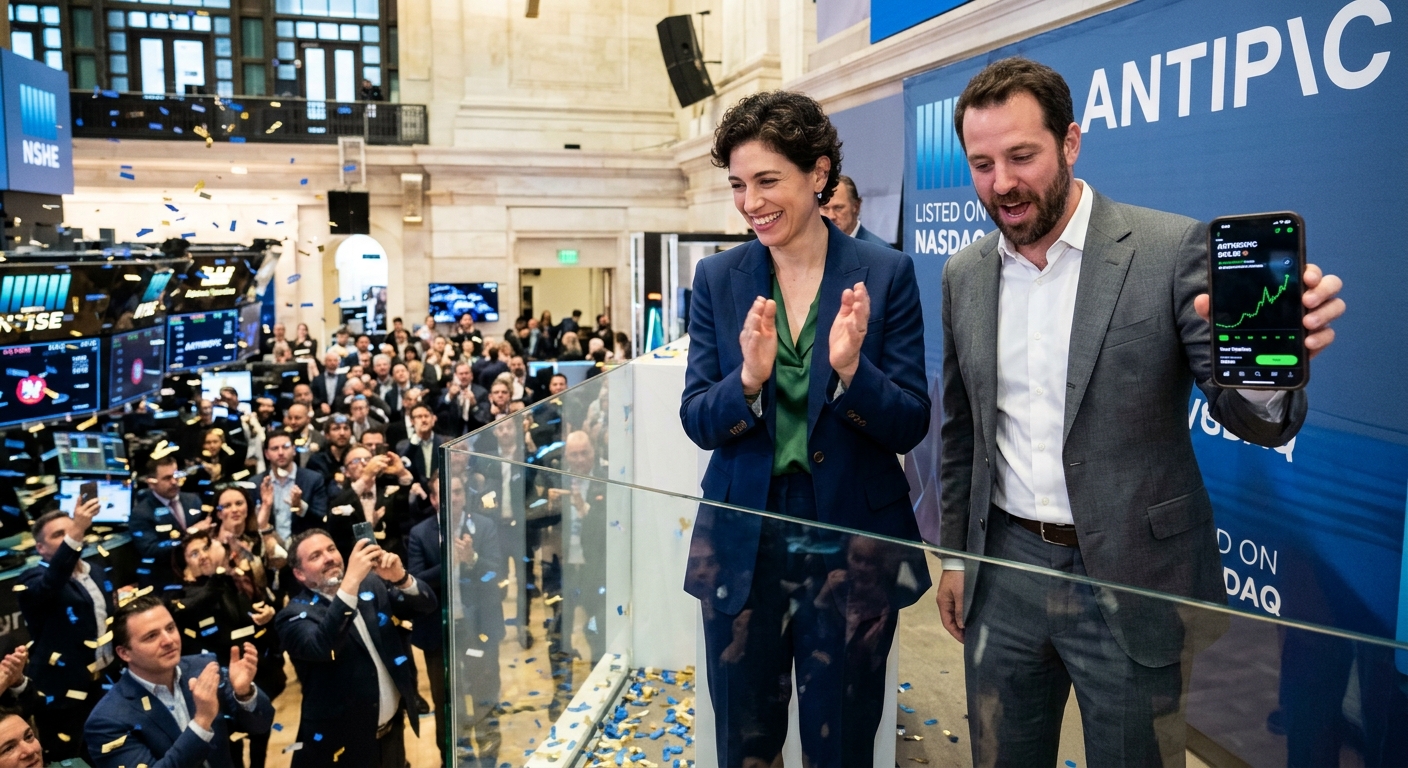
Anthropic’s proposed initial public offering is giving Wall Street something more substantial than another artificial intelligence demonstration: a rapidly expanding business with billions in revenue, deepening corporate relationships and a balance sheet built for an unusually expensive race. The company behind Claude filed its registration statement on October 26 and intends to list on the Nasdaq Global Select Market under the proposed symbol ANT. The offering’s share count and price range have not yet been determined. But the commercial trajectory is already commanding attention: first-half 2026 revenue reached approximately $16.3 billion, representing year-over-year growth of about 1,300%. Even in technology, that is a figure that encourages a second look at the spreadsheet. For Robinhood Markets (NASDAQ: HOOD), the significance extends beyond a potential trading debut. Its expanding brokerage platform and private-market business place it near the intersection of AI company formation, public-market access and demand for exposure to emerging technology leaders. Robinhood Ventures Fund I (NYSE: RVI) already holds positions in private companies including OpenAI and Databricks. The bullish case is not simply that another AI company wants to ring an opening bell. It is that enterprise AI spending is becoming large enough to support consequential businesses across models, cloud infrastructure, custom chips and financial distribution.
Anthropic’s Revenue Growth Moves the Debate Beyond AI Curiosity
Anthropic’s disclosed revenue progression gives the growth story a concrete foundation. The company generated $41 million in revenue in 2023, $386 million in 2024 and $4.6 billion in 2025, according to reporting on its registration statement. Revenue then reached $16.3 billion in the first six months of 2026 alone. The company also cautioned that comparable growth rates should not be expected to continue indefinitely. That caution belongs in the analysis, but it does not erase the underlying achievement. Anthropic has moved from an emerging laboratory to a business generating substantial commercial revenue in a remarkably compressed period. Its enterprise penetration adds another dimension. Reuters reported that more than half of Fortune 500 companies are Anthropic customers, each generating more than $100,000 in annual revenue for the company. That suggests Claude’s commercial reach extends beyond experimental subscriptions and into meaningful corporate spending. The distinction matters. A product can attract enthusiastic users without becoming essential to a corporate budget. Anthropic’s revenue and customer disclosures suggest it is increasingly competing for the latter. Corporate purchasing departments are not famous for spontaneous romance. Sustained spending is generally the more persuasive compliment.
The Customer Opportunity That Caught Robinhood’s CFO’s Attention
Robinhood Chief Financial Officer Shiv Verma focused on two features of Anthropic’s prospectus: extraordinary revenue growth and the distribution of customer spending. In a recent interview, he highlighted that approximately 250 customers were spending more than $10 million annually, interpreting that cohort as evidence of a potentially much larger addressable market. The attraction is easy to understand. Anthropic does not need every corporate customer to become a $10 million account for its business to expand materially. Growth can come from a combination of new customers, wider deployment within existing organizations and higher usage as AI moves into additional workflows. That is an analytical opportunity, not a forecast. A large enterprise customer base establishes distribution, but future spending still depends on product performance, pricing and measurable business value. Reuters reported that roughly 80% of Anthropic’s revenue comes from token consumption rather than flat subscriptions. Tokens are the units of text or other information processed by AI models. This creates an attractive connection between actual usage and revenue, while also making results sensitive to consumption patterns and pricing changes. For many watching the AI sector, that is the central question: can a useful tool become a recurring operating expense that companies willingly expand? Anthropic’s disclosed growth provides encouraging evidence, even if the next chapter will require more than extrapolating a spectacular percentage.
The $80.7 Billion Loss Requires More Than a Headline
Anthropic’s first-half net loss of approximately $80.7 billion is large enough to interrupt even the most cheerful IPO presentation. But its composition is essential to understanding the business. Reuters reported that approximately $72.4 billion reflected a noncash fair-value adjustment associated with convertible financing instruments. That accounting charge is not equivalent to cash spent operating the company. Separately, Anthropic recorded an operating loss of approximately $693 million for the first half and operating income of $974 million in the second quarter. Those distinctions prevent two opposite mistakes: treating the entire net loss as operating cash burn, or pretending that a noncash charge makes every remaining expense irrelevant. The cash-flow figures offer a more constructive perspective. Anthropic generated approximately $3.9 billion of operating cash flow during the first half and held roughly $132 billion in cash and short-term investments, according to Reuters’ examination of the filing. That is substantial financial capacity. It is not proof that future infrastructure spending will earn attractive returns, but it gives the company resources to pursue expansion without relying solely on the proceeds of its proposed IPO. The balance sheet, in other words, has arrived dressed for the occasion.
Amazon, Alphabet and Broadcom Make the AI Opportunity Broader Than One Stock
Anthropic’s expansion also carries implications for Amazon (NASDAQ: AMZN), Alphabet (NASDAQ: GOOGL, GOOG) and Broadcom (NASDAQ: AVGO), whose infrastructure relationships connect Claude’s growth to the wider AI supply chain. In April, Anthropic announced an expanded agreement with Amazon securing access to as much as 5 gigawatts of capacity for training and deploying Claude. The arrangement includes a commitment to spend more than $100 billion over ten years on Amazon Web Services technologies. Amazon separately announced an immediate $5 billion investment in Anthropic, with up to an additional $20 billion tied to future commercial milestones. That followed $8 billion previously invested. Anthropic also expanded its partnership with Google and Broadcom for multiple gigawatts of next-generation tensor processing unit capacity expected to begin coming online in 2027. TPUs are specialized processors designed for AI workloads. These relationships illustrate why Anthropic’s commercial performance matters beyond its own proposed shares. Growing model usage can support demand for cloud services and specialized computing infrastructure. They also introduce an important limitation. Reuters reported that cloud providers including Amazon and Google control roughly half of Anthropic’s revenue through distribution channels. Those partners provide reach and capacity, but Anthropic’s dependence on them remains a meaningful business consideration. The opportunity is broad. So are the interdependencies.
Robinhood’s AI Angle Combines Access, Activity and Private-Market Exposure
Robinhood’s connection to the story has two distinct parts, and keeping them separate makes the thesis stronger. First is the operating company. Robinhood reported third-quarter revenue of $1.424 billion, up 12% from a year earlier, alongside 28.7 million funded customers and $396 billion in total platform assets. Gold subscriptions reached 5.2 million, up 34%. Those figures describe a financial platform with a growing customer and asset base. A prominent AI listing could create an additional engagement opportunity, although Robinhood has not established an Anthropic-specific revenue benefit. Second is Robinhood Ventures Fund I, a separately traded closed-end fund. RVI purchased approximately $75 million of OpenAI common stock in April and provides exposure to a concentrated portfolio of primarily private businesses. Buying HOOD and buying RVI are therefore different propositions: one is ownership in the financial-services company, while the other is ownership in a fund holding a portfolio of companies. The AI exposure has continued to develop. Fortune reported that Robinhood Ventures invested approximately $10 million in Cognition, the developer of the Devin AI software-engineering product, through RVI. Robinhood’s fund page also identifies OpenAI, Databricks and Mercor among its featured holdings. An Anthropic listing could offer a new public valuation reference for parts of that private AI ecosystem. It would not automatically increase the value of every related company, but it could give the market another substantial business against which to compare revenue growth, margins and spending requirements.
A Stronger Robinhood Business Helps, Even When Crypto Does Not
Robinhood’s latest results also support a broader argument: the company is developing more sources of activity than cryptocurrency trading alone. Third-quarter equities revenue increased 41% year over year to $121 million, options revenue rose 31% to $399 million and event-contract revenue reached $173 million. Cryptocurrency revenue, by contrast, declined 55% to $120 million. That mix matters to the Anthropic discussion. Robinhood does not need every asset category to flourish simultaneously to generate growth. A deeper equities franchise and a larger subscription base can provide additional ways to monetize customer relationships. The quarter was not uniformly positive. Net income declined 14% to $476 million, while diluted earnings per share fell 16% to $0.51. The company also recorded $67 million of unrealized losses primarily associated with the mark-to-market of RVI. Those results demonstrate why private-market exposure should not be confused with a one-way escalator. Still, record quarterly revenue and expanding platform assets give the company a more substantial operating foundation as another major AI business approaches the public market. Barron’s reported that Robinhood entered the fourth quarter with more than $13 billion in October net deposits, including $6 billion associated with the Dell family’s contribution to children’s accounts. The composition matters, but the scale underscores the company’s widening distribution role.
Valuation Will Determine How Much Growth New Shareholders Receive
A compelling business and a compelling entry price are not the same thing. Anthropic has confirmed its proposed listing symbol, but not an offering price or share count. A final assessment of the shares will therefore require terms that are not yet available. The spending obligations also deserve attention. Reuters reported approximately $637 billion in total compute arrangements, combining signed contracts and expected deals. That total should not be treated as an immediate cash payment or as uniformly binding, but it conveys the magnitude of Anthropic’s infrastructure ambitions. The bullish interpretation is that Anthropic is preparing capacity for a much larger business. The competing interpretation is that future demand and pricing must justify extraordinary commitments. Both lead to the same useful test: whether revenue growth, operating performance and cash generation can scale alongside the infrastructure bill. Anthropic’s own warning that its growth rates will moderate is sensible. At this size, sustaining commercial momentum matters more than preserving a percentage that already looks as though it arrived from a different industry.
Enterprise AI Is Becoming a Business Story, Not Just a Technology Story
Anthropic’s proposed IPO brings together several developments that make the AI expansion more tangible: substantial recognized revenue, broad corporate adoption, positive first-half operating cash flow and infrastructure partnerships with some of the largest technology companies. For Robinhood, the opportunity is different but connected. Its growing financial platform offers access to public markets, while RVI provides a separate route into selected private companies developing the next generation of software and AI services. The most persuasive case is therefore not that every AI-linked security must rise. It is that commercial adoption is creating multiple businesses worth evaluating on their own economics. Anthropic supplies the growth story. Amazon, Alphabet and Broadcom help supply the computing capacity. Robinhood supplies a growing financial distribution platform. The technology may be artificial. The corporate spending is increasingly real.
The Sources
- Anthropic, “Anthropic files S-1 with the SEC for proposed initial public offering.”anthropic
- SEC.gov, Anthropic Form S-1 filing index, filed October 26, 2026.sec
- IANS, “AI firm Anthropic files for Nasdaq IPO, reports $16.3 billion half-year revenue.”ians
- Reuters, “Should you invest in Anthropic? Five takeaways from its S-1.”reuters
- SEC.gov, Robinhood Markets Form 8-K, dated October 27, 2026.sec
- Robinhood Markets, Form 8-K and “Robinhood Reports Third Quarter 2026 Results.”investors.robinhood
- Anthropic, “Anthropic expands partnership with Google and Broadcom for multiple gigawatts of next-generation compute.”anthropic
- Anthropic, “Anthropic and Amazon expand compute collaboration.”anthropic
- Amazon, announcement of its additional $5 billion Anthropic investment and expanded collaboration.aboutamazon
- Robinhood, “Robinhood Ventures Fund I (RVI) Announces $75M Investment in OpenAI.”robinhood
- Fortune, “Robinhood bets $10 million on AI coding tool maker Cognition.”fortune
- Robinhood, Robinhood Ventures Fund I portfolio and fund information.robinhood
- Barron’s, “Robinhood is moving beyond crypto. Momentum is building, CFO says.”barrons
Stay Updated with Vista Partners
Subscribe to receive market insights, investing ideas, and the latest updates directly in your inbox.