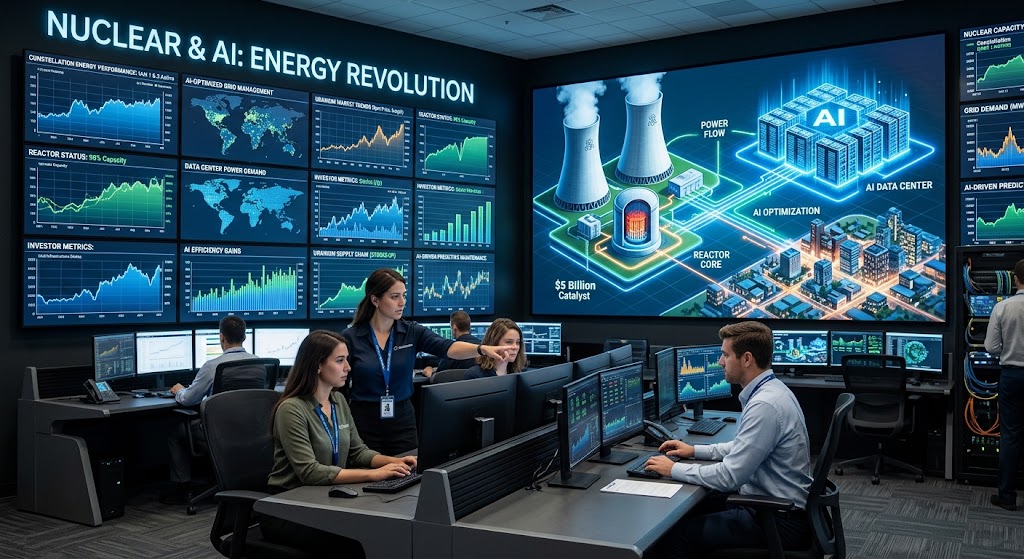
A conditional federal financing commitment puts existing reactors at the center of America’s AI infrastructure race, with implications for NVIDIA, nuclear utilities, uranium producers and critical-minerals suppliers.
America’s artificial intelligence ambitions have encountered an old-fashioned requirement: electricity that arrives when requested. On October 27, Constellation Energy (NASDAQ: CEG) announced a conditional commitment for up to $5 billion in financing from the U.S. Department of Energy to support nuclear plant upgrades. The proposed financing would help expand production from existing reactors, reinforcing an investment thesis that stretches from power generation to uranium, nuclear engineering and the materials needed to connect it all. For many, the operative word is capacity. AI infrastructure needs more of it, established nuclear operators already possess scarce generating assets, and technology companies are signing long-term agreements to secure additional electricity. Constellation says its recent agreements with Alphabet’s Google (NASDAQ: GOOGL, GOOG) and Amazon (NASDAQ: AMZN) have encouraged more than $7 billion of investment targeting approximately 1,080 megawatts of additional nuclear capacity. A separate agreement with Meta Platforms (NASDAQ: META) supports another 30-megawatt expansion at Clinton in Illinois. Silicon Valley has spent years celebrating businesses that scale without much physical infrastructure. Its next chapter appears to require turbines.
What Constellation’s $5 Billion DOE Commitment Actually Means
The announcement is not a completed $5 billion loan, a grant or an unconditional authorization to begin every proposed project. Constellation must complete due diligence, negotiate definitive financing documents and satisfy applicable conditions. The company explicitly states that the commitment does not constitute a final decision to proceed with any individual uprate or every facility under consideration. That distinction strengthens, rather than weakens, a serious investment analysis. The potential opportunity is lower financing costs for projects supported by long-term customer demand, not an immediate windfall. The eight facilities identified for potential financing are:
- Braidwood, Byron, Clinton, Dresden, LaSalle and Quad Cities in Illinois.
- Calvert Cliffs in Maryland.
- Limerick in Pennsylvania.
An uprate increases electricity output from an existing nuclear plant through approved modifications. In the broader Constellation program, planned work includes turbine, steam-generator and digital-control upgrades. The company’s Google-supported projects are expected to begin delivering additional capacity in 2028, while the Amazon-supported Calvert Cliffs expansion is scheduled for 2030 through 2032. The commercial attraction is straightforward: expand the productive capacity of infrastructure that already exists instead of relying entirely on new plants. There is also an important limit to the political sales pitch. Lower project financing costs do not establish that household electricity bills will decline. The Yahoo-carried reporting supplied for this article specifically questions that connection. Investors should distinguish potential financing benefits from unproven consumer-rate outcomes.
Big Tech Is Turning Nuclear Power Into a Long-Duration Infrastructure Business
The significance of the Constellation announcement extends beyond federal financing. Long-term electricity agreements can give nuclear operators greater visibility into future demand and help support major capital commitments. Constellation’s Google and Amazon agreements run for 20 years, aligning substantial technology-sector demand with investments in established power infrastructure. The pattern is visible elsewhere. Talen Energy (NASDAQ: TLN) announced an expanded agreement in June 2025 to supply Amazon with as much as 1,920 megawatts of nuclear electricity through 2042, with extension options. The arrangement supports Amazon’s Pennsylvania data-center operations and allows deliveries to other locations in the state. These contracts do not eliminate operating, regulatory or counterparty risk. They do, however, provide something more useful than a fashionable AI slogan: an identifiable customer and a lengthy purchasing horizon. The investment implication is that nuclear generation can increasingly be evaluated as part of the infrastructure supporting digital growth, not merely as a legacy utility asset.
NVIDIA’s Nuclear Connection Is Becoming More Concrete
NVIDIA (NASDAQ: NVDA) belongs in this discussion for more than its association with AI computing.
On April 23, 2026, Oklo (NYSE: OKLO) announced an agreement with NVIDIA and Los Alamos National Laboratory covering nuclear infrastructure, AI-enabled research and nuclear-fuel development. The collaboration includes modeling, simulation, digital twins and studies related to nuclear-powered AI factories. The relationship introduces a potentially valuable feedback loop: AI tools could help advance nuclear research, while nuclear generation could eventually support AI infrastructure. The distinction between research and commercial operation remains essential. The agreement describes development activities and proof-of-concept work. It is not evidence that an Oklo commercial reactor is already supplying NVIDIA-powered data centers. Still, it illustrates why the AI investment universe is broadening. Accelerators may command the headlines, but electricity availability increasingly belongs in the same strategic conversation. A very capable processor remains a remarkably expensive paperweight during a power interruption.
Existing U.S. Nuclear Operators Offer the Most Established Exposure
The nuclear theme contains several different businesses. An operating utility, a merchant generator and a pre-commercial reactor developer should not be treated as interchangeable securities. For many seeking exposure to existing U.S. nuclear generation, the following companies provide a useful starting universe. The NRC’s operating-reactor directory identifies the licensed operators and facilities, while industry ownership records identify the relevant corporate parents.
Constellation Energy (NASDAQ: CEG)
Constellation is the direct beneficiary of the conditional DOE commitment. Its investment case centers on converting existing nuclear infrastructure, customer contracts and prospective financing into additional output and attractive project economics.
Vistra (NYSE: VST)
Vistra operates U.S. nuclear assets including Beaver Valley and Comanche Peak. Its existing generating fleet provides a different form of exposure from companies still seeking to commercialize reactor designs.
Talen Energy (NASDAQ: TLN)
Talen’s Susquehanna nuclear business and expanded Amazon agreement make it a particularly direct example of the connection between operating nuclear assets and data-center electricity procurement.
Southern Company (NYSE: SO)
Southern’s nuclear operations include Farley, Hatch and Vogtle. Its exposure sits within a broader utility enterprise rather than a narrowly focused nuclear development company.
Duke Energy (NYSE: DUK)
Duke’s nuclear operations include Brunswick and Catawba, placing it among the established public-company routes to U.S. nuclear generation.
Entergy (NYSE: ETR)
Entergy operates Arkansas Nuclear One and other nuclear facilities. Its established operating presence makes it relevant to investors examining nuclear power within the broader utility sector.
Dominion Energy (NYSE: D)
Dominion’s nuclear exposure includes Millstone and Surry. These operating assets offer a fundamentally different starting point from a proposed reactor campus awaiting construction and licensing milestones.
Public Service Enterprise Group (NYSE: PEG)
PSEG Nuclear operates three nuclear units in southern New Jersey and holds a 50% ownership interest in two Pennsylvania nuclear units. It offers another established route to nuclear generation exposure.
NextEra Energy (NYSE: NEE)
NextEra’s nuclear interests include Seabrook and Point Beach. Its nuclear exposure should be evaluated within the economics and capital requirements of the wider company. These companies do not all capture electricity-price changes, capital investment or customer contracts in the same way. The bullish sector thesis is a starting point for company analysis, not a substitute for it.
New Reactors Offer Greater Optionality, With a Longer Checklist
Existing plants can expand production, but the longer-term opportunity also includes new reactor development. Oklo is pursuing advanced reactor commercialization while participating in the NVIDIA and Los Alamos collaboration. That creates exposure to a potentially significant market, but research partnerships and development plans should not be valued as though they were operating power plants. NuScale Power (NYSE: SMR) offers a different business model through its small modular reactor technology. Its commercialization partner, privately held ENTRA1 Energy, announced a collaborative agreement with the Tennessee Valley Authority in September 2025 covering potential deployment of up to six gigawatts of new nuclear generation. ENTRA1 aims to develop and own the plants and sell electricity under future power-purchase agreements. The wording matters: a collaborative development program is not the same as six gigawatts of completed plants, final investment decisions or guaranteed equipment revenue. GE Vernova (NYSE: GEV) provides a more diversified route through nuclear equipment, fuel and services, including its BWRX-300 small modular reactor offering. Many should distinguish that nuclear opportunity from the company’s much broader power-infrastructure business. For the development group, the milestones that deserve attention are concrete:
- Regulatory approvals.
- Binding customer agreements.
- Secured financing.
- Fuel availability.
- Construction progress.
- Commercial operation.
A proposed gigawatt is an opportunity. An operating gigawatt is a business.
Uranium Stocks: The Fuel Behind the Electricity Thesis
A sustained nuclear expansion also creates a logical connection to uranium and the fuel cycle. But uranium mining, conversion, enrichment and reactor-fuel fabrication are distinct activities, with different economics and constraints.
Cameco (NYSE: CCJ; TSX: CCO)
Cameco offers exposure across uranium, fuel services and nuclear technology through its 49% ownership interest in Westinghouse. Its SEC-filed annual disclosures identify those three operating segments, giving investors a broader nuclear-industry position than uranium production alone. Westinghouse also connects Cameco to reactor deployment. An SEC-filed disclosure describes the October 2025 strategic partnership involving Cameco, Brookfield Asset Management (NYSE: BAM; TSX: BAM) and the U.S. government to accelerate deployment of Westinghouse reactor technologies.
Uranium Energy (NYSE American: UEC)
Uranium Energy provides domestic uranium-development exposure. An August 2025 SEC filing describes its Sweetwater initiative in Wyoming, including a permitting effort intended to enable in-situ recovery processing alongside conventional uranium processing. The filing identifies existing licensed capacity of 4.1 million pounds annually, while making clear that the planned dual-feed configuration depends on completing the permitting initiative. Licensed capacity should not be confused with current production or future profits. Execution remains the bridge between the resource and the shareholder.
Centrus Energy (NYSE American: LEU)
Centrus occupies a different part of the chain. Its SEC-filed 2025 annual report describes a business supplying nuclear-fuel components, enrichment and technical services. That makes it relevant to fuel-supply discussions without making it equivalent to a uranium miner. The broader bullish interpretation is that a durable nuclear expansion could create opportunities at several stages of the fuel cycle. The Constellation financing announcement alone, however, does not establish an earnings increase for any particular uranium or enrichment company.
Critical Minerals Add Another Layer to the Opportunity
The nuclear and AI infrastructure themes also intersect with materials processing. Energy Fuels (NYSE American: UUUU; TSX: EFR) provides a particularly direct bridge between uranium and rare earths. Its White Mesa Mill in Utah processes uranium and produces rare-earth products, giving the company exposure to two separate strategic-materials businesses. In August 2025, Energy Fuels reported pilot-scale production of high-purity dysprosium oxide and outlined plans for larger-scale heavy rare-earth separation capacity. The company’s announcement described a development objective, not proof that the proposed commercial expansion had already reached production. Copper provides a separate, broader infrastructure connection. Freeport-McMoRan (NYSE: FCX) is relevant to the electrification theme because data-center and grid expansion require substantial electrical infrastructure. That is an indirect connection to nuclear development, not evidence that Freeport has received business from Constellation’s proposed uprates. These distinctions matter. Uranium is a nuclear fuel input. Rare earths serve separate industrial applications. Copper supports electrical infrastructure. Grouping them into one investment narrative can be useful; pretending they share one demand curve is not.
What Could Interrupt the Bullish Case?
The opportunity is substantial, but investors should monitor where the narrative could outrun the economics. Constellation’s financing remains conditional, and individual projects are not assured. Its planned additions also arrive over several years rather than immediately. Advanced reactor opportunities carry a different timing problem. Research collaborations, development agreements and prospective power purchases must progress into licensed, financed and operating projects before they can support mature utility-style cash flow. For mining and processing companies, permitting and successful expansion matter as much as the direction of the nuclear narrative. Uranium Energy’s Sweetwater filing and Energy Fuels’ rare-earth announcement both illustrate the distance between a defined opportunity and completed commercial execution.
Valuation adds another discipline: a compelling industry outlook does not automatically make every related stock attractive at every price.
The Case: AI’s Next Constraint May Favor Physical Assets
Constellation’s conditional DOE commitment highlights a potentially important shift in the AI investment story. Long-term technology-sector electricity demand is supporting investment in nuclear assets that already exist, while advanced-reactor developers and fuel suppliers pursue the next stage of growth. The most defensible bullish thesis is therefore broader than “buy nuclear.” It is to identify businesses that control scarce operating capacity, secure durable customers, supply essential fuel or convert development plans into commercially productive infrastructure. The technology industry may continue to sell intelligence by the token. The companies supplying its electricity will still expect payment by the megawatt-hour.
The Sources
- Constellation Secures Conditional DOE Loan Commitment of up to $5 Billion to Expand Nuclear Output
- Energy Department Announces $5 Billion Loan to Boost Nuclear Power and Help Lower Costs
- U.S. Energy Department Offers Constellation $5B to Accelerate Nuclear Plant Uprates
- DOE Offers Constellation Up to $5B Loan for 1.1 GW of Nuclear Uprates at Eight Plants
- Trump DOE Loans $5B to Nuclear Plants That Will Power Data Centers
- Talen Energy Expands Nuclear Energy Relationship With Amazon
- Oklo, NVIDIA, and Los Alamos National Laboratory Collaborate to Advance Nuclear Fuel Validation at Los Alamos in Support of Nuclear-Powered AI Factories
- List of Power Reactor Units
- U.S. Nuclear Plant Owners and Operators
- Powering Data
- PSEG Power and Other
- ENTRA1 and NuScale Partnership
- TVA and ENTRA1 Energy Announce Collaborative Agreement in Landmark 6-Gigawatt NuScale SMR Deployment Program
- NVIDIA, Oklo, NuScale and GE Vernova: The Case for AI Power Infrastructure
- Cameco 2025 Annual Information Form, Exhibit 99.1
- Cameco 2025 Annual Report
- Cameco Material Change Report, Exhibit 99.1
- Brookfield Asset Management Form 8-K, October 28, 2025
- Uranium Energy Form 8-K, August 5, 2025
- Centrus Energy 2025 Annual Report
- Energy Fuels Announces Q1 2026 Results
- Energy Fuels Successfully Produces First Kilogram of 99.9% Purity Dysprosium Oxide at Its White Mesa Mill in Utah
- How Copper Price Recovery and AI-Driven Demand Are Shaping Freeport-McMoRan’s Investment Narrative
- The Copper Constraint Behind the Data-Center Boom
- Constellation Secures Conditional DOE Loan Commitment of up to $5 Billion to Expand Nuclear Output
Stay Updated with Vista Partners
Subscribe to receive market insights, investing ideas, and the latest updates directly in your inbox.