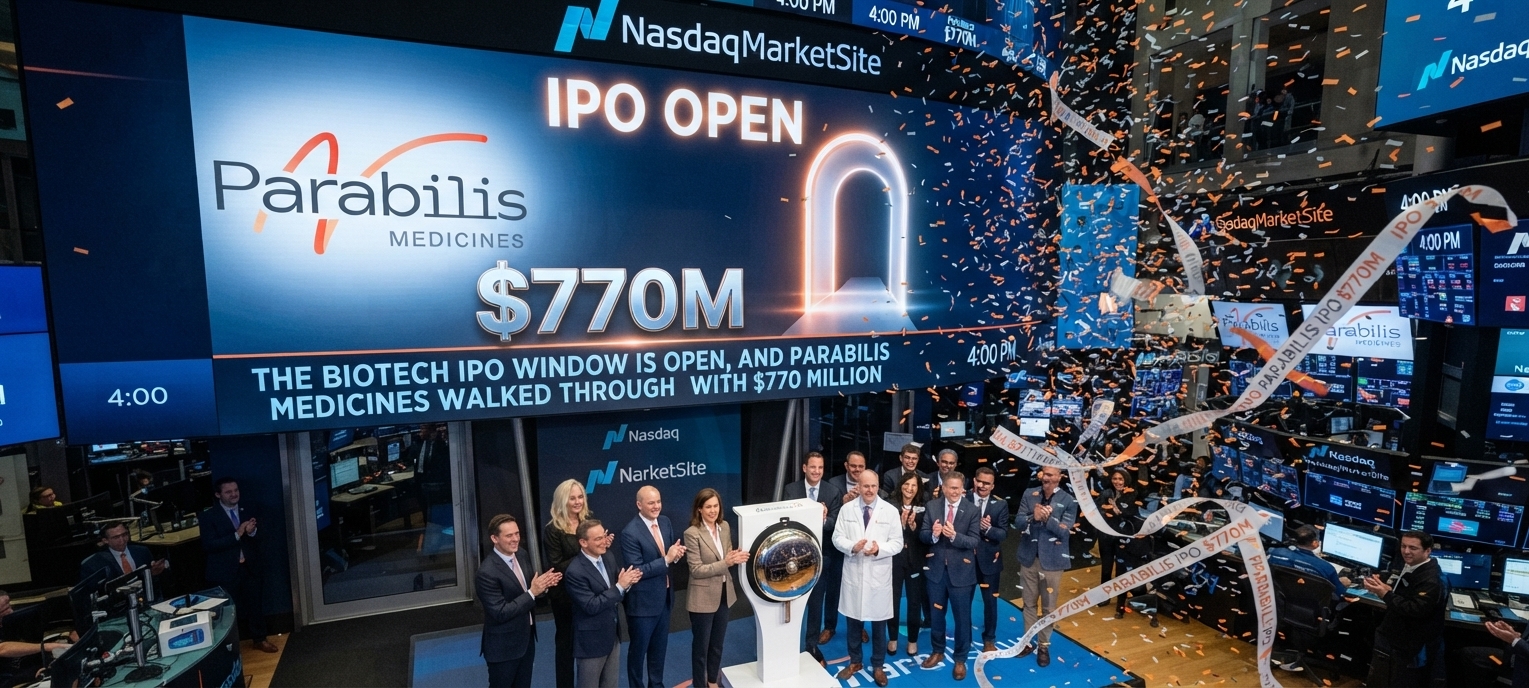
Parabilis Medicines, Inc. (NASDAQ: PBLS) entered public markets with the kind of financial runway, strategic endorsement and clinical ambition that tends to make biotech investors sit up straighter in their Aeron chairs. The Cambridge-based clinical-stage company is pursuing a deceptively simple proposition: use a new therapeutic modality to drug intracellular protein targets that conventional medicines have struggled to reach. Its June 2026 Nasdaq debut was not merely successful; it was upsized, fully exercised and augmented by strategic capital from Regeneron Pharmaceuticals, Inc. (NASDAQ: REGN). With a lead program advancing toward a planned registrational Phase 3 study and cash expected to support operations into 2030, Parabilis is presenting investors with an unusually well-capitalized clinical-stage platform story.
A $770.5 Million IPO With a Strategic Encore
Parabilis began trading on the Nasdaq Global Select Market on June 10, 2026, under ticker PBLS, after selling 38.525 million shares at $20 each. The total included full exercise of the underwriters’ 5.025 million-share overallotment option, producing gross IPO proceeds of approximately $770.5 million before fees and expenses. The company then added a $75 million concurrent private placement with Regeneron, which purchased 4.167 million shares at $18 per share. This was more than a balance-sheet embellishment. It aligned Parabilis with one of biopharma’s most respected drug developers while helping validate the strategic relevance of its proprietary Helicon™ platform. By the end of the second quarter, Parabilis reported $1.1 billion in cash, cash equivalents and marketable securities, compared with $27.7 million at year-end 2025. Management expects that capital position to fund operations into 2030, a rare luxury in clinical-stage biotech, where the phrase “cash runway” is often followed by a small sigh and a larger equity raise.
The Thesis: Helicons and Hard Targets
At the center of the Parabilis investment case is its Helicon™ technology: stabilized alpha-helical peptides designed to engage and modulate biologically important intracellular proteins. The platform is intended to address targets considered difficult, or historically impossible, to reach with conventional small molecules, antibodies or other established approaches. The commercial appeal is straightforward. If Parabilis can repeatedly create drug candidates against high-value intracellular targets, it may have more than a single-asset story. It may have a platform capable of generating multiple medicines across oncology and other serious diseases. The company’s lead investigational medicine, zolucatetide, is described as the first and only direct clinical inhibitor of the β-catenin:TCF interaction. That interaction sits at a central point in the Wnt/β-catenin signaling pathway, a biologically important pathway implicated in several cancers and rare diseases. For many, the attraction is the potential “pipeline-in-a-product” profile:
- Desmoid tumors, where Parabilis plans to discuss its registrational strategy with the U.S. Food and Drug Administration during the fourth quarter of 2026 and remains on track to initiate a planned Phase 3 study in the first half of 2027.
- Familial adenomatous polyposis, or FAP, where the company expected to begin enrollment in a dedicated cohort during the second half of 2026.
- Adamantinomatous craniopharyngioma, or ACP, a rare and locally aggressive tumor associated with substantial morbidity and no approved drug treatment.
- Additional Wnt-driven tumors, including hepatocellular carcinoma and colorectal cancer combinations, alongside other solid-tumor cohorts.
That breadth matters. A successful targeted medicine in rare disease can be important; a medicine with credible expansion opportunities across genetically and biologically linked diseases can be materially more valuable.
Catalysts That Could Keep PBLS on Investors’ Screens
Parabilis has laid out a catalyst-rich calendar, with several events that could sharpen the market’s view of zolucatetide and the wider Helicon platform.
| Expected milestone | Why it matters |
|---|---|
| ESMO 2026 oral presentation, Oct. 23–27 | Parabilis plans to present clinical data from a February data cut in its ongoing Phase 1/2 desmoid-tumor study |
| More mature desmoid data in Q4 2026 | Could provide a clearer picture of durability, response profile and registrational potential |
| FDA engagement in Q4 2026 | A key step toward alignment on the planned registrational Phase 3 study in desmoid tumors |
| Phase 3 start in H1 2027 | Would transition the lead program into its pivotal-development phase, assuming regulatory alignment |
| FAP update in Q1 2027 | Could expand the evidence base for zolucatetide beyond desmoid tumors |
| Additional ACP data in H1 2027 | Provides another genetically anchored clinical-expansion opportunity |
| Regeneron collaboration progress | Offers a second engine of potential value creation around Antibody-Helicon Conjugates |
The company also cited a New England Journal of Medicine correspondence describing a durable clinical and radiologic response in a patient with recurrent ameloblastoma treated with zolucatetide. A single case does not establish broad clinical efficacy, but it provides a useful mechanistic signal in a setting driven by relevant Wnt/β-catenin pathway alterations.
Regeneron Adds More Than Capital
The partnership with Regeneron Pharmaceuticals (NASDAQ: REGN) may be one of the most investor-relevant elements of the Parabilis story. The companies are collaborating to develop Antibody-Helicon Conjugates, which combine Regeneron’s VelocImmune® antibody technologies with Parabilis’ Helicon platform. Parabilis received $125 million in upfront consideration and equity investment, $50 million upfront and a $75 million equity investment, with the collaboration carrying potential development, regulatory and commercial milestone payments of up to approximately $2.2 billion, plus tiered royalties that could reach the low double digits. This does not mean the $2.2 billion will arrive on schedule, or at all; milestone economics are earned only when scientific, clinical, regulatory and commercial hurdles are cleared. But the structure offers a compelling strategic read-through:
- A large-cap drug developer sees enough potential in Helicons to fund a dedicated collaboration.
- The platform has a potential route beyond Parabilis’ wholly owned pipeline.
- If successful, Antibody-Helicon Conjugates could combine tumor-targeting antibodies with medicines aimed at intracellular drivers, a neat way to ask a difficult target to stop hiding indoors.
Experienced Oncology Leadership Joins the Board
Parabilis strengthened its governance in August by appointing Craig L. Tendler, M.D., to its board of directors. Dr. Tendler previously led clinical development and medical affairs for oncology at Johnson & Johnson (NYSE: JNJ)and brings more than 30 years of oncology-development experience. During his tenure at Johnson & Johnson, Dr. Tendler contributed to more than 30 oncology regulatory approvals, 13 FDA Breakthrough Therapy designations and approvals for 15 new molecular entities, according to Parabilis. His background includes work connected to oncology products such as DARZALEX®, CARVYKTI®, TECVAYLI®, TALVEY®, ERLEADA®, RYBREVANT® and BALVERSA®. For Parabilis, the appointment is operationally relevant, not merely decorative. A company approaching potential registrational development in oncology and rare tumors benefits from directors who have navigated late-stage trial design, FDA interactions, launch planning and the occasionally unromantic realities of commercial adoption.
Biotech IPO Market: Capital Has Reopened Its Doors
Parabilis’ public-market debut also belongs to a much broader 2026 revival in biotechnology IPOs. The sector has regained access to equity capital after a comparatively muted period, and the size of several offerings suggests that investors are again willing to finance differentiated science—especially when it comes with meaningful clinical data, credible platform technology or large therapeutic markets. By late September, BioSpace counted 27 newly public biotechs in 2026. The largest reported biotech IPOs included Kailera Therapeutics, Inc. (NASDAQ: KLRA) at $625 million, Parabilis at roughly $670 million in its initial debut as cited in sector coverage, and ADARx Pharmaceuticals, Inc. (NASDAQ: ADRX) at $446.3 million before considering its concurrent strategic private placement.
Parabilis itself reported $770.5 million in gross IPO proceeds after full exercise of the underwriters’ overallotment option. Differences among third-party trackers can arise from whether they count the base deal, the greenshoe, later option exercise, concurrent private placements or other financing components. For many, the practical conclusion is unambiguous: PBLS completed one of the year’s largest biotech equity financings.
Selected 2026 Biotech IPOs Completed
| Company | Ticker | Therapeutic focus | Reported IPO raise |
|---|---|---|---|
| ADARx Pharmaceuticals | NASDAQ: ADRX | RNA interference medicines | $446.25 million at pricing; later reporting indicates the full overallotment brought gross IPO proceeds to approximately $513.2 million |
| Electra Therapeutics | NASDAQ: ETRA | Biotechnology | $350 million |
| Latigo Biotherapeutics | NASDAQ: LTGO | Biotherapeutics | $345.6 million |
| Braveheart Bio | NASDAQ: BRVE | Biotechnology | $382.5 million |
| Kardigan | NASDAQ: KARD | Cardiovascular biotechnology | $400 million |
| Parabilis Medicines | NASDAQ: PBLS | Helicon therapeutics / Wnt biology | $770.5 million, including full underwriters’ option |
| Odyssey Therapeutics | NASDAQ: ODTX | Autoimmune and inflammatory disease | $279 million |
| Hemab Therapeutics | NASDAQ: COAG | Blood-coagulation disorders | $301.5 million |
| Seaport Therapeutics | NASDAQ: SPTX | Neuropsychiatric therapeutics | $254.88 million |
| Kailera Therapeutics | NASDAQ: KLRA | Obesity care | $625 million |
| Generate Biomedicines | NASDAQ: GBIO | AI-enabled drug discovery | $400 million |
| Aktis Oncology | NASDAQ: AKTS | Radiopharmaceutical oncology | $317.7 million |
The table reflects public tracker data and issuer-reported proceeds where available; totals can vary by source because some records include full greenshoe exercise and others capture the original offering only.
Biotech IPOs on File for Late 2026
The fall IPO calendar suggests the sector’s reopening is not a one-quarter curiosity. Several biotech and life-sciences companies had public filings or pending listing processes as of early October 2026, although a filed registration statement is not an assurance that an offering will price or close.
| Company | Proposed ticker | Focus | Status / disclosed target |
|---|---|---|---|
| City Therapeutics | NASDAQ: CTY | RNAi medicines | S-1 filed; tracker lists a $100 million offer size, while reported filings had not yet established final price terms |
| Iambic Therapeutics | NASDAQ: IAM | AI-enabled drug discovery | S-1 filed; no final price range or deal size disclosed in reporting |
| TRex Bio | NASDAQ: TRXB | Immunology | Filed; tracker lists a $100 million offer size |
| Retension Pharmaceuticals | NASDAQ: RTSN | Cardiovascular disease | Filed; tracker lists a $57.5 million offer size |
| Alopexx | NYSE American: ALPX | Biotechnology | Pending; indicated range of $10 to $12 per share and a $36 million offer size |
| Tarsier Pharma | NYSE: TARX | Biotechnology | Pending; indicated range of $8 to $10 per share and a $55.56 million offer size |
| NuvOx Therapeutics | NYSE American: NUOX | Biotechnology | Pending; indicated range of $6 to $8 per share and a $22.88 million offer size |
| Neurospectrum Insights | NYSE American: NSIH | Neuroscience / life sciences | Pending; indicated range of $4 to $5 per share and an $18.75 million offer size |
City Therapeutics, Iambic Therapeutics, TRex Bio and Retension Pharmaceuticals all entered the filing queue during September, reinforcing the view that biotech issuers see an available, if selective, public-market window. Offer sizes shown as “filed” or “pending” are preliminary, may change substantially and should not be treated as final capital raised.
Why PBLS May Stand Out
The biotech market is hospitable again, but not indiscriminate. Many have become more demanding of credible science, substantial financing and clear value-inflection points. On those measures, Parabilis has several attributes working in its favor:
- A major balance sheet: $1.1 billion in cash, cash equivalents and marketable securities as of June 30, 2026, with stated runway into 2030.
- A differentiated modality: Helicons seek to address intracellular proteins that have traditionally proved difficult to drug.
- A lead asset with breadth: Zolucatetide is being studied in multiple Wnt/β-catenin-driven diseases rather than a single narrowly defined indication.
- A credible development path: The company expects FDA engagement in late 2026 and a potential desmoid-tumor Phase 3 start in the first half of 2027.
- Strategic validation: Regeneron’s equity investment and broad Antibody-Helicon Conjugate collaboration provide both financial support and external scientific validation.
- Strengthened board expertise: The addition of Dr. Tendler adds late-stage oncology-development and commercialization experience as the company progresses toward pivotal planning.
A Takeaway
Parabilis Medicines (NASDAQ: PBLS) is not a revenue story today; it is a high-conviction, well-financed clinical and platform story. Its upside rests on proving that zolucatetide can translate early promise into durable clinical benefit and that Helicons can reliably unlock targets that other modalities have left largely untouched. The bullish case is supported by a sizable cash reserve, a lead candidate with several biologically linked expansion routes, a potential registrational milestone ahead, and a strategically meaningful relationship with Regeneron (NASDAQ: REGN). Meanwhile, the 2026 biotech IPO rebound creates a more constructive backdrop for companies that can offer both scientific originality and a credible plan to get from molecule to medicine. Still, many should keep their lab coats buttoned. PBLS remains a clinical-stage biotechnology company, and outcomes will depend on trial data, safety, FDA alignment, execution, competitive developments, intellectual-property durability and the market’s ongoing appetite for long-duration innovation. The company’s cash balance lowers financing risk; it does not repeal the laws of clinical development.
The Sources
- Parabilis Medicines Announces Closing of Upsized Initial Public Offering, Including Full Exercise of Underwriters’ Option to Purchase Additional Shares Parabilis Medicines, June 11, 2026. Covers the company’s $770.5 million gross IPO proceeds, 38.525 million shares sold at $20 per share, the full underwriters’ overallotment exercise and the concurrent $75 million Regeneron private placement.
- Parabilis Medicines Reports Second Quarter 2026 Financial Results and Provides Business Updates Parabilis Medicines, August 13, 2026. Covers Parabilis Medicines’ $1.1 billion cash position, expected operating runway into 2030, zolucatetide’s clinical-development plans, planned FDA meeting and expected Phase 3 timing in desmoid tumors.
- Parabilis Medicines Appoints Accomplished Drug Development Leader Craig L. Tendler, M.D., to Board of Directors Parabilis Medicines, August 25, 2026. Details the appointment of oncology drug-development veteran Craig L. Tendler, M.D., to the Parabilis board.
- Parabilis Medicines Announces Closing of Upsized Initial Public Offering Yahoo Finance / Parabilis Medicines, June 2026. Yahoo Finance distribution of the company’s IPO closing announcement.
- Parabilis Medicines Reports Second Quarter 2026 Financial Results and Provides Business Updates Yahoo Finance / Parabilis Medicines, August 13, 2026. Yahoo Finance distribution of the company’s second-quarter financial and clinical-development update.
- Parabilis Medicines Appoints Accomplished Drug Development Leader Craig L. Tendler, M.D., to Board of Directors Yahoo Finance / Parabilis Medicines, August 25, 2026. Yahoo Finance distribution of the company’s board-appointment announcement.
- Form 8-K: Parabilis Medicines, Inc. U.S. Securities and Exchange Commission filing, August 25, 2026. Confirms the board’s expansion to nine directors and Dr. Tendler’s appointment as a Class II director and member of the Science & Technology Committee.
- ADARx Raises $446M in Biotech’s Third Largest IPO of 2026, City Files to Go Public BioSpace, September 25, 2026. Reviews the 2026 biotechnology IPO environment, ADARx Pharmaceuticals’ financing and City Therapeutics’ public-filing plans.
- 2026 IPO Blitz Continues With Four New Biotech Filings BioSpace, September 22, 2026. Covers the resurgence in biotechnology IPO filings, including Iambic Therapeutics, ADARx Pharmaceuticals and additional late-year filing activity.
- Biotech IPO Calendar 2026: Upcoming Listings, Pricings & SEC Filings BioPharmaWatch, accessed October 3, 2026. Provides a running calendar of biotech IPO pricing activity, S-1 filings, proposed tickers, preliminary offering sizes and pending listings.
- IPO Tracker Life Sciences Perspectives, accessed October 3, 2026. Tracks U.S. life-sciences public offerings, including issuer names, dates, price ranges, deal values and listing status.
- Nvidia, QIA-Backed Iambic Therapeutics Files for U.S. IPO as Biotech Boom Rolls On Reuters, September 21, 2026. Reports on Iambic Therapeutics’ proposed U.S. IPO and the broader late-2026 biotechnology financing environment.
- City Therapeutics Files for U.S. IPO as Biotech Listings Accelerate Reuters, September 2026. Covers City Therapeutics’ S-1 filing and continued momentum in biotechnology capital-markets activity.
- ADARx RNAi Drug Specialist Raises $446 Million IPO BioPharma Dive, September 24, 2026. Reviews ADARx Pharmaceuticals’ upsized public offering and its place in the RNA therapeutics and biotech-IPO markets.
- ADARx Scores Upsized $446 Million IPO, While City Maps Out Its Own Nasdaq Plans Fierce Biotech, September 25, 2026. Discusses ADARx’s IPO, City Therapeutics’ listing intentions and broader investor appetite for RNA-focused biotechnology companies.
- Biotech IPO Tracker 2026: 23 IPOs and Approximately $7.4 Billion Raised BioBucks, updated October 2, 2026. Tracks biotechnology IPOs completed during 2026, reported financing totals and post-listing performance.
Stay Updated with Vista Partners
Subscribe to receive market insights, investing ideas, and the latest updates directly in your inbox.