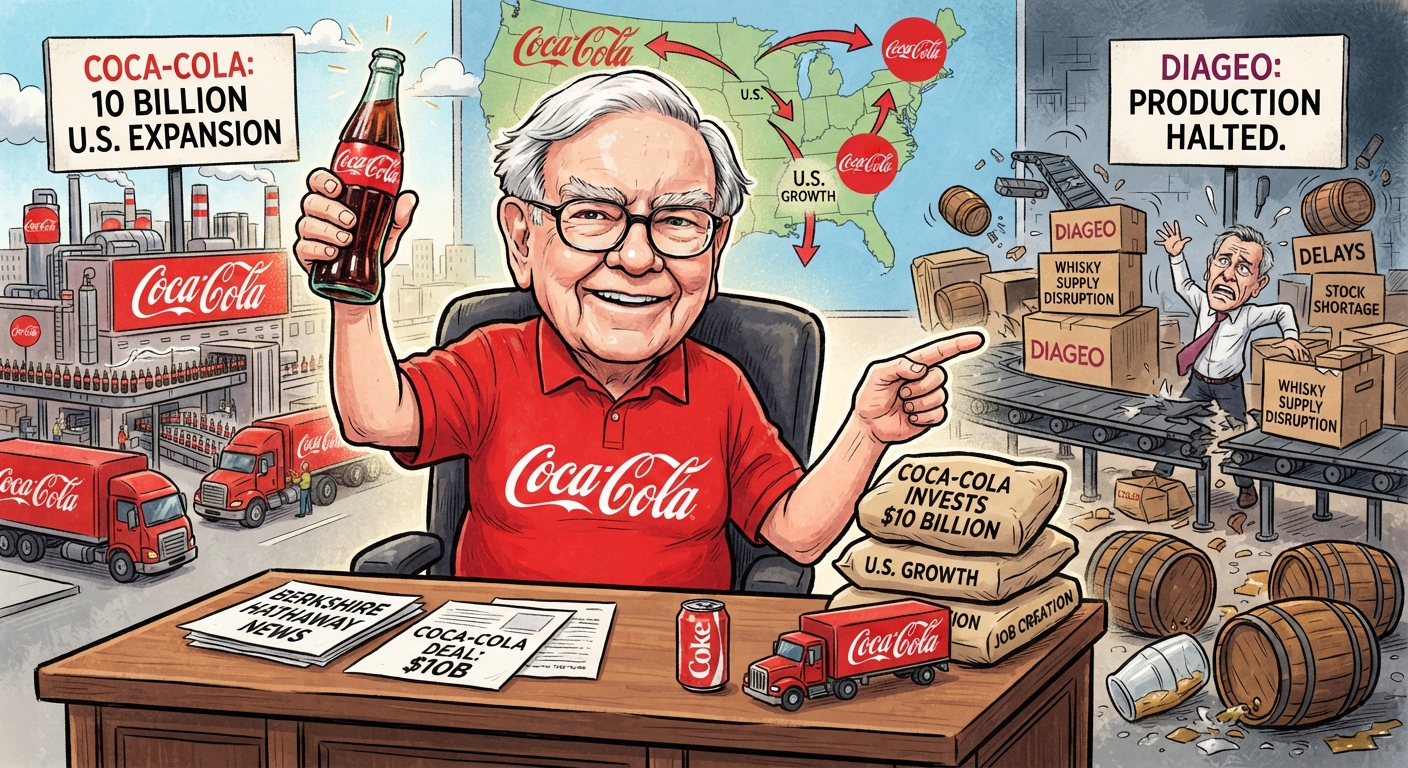
Coca-Cola Co. (NYSE: KO) is preparing to invest $10 billion across its U.S. system through 2030, an expansion that reads less like a defensive refresh and more like a long-duration vote of confidence in American consumption that is likely to have put a smile on the face of Warren Buffett, The Sulton of Omaha. At the same time, supply pressure at Diageo plc (NYSE: DEO) highlights why the beverage business still rewards companies with deep distribution networks, trusted brands and operational redundancy.
A capital commitment with bubbles
Coca-Cola and its bottling partners plan to put $10 billion into U.S. production, distribution and office infrastructure between 2026 and 2030. The program encompasses new or expanded operations in California, Colorado, Indiana, Alabama, Michigan, Minnesota, Florida and New York, an unusually broad geographic footprint for a company whose products already enjoy nearly universal shelf recognition. The important nuance for investors: this is a system-wide commitment, not simply Coca-Cola’s corporate capital-expenditure budget. The Coca-Cola system’s asset-light structure lets KO concentrate on brands, concentrate economics and consumer demand generation, while bottling partners shoulder much of the capital-heavy work of filling cans, moving trucks and keeping the cold box cold. In other words, Coca-Cola gets to own much of the melody without personally tuning every vending machine. That division of labor may be especially attractive in an environment where many want durable growth without an uncontrolled capex hangover.
Why Wall Street may like the math
Coca-Cola entered this next investment cycle with operating momentum. The company reported second-quarter revenue of $13.4 billion, up 7% year over year, and adjusted earnings per share of $0.97. Management also lifted its full-year comparable EPS-growth outlook to 9%–10% and projected organic revenue growth of about 5%. The infrastructure buildout potentially strengthens several elements of the KO investment case:
- Local capacity and service: More production and distribution infrastructure can shorten supply lines, improve replenishment and support new product launches across beverages, including higher-growth categories.
- Brand-led economics: The bottler model means the parent company can continue to emphasize brand investment and beverage innovation rather than becoming overly burdened by factories, fleets and forklifts.
- Scale as a strategic asset: Coca-Cola says its U.S. system contributed $85 billion to U.S. GDP in 2025, supported nearly 1 million jobs and spent about $37 billion with U.S. suppliers. Those figures are company-commissioned, but they illustrate the industrial scale behind a business often viewed mainly through the lens of soft drinks and dividends.
- Investment for demand, not panic: CFO John Murphy characterized the initiative as a growth strategy rather than a tariff-driven response, an important distinction for many trying to separate strategic expansion from reactive spending.
The real message is not merely that Coca-Cola will spend money. It is that the company and its partners are willing to spend it on physical capacity in a mature domestic market, usually a signal that the system sees sufficient demand, mix improvement and return potential ahead.
Diageo shows why execution matters
The same week, Diageo faced a different sort of beverage-industry headline: a planned three-week strike beginning September 28 at its Cameronbridge grain distillery in Scotland. More than 100 workers were reported to be involved in a dispute related to job reductions, creating potential disruption for grain spirit used in blends including Johnnie Walker, Bell’s and Haig. For Diageo (NYSE: DEO), the immediate issue is operational rather than a referendum on the enduring appeal of premium spirits. Still, it is a useful reminder that even global consumer giants can find their supply chains temporarily on the rocks, without the ice. Diageo has said it reduced production at Cameronbridge and expects to maintain lower grain-distillation levels for several years as it balances inventories with demand. The company also says it has alternative roles available for affected employees and remains in discussions with unions.
The contrast is instructive:
| Company | Current strategic signal | Investor interpretation |
|---|---|---|
| Coca-Cola (NYSE: KO) | $10 billion of planned U.S. system investment through 2030 | Capacity expansion, distribution reinforcement and confidence in long-term consumer demand |
| Diageo (NYSE: DEO) | Potential Cameronbridge production disruption amid reduced output | Inventory normalization and labor risk, alongside the enduring value of global premium spirits brands |
Neither story changes the basic appeal of global branded beverages: consumers may postpone a car purchase, but they are generally reluctant to postpone a familiar refreshment. Yet the market tends to reward the company that can keep its product available, its costs controlled and its brands culturally relevant—all at the same time.
The bullish read-through for KO
Coca-Cola’s new investment cycle can be viewed as an effort to reinforce a familiar but powerful flywheel:
Brand strength + Distribution reach + Local bottler investment = More resilient consumer economics
For many, KO’s appeal lies in the combination of global brands, recurring consumer demand, pricing power, an asset-light system and a distribution network that is difficult, and expensive, for rivals to reproduce. The $10 billion program adds a tangible, bricks-and-mortar layer to that thesis. It also arrives at a moment when markets have been unusually captivated by artificial intelligence infrastructure, chips and cloud capacity. Coca-Cola is pursuing a different kind of infrastructure trade: bottles, fountains, coolers, warehouses and delivery routes. It may lack the glamour of a GPU cluster, but it has one advantage that investors have understood for generations: people know exactly what it does, and many buy it repeatedly.
A takeaway
The bullish takeaway is straightforward: Coca-Cola (NYSE: KO) is using the scale of its bottling system to expand U.S. capacity while preserving the brand-led economics that have long supported its business model. The investment is not a guarantee of stock performance, and consumer-staples valuations, currency movements, commodity costs and demand trends still matter. But it is a meaningful signal that the Coca-Cola system sees opportunity worth funding through the end of the decade. Meanwhile, Diageo (NYSE: DEO) offers a reminder that beverage investing is not entirely smooth sipping: supply management, labor relations and inventory cycles can intrude. Its globally recognized Scotch portfolio, including Johnnie Walker, remains a valuable collection of brands, but the Cameronbridge issue places execution squarely on the near-term watch list. For many seeking durable consumer exposure, KO’s $10 billion American buildout makes a persuasive case that the company is not simply selling nostalgia by the can. It is investing in the next round.
The Sources
- Coca-Cola Plans $10 Billion U.S. Investment Through 2030 Yahoo Finance
- Coca-Cola to Invest $10 Billion in U.S. Infrastructure by 2030 Reuters
- The Coca-Cola System: A 140-Year Legacy That Continues to Deliver for America The Coca-Cola Company
- Johnnie Walker and Bell’s Whisky Supplies Face Disruption as Workers Walk Out The Telegraph
- Strike to Bring Production “to a Standstill” at Diageo Distillery, Says Union Yahoo Finance UK
- Our Scotch Whisky Portfolio Diageo plc
Stay Updated with Vista Partners
Subscribe to receive market insights, investing ideas, and the latest updates directly in your inbox.