The day’s headlines carry a useful message for investors: enduring brands do not stand still, they hand off leadership, recruit new cultural capital and turn moments of emotion into long-lived commercial relevance. From Berkshire Hathaway Inc. (NYSE: BRK.A, BRK.B) to On Holding AG (NYSE: ONON), the market is seeing that succession and reinvention can be complementary rather than contradictory.
Berkshire’s New Era Looks Deliberately Familiar
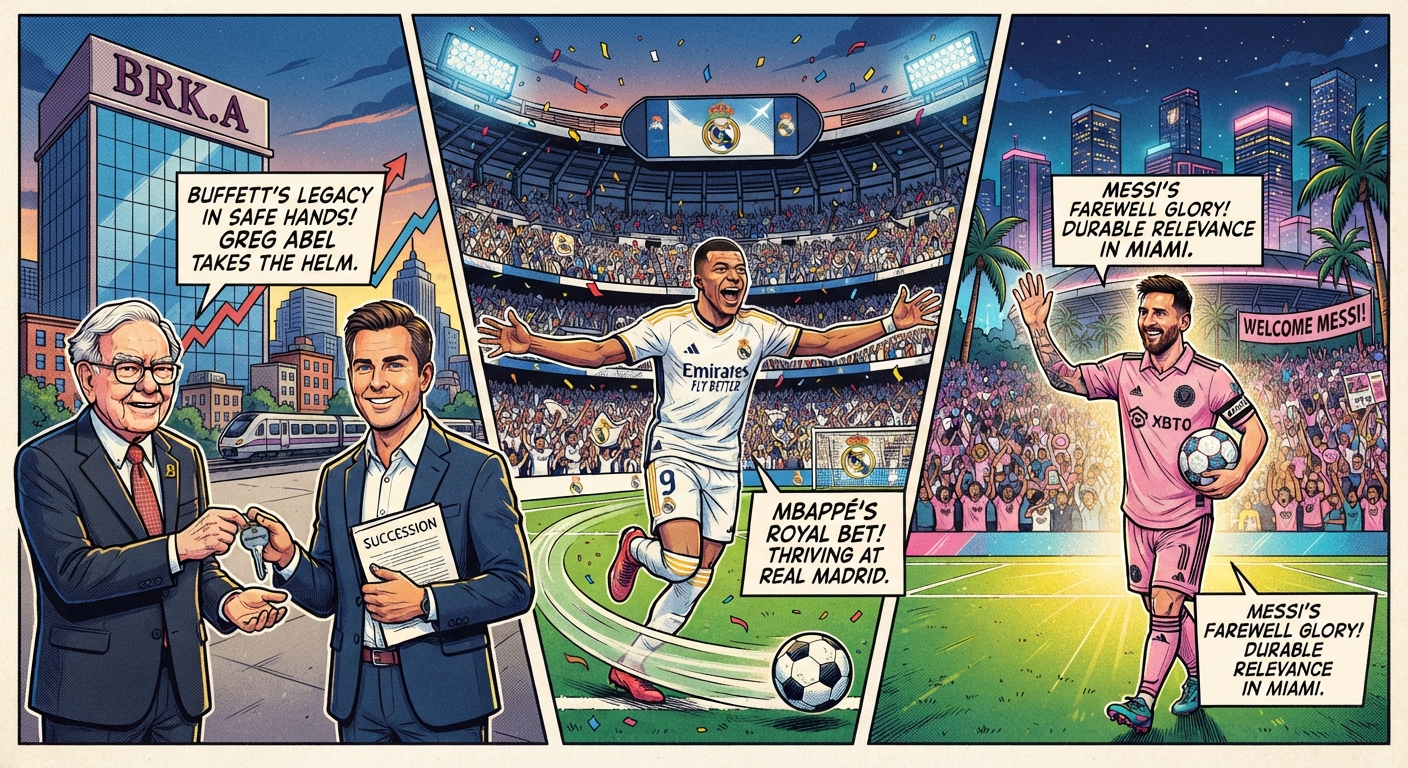
Warren Buffett’s move from chairman to chairman emeritus at Berkshire Hathaway is a historic milestone, but it is not a corporate cliff dive. It is the final, methodical stage of a succession plan that has been discussed, tested and, in quintessential Berkshire fashion, conducted without a fog machine or a management-consulting slide deck. Berkshire said Buffett, 96, will remain a director and continue offering his judgment and perspective. Howard G. Buffett, a Berkshire director since 1993, becomes chairman; Greg Abel remains chief executive officer; and Susan Decker continues as lead independent director. The structure separates operations, board stewardship and the preservation of the company’s famously decentralized culture. That distinction matters. Investors do not need Howard Buffett to impersonate his father, buy another Coca-Cola Co. (NYSE: KO) share certificate, or deliver annual letters in precisely the same Midwestern cadence. His role is to help protect the owner-oriented principles that made Berkshire distinctive—capital discipline, operating autonomy, patience and a healthy allergy to unnecessary drama. Greg Abel, meanwhile, has the operating mandate. The leadership architecture makes the division of labor unusually clear: Abel runs the enterprise; Howard chairs the board and acts as a cultural guardian; Warren remains available as chairman emeritus and director. For shareholders, clarity is often more valuable than charisma, though Berkshire is fortunate enough to retain a little of both.
A Culture That Outlives Its Founder
The bullish case for Berkshire Hathaway is not that the company will recreate the past quarter-century exactly. It is that its succession design recognizes what made the business durable in the first place. Berkshire is not a single-product story vulnerable to the mood of a consumer or the cadence of a product cycle. Its collection of businesses spans insurance, rail transportation through BNSF, energy, manufacturing, housing-related operations including Clayton Homes, consumer brands and a large investment portfolio. Howard Buffett’s long experience on the board, combined with his work in business, agriculture and philanthropy, gives him institutional familiarity with the organization he has been asked to steward. For long-term investors, the signal is constructive:
- Continuity has been formalized. The company’s previously outlined succession plan is now operational rather than theoretical.
- Management accountability is more legible. Greg Abel has operating responsibility, while the board has a defined chairman and continuing lead independent director.
- Buffett’s counsel remains available. Chairman emeritus is not the same as a day-to-day executive post, but the continued board presence reduces the impression of an abrupt institutional break.
- The Berkshire identity remains investable. The company’s real asset has never been only Warren Buffett’s stock selection; it has been an operating and capital-allocation system built to endure.
The market may debate valuation, portfolio positioning and the pace of future acquisitions, as it should. But the governance question has become more resolved, not less. In a market that often rewards novelty before it has earned the right to be trusted, Berkshire’s carefully staged handoff may prove refreshingly investable.
Mbappé Gives On a Serious Shot at Football
If Berkshire represents institutional endurance, On Holding represents a different but equally attractive investing theme: a premium-growth brand entering a vast adjacent category with credibility rather than merely ambition. Kylian Mbappé has ended his relationship with Nike Inc. (NYSE: NKE) and joined On Holding, a Swiss performance-sports company traded under ONON, as the brand enters football. Importantly, this is positioned as more than a standard celebrity endorsement. Mbappé is expected to work with On’s product teams on football footwear and apparel, serve as a global ambassador, and reportedly receive an equity stake in the company. On has also named Thierry Henry, the former France and Arsenal star, as its Director of Football. The combination gives the company one of the sport’s most recognizable current players and one of its most credible former champions as it attempts to establish a foothold in the world’s biggest sporting market. That is a strategic upgrade from simply buying billboard space. A global football launch needs product authority, athlete legitimacy and cultural fluency. Mbappé and Henry offer all three, and, mercifully for shareholders, neither is likely to confuse a football boot with a lifestyle accessory.
Why On Holding Could Be an Investor Story
On built its public-market identity around performance running, premium footwear and design-driven athletic products. Football expands its addressable opportunity, but it also introduces formidable competition from Nike, Adidas AG (OTC: ADDYY) and Puma SE (OTC: PUMSY). That is not a gentle neighborhood. The incumbents have global distribution, decades of athlete relationships and enough boot models to furnish a small museum. Still, disruption in sportswear often starts when a newer brand finds a high-conviction entry point. On’s decision to partner with Mbappé as a product-development collaborator—not merely a paid face of the brand—may help distinguish its football effort from a conventional sponsorship campaign. The company says he will contribute his elite perspective to the development and testing of future footwear and apparel. The early market response reflected investor interest: reports said ONON shares rose in premarket trading after the announcement, with one account placing the gain at 5.7%. The move should not be mistaken for a verdict on the entire football strategy; building a durable category takes product execution, retail reach and patience. But it is a tangible sentiment catalyst for a company seeking to show that it can extend beyond running and tennis. The opportunity for ONON shareholders rests on several potential drivers:
- Category expansion: Football gives On access to a global participation and fan market materially larger than its traditional running niche.
- Brand elevation: Mbappé brings worldwide relevance across Europe, Africa, the Middle East, Asia and North America.
- Product-led differentiation: Co-development can add authenticity if future boots and apparel perform with elite players and everyday consumers.
- Equity alignment: A reported ownership interest could create a longer-term partnership mindset rather than a one-season advertising transaction.
- World Cup-era visibility: Football’s global media cycle remains a powerful runway for brands that can convert attention into repeat purchases.
For Nike, the departure is a reminder that even the largest athletic brands must keep earning athlete loyalty and cultural relevance. For On, it is an invitation to prove that a premium challenger can sprint onto football’s main stage without tripping over its own laces.
Messi Shows the Value of Sporting Legacy
Lionel Messi’s forthcoming farewell appearance for Argentina offers a parallel lesson in the economics of iconic talent. Argentina’s football association has invited Messi to take part in a home friendly against Benin at Buenos Aires’ Monumental Stadium on October 6, following his international retirement. The match is set to be Argentina’s final friendly during the September 21–October 6 international window. Messi’s importance extends far beyond one event. He remains a magnet for broadcast attention, sponsorship engagement, merchandising, ticket demand and global fan participation. For publicly traded companies connected to the sports-media and football ecosystem, elite stars often operate as demand accelerants—not because one player can rewrite a balance sheet, but because they sharpen the emotional reasons consumers watch, buy, subscribe and travel. Potential public-market connections include:
| Company | Ticker | Investor relevance |
|---|---|---|
| Apple Inc. | NASDAQ: AAPL | Apple’s MLS Season Pass relationship makes global football attention and star-driven audience growth strategically relevant to its sports-content ambitions. |
| Adidas AG | OTC: ADDYY | A major global football brand whose commercial opportunity depends on elite competition, national-team visibility and consumer demand for performance gear. |
| Nike Inc. | NYSE: NKE | A dominant sportswear incumbent now facing a high-profile athlete shift as On enters football. |
| On Holding AG | NYSE: ONON | The direct emerging football-growth story through the Mbappé partnership and product-category launch. |
| Berkshire Hathaway Inc. | NYSE: BRK.A, BRK.B | The day’s governance and long-term capital-allocation story, centered on an orderly transition rather than a disruptive reset. |
Messi’s farewell is not a stock-specific catalyst in the narrow sense. It is, however, a reminder that the global sports economy monetizes stories as much as statistics. Great athletes do not merely play matches; they create recurring attention cycles that benefit platforms, sponsors, apparel companies and event ecosystems.
A Takeaway
The common thread across these developments is the value of durable relevance. Berkshire Hathaway is showing investors how a legacy institution can modernize its governance without discarding the culture that built shareholder trust. On Holding is showing how a growth brand can enter a crowded category by offering a marquee athlete a seat at the product table, not merely a place on an advertisement. Messi’s farewell demonstrates that the commercial influence of a generational icon can remain powerful even as an international chapter closes.
For investors, the constructive read is straightforward:
- BRK.A and BRK.B offer a transition story rooted in succession preparation, operational continuity and enduring corporate culture.
- ONON offers a higher-growth, higher-execution-risk narrative built around premium-brand expansion into global football.
- NKE, ADDYY and PUMSY remain important reference points as established athletic-wear leaders defend their turf against a well-funded, fast-moving challenger.
- AAPL remains a broader sports-media ecosystem name to watch as football’s global audience and star power continue to reshape digital engagement.
The scoreboard, as always, will eventually favor execution over headlines. But on this particular day, the headlines are unusually encouraging: one investing institution is built to outlive its founder, one challenger brand is entering football with an authentic ambassador, and one of sport’s greatest figures is demonstrating that a farewell can still fill the stadium—and perhaps the economic ecosystem around it.
The Sources
- Yahoo Finance Warren Buffett steps down as Berkshire Hathaway chairman; Howard Buffett’s role changes
- Reuters Berkshire Hathaway names Warren Buffett chairman emeritus; Howard Buffett succeeds him as chairman
- Berkshire Hathaway / Business Wire via Morningstar Official Berkshire Hathaway leadership-transition news release
- Yahoo Sports Kylian Mbappé leaves Nike and joins Swiss sportswear company On
- Reuters Messi called up by Argentina for farewell appearance following international retirement
- Investopedia On Holding stock reaction following its Mbappé partnership and football-market entry
- Benzinga On Holding stock moves after Kylian Mbappé partnership announcement
- Yahoo Finance Mbappé ends Nike partnership to join On
- CNBC Warren Buffett steps down as Berkshire Hathaway chairman
- Barron’s What Mbappé’s move from Nike to On Holding could mean for the sportswear market
Stay Updated with Vista Partners
Subscribe to receive market insights, investing ideas, and the latest updates directly in your inbox.