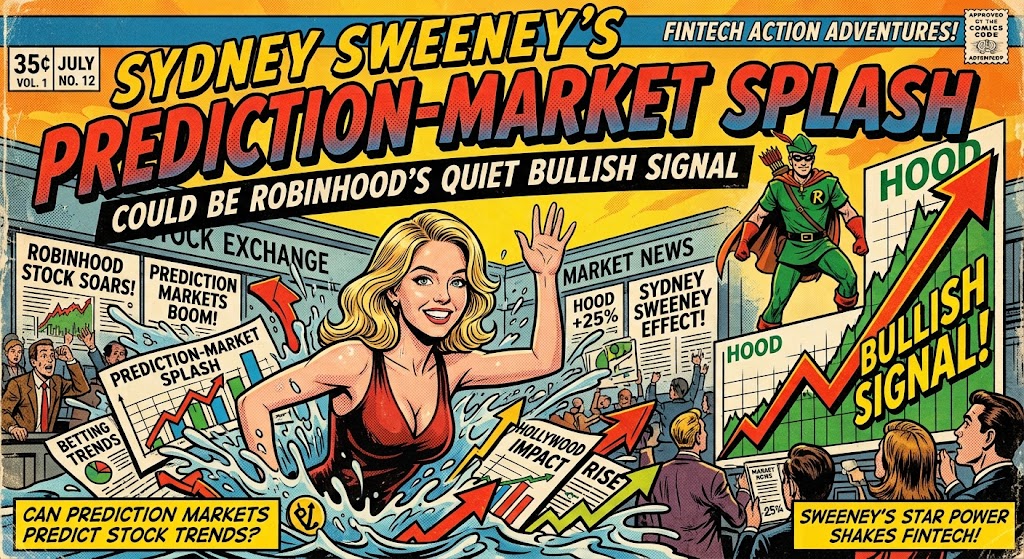
Sydney Sweeney may not have intended to become the face of financial-market infrastructure, but her headline-grabbing campaign for sports prediction platform Novig has put the fast-growing event-contract business squarely in the mainstream conversation. For many, the more consequential beneficiary may be Robinhood Markets, Inc. (NASDAQ: HOOD), whose expanding prediction-markets strategy is turning a once-niche product into a potentially substantial new revenue engine. The celebrity campaign is not the investment thesis by itself. It is the neon sign above the thesis: prediction markets are becoming culturally visible just as Robinhood is assembling the distribution, partnerships and consumer audience to monetize the category at scale.
Sydney Sweeney Puts Prediction Markets in Prime Time
Novig’s campaign featuring Sweeney, timed around the opening of football season, generated viral attention and renewed public debate about celebrities, gambling-adjacent products and the increasingly blurry line between sports fandom and financial trading. Novig positions itself as a sports-focused prediction-market platform, giving users a venue to trade on sports outcomes rather than simply place conventional wagers. The campaign’s provocative creative did what a conventional financial-services commercial rarely achieves: it made prediction markets a mainstream cultural talking point. That matters because consumer adoption in financial technology often begins with awareness rather than an immediate balance-sheet event. Crypto had its Super Bowl commercials. Commission-free stock trading had its meme-stock moment. Prediction markets now have a celebrity campaign that has placed the category in headlines, social feeds and sports discussions. The market’s attention may be focused on Sweeney. Many may be better served watching the platforms quietly building the transaction infrastructure beneath the spectacle.
Robinhood Is Building the Main Street On-Ramp
Robinhood has a compelling structural advantage over stand-alone prediction-market platforms: millions of consumers already use its app to trade stocks, options, exchange-traded funds, cryptocurrency and other financial products. That embedded distribution could allow Robinhood to capture prediction-market demand without relying exclusively on expensive, high-profile customer-acquisition campaigns. Novig may have Sweeney; Robinhood has an existing financial audience, a familiar mobile interface and a product ecosystem built for turning occasional traders into recurring users. Robinhood generated $156 million from event contracts in the second quarter, making prediction markets its second-largest transaction-based revenue source behind options, according to reporting cited by Yahoo Finance. Event-contract volume reached 6.1 billion contracts in July, roughly 20 times the year-earlier level. Those figures make an important distinction: prediction markets are no longer only a marketing phenomenon. At Robinhood, they are already showing up as a material revenue category.
From Viral Campaign to Trading Volume
The Sweeney-Novig campaign illustrates the broader race for consumer attention, particularly as professional and college football create a dense sequence of highly tradeable events. Sports provide something elections do not: a nearly continuous calendar of emotionally charged, widely understood outcomes. For prediction-market operators, that schedule can translate into sustained product engagement. For Robinhood, it creates an additional reason for customers to open the app, potentially every day, well beyond the rhythm of corporate earnings, Federal Reserve announcements or meme-stock enthusiasm. Piper Sandler (PIPR) estimated that Robinhood users could trade around 29.7 billion event contracts between September and December, producing approximately $320 million of revenue during that period. That would imply an annualized revenue pace of roughly $960 million, though the forecast remains dependent on customer participation, product availability and regulatory conditions. In other words, the celebrity campaign may capture the cultural value of the category, while Robinhood’s volumes could capture the commercial value.
HOOD’s Partnership Strategy Broadens Its Reach
Robinhood is expanding its prediction-markets business through partnerships that give it access to a broader range of event contracts and underlying market infrastructure. The company has worked with ForecastEx and Kalshi and has expanded through a multiyear arrangement with Crypto.com and its OG prediction-markets business. Robinhood also plans to take minority stakes in Crypto.com and OG, adding an ownership component to the relationship rather than treating the deal solely as a distribution agreement. This multi-partner strategy could give Robinhood several advantages:
- Broader access to event contracts across sports, economics, politics and culture.
- Greater flexibility in product availability and liquidity.
- Lower dependence on a single exchange or market operator.
- More strategic exposure to the infrastructure supporting prediction markets.
- Additional ways to keep customers engaged inside the Robinhood ecosystem.
For a company known for democratizing market access, the next chapter may involve democratizing the ability to express a view on whether something will happen before the evening news has finished explaining why it mattered.
The Bigger Prize Is Cross-Selling
Robinhood’s opportunity extends beyond event-contract commissions. A customer who arrives to trade an NFL-related contract could later trade stocks, purchase an ETF, explore options, move cash into a yield product or open a retirement account. That is the advantage of a platform model. Every new product can increase engagement with the broader ecosystem, potentially improving customer lifetime value without requiring Robinhood to acquire every customer from scratch.
| Company | Public ticker | Relevance to prediction markets |
|---|---|---|
| Robinhood Markets, Inc. | NASDAQ: HOOD | Consumer-finance platform expanding event-contract access through several market partners |
| Interactive Brokers Group, Inc. | NASDAQ: IBKR | Brokerage connected to ForecastEx, an event-contract venue used in Robinhood’s earlier rollout |
| Coinbase Global, Inc. | NASDAQ: COIN | Crypto-platform peer exposed to the broader overlap of trading, digital assets and event-based markets |
| Crypto.com | Private | Robinhood partner expanding the company’s access to OG prediction-market contracts |
| Kalshi | Private | Regulated event-contract exchange and a leading category participant |
| Novig | Private | Sports-focused prediction-market platform whose Sydney Sweeney campaign elevated category awareness |
| Polymarket | Private | Prominent prediction-market competitor operating in the broader event-contract landscape |
The strategic value for HOOD is that it can benefit from the category’s rising visibility while offering consumers a more diversified financial destination than a sports-only or event-only platform.
Regulation Is Still the Main Variable
Prediction markets remain subject to legal and regulatory uncertainty, particularly where sports-related contracts overlap with state gambling laws and federal derivatives regulation. Ongoing disputes involving Kalshi and state authorities could shape the availability and design of these products across the United States. That risk should remain central to any investment view. Rapid growth can slow if regulators restrict market access, impose new consumer-protection obligations or redefine how sports event contracts are treated. There is also a reputational calculation. The more marketing resembles casino advertising, the more likely policymakers and critics are to question whether the product is being presented responsibly. Sweeney’s Novig campaign has made that debate harder to avoid. Robinhood’s relative advantage is its breadth. Event contracts can become a valuable revenue stream without needing to carry the company’s entire valuation or brand identity.
What Could Drive HOOD Higher
The bullish case for Robinhood rests on execution, volume and product integration rather than celebrity intrigue. Key potential catalysts include:
- Stronger-than-expected event-contract volume during the NFL and college-football seasons.
- Continued growth in event-contract revenue as a share of Robinhood’s transaction-based business.
- Successful integration of contracts from Crypto.com and OG.
- New market categories that broaden engagement beyond elections and sports.
- Increased cross-selling from prediction-market users into Robinhood’s core investing products.
- Regulatory clarity that supports federally structured event-contract markets.
- Evidence that prediction markets retain users between major sports, political and macroeconomic events.
Bottom Line
Sydney Sweeney’s Novig campaign has made prediction markets impossible to ignore. But the more investable story may belong to Robinhood, which is converting the category’s growing visibility into a potentially durable source of trading volume, transaction revenue and app engagement. With $156 million in second-quarter event-contract revenue, explosive July contract activity and a widening network of market partners, Robinhood Markets, Inc. (NASDAQ: HOOD) has positioned itself as one of the most direct public-market beneficiaries of the prediction-market boom. Sweeney may have delivered the attention. Robinhood has the opportunity to turn it into an asset—one contract, one sports matchup and one increasingly engaged retail customer at a time.
Tribe Public: Direct Corporate Access for Everyone

For those following the expanding intersection of fintech, retail trading and prediction markets, Tribe Public LLC offers a useful forum for going beyond the headline and hearing directly from the people building the businesses. Through its RSVP-only CEO presentations, live webinars, Q&A sessions, luncheons, dinners and speaking engagements, Tribe Public connects investors and consumers with corporate leaders and subject-matter experts from companies shaping today’s market conversation. Tribe Public’s model is built around direct access: members can submit questions before or during events, request companies and experts through its “Wishlist,” and receive updates when relevant programs are confirmed. The community includes portfolio managers, registered investment advisers, family offices, accredited investors, business owners, retail traders, brokers, analysts, entrepreneurs and members of the media. With members spanning 31 countries and events hosted across 41 U.S. venues over corporate sponsored luncheon and dinner events, Tribe Public gives public companies and emerging private businesses a practical platform to explain their strategies, discuss market opportunities and engage with an informed audience. For issuers, the format extends beyond a single presentation through newsletters, social media and survey campaigns designed to broaden visibility and sustain investor awareness. All interested can explore upcoming and recent events, submit company requests and learn more at TribePublic.com.
The Sources
- Yahoo Finance / Yahoo Entertainment “Sydney Sweeney’s racy new ad has people talking. The bigger controversy is what she’s selling.”
- Yahoo Finance “Prediction markets spend big on celebrity campaigns even as controversy mounts.”
- Yahoo Finance “NFL Kickoff Heats Up Prediction Market Rivalry.”
- Yahoo Finance “Robinhood Expands Prediction Markets Push With Crypto.com, OG.”
- Yahoo Finance “Robinhood Prediction Markets Face Supreme Court Test as New Jersey Takes On Kalshi.”
- Axios “Robinhood expands prediction markets despite legal uncertainty.”
- CNBC “Piper Sandler expects Robinhood to kickstart football season with a win.”
- Covers “Sydney Sweeney Stars in Novig Sports Prediction Market Ad.”
- Covers “Robinhood Expands Prediction Market Access with OG.com.”
- Prediction News “Sydney Sweeney Takes Equity Stake and Stars in Novig’s First Campaign.”
- BreakingAC “Robinhood vs. Kalshi: Which Election Betting Site Is Better?”
- The Wall Street Journal “Prediction-Markets Race Heats Up as Robinhood and Crypto.com Hold Talks.”
Disclosure: This article is provided solely for informational and editorial purposes and should not be construed as investment advice, financial advice, a recommendation, an offer, or a solicitation to buy or sell any security, derivative, event contract, cryptocurrency or other financial instrument. The article discusses Robinhood Markets, Inc. (NASDAQ: HOOD), Interactive Brokers Group, Inc. (NASDAQ: IBKR), Coinbase Global, Inc. (NASDAQ: COIN) and other public and private companies operating in or connected to the retail-trading, fintech, cryptocurrency and prediction-markets sectors. References to these companies, their products, platforms, strategies, revenues, forecasts, partnerships, advertising campaigns or industry developments are for discussion only and do not constitute an endorsement of, or recommendation to invest in, any company or platform.
Stay Updated with Vista Partners
Subscribe to receive market insights, investing ideas, and the latest updates directly in your inbox.