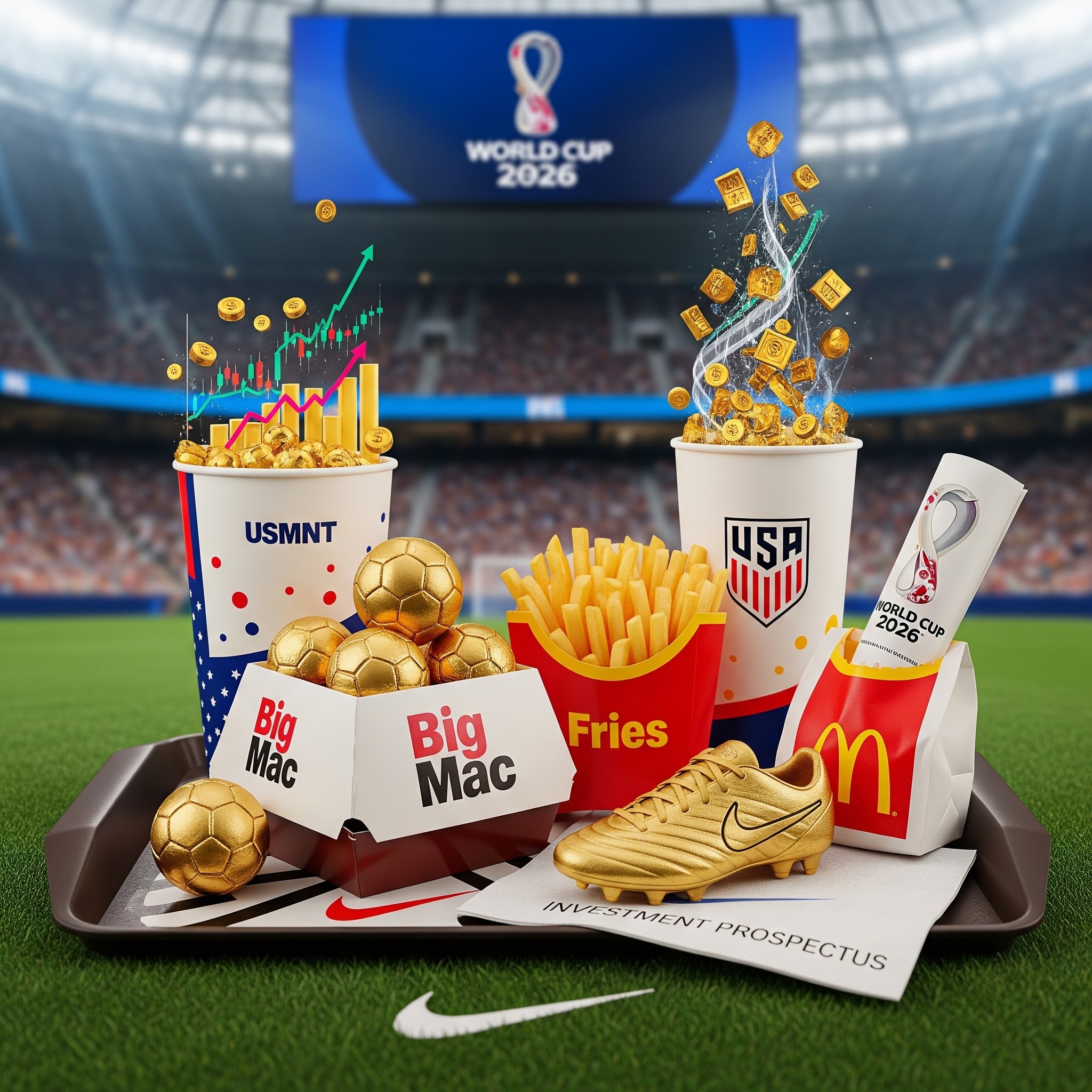
Nike (NKE), McDonald’s (MCD), and the USMNT are about to discover what every youth coach already knows: a World Cup on home soil is the best performance enhancer money can’t technically label as a performance enhancer. For investors, the 2026 tournament is shaping up as a rare alignment of brand rehab, consumer nostalgia, and star-power drama that could turn a sloggy tape into a summer tailwind.
World Cup 2026: The Perfect Scheduling Assist for Nike
Nike enters this World Cup more “rebuilding franchise” than “invincible dynasty,” but the tournament’s timing may be exactly what management ordered. CNBC reports that Nike has leaned heavily into the 2026 World Cup as a key catalyst to revitalize its brand, refresh product lines, and rebuild relationships with retailers after a patchy stretch for the stock and the swoosh. Adidas may own the official tournament sponsorship and supply the match ball, but Nike is countering with an aggressive kit and lifestyle offensive, aiming to turn the global news cycle into a rolling product launch.
From New York kit unveilings to capsule collections designed with creatives and fashion houses, Nike is positioning soccer gear as streetwear first, uniform second. That shift matters for investors because it broadens the addressable consumer base beyond hardcore fans and into the far larger market of casual wear and lifestyle buyers, where margins can be richer and demand less tied to match results.
The USMNT, Pulisic’s Calf, and Nike’s Narrative Risk
On the pitch, the USMNT has started the World Cup in control of its group, but the storyline investors should watch is taped, wrapped, and currently doing modified work away from teammates: Christian Pulisic’s left calf. ESPN reports that manager Mauricio Pochettino describes Pulisic as “much better” but still under day‑to‑day evaluation before the critical group clash with Australia in Seattle today, Friday, June 19 at noon pacific. Pulisic trained apart from the squad with a wrap on that calf and then headed to the gym, underscoring how carefully the staff is managing his availability.
If he cannot go, Pochettino has a deep bench of attacking options—including Brenden Aaronson, Giovanni Reyna, Timothy Weah, and Alejandro Zendejas—to plug into the frontline. For Nike, the risk isn’t simply a missing star; it is a potential pause in the most marketable narrative: an American hero leading a host-nation run in a Nike kit, in Nike boots, in Nike campaigns, on U.S. soil. A healthy Pulisic turns each knockout‑round highlight into free global advertising; a sidelined one forces the brand to pivot faster toward “team-centric” storytelling and broader squad marketing.
McDonald’s: Turning Fandom Into Foot Traffic
While Nike fights for fashion credibility and on‑field glory, McDonald’s is quietly running the most reliable play in consumer marketing: convert big moments into bigger order sizes. The company has rolled out a limited-time FIFA World Cup 26 Meal—anchored by a Big Mac or 10‑piece Chicken McNuggets and a gold‑packaged Big Mac Sauce—alongside a breakfast lineup designed to catch early‑morning matches. Beyond calories, each meal comes with collectible cups featuring global stars including Christian Pulisic, David Beckham, Ronaldinho, Thierry Henry, Son Heung‑Min, Lamine Yamal, Alphonso Davies, and more, plus the now‑inevitable cameo from Grimace. For younger fans, the Happy Meal becomes a World Cup on‑ramp, with a 23‑member Squishmallows squad, including the official 2026 mascots for Canada, Mexico, and the United States, each paired with a scannable code that unlocks a digital game. McDonald’s is layering in app-only offers, bonus reward points, and McDelivery tie‑ins to make sure that every watch party or couch session has a built‑in path to a McDonald’s basket. For investors, that is not just “brand engagement”; it is a campaign engineered to drive higher frequency, bigger tickets, and richer digital data throughout the tournament window.
The Investor Angle: When Storylines Become Cash Flows
World Cups are always about storylines, but this edition layers a particularly investable mix: a legacy performance brand hunting for a reset, a host nation trying to validate its soccer project, and a fast‑food giant weaponizing nostalgia at scale. Nike’s bet is that refreshed kits, collaborative capsule drops, and a home‑soil USMNT run can re‑accelerate demand and repair retailer relationships that have frayed in recent years. Success looks like sell‑through rates that surprise wholesalers, social media feeds full of U.S. jerseys far from stadiums, and a narrative shift from “struggling Nike” to “turnaround in motion.”
McDonald’s, by contrast, does not need a turnaround—it needs a catalyst to deepen habitual behavior. Limited‑time World Cup meals, collectible cups with star players, Squishmallows Happy Meals, app‑based rewards, and global community events are all designed to tighten the loop between watching a match and tapping the McDonald’s app. If U.S. games spike viewership and the USMNT stays in the tournament deep into July, that loop could stay engaged long enough to show up in same‑store sales and digital mix metrics. For both companies, the World Cup is less a one‑off marketing sprint and more a multi‑week narrative campaign with measurable revenue implications.
What Savvy Investors Should Watch Next
Over the next few weeks, investors should track three tells. First, USMNT health and performance: a healthy Pulisic headlining a deep run amplifies Nike’s brand halo and keeps McDonald’s cup collectibles and Happy Meals firmly in the spotlight. Second, the strength of Nike’s World Cup sell‑through and social traction, particularly for lifestyle pieces that transcend match days. Third, any commentary from McDonald’s on early response to its FIFA World Cup 26 Meal, Squishmallows campaign, and app‑driven engagement, which will hint at whether the company is converting fandom into repeatable digital behavior. Taken together, this World Cup offers a rare, data‑rich live experiment in how live sports, culture, and consumer brands intersect on home turf. For investors willing to think like a coach drawing up a game plan, the key is not to chase every highlight, but to watch how Nike and McDonald’s execute through the full 90 minutes of the tournament—and into extra time, when the marketing spend is over but the brand effects linger on the income statement.
The Sources
- CNBC – “Why this year’s World Cup is arriving at the perfect time for struggling Nike”
https://www.cnbc.com/2026/06/18/why-this-years-world-cup-is-arriving-at-the-perfect-time-for-struggling-nike.html - ESPN – “USMNT’s Christian Pulisic trains apart from team again; Pochettino due to address status”
https://www.espn.com/soccer/story//id/49109849/usmnt-christian-pulisic-trains-apart-team-again-pochettino-due-address-status - OneFootball – “USMNT growth & player availability ahead of Australia meeting”
https://onefootball.com/fr/news/usmnt-growth-player-availability-ahead-of-australia-meeting-43029161 - McDonald’s Corporate – “McDonald’s Celebrates FIFA World Cup 26™ Worldwide with Limited-Time Meals, Exclusive Star-Studded Collectibles and Matchday Magic”
https://corporate.mcdonalds.com/corpmcd/our-stories/article/US-FIFA-world-cup-2026.html
Stay Updated with Vista Partners
Subscribe to receive market insights, investing ideas, and the latest updates directly in your inbox.