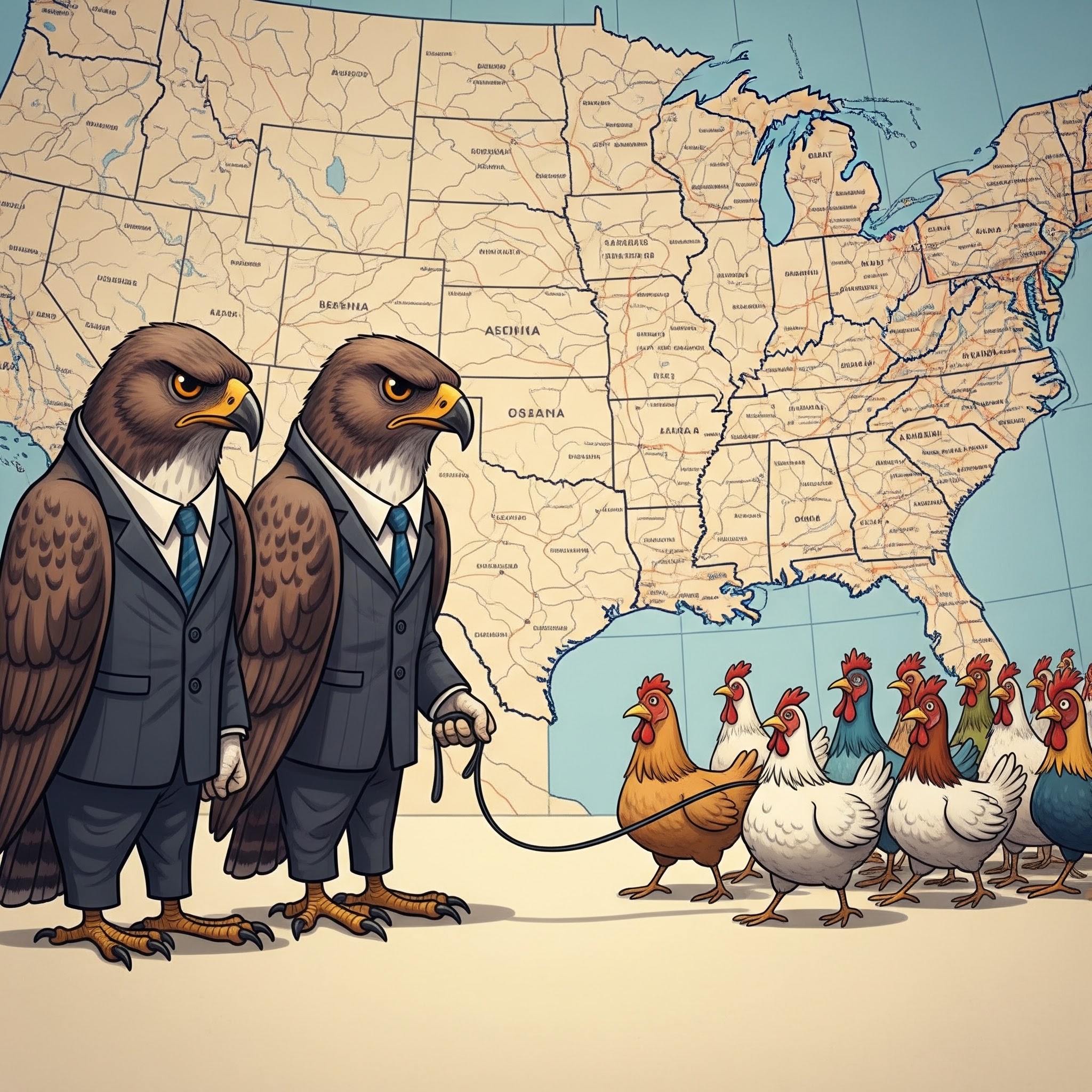
Kevin Warsh’s first meeting as Fed chair ended with exactly what futures markets had been pricing for days: a clean “hold” on the federal funds rate at 3.50% to 3.75%. No surprise on the headline, but the subtext was market‑moving: a more hawkish committee, louder internal disagreement, and a dot plot that quietly retired the last hope of a 2026 rate cut. In other words, Warsh kept the car in the same lane but adjusted the GPS: same destination, slightly different route, a bit less air conditioning.
A Dot Plot That Fired the Strategists
The new dot plot landed with all the drama of a group chat where half the members suddenly stop using emojis. March’s projections had already compressed expectations for easing, with 14 of 19 FOMC participants seeing either no or just one cut in 2026. Today’s update went a step further: the last dot still signaling a cut this year disappeared, and market odds now put a roughly two‑thirds chance on at least one hike instead. For investors who treat the dot plot as a trading plan rather than a probability distribution, this was a rude reminder that each dot is an opinion, not a promise. The Fed again emphasized that the dots are not a “plan of attack” but rather a heat map of where policymakers think policy might need to be if the data refuse to cooperate.
A Committee That’s Hawkish, Not Panicked
Under the surface, the language out of the Fed has shifted decisively toward the hawkish side of the ledger. A recent Deutsche Bank analysis that ran every FOMC voter’s speech through a language model came back with 11 hawks, five neutrals, and just one lonely dove—and most members have grown more hawkish since May. That doesn’t spell an imminent policy shock; it signals a risk‑management posture. The Fed is effectively saying:
- Inflation progress is real but fragile.
- The bar for cuts is higher than the market wanted to believe.
- The bar for a hike is no longer theoretical..
For investors, that’s a subtle but important pivot from “higher for longer” to “higher for as long as needed.”
Warsh’s Quiet Regime Change
If Powell’s Fed defined the post‑pandemic era, Warsh’s Fed is quietly defining what comes next: a central bank that intervenes less and communicates more like an old‑school referee than a market strategist. Recent commentary suggests Warsh wants the Fed’s balance sheet to play a smaller day‑to‑day role in managing financial conditions, reserving heavy asset purchases for true market stress. At this meeting, he paired the steady policy rate with task forces aimed at overhauling operations and communications—plumbing rather than pyrotechnics. It may not make headlines every day, but over time this “regime change” could mean more organic price discovery, wider trading ranges, and a market that leans less on the Fed put.
What the Fed Just Told Every Asset Class
The decision and dot plot reshuffle are not a one‑day headline; they are a funding‑cost story that will ripple through every risk decision investors make over the next 6–12 months.
- Equities: A non‑panicked, mildly hawkish Fed is historically not toxic for stocks—especially if growth holds and inflation grinds lower. Quality balance sheets, pricing power, and cash‑rich platforms should remain in favor if the cost of capital stays elevated.
- Credit: With the median path keeping fed funds in the mid‑3s into 2027, the all‑in yield on high‑grade credit still offers real income without betting on aggressive easing. Spreads have room to wobble if a hike materializes, but the starting yield cushion is far better than in the pre‑2022 era.
- Duration: The disappearance of that lone 2026 cut dot effectively caps the near‑term bull‑steepener dream. Tactical duration trades now hinge on incoming inflation and growth data, not just on faith that the Fed will blink.
- Dollar and global risk: A Fed that is willing—if reluctant—to hike again supports the dollar at the margin and pressures foreign central banks that were hoping for a cleaner green light to ease.
The message: the cost of capital is not going back to the zero‑rate museum seemingly ay time soon. Investors who still price assets as if it will are running a nostalgia strategy, not a risk‑adjusted one.
How Investors Can Trade the New Fed Narrative
The Fed just gave investors a blueprint that rewards discipline over drama. In this regime:
- Funding costs are likely to stay structurally higher, even if the cycle delivers a token cut or two down the road.
- Policy risk is asymmetric: one well‑telegraphed hike is more likely than a surprise cutting cycle.
- The dot plot is a volatility generator, not a roadmap; clustering matters, but history says its one‑year‑ahead accuracy is limited.
For investors, that favors:
- Businesses that can self‑fund growth and don’t need to refinance at punitive levels every 18 months.
- Sectors with durable pricing power and visible cash flows that can absorb an extra 25 basis points of policy risk.
- Portfolio construction that builds in “Fed noise” as a feature, not a bug—using volatility around dots and press conferences as entry points rather than existential threats,
The Fed did not change rates today, but it changed the conversation. The committee is more hawkish, the dot plot is less friendly to cuts, and the new chair is signaling a regime that values credibility over comfort. For investors willing to lean into a world where money has a price again, that may be the most bullish development of all.
Learn More Here
The Sources
- Yahoo Finance – Fed dot plot and 2026 rate‑path coverage (article you referenced as the base)
- CNBC – Fed meeting live updates and Kevin Warsh’s first decision as Fed chair
- CNBC – “Trump trusts Fed Chair Warsh. It matters for more than markets.” (background on Warsh and regime‑change angle)
- Bondsavvy – March and June 2026 Fed dot‑plot expectations and member distributions
- Britannica – “The Fed dot plot – How to Interpret Economic Projections” (conceptual framing for dots vs promises)
- Bankrate – “The Federal Reserve’s Latest Dot Plot, Explained” (limitations and use‑case of the dot plot)
- CME FedWatch Tool – Market‑implied probabilities of rate changes
- Barron’s / major‑media live Fed meeting coverage – Warsh’s first meeting spotlight and tone
- CNBC – “Kevin Warsh’s real Fed ‘regime change’ may happen deep inside Wall Street’s plumbing”
- CNBC video – “Kevin Warsh sworn in as Fed chair: ‘I will lead reform‑oriented Federal Reserve’”
- Federal Reserve – Summary of Economic Projections, March 18, 2026 (baseline macro and rate‑path context)
- YouTube – Fed/FOMC press‑conference–style live coverage
- Fed livestream playlist: https://www.youtube.com/playlist?list=PL4k0fH8EgI3awgCi7ie-SbN4npksL8yuR
- Federal Reserve channel: https://www.youtube.com/federalreserve
Stay Updated with Vista Partners
Subscribe to receive market insights, investing ideas, and the latest updates directly in your inbox.