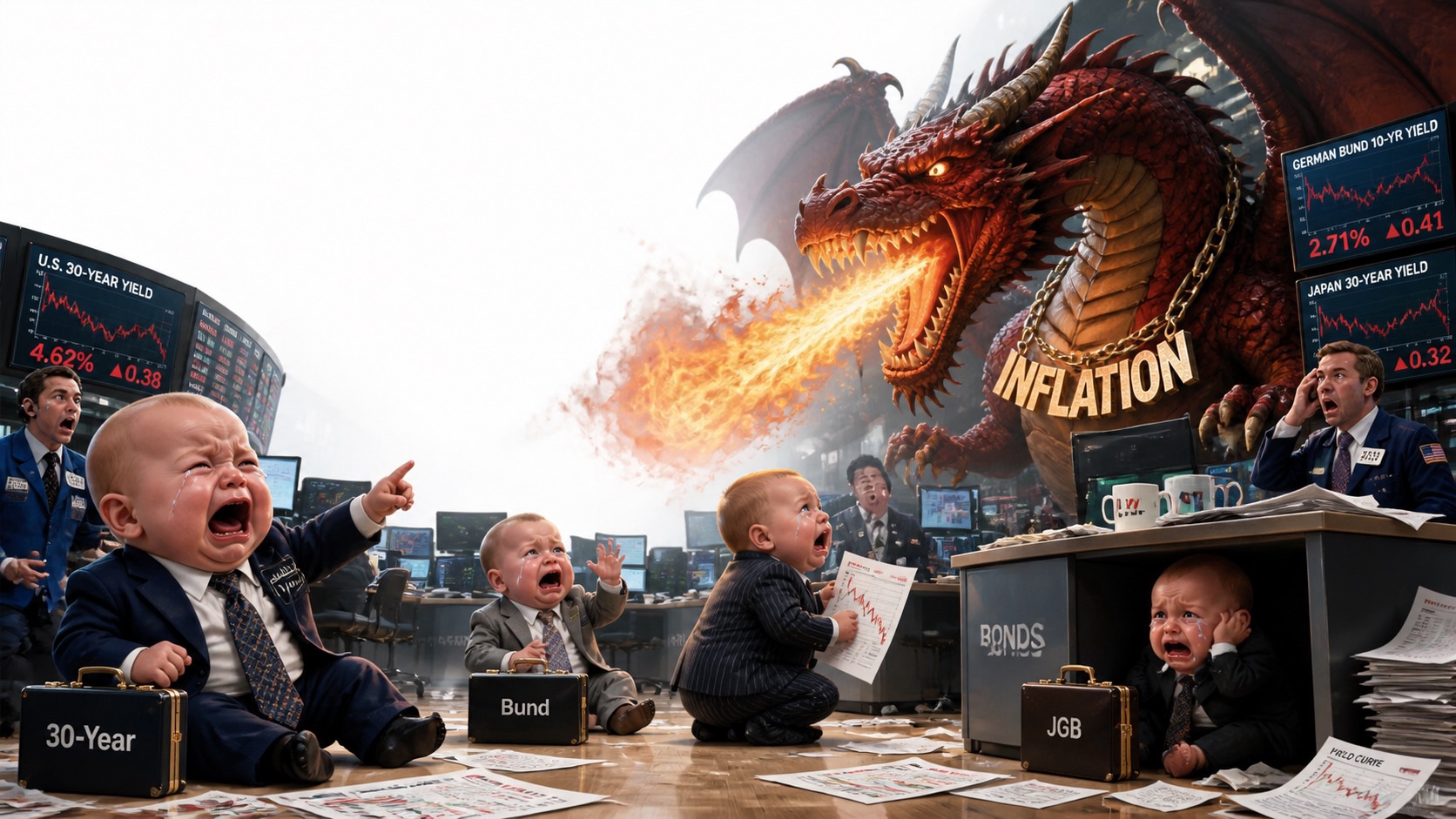
Global bond markets are rarely accused of theatrics, but this week they staged something close to a full-blown protest. Yields surged across major economies, with the U.S. 30-year Treasury drifting toward levels not seen in nearly two decades, while German bunds, U.K. gilts, and Japanese government bonds joined the synchronized selloff.
Equity markets, typically the louder sibling, suddenly found themselves taking cues from fixed income—a reversal that tends to make even seasoned investors sit up straighter.
The message from bonds is not subtle: inflation risks are no longer theoretical, and patience for long-duration assets is wearing thin.
Oil Fuels the Inflation Narrative
At the center of the unease sits energy. A prolonged geopolitical conflict has shuttered roughly 20% of global crude flows and an even larger share of natural gas supply. Three months in, hopes for a swift resolution are fading, replaced by a more durable reality of constrained supply.
Higher energy costs rarely stay in their lane. They bleed into transportation, manufacturing, and ultimately consumer prices. In other words, expensive gas tends to make everything else expensive too—an economic domino effect that central banks cannot ignore.
The bond market, ever forward-looking, appears to be pricing in exactly that.
The Long End Loses Its Appeal
For investors, the long end of the yield curve has become an increasingly uncomfortable place to park capital. Ajay Rajadhyaksha, Barclays’ global chairman of research, summarized the mood succinctly, noting that with debt rising faster than growth and inflation risks intensifying, “there is little reason to reach for the long end.”
It is a polite way of saying that locking in long-term rates today feels less like prudence and more like wishful thinking.
Rising sovereign debt levels across developed markets add another layer of concern. Governments continue to borrow heavily, yet political appetite for meaningful fiscal reform remains elusive. The result is a supply-demand imbalance that pushes yields higher and tests investor confidence.
Stocks Feel the Heat
Equities, which had grown accustomed to a relatively benign rate environment, are beginning to recalibrate. Higher yields increase the discount rate applied to future earnings, which in turn pressures valuations—particularly in growth-oriented sectors.
The shift has been subtle but noticeable. What began as a bond market adjustment is increasingly spilling into broader asset pricing.
Investors are being reminded, once again, that the cost of money matters—and when it rises quickly, it rarely does so quietly.
A Market Looking for Anchors
The current environment leaves markets searching for stability in a landscape where traditional anchors feel less secure. Central banks remain cautious, geopolitical tensions persist, and inflation signals refuse to fade cleanly into the background.
If there is a silver lining, it may be that markets are rediscovering discipline. Higher yields can eventually offer attractive entry points and restore balance between risk and reward. But getting there may involve a few more bouts of volatility—and perhaps a few more bond market “tantrums” along the way.
For now, fixed income has reclaimed the spotlight, and equities are listening more closely than they have in years.
The Sources
- Federal Reserve Bank of New York – “Innovations in Baby Bonds”
https://www.newyorkfed.org/newsevents/events/regional_outreach/2025/0116-2025newyorkfed - Stanford Center on Longevity – “Baby Bonds” overview
https://longevity.stanford.edu/baby-bonds/longevity.stanford - Institute on Race, Power and Political Economy – “Baby Bonds” policy explainer
https://racepowerpolicy.org/baby-bonds/racepowerpolicy - Investopedia – “Baby Bonds: Affordable Investment Options for Individual Investors”
https://www.investopedia.com/terms/b/babybond.aspinvestopedia - Cbonds – “Baby Bonds: Transforming Financial Futures for Children in the U.S.”
https://cbonds.com/glossary/baby-bond/cbonds - Yahoo Finance – “Baby Bonds: Definition, Pros and Cons, Examples”
https://finance.yahoo.com/news/baby-bonds-definition-pros-cons-000418033.htmlfinance.yahoo - New York Fed / media commentary on “taming the inflation dragon” in bond markets (example social post)
https://www.facebook.com/wmur9/posts/a-bond-rout-is-deepening-as-inflation-fears-take-hold-of-the-treasury-market-thr/1026202566facebook - Stock Adobe – Baby dragons imagery for metaphorical “inflation dragon” art
https://stock.adobe.com/search?k=baby+dragonsstock.adobe - Vecteezy – Baby dragon vectors (for dragon-themed market illustrations)
https://www.vecteezy.com/free-vector/baby-dragonvecteezy - VectorStock – Crying cute dragon vectors (visual reference for “tantrum” dragon)
https://www.vectorstock.com/royalty-free-vectors/crying-cute-dragon-vectorsvectorstock
Stay Updated with Vista Partners
Subscribe to receive market insights, investing ideas, and the latest updates directly in your inbox.