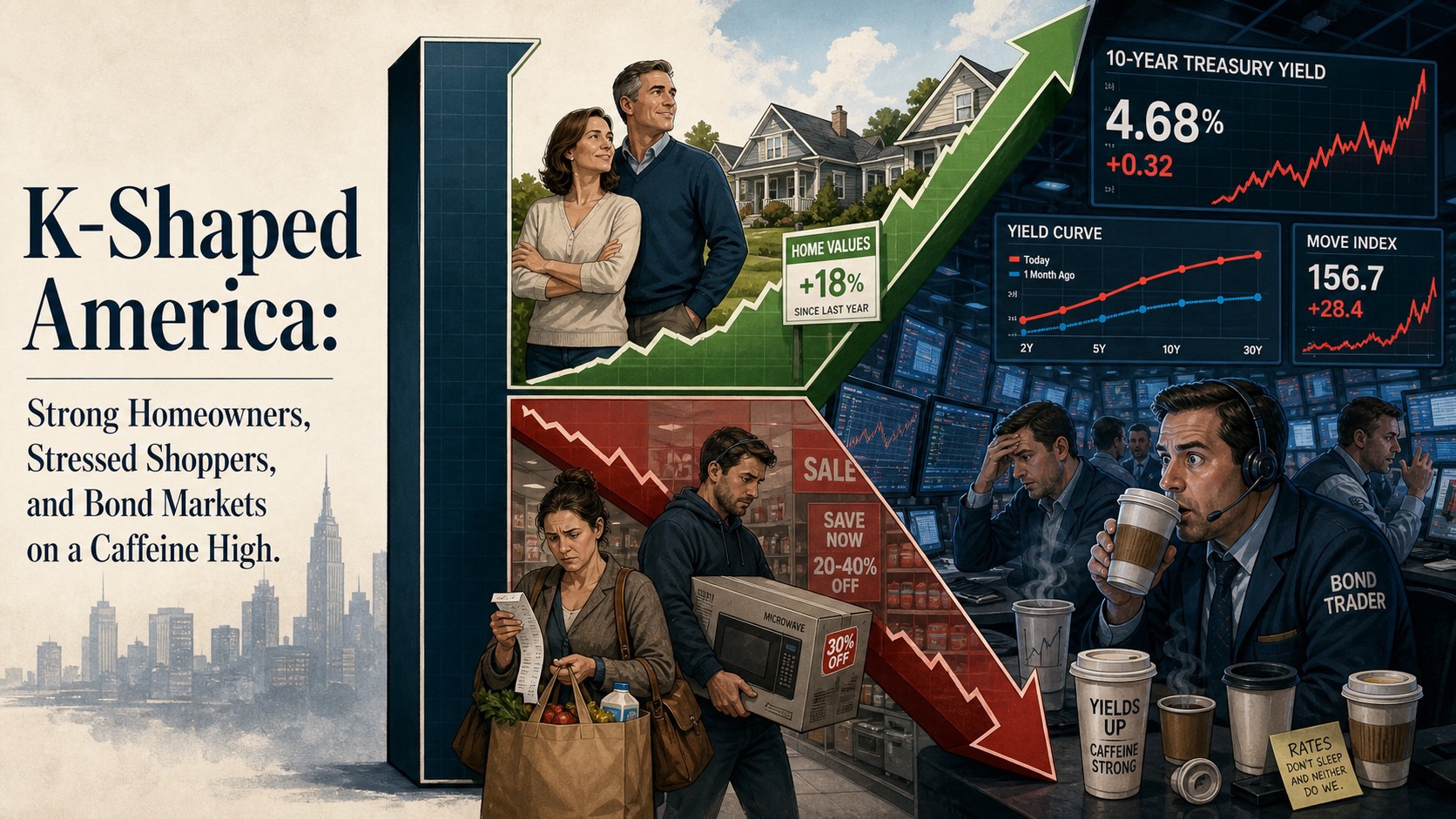
America’s economy is starting to look like the letter K drawn by an urban planner: straight lines for the haves, sharp angles for the have‑nots, and a few confused arrows in between. At the center of the story are homeowners, shoppers, and bond traders—and a few familiar corporate tickers watching it all unfold.
A Tale of Two Housing Markets
The housing market has become the front line of this K‑shaped reality, with affluent buyers still writing offers while everyone else reads listings like fiction. At the top of the K, higher earners with locked‑in pandemic‑era mortgage rates or ample cash can afford to wait for the right property or sit tight and let their home equity quietly compound.
Down the other arm, would‑be buyers face the unpleasant combo of elevated prices, higher rates, and thin inventory, which turns “starter home” into more of a theoretical concept than a practical one. Rents and prices are diverging in many markets, underscoring how ownership remains a wealth‑building escalator—provided you can afford the ticket to get on.
When Americans Treat Appliances Like Luxury Goods (WHR)
Inside the nation’s kitchens and laundry rooms, another story is unfolding: Americans are acting like they’re in a recession even if the data still insists they’re not. Whirlpool Corporation (WHR) has flagged what looks suspiciously like recession‑level demand for big household appliances, with industry volumes sliding as consumers push off anything that isn’t truly broken.
The company is seeing a notable drop in discretionary appliance purchases, a sign that middle‑income homeowners are trading “new kitchen” daydreams for “let’s see if the dishwasher survives another year” pragmatism. Higher rates, low housing turnover, and rising everyday costs are squeezing budgets, making big‑ticket upgrades the easiest line item to delay.
The Consumer: Cautious, Selective, and Clipping Coupons (MCD, WHR)
Corporate leaders across sectors are now harmonizing on the same theme: the consumer is still standing, but no longer in a buying mood for anything that doesn’t come with fries or a discount code. Fast‑food bellwether McDonald’s (MCD) has pointed to pressure on its core customer, while Whirlpool (WHR) is warning that the strain spans income levels, from value‑seekers to suburban homeowners.
This pullback is classic late‑cycle behavior: households continue to spend on essentials but grow more selective and promotion‑sensitive everywhere else. Retailers and manufacturers now face the uncomfortable math of higher financing costs, softening volumes, and consumers who have discovered that “wait” is, in fact, a perfectly viable purchasing strategy.
Bond Traders Smell a New Era (Treasuries, TLT)
Over in the bond market, traders are watching yields climb and asking a simple question with very expensive implications: what if “higher for longer” is not a slogan but a regime? Long‑term U.S. Treasury yields, which investors can access via vehicles like the iShares 20+ Year Treasury Bond ETF (TLT), have pushed toward multi‑decade highs as war‑driven energy shocks and stubborn inflation fears trigger some of the worst stretches for bonds in years.
The move has spilled across global fixed income, with debt markets from the UK to Japan repricing what persistent price pressures and heavier government borrowing might mean. For investors raised on the idea that every bond selloff was a buying opportunity, this new landscape feels less like a dip to be bought and more like a tectonic plate quietly shifting under their portfolios.
K‑Shaped Risks, K‑Shaped Opportunities
The K‑shaped economy may be brutal for policymakers, but it is oddly generous to active investors who know where each arm of the letter is pointing. On the upside, sectors tied to higher‑income households and structural trends—from certain corners of real estate to data‑centric infrastructure—continue to attract capital and command pricing power.
On the downside, businesses tethered to big‑ticket discretionary spending face slower demand and tougher conversations with their lenders as yields reset higher. The spread between winners and strugglers grows wider with every central‑bank meeting and geopolitical headline, making “average” an increasingly unreliable investment strategy.
What It Means for Investors and Homeowners
For homeowners comfortably on the upper arm of the K, rising rates and firm prices reinforce the value of staying put—or at least negotiating from a position of strength. For renters and first‑time buyers, the path to ownership is steeper, but not necessarily closed; markets with more balanced supply or softer demand could offer windows of opportunity as the cycle grinds on.
Bond investors, meanwhile, are being forced to consider a world where the “risk‑free rate” comes with more drama than many tech earnings calls. In this environment, duration, credit quality, and sector selection matter again, and the old habit of reaching for yield without reading the fine print looks increasingly out of fashion.
The Sources
- U.S. Bank – “The K‑Shaped Economy in 2026”
https://www.usbank.com/corporate-and-commercial-banking/insights/economy/macro/k-shaped-economy.html[1] - Liberty Street Economics (NY Fed) – “Tracking the K‑Shaped Economy: Who’s Driving Spending?”
https://libertystreeteconomics.newyorkfed.org/2026/05/tracking-the-k-shaped-economy-whos-driving-spending[2] - CNBC – “K‑shaped economy ‘alive and well,’ expert says. What new research shows”
https://www.cnbc.com/2026/05/01/k-shaped-economy.html[3] - Realtor.com – “How Housing Became the Front Line of the K‑Shaped Economy”
https://finance.yahoo.com/news/housing-became-front-line-k-110000806.html[4] - NewHomeSource / Zonda – “The K‑Shaped Housing Market: Why 2026 Will Feel Very Different Depending on Your Income”
https://www.newhomesource.com/news/housing-market-trends/the-k-shaped-housing-market-why-2026-will-feel-very-different[5] - Fortune – “The K‑shaped economy has left many six‑figure earners ‘on thin ice’”
https://fortune.com/2026/03/22/k-shaped-economy-six-figure-earners-on-thin-ice-housing-costs-lifestyle-creep-job-market-risks[6] - TD Economics – “U.S. Consumer Spending: Still a K, but That’s OK”
https://economics.td.com/us-k-shaped-consumer-spending[7] - YouGov – “U.S. consumer spending and budgeting trends in 2026”
https://yougov.com/en-us/articles/54197-us-consumer-spending-and-budgeting-trends-in-2026[8] - Deloitte – “State of the US Consumer: April–May 2026”
https://www.deloitte.com/us/en/insights/topics/economy/consumer-pulse/state-of-the-us-consumer.html[9] - Fidelity – “Bond market outlook 2026”
https://www.fidelity.com/learning-center/trading-investing/bond-market-outlook[10] - International Banker – “Will US Bond Markets Continue to Confound Expectations in 2026?”
https://internationalbanker.com/brokerage/will-us-bond-markets-continue-to-confound-expectations-in-2026[11] - NAR – “Ask the Economist: Are We Currently in a K‑Shaped Economy?”
https://www.nar.realtor/videos/ask-the-economist-are-we-currently-in-a-k-shaped-economy[12]
Stay Updated with Vista Partners
Subscribe to receive market insights, investing ideas, and the latest updates directly in your inbox.