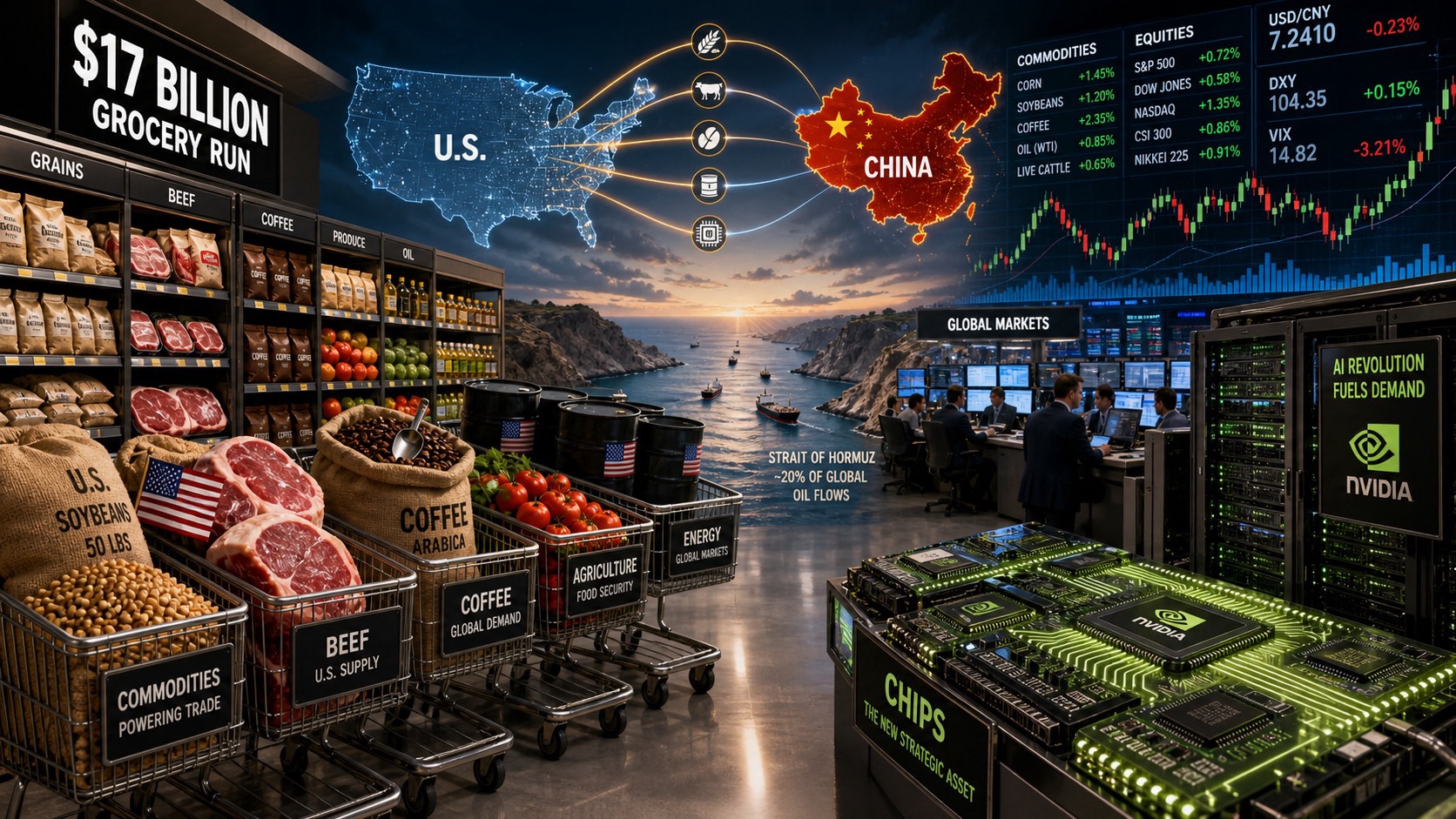
The global economy is serving up a curious 2026 prix fixe: China shopping for U.S. commodities again, CEOs quietly hiking menu prices, tankers dodging tension near Hormuz, and Nvidia (NVDA) back on investors’ dessert tray as “flavor of the day.”
China’s $17 Billion Shopping List: From Trade War Hangover To Commodity Courtship
China is back in the U.S. checkout line, agreeing to purchase at least $17 billion a year of American agricultural goods through 2028, a move that effectively reopens a critical export valve for U.S. farmers still nursing bruises from earlier trade skirmishes. The White House has framed the deal as a marquee outcome of President Donald Trump’s latest summit in Beijing, even as Chinese officials keep some of the fine print artfully vague.
For Washington, locking in multi‑year demand from the world’s second‑largest economy helps stabilize a sector that has weathered tariffs, droughts, and pandemic‑era volatility in one long, bruising cycle. For Beijing, committing to American supply is less an act of charity than a hard‑nosed hedge in a world where energy flows are disrupted and food security is back at the top of every Politburo agenda.
Energy Security Meets Food Security
China’s renewed appetite for U.S. commodities is unfolding as tensions around Iran and the Strait of Hormuz keep oil markets on edge and policymakers awake at inconvenient hours. The conflict has already produced the largest disruption to global oil supply in modern history, sending Brent crude roughly 50% higher and gas above $7 in California at the local Chevron (CVX) station reminding investors that “just‑in‑time” shipping can quickly become “not‑this‑month.”
In that context, American barrels and bushels look less like ordinary exports and more like geopolitical insurance policies, with buyers seeking reliability as much as price. The Western Hemisphere’s energy producers, from Texas shale to Alberta sands, suddenly find themselves in the unusual position of being cast as the grown‑ups in the room, supplying a world that has rediscovered the downside of relying on a single chokepoint in the Gulf.
America’s Kitchen Table Inflation: Beef, Coffee, And The New Normal
While tankers navigate geopolitics, U.S. households are navigating grocery aisles a the Walmart’s (WMT) of the world that feel more like luxury boutiques than staples markets. Food prices rose 0.5% month over month and 3.2% year over year in April, the fastest annual pace in three years, with grocery prices up 2.9% and restaurant tabs climbing 3.6%. Even the most disciplined shoppers are discovering that their carts have developed champagne tastes on a beer budget.
The sticker shock is particularly acute in the protein and caffeine aisles, where raw ground beef prices have jumped about 15% from a year earlier to a record $6.90 per pound, and coffee prices are up 18.5% year over year and 2% from just last month. CEOs from fast‑casual chains like McDonald’s (MCD) to global restaurant conglomerates say elevated beef costs are “persisting,” forcing them into a delicate balancing act: protecting margins without testing customer loyalty with every menu reprint.
CEOs Walk A Pricing Tightrope
Corporate leaders, who spent much of 2024 insisting inflation was “transitory,” now talk more like chefs staring at a volatile futures curve than macro theorists debating Phillips curves. Executives at restaurant operators such as Chipotle (CMG) and Restaurant Brands International (QSR), parent of Burger King, have flagged mid‑single‑digit beef inflation and high‑single‑digit overall food cost increases, highlighting how a single input can chew up a quarter of the cost structure.
Many chains are responding with the kind of quiet, surgical price increases that show up more clearly on a receipt than in a press release, as they attempt to pass along higher input costs without triggering a consumer revolt. For now, strong labor markets and rising nominal wages are cushioning the blow, but the longer food inflation lingers, the more it risks eroding the discretionary spending that has underpinned much of the post‑pandemic expansion.
Strait Of Hormuz: A Narrow Passage With Wide Consequences
The unresolved standoff around the Strait of Hormuz sits behind much of this pricing anxiety, acting as a kind of invisible surcharge baked into everything from gasoline to groceries. Iran’s semi‑official Fars news agency has outlined five U.S. conditions for a peace deal—ranging from transferring uranium stockpiles to releasing less than a quarter of Iran’s frozen assets—though Washington has not confirmed those terms, leaving markets to trade on rumor as much as fact.
With Trump warning that “the clock is ticking” and midterm elections looming, the administration faces a three‑part puzzle: reopen the strait, cool oil prices, and de‑escalate a conflict that has already upended shipping routes. Until there is a durable solution, traders will price in a risk premium, ensuring that energy remains a key transmission channel for geopolitical tension into global inflation data—and into the mood at the average U.S. gas pump.
Nvidia: Still The Market’s Favorite Flavor
While households debate the cost of burger night, Wall Street appears content to supersize its exposure to artificial intelligence, with Nvidia once again emerging as the market’s “flavor of the day.” The chipmaker has rejoined the exclusive $5 trillion market‑cap club, and some analysts now sketch out a path to a $9 trillion valuation as the company extends its reach beyond GPUs into AI inference, custom silicon, and consumer‑facing AI platforms.
Heading into its next earnings report on Wednesday, May 20, analysts see revenue growth potentially in the mid‑50% to near‑60% range, with gross margins hovering around 71% and a valuation multiple below that of the broader semiconductor ETF, even after a 70% year‑to‑date surge in the SOXX index. Wall Street’s enthusiasm is not just about chips; Nvidia is rolling out a new CPU to challenge Intel (INTC) and AMD while partnering with Corning (GLW) on optical technology to clear bottlenecks in the AI supply chain, drawing 76 buy ratings and a near‑cult‑like following among momentum traders.
When AI Meets The Aisle Endcap
The contrast between Nvidia’s high‑flying multiple and the grounded reality of beef and coffee inflation is stark but instructive: in modern markets, narrative is a currency of its own. Investors are willing to look through short‑term macro turbulence—oil shocks, food price spikes, diplomatic brinkmanship—so long as the long‑duration earnings stories in AI, cloud, and automation remain intact.
Over time, though, these worlds overlap: AI‑driven logistics, precision agriculture, and smarter energy grids all promise to make supply chains more resilient, potentially easing some of the very bottlenecks now inflating grocery bills and jolting fuel prices. If Nvidia and its peers can deliver those efficiencies at scale, the “flavor of the day” trade in semiconductors could ultimately help bring a bit more predictability—and perhaps a few cheaper steaks—to the real economy.
A World Of Higher Stakes And Thinner Margins
Taken together, China’s commodity commitments, Hormuz‑linked energy risk, sticky food inflation, and AI exuberance describe an economy that is both surprisingly resilient and perpetually on edge. Governments are relearning the old lesson that supply security matters, companies are rediscovering the art of pricing power, and investors are reminded daily that the most reliable growth stories often live far from the nearest shipping lane.
For portfolio managers, the message is clear: energy security, food inflation, and AI leadership are no longer separate chapters—they are now interlocking themes that will drive asset prices and policy debates alike. In this environment, diversification is not a cliché but a survival skill, as the global economy continues to serve a menu where the specials change fast, the bill keeps rising, and the market’s favorite flavor remains whatever promises growth in a world suddenly obsessed with scarcity.
The Sources
- China’s multi‑year agreement to buy at least $17 billion annually in U.S. agricultural goods
https://finance.yahoo.com/economy/policy/articles/china-buy-least-17-billion-173148370.htmlbloomberg - Rising U.S. food prices and CEO commentary on beef, coffee, and tomatoes
https://finance.yahoo.com/news/beef-coffee-tomatoes-americas-ceos-call-out-where-food-prices-are-rising-194217489.htmlfinance.yahoo - U.S.–Iran tensions and the difficulty of reaching a deal over the Strait of Hormuz
https://finance.yahoo.com/sectors/energy/articles/us-iran-far-hormuz-deal-171143829.htmlfinance.yahoo - Nvidia’s renewed momentum and why it could again become the market’s “flavor of the day”
https://finance.yahoo.com/video/how-nvidia-could-once-again-become-the-flavor-of-the-day-150527580.htmlfinance.yahoo
Stay Updated with Vista Partners
Subscribe to receive market insights, investing ideas, and the latest updates directly in your inbox.