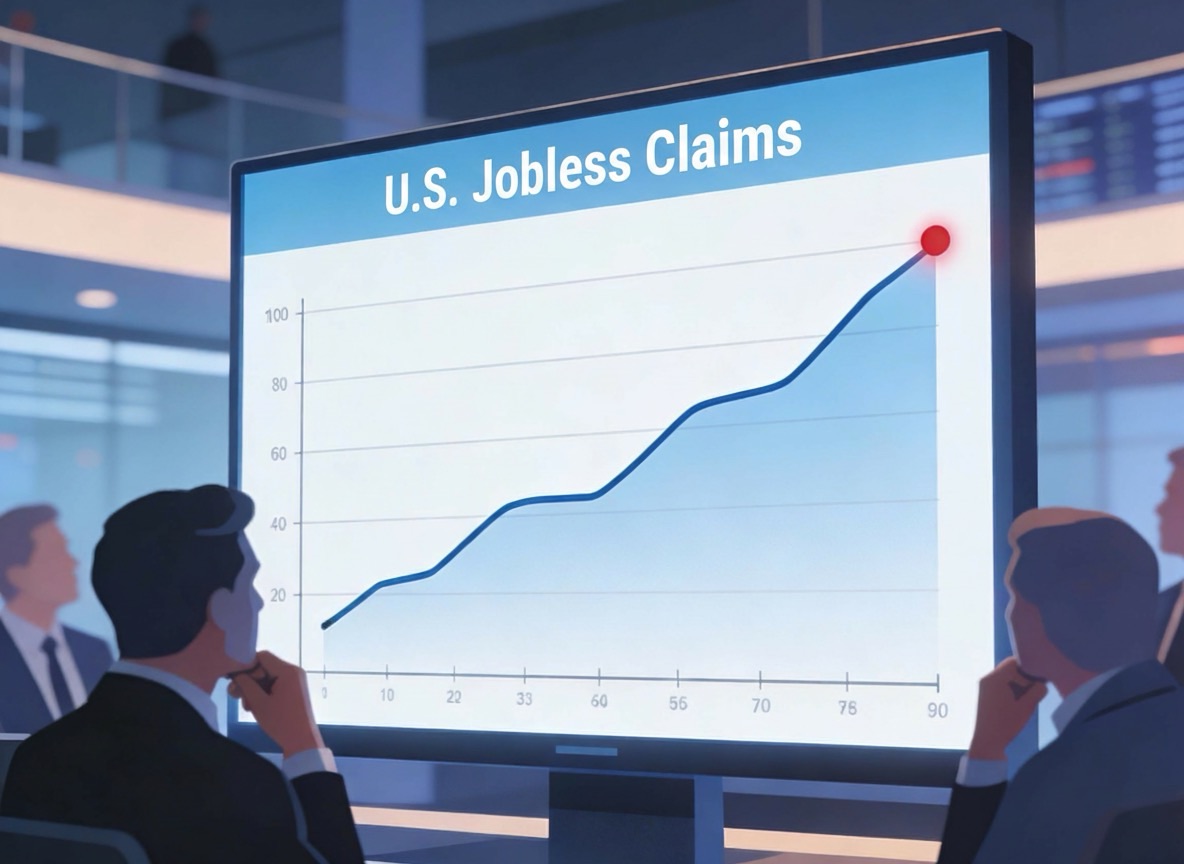
U.S. jobless claims just posted their sharpest rise in two months, but the numbers still paint a picture of a labor market that is cooling, not cracking.
Jobless Claims Jump – But Stay in the “Comfort Zone”
For the week ending January 31, initial applications for unemployment benefits climbed by 22,000 to 231,000, the highest level in roughly two months and well above economists’ expectations around 211,000. The four-week moving average, a steadier gauge that smooths out volatility, also ticked higher to about 212,250, signaling some softening beneath the weekly noise.
Yet in historical context, 231,000 is still more “moderate headwind” than “storm warning,” remaining within the low range that has defined the post-pandemic labor reset. Continuing claims, a proxy for how hard it is to find a new job after a layoff, hovered around 1.84 million, elevated from prior weeks but not remotely indicative of a broad-based collapse in hiring.
Corporate Layoffs: The Headlines Are Loud, The Data Is Softer
Names like UPS, Amazon, and Dow have featured prominently in layoff headlines over the past year, giving the impression of a broad corporate retrenchment. These cuts, while real for affected workers, are occurring against a backdrop of a still-low unemployment rate and an overall jobless-claims level that would have looked downright enviable in prior cycles.
Recent government data show hiring has cooled, with nonfarm payroll gains slowing to about 50,000 in December and revisions knocking prior months lower, underscoring a more subdued job-creation environment. Still, the jobless rate has edged down to around 4.4%, suggesting the labor market is easing off the boil rather than slipping into recessionary territory. In Wall Street terms, this looks less like a “mass layoff cycle” and more like a late-innings normalization where management trims the bench but keeps the core lineup intact.
A Normalizing Labor Market in a Lower-Rate World
Economists increasingly describe 2026 as a transition year from an overheated, stimulus-fueled labor boom to a more sustainable, disinflationary pace. Job openings have drifted lower, indicating that employers are not scrambling to add staff at any price—but they are also not racing to slash payrolls, a nuance easily lost in the daily tape.
The Federal Reserve, having spent 2022–2023 lifting rates to tame inflation, shifted to modest rate cuts last year and is now on hold, citing an economy that looks more balanced and a labor market that is stabilizing rather than stalling. Lower borrowing costs offer a cushion to businesses and households, even as slower hiring and elevated uncertainty keep growth expectations restrained. In classic Wall Street fashion, the market is now trying to price in a world where the punch bowl isn’t entirely gone—just moved a little farther from the dance floor.
Investor Takeaway: Cooling, Not Crashing
For investors, a single week’s jump in jobless claims to 231,000 is noteworthy, but hardly a thesis-breaking event. The data fit neatly into the emerging narrative of a cooling yet resilient labor market—one where wage pressures ease, the Fed has room to stay patient, and the economy walks the narrow path between slowdown and slump.
Equity markets have already been trading this “softening but not sinking” labor story, with Treasury yields slipping as traders weigh weaker jobs data against the prospect of a more accommodative rate backdrop. In that sense, the rise in jobless claims is less a plot twist and more a continuation of a familiar storyline: fewer fireworks, more fundamentals. As long as claims remain in this historically low band, Wall Street’s biggest worry may not be the labor market falling apart—but the narrative becoming too dull for the next headline.
Sources
- https://finance.yahoo.com/news/us-applications-jobless-benefits-jump-134045248.html[1]
- https://ca.finance.yahoo.com/news/us-weekly-jobless-claims-increase-133926766.html[2]
- https://www.floordaily.net/flooring-news/initial-jobless-claims-rose-by-22000-in-week-ending-january-31[3]
- https://www.ksat.com/business/2026/02/05/us-applications-for-jobless-benefits-jump-by-22000-to-231000-last-week-the-most-in-2-months/[5]
- https://www.investmentnews.com/equities/jobs-report/265126[6]
- https://parwcc.com/parwcc-2026-u-s-job-market-outlook-stability-skills-and-sector-splits-ahead/[4]
- https://www.northwesternmutual.com/life-and-money/stocks-rally-in-2026-but-labor-uncertainty-remains/[7]
- https://www.cnbc.com/2026/02/05/us-treasury-yields-investors-await-more-jobs-data-.html[9]
- https://finance.yahoo.com/news/us-applications-jobless-benefits-proxy-133359246.html[8]
- https://finance.yahoo.com/news/us-weekly-jobless-claims-fall-134039846.html[10]
Stay Updated with Vista Partners
Subscribe to receive market insights, investing ideas, and the latest updates directly in your inbox.