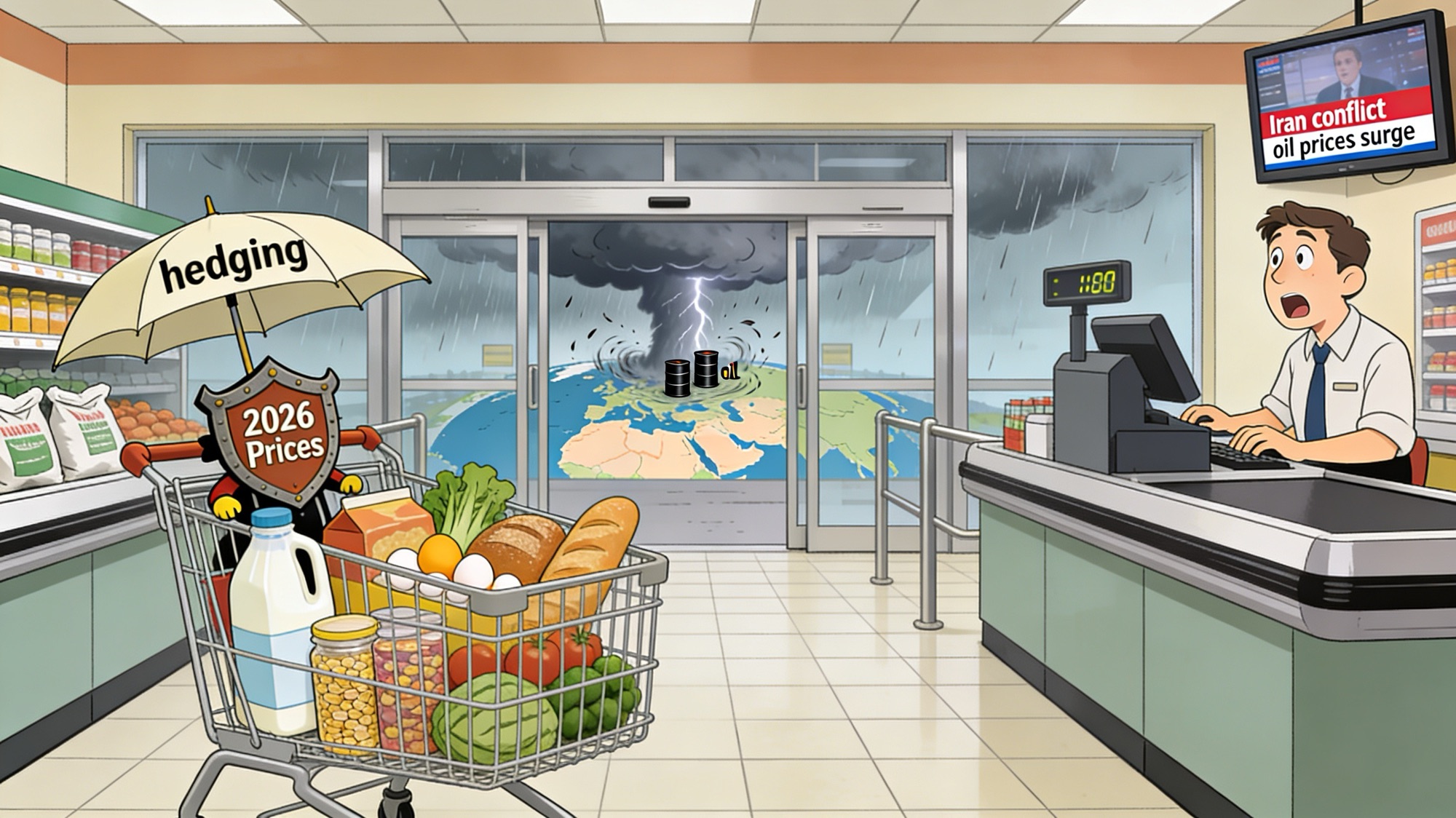
Iran’s war and the blockade of the Strait of Hormuz are already roiling oil and fertilizer markets, but the punchline for American shoppers—and investors—is that the real hit to grocery bills, and to the likes of Walmart (WMT), Target (TGT), and Amazon (AMZN), is more likely a 2026–2027 story than a “this week at Costco” moment. The pipeline from higher diesel and fertilizer costs to higher food prices moves with all the urgency of a quarterly earnings call Q&A: slow, deliberate, and just suspenseful enough to keep both consumers and shareholders on edge.
The War, the Strait, and the Silent Surcharge
Iran’s obstruction of the Strait of Hormuz has pinched a major share of global seaborne oil flows and a significant chunk of fertilizer shipments, turning one geographic chokepoint into a multi-quarter risk factor for food and retail margins. Oil prices have jumped, diesel has followed, and the fertilizer market has rediscovered volatility with the enthusiasm of a meme-stock message board.
For big-box bellwethers like Walmart (WMT) and Target (TGT), and e-commerce titan Amazon (AMZN) with its growing grocery footprint through Amazon Fresh and Whole Foods, higher transport and packaging costs are already a line item in risk disclosures—even if not yet a headline in the weekly ad circular. Farmers and food producers are absorbing higher input costs today, while retailers sit in the middle of the value chain, deciding how much to pass through without alienating consumers who have become highly price-sensitive after several years of elevated inflation.
Why Your Grocery Bill Hasn’t Exploded…Yet
The mystery of the relatively tame grocery bill, despite the geopolitical drama, is less a miracle and more a matter of timing, contracts, and inventory cycles. Many large North American farmers locked in fertilizer and diesel purchases for the current growing season before the conflict escalated, muting the immediate blow that might otherwise have rippled more quickly into retail prices at Walmart’s supercenters or Target’s grocery aisles.
Because crops are planted and harvested on an annual rhythm, today’s input shock doesn’t fully translate into shelf prices until future harvests—think more 2026–2027 than “this weekend’s family shop.” Energy-price shocks, by contrast, filter through faster and more broadly, nudging up costs on everything from refrigerated dairy to trucked-in produce. That dynamic matters for Amazon (AMZN), which runs an energy-intensive logistics network, as well as for national grocery chains like Kroger (KR), Costco (COST), and Albertsons (ACI), all of which rely on vast truck fleets and cold-chain infrastructure to keep shelves stocked and freezers humming.
The Lagged March of Food Inflation
History and research on cost pass-through suggest that spikes in energy and agricultural inputs seep into consumer prices gradually and incompletely rather than in one dramatic leap. Firms along the supply chain face menu costs, contractual obligations, and competitive pressures, so they often absorb part of the blow before adjusting price tags—and then typically in stages, not all at once.
For publicly traded grocery and big-box names—Walmart (WMT), Target (TGT), Costco (COST), Kroger (KR), Albertsons (ACI), and Amazon (AMZN)—that means a familiar balancing act between margin protection and market share. Central bankers have seen versions of this movie before: energy and food shocks can add meaningful pressure to headline inflation, but the full impact tends to unfold over several quarters. If the Iran conflict and Strait disruptions persist, food-at-home inflation could re-accelerate, with retailers caught between higher costs at the back door and consumer resistance at the front door.
Farmers on the Front Line, Retailers in the Middle
On the farm side, the math is getting harder even if the supermarket sticker has not yet fully caught up. As diesel, fertilizer, and packaging costs rise, farmers’ margins are squeezed, influencing what gets planted next season and how aggressively producers and processors push for higher prices from their downstream customers—among them the big U.S. chains and platforms that increasingly dominate grocery spending.
Retailers like Walmart (WMT) and Kroger (KR) rely on their scale to negotiate with suppliers and keep “everyday low prices” credible, while Target (TGT) and Costco (COST) lean on curated assortments, private labels, and membership models to protect loyalty even as costs creep higher. Amazon (AMZN), still scaling its food ambitions, faces the dual challenge of managing higher logistics costs and convincing shoppers its digital cart can compete on price with the brick-and-mortar giants. Today’s war premium on inputs, in other words, is setting up tomorrow’s negotiation across the table between suppliers and the largest publicly traded grocery and mass-merchandise players in America.
What This Means for Shoppers and Investors Now
For now, American consumers are living in a strange interlude where the macro headlines scream “inflation risk” while the grocery aisle mostly whispers it. Gas and diesel have moved first, but food-price data show only modest additional pressure so far, thanks to earlier input hedging, inventory buffers, and retailers’ willingness—so far—to eat some of the higher costs to protect traffic and basket size.
For investors in Walmart (WMT), Target (TGT), Amazon (AMZN), Costco (COST), Kroger (KR), Albertsons (ACI), and other food-exposed retailers, the key questions over the next several quarters are classical but newly sharpened by geopolitics: How much cost can these companies absorb before margin compression becomes visible in earnings, and when do they decide to push through a new round of price hikes that consumers will actually feel at the checkout? Until that inflection point, the Iran war remains less a shock at the register and more a slow-moving risk embedded in guidance, commentary on earnings calls, and the fine print of operating margin assumptions—proof that in the global food economy, geopolitics travels on a delay, but it rarely cancels its reservation.
The Sources
Here’s a numbered source list you can drop in at the end of the piece:
- Yahoo Finance – “Why the Iran war might not raise your grocery bill until next year”
https://finance.yahoo.com/economy/policy/article/why-the-iran-war-might-not-raise-your-grocery-bill-until-next-year-120223060.html[1] - Fortune – “The Iran war is exacerbating already high grocery bills”
https://fortune.com/2026/04/08/iran-war-high-grocery-prices-getting-worse[2] - Business Insider – “The Iran War Could Haunt Grocery Bills Long After the Fighting Stops”
https://www.businessinsider.com/iran-war-fertilizer-shortage-grocery-inflation-long-after-fighting-stops-2026-4[3] - CNBC – “Grocery shock on the horizon for U.S. elections as Iran war drags on”
https://www.cnbc.com/2026/04/02/grocery-shock-on-the-horizon-for-us-elections-as-iran-war-drags-on.html[4] - MarketWatch – “Your grocery bill will be the next casualty of the Iran war”
https://www.marketwatch.com/story/you-think-iran-is-only-about-oil-no-its-also-about-your-dinner-table-636de6a5[5] - IFPRI – “The Iran war’s impacts on global fertilizer markets and food production”
https://www.ifpri.org/blog/the-iran-wars-impacts-on-global-fertilizer-markets-and-food-production[6] - Goldman Sachs – “How the Conflict in the Strait of Hormuz Could Affect Global Agriculture Prices”
https://www.goldmansachs.com/insights/articles/how-the-conflict-in-the-strait-of-hormuz-could-affect-global-agriculture-prices[7] - The Jerusalem Post – “Hormuz closure disrupts global fertilizer trade, raising food prices”
https://www.jpost.com/international/article-892976[8] - ABC News Daily (podcast) – “When will the Iran war hit your grocery bill?”
https://www.youtube.com/watch?v=Yhn-dNyx6Ao[9] - Democracy Now – “The Looming Food Crisis: Why the Strait of Hormuz Is Disrupting Global Food and Fertilizer Supplies”
https://www.democracynow.org/2026/4/23/adam_hanieh[10]
Stay Updated with Vista Partners
Subscribe to receive market insights, investing ideas, and the latest updates directly in your inbox.