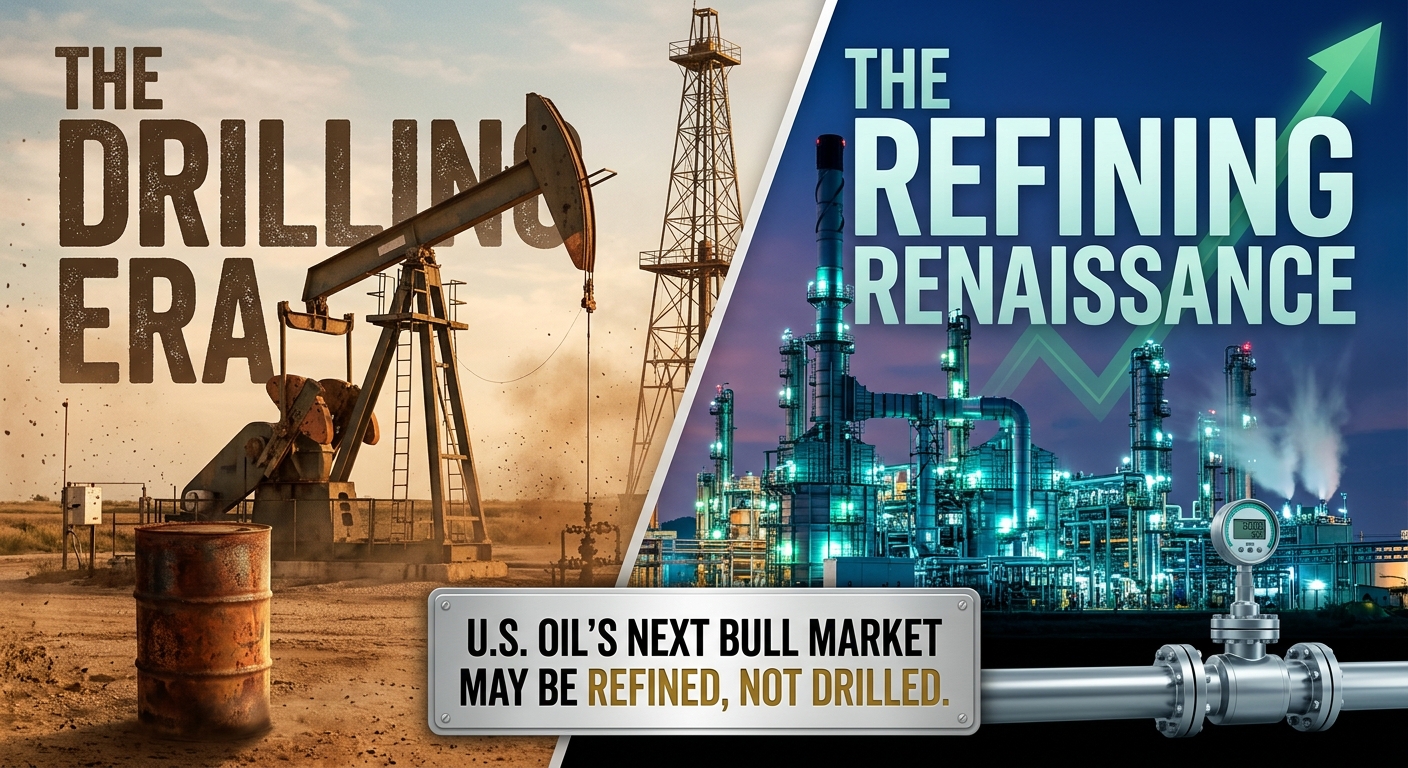
The White House’s current focus on gasoline prices is turning Wall Street’s attention toward a less glamorous, but potentially more investable, part of the energy chain: the infrastructure that turns crude oil into usable fuel and gets it to market. For many, the emerging opportunity is not merely in finding another barrel; it is in delivering the right barrel to the right refinery, at the right time, with enough operational flexibility to make the economics work. President Trump is reportedly scheduled to meet with oil-industry executives to discuss expanded U.S. refining capacity and lower prices at the pump. The agenda reportedly puts refiners and fuel retailers near the center of the conversation, rather than treating upstream production as the only lever. That distinction matters: crude supply is only half the story. Consumers buy gasoline, diesel and jet fuel not barrels of promise sitting in a storage tank wearing a hard hat. The market implication is constructive for a broad group of energy businesses: refiners, logistics operators, midstream companies, domestic producers with advantaged market access, and oil-service firms positioned to benefit if capital spending follows the policy talk. Chevron Corp. (NYSE: CVX) is expected to participate, while Exxon Mobil Corp. (NYSE: XOM) reportedly was not invited amid public differences over the investability of Venezuela.
Why Refining Is Back in Vogue
America remains one of the world’s largest energy producers, yet retail fuel prices can still rise sharply when refining, distribution, maintenance and regional supply constraints collide. That is the inconvenient truth of the gasoline market: the last mile often gets more political than the first thousand. The White House’s emphasis on refinery capacity acknowledges this reality. A barrel of crude is economically useful, of course, but its value ultimately depends on conversion capacity, product yields, transportation links, refinery configurations and local demand. When those links tighten, the gasoline market can behave like an airport boarding line during a thunderstorm: everyone knows the destination, but no one is thrilled by the routing. For many, this shifts attention toward companies that own or influence the bottlenecks:
| Energy Segment | Potential Investor Benefit | Public-Company Examples |
|---|---|---|
| Integrated oil | Exposure to production, refining, trading and global supply chains | Chevron Corp. (NYSE: CVX); Exxon Mobil Corp. (NYSE: XOM) |
| Independent refiners | Direct exposure to gasoline, diesel and refining-margin dynamics | Marathon Petroleum Corp. (NYSE: MPC); Valero Energy Corp. (NYSE: VLO); Phillips 66 (NYSE: PSX) |
| Midstream and logistics | Potential upside from pipelines, terminals, storage and product movement | Enterprise Products Partners L.P. (NYSE: EPD); Kinder Morgan Inc. (NYSE: KMI); Energy Transfer LP (NYSE: ET) |
| Domestic producers | Potential benefit from stronger local demand and a supportive policy backdrop | Sable Offshore Corp. (NYSE: SOC); Occidental Petroleum Corp. (NYSE: OXY); ConocoPhillips (NYSE: COP) |
This is not an argument that every refinery project will be built, nor that gasoline prices can be managed from a conference room. Large energy infrastructure takes time, permitting and capital, three items that rarely arrive early to a meeting. But the political focus itself could matter. It can encourage investment discussions, sharpen regulatory priorities and elevate the strategic importance of domestic barrels that can replace imports in regional markets.
Venezuela Adds Another Supply Lever
The administration’s oil strategy also includes Venezuela, where Chevron (NYSE: CVX) has been a notable U.S. operator. Chevron is reportedly approaching a potential agreement to expand its Venezuelan presence through interests in additional heavy-oil fields, while the company already has established operations in the country. That creates a nuanced opportunity for the major integrated companies. Venezuelan crude can be highly relevant to Gulf Coast refining systems designed to process heavier feedstocks. If legal, commercial and operational conditions become more durable, increased Venezuelan supply could support refinery utilization and crude sourcing flexibility. Yet investors should resist the temptation to treat Venezuela as a simple production-growth switch. Policy stability, contractual protections, sanctions compliance, infrastructure condition and capital discipline will determine whether headline potential becomes durable cash flow. Exxon Mobil (NYSE: XOM) has reportedly remained cautious, emphasizing the need for stronger investment protections before committing new spending. The bigger point is bullish: energy security is increasingly being discussed as a system, not a slogan. A more resilient supply network, domestic production, selective imported crude, capable refineries, pipelines, storage and marine access, could support capital allocation across the sector.
Sable Offshore: A California Barrel With Strategic Appeal
Sable Offshore Corp. (NYSE: SOC) stands out as a particularly interesting, higher-risk domestic-energy story because its Santa Ynez Unit restart offers exposure to a market where local crude supplies can matter disproportionately. California has long been a complex energy market: high demand, extensive regulation, constrained infrastructure and substantial reliance on imported crude have made locally produced barrels strategically valuable when they can reach refineries efficiently. Sable’s second-quarter 2026 results show a company moving from restart narrative toward measurable operating traction. The company reported:
- $137.1 million in quarterly revenue.
- $9.4 million of positive operating cash flow, its first full quarter of revenue generation and positive operating cash flow since inception.
- Approximately 21,000 barrels per day in average net sales volumes during the quarter.
- An exit oil-sales rate of roughly 40,000 net barrels per day, a 149% increase from the first day of the quarter.
- Average production of 723 barrels of oil per day per well from an average of 35 producing wells per day.
Those numbers matter because the SOC story is fundamentally a ramp-up story. Production, sales volumes, well optimization, pipeline and processing reliability, refinery access and realized pricing will all determine whether the company’s operating leverage becomes as compelling in practice as it appears on a spreadsheet. Management said preliminary July sales reached approximately 38,000 gross barrels per day, while average August sales through August 9 were approximately 42,000 gross barrels per day. Sable expects all 77 production wells at the Harmony and Heritage platforms to be online during the third quarter, with Platform Hondo targeted to return in September. The company also outlined perforation additions at Hondo that it estimates could add incremental output. That is precisely the type of operating sequence that investors watch closely: not a vague promise of future capacity, but a succession of visible milestones that can increase production, improve unit economics and broaden marketing flexibility.
The SOC Catalyst Checklist
The bullish case for Sable Offshore (NYSE: SOC) rests on five interlocking developments.
- Volume recovery: Bringing additional wells online and restoring Platform Hondo could increase the company’s sales capacity beyond its early-stage restart profile. Management’s 2026 second-half guidance calls for 47,500 to 52,500 gross barrels of oil equivalent per day, or 40,000 to 45,000 net barrels of oil equivalent per day.
- Improved crude quality: Sable said Hondo’s lower-sulfur oil could help normalize fieldwide sulfur content after the planned restart. Better quality characteristics could reduce commercial friction and improve refinery acceptance.
- Less midstream friction: The company said downstream partners temporarily constrained average gross oil-sales throughput to 40,000 barrels per day beginning in July, but expected relief beginning in the second half of August as California refiners adjusted supply slates.
- Marketing optionality: Sable is pursuing waterborne marketing options through existing Los Angeles-area marine terminals. It also cited the potential for added market access if the San Pablo Bay Pipeline system becomes available again. Optionality is an overused Wall Street word, but in crude marketing it can be a genuinely valuable one—especially when the alternative is being politely overruled by a bottleneck.
- Cash-flow discipline: Management reduced its midpoint second-half 2026 capital-expenditure outlook by 41% to $85 million, with the stated goal of optimizing cash flow and accelerating debt amortization.]
The company has also hedged production with costless Brent collars. Its disclosed floors are $65 per barrel across hedged periods through 2028, while the call ceilings vary by period. Hedging can cushion downside price risk, although it also caps a portion of upside if Brent prices rise sharply.
The Important Caveat: This Is Not a Quiet Story
A compelling investment case does not become risk-free merely because the barrels are real. Sable Offshore (NYSE: SOC) has meaningful execution, balance-sheet, regulatory and marketing risks that investors should weigh alongside the production ramp. The company reported $18.5 million of nonrecurring demurrage charges during the second quarter as California refiners adjusted to unexpected Pacific Outer Continental Shelf crude volumes. It also cited temporary throughput constraints and crude-quality deductions, all of which can affect realized pricing and operating cash flow. Its refinancing improved maturity runway, but the capital structure remains consequential. Sable disclosed a $675 million senior secured term loan due in December 2028 with a 15% annual coupon, mandatory amortization requirements and an excess-cash-flow sweep. It also issued $345 million of 6.5% convertible senior notes due in 2031 and $115 million of common stock at $3.08 per share. That means the investment debate should not stop at production growth. Many should monitor:
- Actual sales volumes versus the company’s guidance range.
- Realized pricing and the size of marketing and transportation deductions.
- Platform Hondo’s restart timing and production performance.
- Midstream throughput improvements and marine-marketing progress.
- Capital spending, operating cash flow and required debt amortization.
- Additional share issuance or potential dilution from convertible notes.
A Takeaway
The bullish energy narrative for late 2026 is increasingly about execution at the bottlenecks. Washington is pushing the industry to address pump prices, refinery capacity and domestic fuel availability; Chevron (NYSE: CVX) may gain additional strategic relevance through Venezuela; refiners such as Marathon Petroleum (NYSE: MPC), Valero Energy (NYSE: VLO) and Phillips 66 (NYSE: PSX) remain important expressions of product-market tightness; and midstream operators may benefit if investment in crude and fuel logistics accelerates. Within that backdrop, Sable Offshore (NYSE: SOC) offers a more specialized proposition: a rapidly ramping California offshore oil-restart story whose upside depends on converting operational progress into sustained, higher-margin crude sales. The company has already demonstrated revenue generation, positive operating cash flow and a sharply higher exit sales rate. Its next challenge is to make those gains repeatable while easing transport, quality and market-access constraints. For many comfortable with elevated operational and financing risk, SOC may be one of the market’s more magnetic energy turnaround-and-ramp stories. It is not the sleepy dividend aristocrat of the oil patch. It is closer to a high-powered offshore restoration project trying to merge onto the California crude market at speed provided the on-ramp, the pipeline and the refinery gate all cooperate.
The Sources
- Yahoo Finance Video: “Trump to meet with oil executives on lowering gas prices and Exxon isn’t invited”
- Yahoo Finance / Business Wire: “Sable Offshore Corp. Reports Second Quarter 2026 Financial and Operational Results”
- Sable Offshore Investor Relations: “Sable Offshore Corp. Reports Second Quarter 2026 Financial and Operational Results”
- U.S. Securities and Exchange Commission: Sable Offshore Corp. First-Quarter 2026 Results Release
- U.S. Energy Information Administration: Refining Today in Energy
- Reuters: “Exxon, Chevron See Glimmer of Venezuela’s Potential, but Long Road Ahead”
- Chevron: Venezuela Highlights of Operations
- The Wall Street Journal: “Chevron, Other U.S. Firms Near Deal to Invest Billions in Venezuelan Oil Fields”
- Yahoo Finance: “Chevron (CVX) Nears Major Venezuela Oil Deal”
- Quiver Quantitative: “Sable Offshore Reports $137.1 Million in Q2 Revenue”
This material is for informational and editorial purposes only and is not investment advice. Energy equities, especially companies with concentrated assets, leverage, regulatory exposure and production-restart plans, can be volatile. Investors should review company filings, earnings materials and their own risk tolerance before making an investment decision.
Stay Updated with Vista Partners
Subscribe to receive market insights, investing ideas, and the latest updates directly in your inbox.