The AI Trade Is Growing Up
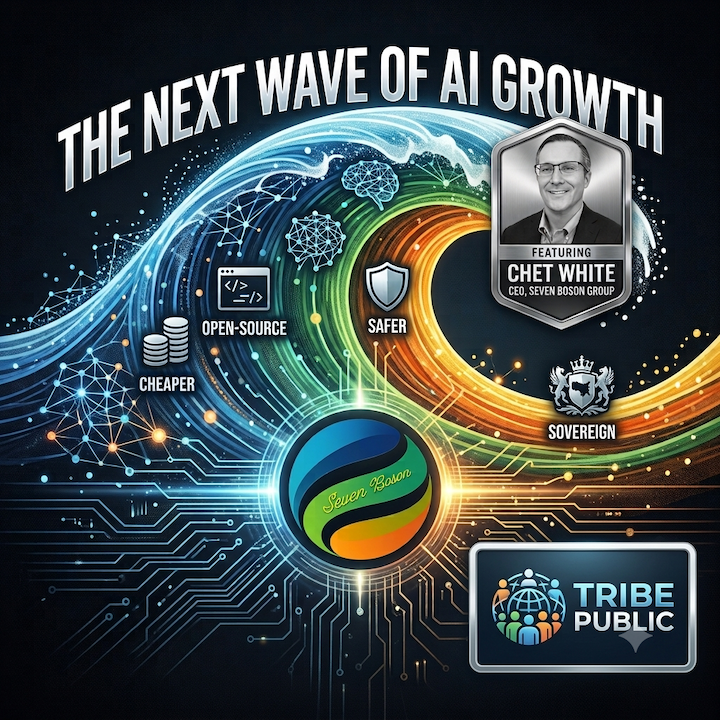
Artificial intelligence has spent the last several years behaving like a fashionable restaurant with a six-month waiting list: expensive, crowded, and occasionally more admired for the bill than the meal. The next phase, however, may be defined less by spectacle and more by practical economics, security, and ownership. At Tribe Public’s Next CEO Presentation and Q&A Webinar Event on Friday, August 7, 2026, Chet White—Chairman, CEO and Managing General Partner of Seven Boson Group, MGP/PM Helios Alpha and MP Carat Ventures—outlined that transition in his presentation, “The Next Wave of AI Growth – Cheap, Opensource, Safe, and Sovereign.” The core proposition was straightforward: the AI market’s most durable opportunity may be moving beyond centralized, costly model access toward AI systems that can be operated securely, affordably, and independently by enterprises and nations. That is an investment thesis with fewer fireworks than the early large-language-model boom—but potentially far more plumbing, and Wall Street has historically learned to appreciate the firms that own the plumbing.
From AI Access to AI Ownership
Seven Boson Group describes its focus as sovereign AI automated decision intelligence optimized with clean energy—enabling nations and enterprises to deploy and operate private AI-cloud and power systems under local control. The strategic attraction is clear: data, compute infrastructure, energy and operational governance become owned assets rather than permanently rented services. For regulated enterprises, governments, and organizations managing sensitive information, sovereignty is not merely a feature on a product sheet. It is an operating requirement. Current industry discussion increasingly frames open models and private-cloud deployment as a path to jurisdictional control, particularly where sensitive data cannot be routed to outside inference endpoints.
That shift presents a notably different AI calculation:
- Lower-cost AI: More efficient models, private deployment options, and declining dependence on perpetual usage fees can improve the economics of high-volume workloads.
- Open-source AI: Open architectures give enterprises more flexibility to customize models, review components, and reduce dependency on a single vendor.
- Safe AI: Governance, monitoring, cybersecurity, auditable systems, and policy enforcement rise from afterthoughts to core infrastructure.
- Sovereign AI: Nations and enterprises can retain control over infrastructure, data residency, model deployment, and critical decision systems.
Open-source systems are not automatically inexpensive; self-hosting brings hardware, engineering, security, and operating costs. But for large, persistent, and sensitive AI workloads, the ability to control the full cost structure—and avoid a future invoice with the emotional complexity of a small opera—can be strategically valuable.
Energy Is Becoming an AI Asset
The original AI boom centered on chips, models, and data centers. The next leg increasingly turns on something less glamorous but considerably harder to negotiate with: electricity. AI infrastructure requires dependable power, and power availability increasingly shapes where AI capacity can be built, expanded, and operated. Research on 2026 venture and enterprise trends points to capital migrating toward AI infrastructure, sovereign compute, energy systems, governance, and applications with measurable returns rather than simply additional compute for compute’s sake. That backdrop supports Seven Boson Group’s emphasis on coupling AI platforms with clean-energy optimization. In this framing, energy is no longer just an operating expense. It becomes a strategic input to AI independence, deployment scale, resilience, and long-term unit economics. For investors, the implication is worth underlining: the AI opportunity may broaden beyond the companies building the largest models and toward those enabling secure deployment, reliable power, trusted orchestration, and local control.
Chet White’s Market Perspective
Chet White brings more than 35 years of investment-management and financial-advisory experience focused on emerging-growth technology companies. His prior roles include Managing Director of Technology Investment Banking at MCF & Co., Senior Vice President of Emerging Technology Equity Research at Wells Fargo & Co. (NYSE: WFC) and L.H. Friend, and investment executive positions at UBS Group AG (NYSE: UBS) and Morgan Stanley (NYSE: MS). That background is particularly relevant at a moment when AI investors are beginning to distinguish between technological possibility and economic durability. Corporate leaders broadly expect AI agents to generate measurable returns, but the market is demanding more focused investment, tangible business outcomes, and clear accountability for spending. The practical question is evolving from “Can an organization use AI?” to “Can it operate AI securely, economically, and on its own terms?” The winners may be the companies that answer all four parts of that question without requiring a budget that resembles a national infrastructure program.
A Broader AI Investment Map
The sovereign-AI thesis does not displace the established AI ecosystem. Rather, it adds potentially investable layers to it: private AI clouds, data-center infrastructure, cybersecurity, cooling, power generation, energy storage, networking, AI governance, and specialized enterprise applications.
| AI Theme | Why It Matters | Representative Public-Company Exposure* |
|---|---|---|
| AI compute and semiconductors | Compute remains foundational to training and inference | NVIDIA Corp. (NASDAQ: NVDA), Advanced Micro Devices, Inc. (NASDAQ: AMD) |
| Enterprise and private cloud | Businesses need deployment, integration, and operational control | Microsoft Corp. (NASDAQ: MSFT), Amazon.com, Inc. (NASDAQ: AMZN), Alphabet Inc. (NASDAQ: GOOGL) |
| Cybersecurity and governance | AI expands the attack surface and raises data-control requirements | Palo Alto Networks, Inc. (NASDAQ: PANW), CrowdStrike Holdings, Inc. (NASDAQ: CRWD) |
| Power and grid infrastructure | AI capacity depends on reliable, scalable electricity | Vertiv Holdings Co. (NYSE: VRT), Eaton Corp. plc (NYSE: ETN) |
| AI sovereignty and private deployment | Government and regulated-industry demand may favor local, controlled systems | An emerging market category; Seven Boson Group is privately held |
*Illustrative examples only, not recommendations. Seven Boson Group is privately held and does not have a public-market ticker.
The Takeaway
The market is beginning to move from AI novelty to AI utility. That transition should favor solutions that make AI less expensive to operate, more flexible to deploy, more secure to govern, and more independent from centralized infrastructure. Seven Boson Group’s thesis is positioned at the convergence of these forces: automated decision intelligence, clean-energy optimization, private infrastructure, and sovereign control. Whether the opportunity ultimately belongs to national clouds, enterprise-owned AI stacks, or a hybrid of the two, the direction of travel is becoming clearer. The next AI cycle may not be won solely by the company with the biggest model. It may be won by the organizations that make intelligence affordable, safe, durable, and locally owned—a decidedly less theatrical proposition, perhaps, but one investors have often found quite profitable.
About Tribe Public
Tribe Public’s corporate-sponsored events provide investors, consumers, and members of the business community with direct access to corporate management teams and subject-matter experts across sectors. The platform also hosts in-person dinner, luncheon, and speaking events across the United States, connecting companies, family offices, portfolio managers, accredited investors, advisors, business owners, and media professionals. Tribe Public’s event platform highlights upcoming CEO presentations and community engagement opportunities.
The Sources
Sources
- Tribe Public — Events — Event platform and CEO-presentation information. tribepublic
- Seven Boson Group — Sovereign AI platform and clean-power systems overview. sevenbosongroup
- Tribe Public Webinar Video: “The Next Wave of AI Growth – Cheap, Opensource, Safe, and Sovereign”
- Seven Boson Group — Team — Chet White’s leadership role and company-team information. sevenbosongroup
- Tribe Public — Corporate-access events, dinners, presentations, and investor community information.
- Tribe Public Disclaimers
- Vista Partners Disclaimer
- Andreessen Horowitz: “Asserting American Leadership in Open Source AI”
- Tony Blair Institute: “Open Source: How Middle Powers Can Build Influence in the Age of AI”
- SiliconANGLE: “What Is Sovereign AI—and Why It Will Decide the Winners and Losers in the AI Race?”
- Trend Micro: “TrendAI Joins NVIDIA’s Open Secure AI Alliance”
- BCG: “As AI Investments Surge, CEOs Take the Lead”
- AlphaSense: “The State of Venture Capital: AI Sector Funding Trends in 2026”
- Wells Fargo & Co. (NYSE: WFC)
- UBS Group AG (NYSE: UBS)
- Morgan Stanley (NYSE: MS)
- NVIDIA Corp. (NASDAQ: NVDA)
- Advanced Micro Devices, Inc. (NASDAQ: AMD)
- Microsoft Corp. (NASDAQ: MSFT)
- Amazon.com, Inc. (NASDAQ: AMZN)
- Alphabet Inc. (NASDAQ: GOOGL)
- Palo Alto Networks, Inc. (NASDAQ: PANW)
- CrowdStrike Holdings, Inc. (NASDAQ: CRWD)
- Vertiv Holdings Co. (NYSE: VRT)
- Eaton Corp. plc (NYSE: ETN)
Disclosure: This article is for informational and educational purposes only and does not constitute investment advice, an offer to sell, or a solicitation to buy any security. Investors should conduct their own due diligence and consult qualified financial, legal, and tax professionals before making investment decisions.
Stay Updated with Vista Partners
Subscribe to receive market insights, investing ideas, and the latest updates directly in your inbox.