


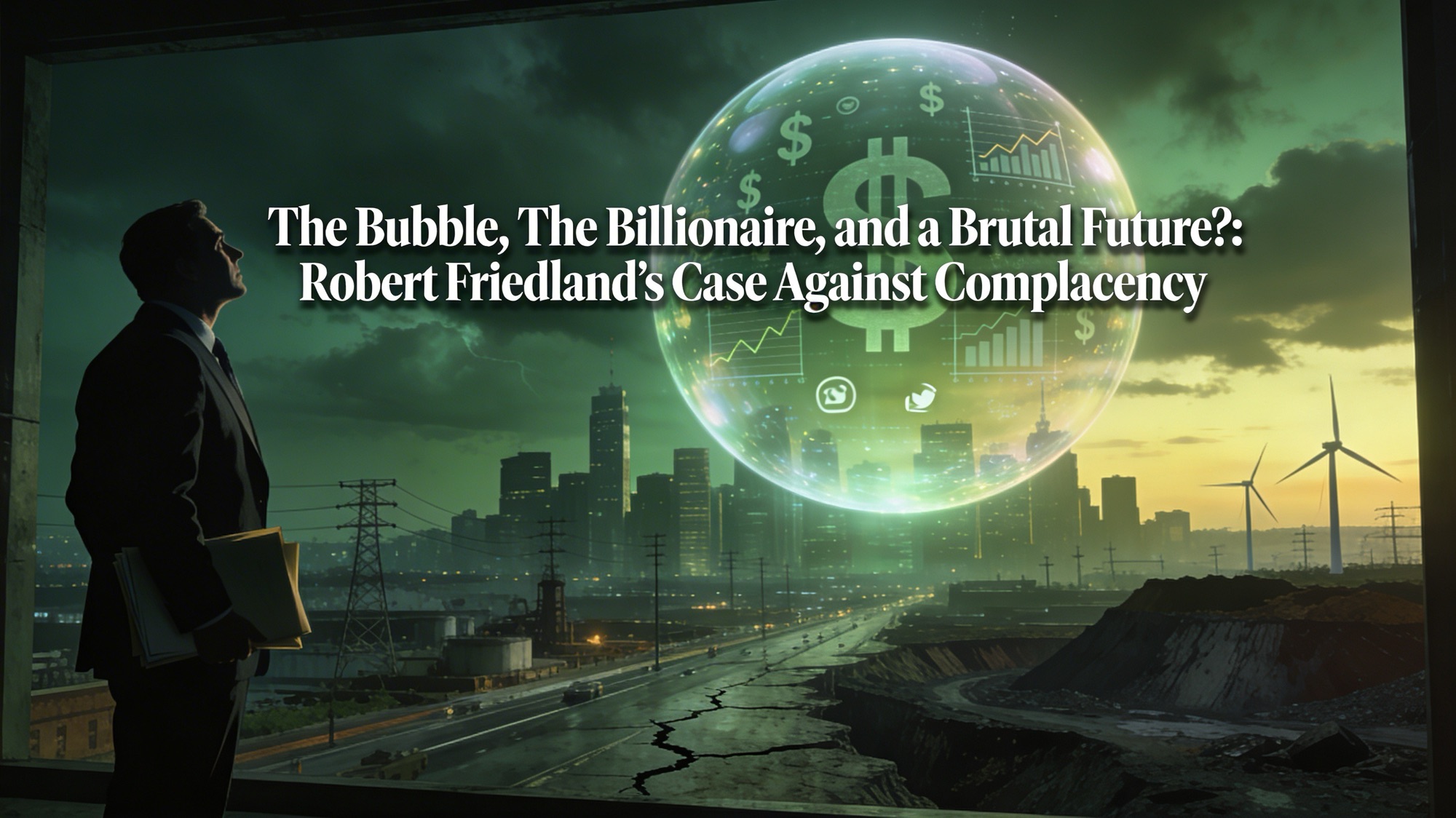
The illusion of comfort that has defined much of American life in recent years is colliding with a far harsher reality taking shape beneath the surface. Robert Friedland, the influential billionaire investor and mining magnate, has been sounding the alarm that many Americans are living in a bubble, shielded from the structural and environmental forces already reshaping the world around them. His warning is not about a routine recession or a temporary market dislocation; it is about a profound disconnect between day‑to‑day sentiment and the scale of change bearing down on the global economy.
A Rude Awakening Ahead
Friedland argues that we are heading toward a “rude awakening” as economic, environmental, and geopolitical pressures converge in ways that will test institutions, capital, and social stability. From climate change to resource scarcity and from automation to artificial intelligence, the systems that underpinned the post‑Cold War era are being re‑wired in real time. For many citizens, these dynamics still feel abstract, but their impacts are already visible in supply chains, energy markets, labor dynamics, and the cost of capital. The time to acknowledge and adapt to these realities is not when the shocks fully manifest, but now, while there is still room to reposition.
Systemic Change Is Here
This moment is also about systemic change. Climate volatility is disrupting agriculture, infrastructure, and insurance models, while climate policy is accelerating the shift toward electrification, renewables, and efficiency technologies. At the same time, automation and AI are transforming how work is done, which jobs endure, and where value accrues, often faster than governments and educational systems can respond. These forces are not distant trends; they are beginning to influence daily life—from the reliability and price of energy to the resilience of local economies and the durability of retirement portfolios.
Complacency vs. Adaptation
Friedland’s central critique is complacency. It is no longer sufficient to assume that technological progress, central banks, or policymakers will always smooth out every dislocation. The next decade is likely to feature higher capital intensity, more acute competition for critical resources, and more frequent climate‑driven disruptions. In such an environment, adaptation—not passive optimism—will separate those who preserve and grow wealth from those who are caught unprepared. Living in a fantasy that “everything will be okay” without deliberate action is, in his view, a luxury the world can no longer afford.
An Investor’s Mandate
For investors, this reality demands a recalibration of priorities. Resilience, innovation, and resource security are emerging as the cornerstones of long‑term value creation. Capital is increasingly being drawn to companies and projects that address hard problems: securing critical minerals, building smarter and more robust infrastructure, enabling the energy transition, and delivering technologies that enhance efficiency and reduce risk rather than simply adding convenience. Those who orient toward solving these structural challenges, rather than chasing the next speculative distraction, will be better positioned in what Friedland has described as a more “reality‑driven” future.
The End of “It Will Be Fine”
The warning is blunt but constructive: the era of assuming that the future will look like a smoother version of the past is over. The coming phase will reward awareness, strategic preparation, and the courage to confront uncomfortable truths—about resource limits, environmental constraints, geopolitical fragmentation, and the uneven impacts of technological disruption. The sooner individuals, businesses, and policymakers accept this, the more agency they will have in shaping outcomes instead of being swept along by them.
Fault Lines in Capital Flows
The implications are increasingly visible in capital flows and policy debates. Concerns around the concentration of critical minerals production and processing are driving efforts to diversify supply, secure offtake agreements, and reassess national industrial strategies. This matters because these materials sit at the heart of clean energy technologies, electric vehicles, grid storage, and the advanced computing hardware that powers AI. At the same time, the build‑out of data centers and AI infrastructure is contributing to a step‑change in electricity demand, straining existing grids and forcing a re‑think of how and where new generation and transmission will be financed and constructed.
Stepping Out of the Bubble
In other words, the “reality‑driven” future Friedland describes is already forming at the intersection of resource security, digital infrastructure, and the climate transition. For investors, this translates into a clear mandate: focus on the companies, projects, and regions positioned along these fault lines—critical minerals, grid and power assets, climate and efficiency technologies, and resilient, diversified supply chains—rather than relying on yesterday’s playbook. At Vista Partners, the core belief is that the true opportunity in this unsettled global landscape lies in understanding these structural shifts before they become conventional wisdom and in allocating capital to those working to solve the hardest, most durable problems.
The world is shifting fast. The choice now is whether to remain in the comfort of the bubble or to step out, confront the realities ahead, and prepare thoughtfully for what is coming.
The Sources
- [1] Robert Friedland, an influential billionaire investor, has some … https://www.facebook.com/Surveee.org/posts/robert-friedland-an-influential-billionaire-investor-has-some-unsettling-words-f/994798243106559/
- [2] Robert Friedland, an influential billionaire investor, has some … https://www.facebook.com/photo.php?fbid=994798229773227&set=a.213126797940378&type=3
- [3] DEMOCRACY SUPPORTERS UNITE https://www.facebook.com/groups/131739878484971/posts/1301185921540355/
- [4] DEMOCRACY SUPPORTERS UNITE https://www.facebook.com/groups/131739878484971/posts/1301102668215347/
- [5] AI’s arrival complicates Big Tech climate goals, and some worry it’s … https://www.audacy.com/wwl/news/business/ap-climate-goals-technology-companies-2nd-ld-writethru
- [6] [PDF] Introduction – New Orleans Investment Conference https://neworleansconference.com/wp-content/uploads/2025/01/NOIC-2024-Transcripts-2.pdf
- [7] IEA Global Critical Minerals Outlook2025. | PDF – Slideshare https://www.slideshare.net/slideshow/iea-global-critical-minerals-outlook2025/279448036
- [8] [PDF] Global Critical Minerals Outlook 2025 https://iea.blob.core.windows.net/assets/642bb824-3f89-4949-8f84-d41bfa58ae03/GlobalCriticalMineralsOutlook2025_CorrigendaNotice.pdf
- [9] Tech company climate goals under pressure due to AI energy demand https://apnews.com/article/technology-artificial-intelligence-climate-change-data-centers-ef3a9c264bd6376d77e2c81ab266fb38
- [10] Can US infrastructure keep up with the AI economy? – Deloitte https://www.deloitte.com/us/en/insights/industry/power-and-utilities/data-center-infrastructure-artificial-intelligence.html
- [11] Deloitte: AI Data Center Power Demand Could Surge 30x by 2035 … https://www.prnewswire.com/news-releases/deloitte-ai-data-center-power-demand-could-surge-30x-by-2035-amid-power-and-grid-capacity-constraints-302488877.html
- [12] Higher Power: Can AI Investment & Climate Strategy Co-Exist? https://www.corporatecomplianceinsights.com/higher-power-can-ai-investment-climate-strategy-co-exist/
- [13] ESG Articles and News from Corporate Compliance Insights https://www.corporatecomplianceinsights.com/tag/esg/
- [14] Surveee – Robert Friedland, an influential billionaire … – Facebook https://www.facebook.com/Surveee.org/photos/robert-friedland-an-influential-billionaire-investor-has-some-unsettling-words-f/994798229773227/
- [15] [PDF] ABSTRACT Title of Dissertation: IRRELEVANT GENIUS – UMD DRUM https://drum.lib.umd.edu/bitstreams/ab5b15d1-4173-4b4b-9013-c5160909cc74/download

