


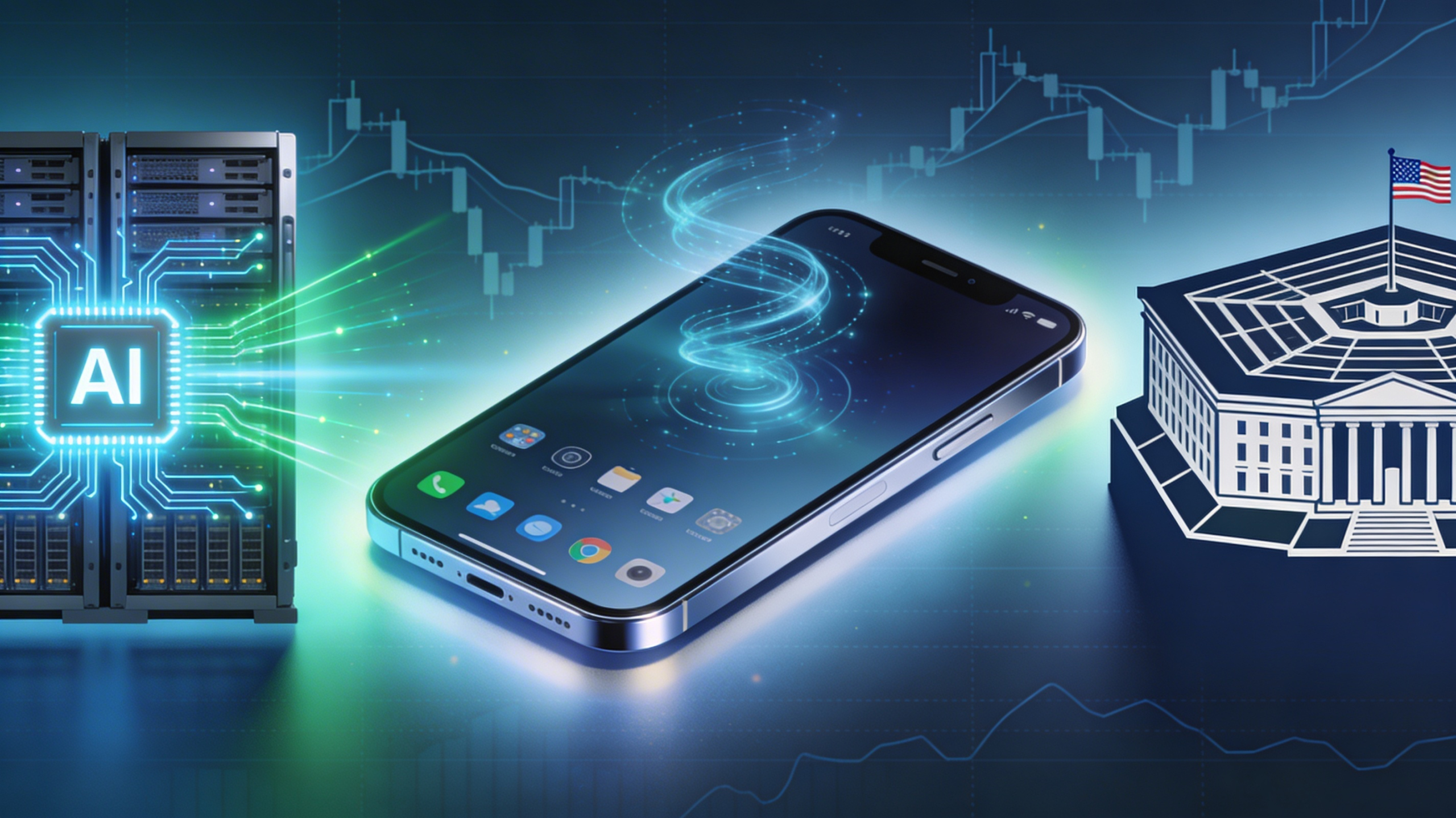
The trading week opened with a very 2026 question: what do you buy when chips, phones, defense‑grade algorithms, and even old‑school networks all decide to reinvent themselves at once? Investors answered with a familiar refrain—more tech.
Nvidia Bets $4 Billion That Light Beats Copper
Nvidia is doubling down on the idea that the future of AI isn’t just about bigger models, but faster plumbing. The company committed a combined $4 billion—$2 billion each to Coherent and Lumentum—to secure cutting‑edge photonics that can move data around its next‑generation AI data centers at the speed of, essentially, physics.
The deals come with multibillion‑dollar purchase agreements for advanced lasers and optical networking gear, effectively turning Nvidia into both cornerstone investor and anchor customer. While Nvidia shares eased about 1.2% in premarket trading, Coherent (COHR) and Lumentum (LITE) jumped roughly 8% and 7% as Wall Street decided that being on Nvidia’s supplier list is the closest thing semiconductors have to a royal warrant.
Behind the numbers is a strategic wager that silicon photonics will be critical to scaling AI infrastructure as today’s electrical interconnects hit power and bandwidth ceilings. In an era when training runs are measured in gigawatts and data centers are starting to look like small utilities, shaving latency and power loss between chips is more than an engineering nicety—it is the business model.
Apple’s iPhone 17e: Luxury Brand, Outlet Pricing
Over in Cupertino, Apple (AAPL) opened its own front in the AI era—not with an exotic headset, but with something much more dangerous to rivals: a cheaper iPhone that does not feel cheap. The new iPhone 17e starts at $599, coming in about $200 below the standard iPhone 17 while sharing the same processor.
To hit that price, Apple trimmed around the edges: a slightly smaller display, a single rear camera instead of two, and no Dynamic Island interface flourish. For many upgraders coming from older devices, those trade‑offs may feel more like fine print than sacrifice, especially when the chip inside unlocks Apple’s latest AI features.
The timing is deliberate. Global smartphone shipments are expected to decline in the near term amid memory shortages tied to AI demand, yet Apple is expanding its budget lineup for a second straight year after the reception to last year’s 16e. While the market frets about unit volumes, Apple is tuning its price ladder to pull more users into its ecosystem just as it prepares a revamped, AI‑heavy Siri powered by Google’s Gemini later this year.finance.
OpenAI Heads to the Pentagon—And Into the Spotlight
If Nvidia is rewiring the data center and Apple is re‑pricing the handset, OpenAI is testing the boundaries of where commercial AI belongs. The company signed a contract with the U.S. Department of Defense, a move that arrives amid rising geopolitical tensions and an unusually public feud between the Pentagon and Anthropic.
Anthropic has resisted government pressure for less‑restricted access to its AI models, prompting threats that it could be tagged as a supply‑chain risk. OpenAI, by contrast, says its Pentagon deal includes guardrails similar to those Anthropic advocates, with CEO Sam Altman stressing the firm’s ethical commitments. In practice, that sets up a real‑time case study in how AI vendors balance lucrative government contracts with reputational risk among employees, civil society groups, and international customers.
The deal also lands just days after Amazon (AMZN) agreed to invest $50 billion in OpenAI and commit 2 gigawatts of Trainium capacity, while Microsoft (MSFT) reiterated that its own partnership with the startup remains intact. For now, OpenAI is managing to play three‑dimensional chess across cloud, capex, and defense, while everyone else watches to see how many boards can be kept in the air at once.
BYD, SpaceX, and the Global Tech Undercard
The day’s tape also featured a supporting cast that would be headliners in any other market cycle. BYD shares rose about 4% after the Chinese EV giant teased “disruptive technology” at an upcoming event, even as it reported a 41% slide in February global sales. The message from investors: in a market this hungry for innovation, credible promises about the future can sometimes outrun uncomfortable math about the recent past.
SpaceX, meanwhile, is reportedly weighing a confidential IPO filing that could value the company north of $1.75 trillion. That would cement the launch provider as one of the world’s most richly valued private enterprises, reflecting not only its rocket business but also the capital markets’ growing comfort with space infrastructure as a core part of the digital economy.
Layered on top of all this is ongoing strain in smartphone supply chains, with memory shortages linked to AI workloads expected to drive a meaningful decline in shipments this quarter. The irony is hard to miss: the same AI boom lifting data‑center spending and photonics valuations is squeezing components for the pocket computers that first taught consumers to expect cloud intelligence everywhere.
Nokia and Nvidia: Turning Networks into AI Superhighways
Just as Nvidia courts photonics makers for its data centers, it is also wiring itself into the less glamorous—but equally critical—world of telecom networks through Nokia (NOK). In late 2025, Nvidia agreed to invest $1 billion in Nokia at a subscription price of $6.01 per share, cementing a strategic partnership to build AI‑native 5G‑Advanced and 6G networks on Nvidia platforms. For longtime Nokia watchers, the phrase “strategic investor” is more often associated with nostalgia than growth, but this time the money is aimed squarely at AI‑RAN: radio access networks that push intelligence all the way to the cell tower.nvidianews.nvidia+3
Under the deal, Nokia is accelerating its 5G and 6G RAN software on Nvidia’s CUDA platform and embedding Nvidia’s AI‑focused RAN hardware into future baseband products. The two companies are also collaborating on AI networking solutions, from data‑center switching using Nokia’s SR Linux on Nvidia’s Spectrum‑X Ethernet platform to applying Nokia’s telemetry and fabric‑management tools across Nvidia AI infrastructure. In effect, Nvidia supplies the GPUs and AI plumbing, Nokia supplies the carrier‑grade networking stack, and together they give operators a path to turn mobile networks into distributed AI grids rather than mere conduits for video streams.
For Nokia shareholders, Nvidia’s capital and endorsement add financial and strategic weight to a turnaround that now leans heavily on AI‑RAN economics. For Nvidia holders, the tie‑up extends the company’s reach beyond data centers and into the “most valuable real estate for AI—the edge, where data is created,” as partners have framed it. In a market where everyone wants exposure to AI infrastructure, owning a chip designer that is simultaneously backing photonics in the data center and GPUs in the radio network—and a legacy network vendor repositioning itself as an AI‑era gatekeeper—has its appeal.delloro+4
The Through‑Line: AI as Infrastructure, Not Hype
Strip away the tickers, and a common theme emerges: AI is quietly graduating from marketing slogan to industrial infrastructure. Nvidia’s photonics push is about reducing the physical friction of moving data; Apple’s budget iPhone aims to broaden the installed base that can actually run AI features; OpenAI’s Pentagon contract tests where society will draw the line on dual‑use algorithms; and Nokia’s embrace of Nvidia capital reframes the radio network as an AI platform rather than a cost center.
For investors, that means the AI trade is increasingly less about guessing the next viral model and more about understanding who controls the pipes, platforms, and policy relationships that make those models durable. On a day when markets digested billions of dollars of chip investments, a cheaper flagship iPhone, a headline‑grabbing defense deal, and a quiet but consequential Nokia‑Nvidia alliance, the through‑line was surprisingly sober: the AI era is maturing, and the winners are behaving less like speculative darlings and more like the utilities, arms suppliers, and consumer staples of the digital age.
The Sources
- Tech stocks today: Nvidia invests $4B in photonics makers, Apple announces low-cost iPhone, OpenAI strikes deal with Pentagon – Yahoo Finance Live
https://finance.yahoo.com/news/live/tech-stocks-today-nvidia-invests-4b-in-photonics-makers-apple-announces-low-cost-iphone-openai-strikes-deal-with-pentagon-163709849.html[finance.yahoo] - Apple launches cheaper iPhone 17e in push to boost iPhone sales – CNN
https://www.cnn.com/2026/03/02/tech/apple-iphone-17e-launch[cnn] - Apple introduces iPhone 17e – Apple Newsroom
https://www.apple.com/newsroom/2026/03/apple-introduces-iphone-17e/[apple] - Apple launches lower cost iPhone 17e and a new iPad Air powered by its M4 chip – CNBC
https://www.cnbc.com/2026/03/02/apple-iphone-17e-ipad-air-m4-chip.html[cnbc] - Amazon invests $50 billion in OpenAI, committing to 2 gigawatts of Trainium capacity – Tom’s Hardware
https://www.tomshardware.com/tech-industry/amazon-invests-50-billion-in-openai[tomshardware] - Chip giants again back Ayar Labs for optical interconnects – optics.org
https://optics.org/news/15/12/24[optics] - Nokia partners with Nvidia – Nokia Newsroom
https://www.nokia.com/newsroom/nokia-partners-with-nvidia/[nokia] - NVIDIA and Nokia to pioneer the AI platform for 6G – Nokia Newsroom
https://www.nokia.com/newsroom/nvidia-and-nokia-to-pioneer-the-ai-platform-for-6g–powering-americas-return-to-telecommunications-leadership/[nokia] - NVIDIA and Nokia to pioneer the AI platform for 6G – Nvidia Newsroom
https://nvidianews.nvidia.com/news/nvidia-nokia-ai-telecommunications[nvidianews.nvidia] - Telco giants join forces with Nvidia for AI-ready 6G infrastructure – Silicon Republic
https://www.siliconrepublic.com/comms/nvidia-6g-ai-telecommunication-bt-t-mobile-nokia-sktelecom-ericsson-softbank[siliconrepublic] - Nokia and NVIDIA Take on RAN – Dell’Oro Group
https://www.delloro.com/nokia-and-nvidia-take-on-ran/[delloro]

