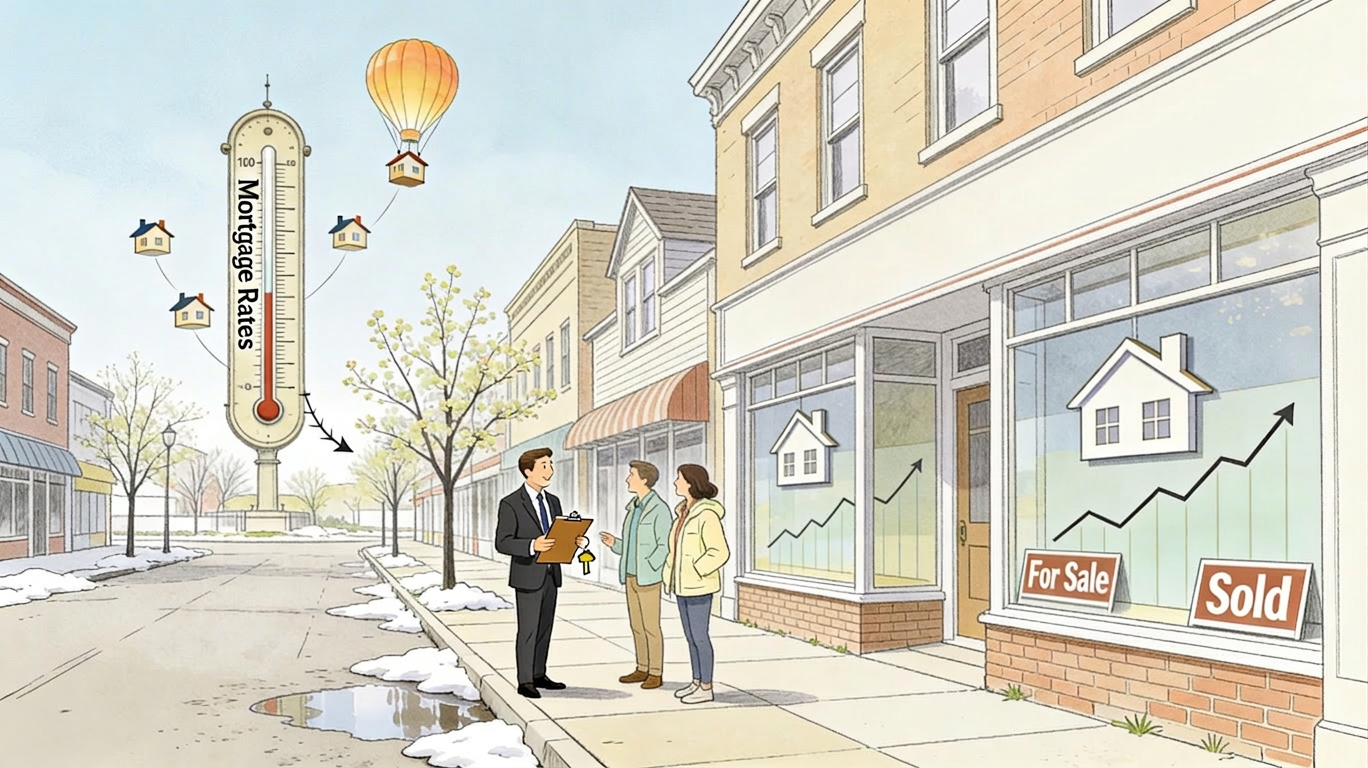
US existing-home sales surprised to the upside in February, offering a rare dose of optimism for a housing market that has spent two years learning the meaning of the word “constrained.” Buyers, it seems, are finally willing to come out from behind the mortgage-rate sofa.
A Spring Thaw In A Frozen Market
Sales of previously owned homes rose 1.7% in February to an annualized pace of about 4.09 million units, marking a second monthly gain and defying expectations for another decline. That’s still below pre-pandemic norms, but in market terms, moving from “falling” to “rising” is the difference between catching a knife and catching a bid.
Economists had expected resales to fall toward 3.89 million, so February’s print qualified as a genuine upside surprise rather than a rounding error. The improvement comes as the crucial spring selling season approaches, giving agents something more cheerful to talk about than staging tips and rate-lock fatigue.
Mortgage Rates Blink First
The key catalyst was a retreat in borrowing costs, with the average 30‑year fixed mortgage hovering near 6% in early March, down from higher levels earlier in the cycle. For would‑be buyers who spent 2024 doom-scrolling rate charts, that shift has started to look less like a headwind and more like a negotiable inconvenience.
Part of the rate relief reflects moves in Washington, where regulators stepped in to support mortgage markets by buying more agency bonds from Fannie Mae and Freddie Mac, helping to nudge financing costs lower. The catch: geopolitical tensions and higher oil prices are pushing Treasury yields back up, limiting how much further mortgage rates can realistically fall from here.
Inventory Is Back… But Not In Bulk
On the supply side, existing-home inventory rose roughly 2–2.4% in February to about 1.29 million units, up nearly 5% from a year earlier but still well shy of the 1.5–1.6 million range that prevailed before the pandemic. In market jargon, this is less a glut and more a polite trickle.
At the current sales pace, it would take about 3.8 months to clear the listed inventory, slightly higher than 3.6 months a year ago but still below the 5–6 month range associated with a truly balanced market. That dynamic helps explain why days on market have stretched to about 47 days from 42 a year earlier, even as sellers still enjoy enough leverage to resist fire-sale pricing.
Prices, Affordability, And The Return Of The Rookie Buyer
Median existing-home prices are essentially holding the high ground, rising only modestly—around 0.3–0.8% year over year—to roughly 398,000 dollars. The market isn’t cheap, but it is no longer sprinting away from buyers at double-digit annual gain.
That cooling pace has quietly improved affordability, with the National Association of Realtors’ index climbing for eight consecutive months to around 117.6 in February, its highest level since early 2022. First-time buyers are responding: their share has climbed to about 34%, the strongest in several years, even though economists still view 40% as the threshold for a truly healthy, renewal-friendly market.
Regional Winners, All‑Cash Players, And The Road Ahead
Regionally, the South, Midwest, and West all saw February sales increase, while the Northeast sat this round out with a decline, partly after winter weather made open houses more theoretical than practical. The West led gains with an 8%-plus jump in activity, helped by improved affordability from prior price corrections and rate relief.
All‑cash purchases still account for roughly 31% of deals, only slightly off last year’s level, underscoring how investors and equity‑rich buyers remain active even as financing costs stay elevated by historical standards. Distressed sales, meanwhile, are stuck near 3%, a reminder that this is a slow market, not a stressed one.
The Sources
- Yahoo Finance – “US existing home sales unexpectedly increase in February”
https://finance.yahoo.com/news/us-existing-home-sales-unexpectedly-140129355.html[finance.yahoo] - Yahoo Finance (Canada) – “US homes sales rose in February as homebuyers seized on easing mortgage rates”
https://ca.finance.yahoo.com/news/us-homes-sales-bounced-back-140356618.html[ca.finance.yahoo] - Business Times – “US existing home sales unexpectedly increase as mortgage rates decline”
https://www.businesstimes.com.sg/property/us-existing-home-sales-unexpectedly-increase-mortgage-rates-decline[businesstimes.com] - National Association of Realtors – “NAR Existing-Home Sales Report Shows 1.7% Increase in February”
https://www.nar.realtor/newsroom/nar-existing-home-sales-report-shows-1-7-increase-in-february[nar] - Markets Insider – “NAR Existing-Home Sales Report Shows 1.7% Increase in February”
https://markets.businessinsider.com/news/stocks/nar-existing-home-sales-report-shows-1-7-increase-in-february-1035914475[markets.businessinsider] - Rate.com – “What did existing home sales look like in February 2026?”
https://www.rate.com/mortgage/resource/what-did-existing-home-sales-look-like-in-february-2026-[rate] - Yahoo Finance – “Home sales improved in February, but higher mortgage rates threaten that progress”
https://finance.yahoo.com/news/home-sales-improved-in-february-but-higher-mortgage-rates-threaten-that-progress-143720136.html[finance.yahoo] - Yahoo Finance – “Home Sales Rose in February as First-Time Buyers Jumped Back …”
https://finance.yahoo.com/news/home-sales-rose-february-first-140024799.html[finance.yahoo] - Haver Analytics – “U.S. Existing Home Sales Unexpectedly Rebound in February”
https://www.haver.com/articles/u-s-existing-home-sales-unexpectedly-rebound-in-february[haver]