Skip to content Skip to sidebar Skip to footer

Is Broadcom the New AI Utility Stock? Why Alphabet and Anthropic Just Locked In the Power -( $AVGO $GOOG $GOOGL $NVDA )

Broadcom’s latest AI alliance with Google parent Alphabet Inc. (GOOGL, GOOG) and Anthropic is less a routine chip deal and more a declaration that the quiet power behind the cloud plans to stay loud for the next decade. The three-way pact locks in custom AI silicon and multi‑gigawatt compute capacity that could reshape who really controls the tollbooths on the generative AI superhighway.

Broadcom’s Big AI Bet (AVGO)

Broadcom Inc. (AVGO) has signed a long‑term agreement to design and supply future generations of Alphabet’s custom tensor processing units, effectively becoming a core architect of the Google AI brain. In parallel, a supply‑assurance deal through 2031 secures Broadcom’s role in providing networking and other components for Google’s next‑generation AI racks, the plumbing that keeps massive clusters of chips talking to each other.

For investors, that translates into unusually clear visibility into AI‑driven revenue at a time when most chip stories still hinge on “if” and “when” rather than “how long.” It also subtly upgrades Broadcom’s image from “AI beneficiary” to “AI landlord,” collecting rent in the form of recurring infrastructure demand from one of the world’s most cash‑rich tenants.

Anthropic’s 3.5‑Gigawatt Power Play

The new wrinkle is Anthropic, the privately held AI firm behind the Claude models, which is now set to tap roughly 3.5 gigawatts of next‑generation Google TPU compute capacity via Broadcom starting in 2027. That multi‑gigawatt commitment is designed to power Anthropic’s frontier models and meet soaring demand from enterprises deploying its AI tools.

Anthropic recently disclosed that its annualized revenue run rate has surged beyond 30 billion dollars, more than tripling from around 9 billion at the end of last year, a move that would make many cloud veterans reach for the antacids. More than 1,000 of its customers now spend over 1 million dollars a year, a figure that has doubled in less than two months as new adopters pile into generative AI.

Alphabet’s Strategic Triangle (GOOGL, GOOG)

For Alphabet (GOOGL, GOOG), the arrangement tightens an already intricate triangle: it gets a committed chip design and networking partner in Broadcom while channeling vast TPU capacity to a fast‑growing model provider that keeps its own Gemini efforts on their toes. The vast majority of the new infrastructure will be located in the United States, reinforcing Alphabet’s and Anthropic’s previously announced plans to pour tens of billions into domestic AI capacity.

This also underscores Alphabet’s preference for custom silicon as a differentiator, leveraging TPUs as a counterweight to NVIDIA’s (NVDA) dominance in AI accelerators while still coexisting with GPU‑heavy workloads. In the process, Alphabet cements itself not only as a cloud platform but as an end‑to‑end AI infrastructure stack, from chips and networks to models and applications.

A Positive Signal for Tech Investors

Broadcom shares (AVGO) rose about 3 percent in after‑hours trading on Monday after the deals were disclosed, signaling investors’ willingness to reward long‑dated AI contracts even before full financial details are public. Street analysts have already flagged the expanded partnerships as putting the spotlight firmly back on Broadcom as a major winner in AI infrastructure, with the potential to outperform prior AI revenue expectations.

More broadly, the pact serves as a bullish read‑through for the entire tech sector: hyperscalers are not easing up on AI capex; they are formalizing it into multi‑year pipelines that resemble utilities more than product cycles. In an environment where investors still debate whether AI is a bubble or a business, binding contracts through 2031 are about as close to a punchline as Wall Street gets.

The New AI Utility Class

If the first wave of AI enthusiasm crowned model makers and GPU vendors as market darlings, this phase is quietly elevating a new “AI utility class” of companies that supply the power, pipes, and custom silicon behind the scenes. Broadcom (AVGO) and Alphabet (GOOGL, GOOG) are positioning themselves as core owners of that infrastructure, while Anthropic turns guaranteed access to 3.5 gigawatts of TPU power into its own competitive moat.

Anthropic, for its part, is turning compute commitments into a durable advantage, locking in multi‑gigawatt capacity while rivals scramble for chips and grid access. Put together, the trio is sketching a blueprint for AI’s next chapter: durable contracts, domestic build‑out, and a quiet understanding that in this business, whoever controls the wattage tends to control the narrative too.

The Sources


[1] Alphabet Inc. – Wikipedia https://en.wikipedia.org/wiki/Alphabet_Inc.
[2] Tech stocks today: Broadcom expands partnership with Google … https://finance.yahoo.com/sectors/technology/article/tech-stocks-today-broadcom-expands-partnership-with-google-anthropic-144220880.html
[3] Broadcom expands chip deals with Google and Anthropic https://finance.yahoo.com/sectors/technology/articles/broadcom-expands-chip-deals-google-084815627.html
[4] Anthropic Google Broadcom TPU deal 3.5 gigawatts and $30 billion … https://finance.yahoo.com/sectors/technology/articles/anthropic-google-broadcom-tpu-deal-113234906.html
[5] Broadcom Inc. (AVGO) Stock Price, News, Quote & History https://finance.yahoo.com/quote/AVGO/
[6] Broadcom shares jump on long-term AI chip and networking deals … https://finance.yahoo.com/markets/stocks/articles/broadcom-shares-jump-long-term-221647887.html
[7] Broadcom’s stock is rising. Here’s why its new Google and Anthropic … https://www.marketwatch.com/story/broadcoms-stock-is-rising-heres-why-its-new-google-and-anthropic-deals-are-so-significant-6d98a067
[8] AVGO) expands Google, Anthropic AI TPU and networking deals https://www.stocktitan.net/sec-filings/AVGO/8-k-broadcom-inc-reports-material-event-35aab0650b17.html
[9] Anthropic – Wikipedia https://en.wikipedia.org/wiki/Anthropic
[10] Anthropic Stock: $380B Valuation — Is It a Buy? | TSG Invest https://tsginvest.com/anthropic-pbc/
[11] Anthropic expands partnership with Google and Broadcom for … https://www.anthropic.com/news/google-broadcom-partnership-compute
[12] Anthropic’s revenue surpasses $30 billion; signs 3.5-gigawatt compute deal with Google and Broadcom https://m.techflowpost.com/en-US/article/31003
[13] Anthropic, Google, Broadcom announce 3.5GW TPU deal https://www.siliconrepublic.com/machines/anthropic-google-broadcom-announce-3-5gw-tpu-deal
[14] Broadcom to supply Anthropic with 3.5 gigawatts of Google TPU … https://www.tomshardware.com/tech-industry/broadcom-expands-anthropic-deal-to-3-5gw-of-google-tpu-capacity-from-2027
[15] META_TITLE_QUOTE – Yahoo Finance https://finance.yahoo.com/quote/AVGO/latest-news/
[16] AVGO: Broadcom Inc – Stock Price, Quote and News – CNBC https://www.cnbc.com/quotes/AVGO
[17] AVGO – BROADCOM INC | Stock Quotes from Fidelity Investments https://digital.fidelity.com/prgw/digital/research/quote/dashboard/summary?symbol=AVGO
[18] Broadcom: AVGO Stock Price Quote & News – Robinhood https://robinhood.com/us/en/stocks/AVGO/
[19] AVGO Stock Quote Price and Forecast – CNN https://www.cnn.com/markets/stocks/AVGO
[20] AVGO Stock Price and Chart — NASDAQ:AVGO – TradingView https://www.tradingview.com/symbols/NASDAQ-AVGO/
[21] GOOGL: Alphabet Class A – Stock Price, Quote and News – CNBC https://www.cnbc.com/quotes/GOOGL
[22] Broadcom Inc. Stock Quote (U.S.: Nasdaq) – AVGO – MarketWatch https://www.marketwatch.com/investing/stock/avgo
[23] Alphabet Inc. (Google) Stock – Investing.com https://www.investing.com/equities/google-inc
[24] Company \ Anthropic https://www.anthropic.com/company
[25] AVGO – Broadcom Inc Stock Price and Quote – Finviz https://finviz.com/quote.ashx?t=AVGO
[26] GOOGL Stock Price Quote & News – Alphabet Class A – Robinhood https://robinhood.com/us/en/stocks/GOOGL/


April 6, 2026 – Wall Street Holds Its Breath: Stocks Tiptoe Higher as Cease-Fire Hopes Cool the Oil Fever – ( $HIMS $MCD $MODD $NOK $NVDA $QQQ $SER $SOAR $SPCE Rise!)

US stocks traded with a muted positive bias Monday as investors weighed tentative cease-fire efforts in the U.S.-Iran conflict against still-elevated oil and rate expectations. Early gains were modest, but they extended last week’s rebound as traders remained positioned for further geopolitical headlines and upcoming macro data.

Indexes and overall tone

  • Major U.S. indexes were little changed to slightly higher, with the S&P 500 (+.44%), Dow (+.36%), and Nasdaq edging up +.54% as risk appetite stabilized but stayed cautious.
  • The move follows a strong prior week that snapped a multi-week losing streak for the S&P 500 and Nasdaq, leaving dip-buyers in control but selective amid headline risk. The Russell 2000 small caps closed at 2,540.64, +.42% today.
  • Volatility stayed contained as investors treated cease-fire talks as a near-term positive but not yet a definitive turning point for the conflict or energy markets. The CBOE Volatility Index (VIX) closed at $24.17, +1.26% on the day.

Geopolitics and oil

  • Markets focused on reports of a potential 45‑day cease-fire proposal between the U.S. and Iran, which raised hopes for progress toward ending hostilities.
  • Oil prices, which had spiked on fears around the Strait of Hormuz and supply disruptions, eased off recent highs but remained elevated, with Crude Oil hovering near $112/BBL.
  • Energy names traded on these swings in crude, while broader cyclicals reacted more to the perceived probability of de‑escalation than to day‑to‑day price ticks.

Rates, dollar, and safe havens

  • Treasury yields were little changed to slightly softer, with the 10‑year near the mid‑4% area as investors balanced geopolitical risk against a still-firm U.S. growth and inflation backdrop.
  • The dollar edged lower versus major peers, reflecting some unwind of haven demand as cease-fire discussions gained visibility.
  • Gold held firm with a slight bid at $4,684.20, and bitcoin hovered around the $69.9k range, underscoring ongoing demand for alternative and digital havens even as headline risk appeared to cool at the margin.finance.

Sector and thematic moves

  • Defense, energy, and other geopolitically sensitive groups remained in focus, but performance was more mixed than the straight “war trade” pattern seen in prior sessions.
  • Mega-cap tech and AI beneficiaries continued to underpin the tape after a powerful week‑long rebound, though gains were more measured as investors waited for the next catalysts.
  • Rate‑sensitive areas such as parts of growth tech and high‑multiple software saw a more balanced tone, reflecting stable yields and some rotation back into secular growth stories.

Narrative for investors

The evolving U.S.-Iran storyline remains the market’s primary macro swing factor, with equities now trading a “negotiation range” rather than a pure escalation or panic regime. For positioning, the day’s action reinforces a barbell approach: maintain exposure to quality growth and AI‑linked leaders that drove last week’s rebound, while keeping some defensive and energy exposure as insurance against any breakdown in cease‑fire efforts.

VP Watchlist Updates

Below is an update‑style snapshot on the VP Watchlist names for the week, focused on recent catalysts, positioning, and narrative rather than precise price moves.

Hims & Hers (HIMS, $20.33, +6.22%)

Novo Nordisk (NVO) announced (March 31) a new multi-month subscription program for Wegovy® (semaglutide) that provides eligible self-pay patients who enroll in the program through select telehealth providers a lower, predictable monthly price. The program is designed to reduce cost uncertainty and help people start and stay on FDA-approved obesity treatment. This first and only subscription program for FDA-approved Wegovy® will be available beginning March 31, 2026, through Ro, WeightWatchers, LifeMD, with Hims & Hers (HIMS), Sesame, and others to follow soon.

Eupraxia Pharmaceuticals (EPRX, $7.10)

Eupraxia Pharmaceuticals Inc. (“Eupraxia” or the “Company”), a clinical-stage biotechnology company leveraging its proprietary Diffusphere™ technology designed to optimize local, controlled drug delivery for applications with significant unmet need, co-hosted a Tribe Public www.TribePublic.com, CEO Presentation & Q&A Webinar event, Wednesday, April 1 titled “Turning EOE Into a Once-a-Year Appointment.” The event featured James A. Helliwell, M.D., Co‑founder and CEO of Eupraxia Pharmaceuticals (NASDAQ: EPRX), who discusses the company’s precision drug‑delivery platform, its approach to Eosinophilic Esophagitis (EoE), and broader pipeline priorities, followed by a focused 5–10 minute Q&A. You may watch it now at this Youtube link.

Eupraxia announced (March 17) positive symptom data from patients in the two highest dose cohorts from its ongoing Phase 1b/2a part of the RESOLVE trial evaluating EP-104GI for the treatment of eosinophilic esophagitis (“EoE”). “We are very pleased to see such a meaningful symptom response at 24 weeks in the highest dose of the Phase 1b/2a portion of the RESOLVE study,” said Dr. James A. Helliwell, Chief Executive Officer of Eupraxia. “We believe this type of response based on a single administration procedure would represent a compellingly different option for EoE patients. Importantly, the response that we are observing across cohorts 4-9 has increased as patients progress through the study through to week 24. We believe this demonstrates the importance of stable, continuous long-term local steroids in tamping down signs of inflammation quickly and acting on fibrosis in the longer term. Also, as previously reported, we continue to be encouraged by the safety profile that we have observed with EP-104GI. Currently, with 31 patients dosed in the Phase 1b/2a study, and over 220 months of follow up, there have been no reported serious adverse events.”

Modular Medical (MODD $5.54, +10.58%)

  • Modular Medical, Inc., an innovative insulin delivery technology company, announced (March 26) that it will effect a 1-for-30 reverse stock split of its outstanding common stock. The reverse stock split will become effective at 5:30am ET on March 31, 2026. The common stock is expected to begin trading on a split-adjusted basis on the Nasdaq Capital Market (“Nasdaq”) under the same symbol “MODD” when the market opens on March 31, 2026, with the new CUSIP number 60785L306. The reverse stock split was approved by the Company’s shareholders at the Company’s fiscal 2026 Annual Meeting, held on January 23, 2026. The reverse stock split is intended to increase the per share trading price of the Company’s common stock to satisfy the $1.00 minimum bid price requirement for continued listing on Nasdaq. The reverse stock split will reduce the number of outstanding shares of the Company’s common stock from 139,810,797 shares pre-reverse split to approximately 4,660,360 shares post-reverse split. The number of authorized shares of common stock and the par value per share will remain unchanged. As a result of the reverse stock split, every 30 shares of the Company’s pre-reverse split common stock will be combined and reclassified into one share of common stock, as applicable. Proportionate voting rights and other rights of such holders will not be affected by the reverse stock split. Holders of fractional shares will be paid cash in lieu of shares.
  • Modular Medical recently priced a public offering of 68,098,000 shares of common stock (or pre-funded warrants) alongside warrants to buy an equivalent number of shares, targeting gross proceeds of about 12 million dollars before fees. The combined public offering price of roughly 17.62 cents per share and accompanying warrant comes at a premium to the prevailing market, a rare feat in a sector where financings often resemble clearance sales rather than premium shelf space.
  • Earlier this in 2025, the company began production of validation lots for its disposable cartridge and infusion set, keeping it on track for a planned commercial launch in the first quarter of 2026, contingent on FDA 510(k) clearance—an event path that positions upcoming regulatory decisions as key stock catalysts.

The InterGroup Corporation (INTG, $37.15)

  • InterGroup Corporation delivered (Feb. 17) a notably stronger quarter, highlighted by a 20% jump in total revenue to $17.3 million and a 27% surge in hotel revenue as renovated rooms returned to service and travel demand improved. The company swung from a prior-year net loss to $1.0 million in net income, with operating income more than doubling to $2.0 million, underscoring better cost control and improved operating efficiency. Management further enhanced liquidity and sharpened strategic focus by selling a non-core 12‑unit Los Angeles multifamily property, generating a meaningful gain and additional working capital while maintaining stable performance across its real estate portfolio.

Volato Group, Inc. (SOAR, +3.81%) & M2i Global, Inc. (MTWO)

  • flyExclusive (NYSE American: FLYX), the vertically integrated private aviation company, announced (March 25) two milestones in its proprietary technology development: the filing of a utility patent application for a novel aircraft schedule optimization architecture, and the availability of Contrails, its Flight Management System, to other Part 135 operators beginning in Q2 2026. Both announcements coincide with the company’s presence at the NBAA Schedulers & Dispatchers Conference 2026 in Cleveland. “We have spent years building flyExclusive into one of the most operationally capable private aviation companies in the country. Contrails is how we make that expertise available to the broader industry—and the intellectual property behind it reflects the depth of investment we have made in solving problems that matter to every serious operator. We believe the right technology, built by people who actually run flights, changes what is possible in this industry. Today we are unable to source lift for nearly 300 trip requests per day. We believe Contrails will allow us to address that demand far more efficiently—both within our own operation and through coordination with other operators—and that represents a material revenue opportunity for flyExclusive and for all participating operators.”
  • Volato Group, Inc. announced (March 10) that it has entered into an amendment to its Aircraft Management Services Agreement with flyExclusive, Inc. (“FLYX”) providing for the sale of certain legacy intellectual property assets. The agreement provides for consideration valued at approximately $1.3 million, payable in FLYX Class A common stock, subject to customary conditions. The assets relate to legacy intellectual property developed during earlier stages of the Company’s technology initiatives and are not part of Volato’s current operating platforms. Volato continues to evaluate opportunities to streamline its asset base and focus resources on strategic priorities, including the continued development of its core software platforms and the pending business combination with M2i Global, Inc.
  • Volato and M2i Global reaffirmed their goal of closing their business combination in the first quarter of 2026, citing steady advancement through SEC review and integration planning as they move toward a combined listing. The deal, originally announced in 2025, will effectively transition Volato from a pure‑play private aviation operator into a diversified platform spanning aviation technology and critical minerals, with M2i shareholders expected to own the majority of the combined entity. Operationally, the partnership is already visible: the two companies recently initiated their first shipment of titanium ore from Western Australia to the United States from Titanium X, underscoring how the critical‑minerals vertical could become a meaningful growth engine as domestic supply‑chain security rises in strategic importance.
  • On Feb. 4, M2i Global,Inc.along with Volato Group, Inc. announced that Titanium X has initiated its first shipment of titanium ore from Western Australia to the U.S. under its collaboration agreement.

NVIDIA (NVDA, $177.64, +.14%) (NOK, $8.89, +.79%)

  • In an AI market obsessed with GPUs and stardust, Nokia (NOK) is quietly reminding investors that none of this magic moves without serious plumbing. While Nvidia (NVDA) prepares to headline its GTC 2026 “Woodstock of AI” showcase, the chip giant has already written a very real check to Nokia, committing a $1 billion investment to help rewire the world’s networks for 5G‑Advanced, 6G, and AI‑native workloads. The message is simple enough: GPUs may be the new rock stars, but networking is the stadium.
  • Nvidia delivered strong fourth-quarter results recently, posting revenue of $68.1 billion, well above analyst expectations. Looking ahead, the company projects $7.8 billion in revenue for the first quarter of 2026, reflecting continued robust demand for its AI chips even amid broader market headwinds.
  • NVIDIA and Nebius Group N.V. (NASDAQ: NBIS) (March 11) announced a strategic partnership to develop and deploy the next generation of hyperscale cloud for the AI market, from AI natives to enterprises. NVIDIA will invest $2 billion in Nebius.

McDonald’s (MCD, $309.76, +.85%)

  • In the run-up to World Protein Day on 27th February, McDonald’s India (West & South), owned and operated by Westlife Foodworld, is celebrating Protein Week, reinforcing its leadership in nutrition-led innovation. Making protein more accessible, affordable and customizable, Indian consumers can use the McDonald’s app to explore these nutritious offerings and avail of protein burgers starting at just INR 69. Enhancing this convenience, consumers ordering via McDelivery can also enjoy free delivery on the Protein Plus meal range.

Opendoor (OPEN, $4.61)

Tesla (TSLA, $352.82)

Elon Musk’s latest Texas-sized ambition is to build his own AI chip empire, and this time the factory floor will sit right next to the robots, rockets, and robotaxis that plan to use it. The Terafab project, a new semiconductor venture linking Tesla (TSLA), SpaceX, and xAI in Austin, aims to churn out custom chips for AI, humanoid robots, and space systems at a scale that makes today’s GPU land rush look like a warm‑up act. Learn more here.

There are open secrets on Wall Street, and then there is SpaceX’s long‑anticipated march toward the public markets, now reportedly via a confidential filing with the SEC that could set up a June debut. For a company that routinely broadcasts rockets into orbit, it is taking a decidedly hush‑hush approach to its paperwork

Serina Therapeutics (NYSE: SER, $2.15, +1.42%)

Serina Therapeutics (NYSE: SER) (www.serinatx.com) seems to have have just traded itself into Wall Street’s good graces, pairing fresh capital with a late-session pop that suggests investors are finally starting to connect the dots between polymer chemistry and portfolio returns. In Huntsville, Alabama, Serina Therapeutics announced definitive agreements for a private placement of common stock and pre-funded warrants that could bring in up to 30 million dollars in gross proceeds. The first 15 million dollar tranche is expected to close on March 20, 2026, with a second tranche of up to 15 million dollars anticipated by April 30, 2026, subject to customary closing conditions.

What makes the deal stand out in a biotech tape crowded with discounts is the pricing: the securities are being sold at about 2.25 dollars per share, a roughly 68 percent premium to Serina’s March 17 closing price, signaling that insiders are willing to pay up for exposure to the company’s clinical agenda. The financing also adds board-level heft, with director Greg Bailey, M.D., stepping into a Co-Chairman role as he leads the investment, a move that effectively puts the capital and the governance on the same optimistic page. Learn more here.

GeoVax Labs (GOVX, $1.25)

Virgin Galactic Holdings, Inc. (NYSE: SPCE, $3.07, +24.80%)

Virgin Galactic Holdings, Inc. (NYSE: SPCE) (“Virgin Galactic” or the “Company”) announced (March 30) its financial results for the fourth quarter and full year ended December 31, 2025 and provided a business update. They highlighted the following: Sales Open for Virgin Galactic Spaceflight Expeditions – Priced At $750K, First of Two New SpaceShips Progressing to Ground Test Phase in April; Flight Test Phase Begins Q3 2026
Commercial Spaceflight Operations with First New SpaceShip Continue on Track for Q4 2026, &
Second New SpaceShip Expected to Enter Service Between Late Q4 2026 and Early Q1 2027

AleAnna, Inc. (ANNA, $7.81)

AleAnna, Inc. (ANNA) recently turned a dry technical milestone—its year‑end reserves report—into something closer to an Italian energy renaissance, with proved natural gas reserves jumping 47% after a year of active production. For investors hunting for credible growth stories in a world of energy-transition buzzwords, this is one of the rare cases where the molecules are actually catching up to the marketing. Learn more here.

The Sources

  1. Yahoo Finance – “Stock market today: US stocks rise as hopes emerge for an end to Middle East hostilities”
    https://finance.yahoo.com/news/live/stock-market-today-us-stock-futures-mixed-oil-dips-as-hopes-emerge-for-an-end-to-middle-east-hostilities-002656744.htmlfinance.yahoo
  2. Yahoo Finance – “Oil dips, stocks inch higher on ceasefire hopes”
    https://finance.yahoo.com/sectors/energy/articles/oil-dips-stocks-inch-higher-100230621.htmlfinance.yahoo
  3. Yahoo Finance Canada – “US stocks and oil prices swing as Trump’s deadline on Iranian…”
    https://ca.news.yahoo.com/us-stocks-oil-prices-swing-174320643.htmlnews.yahoo
  4. Yahoo Finance – “US stock futures mixed, oil dips as hopes emerge for an end to…”
    https://ca.finance.yahoo.com/news/stock-market-today-oil-surges-futures-fall-as-trump-ratchets-up-threats-against-iran-002656735.htmlfinance.yahoo
  5. CNBC – “S&P 500 posts fourth winning day, rising on hopes for last-minute Iran ceasefire: Live updates”
    https://www.cnbc.com/2026/04/05/stock-market-today-live-updates.htmlcnbc
  6. The Wall Street Journal – “Stock Market Today: Dow, Nasdaq Move Higher on Cease-Fire Efforts — Live Updates”
    https://www.wsj.com/livecoverage/stock-market-today-dow-sp-500-nasdaq-04-06-2026wsj
  7. Fortune – “Wall Street knows something about Trump and Iran: Both sides are running out of time”
    https://fortune.com/2026/04/06/markets-frozen-iran-war-trump-ceasefire-talks-oil-price-brent-crude-wti/fortune
  8. CNN Business – “Oil prices climb after Trump threatens Iran over Strait of Hormuz”
    https://www.cnn.com/2026/04/05/business/oil-prices-iran-warcnn
  9. CNBC – “Trump’s threat to hit Iran ‘extremely hard’ jolts global stocks…”
    https://www.cnbc.com/2026/04/02/trump-iran-escalation-asian-stocks-oil-prices-markets.htmlcnbc
  10. TS2 Tech – “Stock Market Today: Dow Futures Edge Up, Oil Swings as Trump’s Iran Threats Keep Wall Street on Edge”
    https://ts2.tech/en/stock-market-today-dow-futures-edge-up-oil-swings-as-trumps-iran-threats-keep-wall-street-on-edge/ts2

The Bubble, The Billionaire, and a Brutal Future?: Robert Friedland’s Case Against Complacency -( $SPY $QQQ $DIA )

The illusion of comfort that has defined much of American life in recent years is colliding with a far harsher reality taking shape beneath the surface. Robert Friedland, the influential billionaire investor and mining magnate, has been sounding the alarm that many Americans are living in a bubble, shielded from the structural and environmental forces already reshaping the world around them. His warning is not about a routine recession or a temporary market dislocation; it is about a profound disconnect between day‑to‑day sentiment and the scale of change bearing down on the global economy.

A Rude Awakening Ahead

Friedland argues that we are heading toward a “rude awakening” as economic, environmental, and geopolitical pressures converge in ways that will test institutions, capital, and social stability. From climate change to resource scarcity and from automation to artificial intelligence, the systems that underpinned the post‑Cold War era are being re‑wired in real time. For many citizens, these dynamics still feel abstract, but their impacts are already visible in supply chains, energy markets, labor dynamics, and the cost of capital. The time to acknowledge and adapt to these realities is not when the shocks fully manifest, but now, while there is still room to reposition.

Systemic Change Is Here

This moment is also about systemic change. Climate volatility is disrupting agriculture, infrastructure, and insurance models, while climate policy is accelerating the shift toward electrification, renewables, and efficiency technologies. At the same time, automation and AI are transforming how work is done, which jobs endure, and where value accrues, often faster than governments and educational systems can respond. These forces are not distant trends; they are beginning to influence daily life—from the reliability and price of energy to the resilience of local economies and the durability of retirement portfolios.

Complacency vs. Adaptation

Friedland’s central critique is complacency. It is no longer sufficient to assume that technological progress, central banks, or policymakers will always smooth out every dislocation. The next decade is likely to feature higher capital intensity, more acute competition for critical resources, and more frequent climate‑driven disruptions. In such an environment, adaptation—not passive optimism—will separate those who preserve and grow wealth from those who are caught unprepared. Living in a fantasy that “everything will be okay” without deliberate action is, in his view, a luxury the world can no longer afford.

An Investor’s Mandate

For investors, this reality demands a recalibration of priorities. Resilience, innovation, and resource security are emerging as the cornerstones of long‑term value creation. Capital is increasingly being drawn to companies and projects that address hard problems: securing critical minerals, building smarter and more robust infrastructure, enabling the energy transition, and delivering technologies that enhance efficiency and reduce risk rather than simply adding convenience. Those who orient toward solving these structural challenges, rather than chasing the next speculative distraction, will be better positioned in what Friedland has described as a more “reality‑driven” future.

The End of “It Will Be Fine”

The warning is blunt but constructive: the era of assuming that the future will look like a smoother version of the past is over. The coming phase will reward awareness, strategic preparation, and the courage to confront uncomfortable truths—about resource limits, environmental constraints, geopolitical fragmentation, and the uneven impacts of technological disruption. The sooner individuals, businesses, and policymakers accept this, the more agency they will have in shaping outcomes instead of being swept along by them.

Fault Lines in Capital Flows

The implications are increasingly visible in capital flows and policy debates. Concerns around the concentration of critical minerals production and processing are driving efforts to diversify supply, secure offtake agreements, and reassess national industrial strategies. This matters because these materials sit at the heart of clean energy technologies, electric vehicles, grid storage, and the advanced computing hardware that powers AI. At the same time, the build‑out of data centers and AI infrastructure is contributing to a step‑change in electricity demand, straining existing grids and forcing a re‑think of how and where new generation and transmission will be financed and constructed.

Stepping Out of the Bubble

In other words, the “reality‑driven” future Friedland describes is already forming at the intersection of resource security, digital infrastructure, and the climate transition. For investors, this translates into a clear mandate: focus on the companies, projects, and regions positioned along these fault lines—critical minerals, grid and power assets, climate and efficiency technologies, and resilient, diversified supply chains—rather than relying on yesterday’s playbook. At Vista Partners, the core belief is that the true opportunity in this unsettled global landscape lies in understanding these structural shifts before they become conventional wisdom and in allocating capital to those working to solve the hardest, most durable problems.

The world is shifting fast. The choice now is whether to remain in the comfort of the bubble or to step out, confront the realities ahead, and prepare thoughtfully for what is coming.

The Sources

  1. [1] Robert Friedland, an influential billionaire investor, has some … https://www.facebook.com/Surveee.org/posts/robert-friedland-an-influential-billionaire-investor-has-some-unsettling-words-f/994798243106559/
  2. [2] Robert Friedland, an influential billionaire investor, has some … https://www.facebook.com/photo.php?fbid=994798229773227&set=a.213126797940378&type=3
  3. [3] DEMOCRACY SUPPORTERS UNITE https://www.facebook.com/groups/131739878484971/posts/1301185921540355/
  4. [4] DEMOCRACY SUPPORTERS UNITE https://www.facebook.com/groups/131739878484971/posts/1301102668215347/
  5. [5] AI’s arrival complicates Big Tech climate goals, and some worry it’s … https://www.audacy.com/wwl/news/business/ap-climate-goals-technology-companies-2nd-ld-writethru
  6. [6] [PDF] Introduction – New Orleans Investment Conference https://neworleansconference.com/wp-content/uploads/2025/01/NOIC-2024-Transcripts-2.pdf
  7. [7] IEA Global Critical Minerals Outlook2025. | PDF – Slideshare https://www.slideshare.net/slideshow/iea-global-critical-minerals-outlook2025/279448036
  8. [8] [PDF] Global Critical Minerals Outlook 2025 https://iea.blob.core.windows.net/assets/642bb824-3f89-4949-8f84-d41bfa58ae03/GlobalCriticalMineralsOutlook2025_CorrigendaNotice.pdf
  9. [9] Tech company climate goals under pressure due to AI energy demand https://apnews.com/article/technology-artificial-intelligence-climate-change-data-centers-ef3a9c264bd6376d77e2c81ab266fb38
  10. [10] Can US infrastructure keep up with the AI economy? – Deloitte https://www.deloitte.com/us/en/insights/industry/power-and-utilities/data-center-infrastructure-artificial-intelligence.html
  11. [11] Deloitte: AI Data Center Power Demand Could Surge 30x by 2035 … https://www.prnewswire.com/news-releases/deloitte-ai-data-center-power-demand-could-surge-30x-by-2035-amid-power-and-grid-capacity-constraints-302488877.html
  12. [12] Higher Power: Can AI Investment & Climate Strategy Co-Exist? https://www.corporatecomplianceinsights.com/higher-power-can-ai-investment-climate-strategy-co-exist/
  13. [13] ESG Articles and News from Corporate Compliance Insights https://www.corporatecomplianceinsights.com/tag/esg/
  14. [14] Surveee – Robert Friedland, an influential billionaire … – Facebook https://www.facebook.com/Surveee.org/photos/robert-friedland-an-influential-billionaire-investor-has-some-unsettling-words-f/994798229773227/
  15. [15] [PDF] ABSTRACT Title of Dissertation: IRRELEVANT GENIUS – UMD DRUM https://drum.lib.umd.edu/bitstreams/ab5b15d1-4173-4b4b-9013-c5160909cc74/download

Rational Bubbles and Economic Cockroaches: Is Mohamed El‑Erian’s Wry Take on Today’s Market Jitters Spot On? -( $DIA $SPY $QQQ $VIX )

Mohamed El‑Erian is warning that the global economy is drifting toward a slow‑growth, high‑inflation mix as the Iran conflict lingers, but his message is oddly constructive for investors willing to respect risk while hunting opportunity. Think of it as the market equivalent of turbulence at cruising altitude: uncomfortable, but not necessarily a crash.

A World Tiptoeing Toward Stagflation

El‑Erian argues that the longer the Iran war grinds on, the higher the odds that stagflation — weaker growth paired with stubborn inflation — becomes the defining global backdrop rather than a scary tail risk. Energy shocks, disrupted trade routes, and supply bottlenecks for inputs such as helium, fertilizers, and pharmaceuticals are already nudging prices higher even as growth expectations cool.

He notes that markets have begun to register the strain, from a more than 1.5% slide in the S&P 500 on renewed Middle East tensions to synchronized setbacks across major financial centers in London, Hong Kong, and Tokyo. Yet, in his telling, these are stress fractures in a still‑standing system, not the opening scene of a 2008‑style sequel.

The Fed’s Narrow Runway

In El‑Erian’s view, the Federal Reserve now faces the least favorite assignment in central banking: managing an energy‑driven inflation flare‑up with limited policy room and a credibility hangover from its “transitory” era. Inflation has hovered above the Fed’s 2% target for years and sits in the mid‑2% range, even before any full‑blown energy spike filters through.

He has long warned that inflation is likely to prove sticky, clustering above prior comfort zones — closer to 3% or even 4% — than the symmetric 2% target that populates policy speeches. That leaves the Fed in a bind: cut too fast, and it risks re‑accelerating prices; stay too tight for too long, and growth and employment bear the brunt.

From Rational Bubbles to Cockroaches

If the macro backdrop sounds grim, El‑Erian’s market framing is more nuanced — and occasionally mischievous. He has described the AI trade as a “rational bubble,” a period in which investors are broadly right about the transformative potential of the technology but are occasionally very wrong about specific valuations. Some investors, he suggests, have gone beyond their analytic comfort zone and due‑diligence capacity, a polite economist’s way of saying that spreadsheets are being reverse‑engineered to justify enthusiasm.

He also distinguishes “cockroaches” from “termites” in markets: isolated blow‑ups and credit mishaps that arrive in disturbing clusters but don’t threaten the foundation, versus slow‑burn forces that quietly undermine the system itself. Current stresses, he argues, still look like cockroaches — unpleasant but survivable — rather than termites chewing through the global financial floorboards.

The New Investing Playbook

Taken together, his message is less “run for the hills” and more “upgrade your toolkit.” In a world of persistent geopolitical risk, elevated but not runaway inflation, and policy makers with less room for error, investors may need to rely less on index autopilot and more on genuine risk discrimination.

El‑Erian highlights that supply‑chain disruptions now extend beyond oil into specialized inputs that power everything from chip fabs to agriculture, reinforcing the case for diversified sourcing and more resilient business models. At the same time, he points out that the system itself — banks, plumbing, and core institutions — remains intact, giving investors scope to stay engaged rather than exit the arena entirely.

Opportunity In A Noisy World

For portfolio managers, his comments amount to a call for humility with a side of opportunism: respect the odds of stagflation, but do not underestimate the economy’s capacity to adapt. The combination of geopolitical volatility, a constrained Fed, and re‑priced growth expectations can create attractive entry points in companies and sectors built for higher‑for‑longer inflation and recurring supply shocks.

In an era when every data release and headline feels like a referendum on the future, El‑Erian’s core message is surprisingly steady: the world is not ending, but the old playbook is. For investors willing to trade drama for discipline, that may be the most constructive warning they hear all cycle.

The Sources


[1] Top economist Mohamed El-Erian warns of stagflation gripping the … https://finance.yahoo.com/news/top-economist-mohamed-el-erian-181725097.html
[2] Legendary investor Mohamed El-Erian warns that the economic … https://finance.yahoo.com/economy/articles/legendary-investor-mohamed-el-erian-144349240.html
[3] Top economist Mohamed El-Erian warns of stagflation gripping the … https://www.aol.com/finance/top-economist-mohamed-el-erian-181725339.html
[4] Top economist Mohamed El-Erian warns the AI bubble will ‘end in tears … https://finance.yahoo.com/news/top-economist-mohamed-el-erian-203322499.html
[5] Top economist Mohamed El-Erian blames Fed for policy … – Fortune https://fortune.com/2022/10/05/mohamed-el-erian-fed-slow-inflation-response-recession/
[6] Top economist Mohamed El-Erian sees inflation getting ‘sticky’ at 4% https://finance.yahoo.com/news/top-economist-mohamed-el-erian-110000647.html
[7] El-Erian Sees a 55% Probability of a US Soft Landing – YouTube https://www.youtube.com/watch?v=bA9qotXlirI
[8] Anti-AI rotation needs fundamental support, not technicals: El-Erian https://finance.yahoo.com/video/anti-ai-rotation-needs-fundamental-144825914.html
[9] Economist Mohamed El-Erian says the US economic survival is not … https://finance.yahoo.com/economy/articles/economist-mohamed-el-erian-says-111500348.html
[10] 3 aspects of a new Fed that Mohamed El-Erian is focused on https://finance.yahoo.com/video/3-aspects-fed-mohamed-el-193533967.html
[11] What Mohamed El-Erian said about Fed rate cuts, the economy, AI, and … https://www.youtube.com/watch?v=AIFdm2U1mbQ
[12] Top economist Mohamed El-Erian says we’re not just headed for … https://www.reddit.com/r/Economics/comments/z399dc/top_economist_mohamed_elerian_says_were_not_just/
[13] Mohamed El-Erian on inflation: ‘be careful of a Fed that is … – YouTube https://www.youtube.com/watch?v=mAdQ3_E2shs
[14] Labor market is decoupling from growth, says Mohamed El-Erian of … https://www.youtube.com/watch?v=KAuyBlQRG-M
[15] El-Erian: Don’t Get in the Way of Soft Landing Narrative – YouTube https://www.youtube.com/watch?v=27opyjamNTE

Chasing Vibes or Buying an AI Moat? OpenAI’s ‘Tech bros’ TBPN Deal Explained

OpenAI’s purchase of TBPN turns a buzzy tech talk show into a strategic asset, and in the process makes the company look less like a lab and more like a network—in every sense of the word. The deal may read as “chasing vibes,” but beneath the memes and microphones sits a serious bet on narrative control, distribution, and an IPO‑ready brand.

OpenAI Buys A Water Cooler

TBPN—short for Technology Business Programming Network—is a three‑hour‑a‑day live show where founders, VCs, and CEOs hash out tech, AI, and defense in real time across YouTube, X, and podcast platforms. Hosted by former founders John Coogan and Jordi Hays, the show has evolved from a scrappy “Technology Brothers” project into Silicon Valley’s de facto water cooler, with a loyal, high‑intent audience of industry insiders.

OpenAI is not buying a distressed asset; TBPN is on track to generate north of $30 million in annual revenue, a rare feat in business media that gives the acquirer both cultural reach and a real P&L. The show will retain its own brand while reporting into OpenAI’s strategy organization, a structure that keeps the content familiar to viewers while clearly aligning it with the company’s agenda. or

From AI Lab To Media Company

The TBPN acquisition marks OpenAI’s first move into owning a major media property, placing it in the rarefied club of tech firms that directly control both the infrastructure and the conversation layered on top. This step follows years of growing public concern over AI’s social, labor, and environmental impacts, which has pushed the company to look for new ways to “change the narrative” around its technology.

OpenAI already runs its own long‑form podcast, but TBPN brings something different: an existing, independent platform that frequently covers OpenAI and its rivals, with enough credibility to matter when regulatory scrutiny intensifies. When a company facing antitrust and safety questions buys part of the commentary ecosystem, it is not just acquiring distribution—it is acquiring optionality over tone.

An M&A Strategy That Won’t Sit Still

The TBPN deal lands in the middle of a broader acquisition sprint: OpenAI has snapped up 17 companies in three years, with six deals already announced in 2026, nearly matching its 2025 pace. Earlier moves focused on infrastructure and developer tools—names like Rockset, Multi, Astral, and Promptfoo—designed to harden the data layer and evaluation stack behind generative AI.

Taken together, the portfolio looks like a barbell: on one end, low‑level tools for building and testing AI systems; on the other, high‑leverage surface areas where users and decision‑makers actually experience the technology. TBPN sits firmly on that second end, signaling that distribution and perception are now strategic assets on par with model weights and GPU contracts.

Why TBPN Matters Before The IPO

Internally, OpenAI leaders have framed the road to artificial general intelligence as requiring not just breakthroughs in models, but “constructive conversation” about how those models reshape work and society. TBPN gives the company three hours a day of live, highly engaged airtime with precisely the demographic that influences enterprise adoption, regulation, and investment flows.

As OpenAI edges toward a late‑2026 public listing, the acquisition functions as a pre‑IPO narrative hedge: investors will not only underwrite revenue and margins, but also the political and cultural risk of AI, and TBPN offers a friendlier forum to frame that risk. It is difficult to think of a more efficient way to turn “sentiment management” into an operating expense than to own the talk show that everyone in your cap table already streams

The Risks Of Owning The Room

For all its upside, the move invites obvious questions. A media brand that built its audience by interrogating power now finds itself owned by one of its favorite subjects, and skeptics will wonder how sharp the elbows can remain when the landlord is also the headline. Even if OpenAI pledges editorial independence, the mere fact that TBPN reports into its strategy arm—rather than, say, a foundation—will fuel concerns about self‑dealing and soft‑focus coverage.

Regulators and rival AI firms will also be watching for subtler advantages: priority access to guests, preferential framing of policy debates, and the quiet sidelining of critics in favor of more “constructive” voices. In an era when platform power is already under the microscope, adding “media owner” to OpenAI’s resume ensures that this acquisition will be scrutinized not only on financial terms, but on civic ones.

Chasing Vibes Or Building A Moat?

From a distance, buying a talk show looks like a vibe play from a company that once insisted it would stay laser‑focused on core research. Up close, it resembles a classic moat‑building maneuver: consolidate tools, compute, and conversation into a flywheel that spins faster than competitors can respond.

If OpenAI’s early acquisitions were about building what the models can do, TBPN is about shaping what the market believes those models should do. In a bull market for attention, that may prove to be the most valuable capability of all—especially for a company preparing to see its every quarterly call analyzed on the very network it now owns.

The Sources


[1] OpenAI Buys Streaming Show ‘TBPN,’ Aiming to Change Narrative on A.I. https://www.nytimes.com/2026/04/02/technology/openai-buys-tbpn.html
[2] OpenAI acquires TBPN, the buzzy founder-led business talk show https://techcrunch.com/2026/04/02/openai-acquires-tbpn-the-buzzy-founder-led-business-talk-show/
[3] OpenAI acquires popular tech podcast TBPN – CNBC https://www.cnbc.com/2026/04/02/openai-acquires-tech-podcast-tbpn.html
[4] TBPN – Wikipedia https://en.wikipedia.org/wiki/TBPN
[5] Data: OpenAI Has Already Done Nearly As Many M&A Deals In … https://news.crunchbase.com/ma/data-openai-2023-2026-acquisitions-open-source-astral-promptfoo/
[6] Breaking down the magic behind TBPN https://jdahl.substack.com/p/breaking-down-the-magic-behind-tbpn
[7] OpenAI Buys Some Positive News – WIRED https://www.wired.com/story/openai-acquires-tbpn-buys-positive-news-coverage/
[8] OpenAI is officially a media company, after buying Silicon Valley’s … https://www.marketwatch.com/story/openai-is-officially-a-media-company-after-buying-silicon-valleys-favorite-podcast-tbpn-d6949c82
[9] OpenAI Moves Into Media After Acquiring Streaming Series ‘TBPN’ https://deadline.com/2026/04/openai-acquires-streaming-series-tbpn-1236772434/
[10] OpenAI acquires technology talk show TBPN in surprise move https://www.reuters.com/business/media-telecom/openai-acquires-technology-talk-show-tbpn-surprise-move-2026-04-02/
[11] OpenAI’s 2026 Acquisitions Approach 2025 Levels | PipelineRoad https://pipelineroad.com/news/20260325-openai-s-2026-acquisitions-approach-2025-levels
[12] OpenAI’s Aggressive M&A Strategy and Its Implications for AI … https://www.ainvest.com/news/openai-aggressive-strategy-implications-ai-hardware-enterprise-ai-adoption-2601/
[13] Why OpenAI’s Fidji Simo Bought the TBPN Podcast Amid Crusade Against ‘Side Quests’ https://www.theinformation.com/articles/openais-fidji-simo-bought-tbpn-podcast-amid-crusade-side-quests
[14] OpenAI TBPN acquisition explained: https://x.com/NickADobos/status/2039868360599462164
[15] 33. TBPN (John Coogan & Jordi Hays) – Inside Tech’s Water Cooler https://jacksondahl.com/dialectic/tbpn

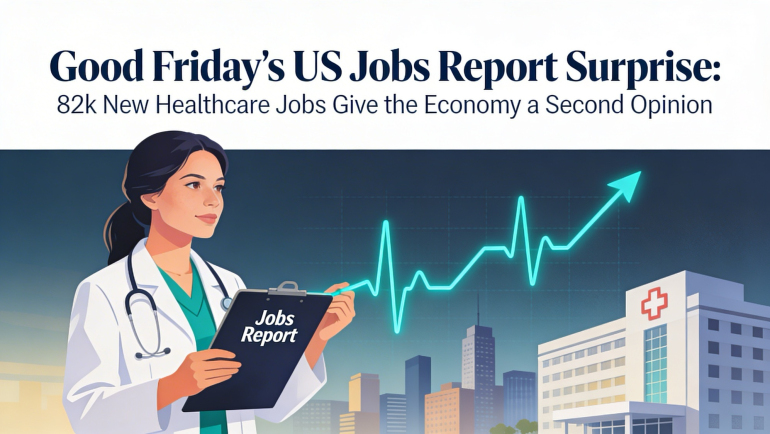
Good Friday’s US Jobs Report Surprise: 82k New Healthcare Jobs Give the Economy a Second Opinion -( $FIGS $QQQ $SPY $DIA )

The latest March jobs report delivered the economic equivalent of a plot twist: the US economy added 178,000 jobs while the unemployment rate fell to 4.3%, confounding forecasts that had braced for a far softer print. Instead of signaling a labor market on the brink, the data suggest an economy that may be slowing—but stubbornly refuses to stall.

A Labor Market That Forgot To Flinch

Economists entered March expecting something closer to a rounding error than a rebound, with consensus calls clustering around 60,000 jobs after February’s strike- and weather-distorted decline. Instead, payrolls advanced by 178,000, nearly triple some projections, offering a reminder that forecasting the US labor market remains as tricky as timing the perfect market top.

The unemployment rate slipped to 4.3%, returning toward levels seen earlier in the year and reinforcing the narrative of a labor market that is cooling from white‑hot to merely warm, not freezing over. Weekly jobless claims remain relatively low, underscoring that layoffs are still more exception than norm even as hiring shifts into a lower gear.

Under The Hood: Quiet Strength, Strategic Caution

Beneath the headline, the report reflects an economy adjusting rather than unraveling, with hiring more selective but still broadly positive across key industries. Recent private payroll data showed employers adding around 62,000 positions in March, led by smaller firms, while sectors like trade and transportation pulled back—hinting at a rotation rather than a retreat.

Health care and services continue to do much of the heavy lifting, extending a multi‑month pattern in which labor‑intensive, domestically focused industries carry growth as goods‑centric sectors normalize. At the same time, prior‑month revisions and strike‑related distortions remind investors that the trend, not any single release, tells the truer story of labor demand.

Wages, Workers, And A Soft‑Landing Script

Pay growth remains positive but more measured, easing some of the inflation anxieties that once turned every robust jobs print into a monetary policy scare. With private‑sector pay up around the mid‑single digits year over year, workers are still seeing gains, but the pace looks more compatible with a central bank that would prefer to pause rather than pounce.

Labor force participation is edging higher over time, helped by increased participation from women and immigrants, which expands the pool of available workers and helps cap wage‑price spirals even as hiring continues. The result is a labor market that looks less like a bubble and more like a rebalancing act—tight enough to support spending, loose enough to avoid overheating.

Markets, Fed, And The “Not Too Hot” Narrative

For investors, the March print walks an unusually narrow line: strong enough to ward off immediate recession chatter, but not so strong that it forces a sudden hawkish turn in policy expectations. Recent history has trained markets to fear good news for jobs as bad news for rates, yet the combination of moderate payroll gains, 4.3% unemployment, and tempered wage growth leans toward a soft‑landing script rather than a late‑cycle scare.

Consumer confidence has ticked higher even as job openings and hiring plans have cooled, a pairing that suggests households still feel reasonably secure—even if corporate America is budgeting headcount with a sharper pencil. In that sense, the latest report reads less like the first chapter of a downturn and more like a mid‑cycle rewrite, where growth gets edited but not erased.

What It Means For Main Street And Wall Street

For workers, a 4.3% unemployment rate with continued job creation means opportunities remain available, especially in sectors hungry for talent, even if switching jobs now requires a bit more strategy than bravado. For businesses, the message is to plan for a world where labor is neither cheap nor scarce enough to dictate terms, but balanced enough that execution matters more than headline macro.

And for investors scanning every data point for the end of the cycle, the March jobs report offers a familiar but reassuring punchline: the US labor market may be slower, messier, and more nuanced—but it is still, for now, very much open for business.

Maybe Check Out FIGS Now!!

FIGS (FIGS) looks well positioned to ride the wave of healthcare’s hiring surge, as every incremental nurse, doctor, tech, and allied professional is a potential new customer—or new wardrobe cycle. As a direct‑to‑consumer healthcare apparel and lifestyle brand with a dominant share of the US medical uniform market, FIGS has already highlighted that growing healthcare employment is a key structural tailwind for demand, underpinning its upbeat revenue outlook for 2026 and beyond. With more than 23 million healthcare professionals in the US and an even larger global TAM, robust job creation in hospitals, outpatient centers, and home health settings effectively expands FIGS’ addressable base and supports higher reorder frequency as systems standardize uniforms via its TEAMS platform.

Sources


[1] March jobs report to show updated view of fragile labor market as … https://finance.yahoo.com/economy/article/march-jobs-report-to-show-updated-view-of-fragile-labor-market-as-war-unfolded-190000402.html
[2] US economy adds 228,000 jobs in March, unemployment rate rises … https://finance.yahoo.com/news/us-economy-adds-228000-jobs-in-march-unemployment-rate-rises-to-42-203511885.html
[3] Market Minute: U.S. March jobs report preview https://realeconomy.rsmus.com/market-minute-u-s-march-jobs-report-preview/
[4] What to Expect From Friday’s Report on Jobs – Yahoo Finance https://finance.yahoo.com/economy/articles/job-creation-likely-bounced-back-203439984.html
[5] Unemployment falls to 4.3% as hiring surges beyond expectations https://finance.yahoo.com/news/unemployment-falls-4-3-hiring-154814789.html
[6] US job growth accelerates in January, unemployment rate falls to 4.3% https://finance.yahoo.com/news/us-job-growth-accelerates-january-134650513.html
[7] 130000 Jobs Added in January, Unemployment Drops Slightly to 4.3% https://www.jec.senate.gov/public/index.cfm/republicans/2026/2/130-000-jobs-added-in-january-unemployment-drops-slightly-to-4-3
[8] US consumer confidence rises, but job openings and hiring drop … https://www.reuters.com/business/us-consumer-confidence-nudges-higher-march-2026-03-31/
[9] Workforce Newsroom – ADP Media Center https://mediacenter.adp.com/2026-04-01-ADP-National-Employment-Report-Private-Sector-Employment-Increased-by-62,000-Jobs-in-March-Annual-Pay-was-Up-4-5
[10] ADP National Employment Report: Private Sector … – PR Newswire https://www.prnewswire.com/news-releases/adp-national-employment-report-private-sector-employment-increased-by-62-000-jobs-in-march-annual-pay-was-up-4-5-302731281.html
[11] ADP® Employment Report https://adpemploymentreport.com
[12] March Jobs Report: Economy Moving Steadily Toward Stable … https://nul.org/jobs-report/2024/March
[13] Jobs report lands with surprising 130,000 positions added to US … https://finance.yahoo.com/news/jobs-report-lands-surprising-130-134716286.html
[14] the slowest pace of job growth outside a recession since 2003. https://www.facebook.com/yahoofinance/posts/the-economy-gained-a-paltry-181000-jobs-for-the-entirety-of-last-year-revised-do/1271720578156051/
[15] US added twice as many jobs as expected in January – Yahoo Finance https://finance.yahoo.com/video/us-added-twice-many-jobs-133643055.html

How to Stop Scaring Off Family Offices: A Survival Guide for CEOs

Family offices are not just another line on the capital-raising target list; they are slow-moving, high-conviction decision engines run by people whose last name is on both the door and the check. Approaching them like just another fund is why most pitches die somewhere between “nice to meet you” and “we’ll be in touch.”

Why Family Offices Are Different

  • Family offices invest their own capital, think in decades, and care as much about reputation and legacy as IRR.
  • They prize discretion, avoid mass marketing channels, and tend to favor trusted introductions, intimate gatherings, and curated conferences over cold outreach or ad campaigns.

Treating them like anonymous institutions ignores the emotional, familial, and reputational layers that sit on top of their spreadsheets.

What Most Companies Get Wrong

  • Generic “spray and pray” outreach, cold decks, and mass emails land poorly with families who expect tailored communication and a clear understanding of their priorities and history.
  • Many teams arrive underprepared—fuzzy cap tables, shallow unit economics, and hand‑wavy cash forecasts—eroding confidence before any serious conversation begins.
  • Pitch meetings often sound like technical manuals: heavy on jargon, light on story, and completely detached from why this opportunity belongs in a multi‑generational portfolio.

In other words, founders frequently ask for a long‑term partnership while presenting like short‑term traders.

Getting the First Minute Right

  • A disciplined, 60‑second explanation of what the company does, why it matters, and where it is going is no longer optional; it is the minimum ante to stay in the room.
  • The person delivering that message—CEO, CIO, or founder—needs to project clarity, integrity, and the ability to navigate both risk and relationships, not just slideware.
  • Humor helps, but only when it signals confidence and self‑awareness; families are looking for steady hands, not aspiring comedians.

If a simple question about burn rate, governance, or team dynamics knocks the speaker off balance, the follow‑up email will be drafted in the past tense.

From Transactional Pitch To Partnership

  • The most effective companies approach family offices as potential partners in value creation—offering transparency, clear alignment on risk, and a defined role for the family’s network and expertise.
  • They clarify governance, reporting cadence, and optionality early—how capital will be used, how impact will be measured, and how the relationship evolves over five to ten years.
  • They also recognize internal dynamics: single‑family offices often move faster and lean into legacy themes, while multi‑family offices resemble smaller investment firms with committees and more structured processes.

In this world, patience is not a virtue tacked on at the end; it is the operating system.

Setting The Stage For What’s Next

This is the first installment of a multi‑part field guide on engaging family offices, prepared for Vista Partners LLC in association with its sister organization, Tribe Public (www.TribePublic.com), which regularly convenes investors, family offices, and innovators in intimate, high‑signal forums across 41-venues across the US and hosts Tribe Public CEO Presentation and Q&A Events with experts and leaders from a wide offering of sectors and interests. In upcoming parts, the series will dig into practical tactics—from being truly “data‑room ready” to navigating internal family dynamics—that help transform promising introductions into durable, aligned capital relationships.

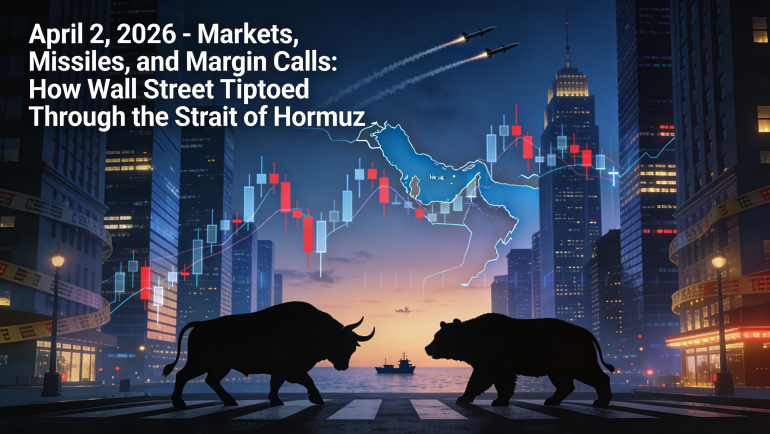
April 2, 2026 – Markets, Missiles, and Margin Calls: How Wall Street Tiptoed Through the Strait of Hormuz – ( $ANNA $INTG $MTWO $NOK $NVDA $OPEN Rise!)

US stocks ended a volatile, holiday-shortened week mixed but resilient, as investors juggled Iran-war headlines, oil shock, and shifting Fed-cut expectations while the major indexes largely shook off early Thursday losses tied to Strait of Hormuz risks.

Index performance and tone

  • The Dow spent much of the week on a roller coaster, suffering steep intraday drops as oil spiked and war rhetoric intensified, before recovering a large chunk of those losses into Thursday’s close.
  • The S&P 500 and Nasdaq began the week under pressure but staged a sharp late-March “V-bottom” rebound that extended into the new quarter, leaving the tech-heavy benchmark still well above its mid-March correction lows despite continued swings.
  • By the Thursday close (ahead of Good Friday’s closed stock market), equity markets had transitioned from panic to uneasy optimism: volatility remained elevated, but buyers consistently appeared on deep dips, especially in large-cap tech and quality growth.

Geopolitics, oil, and inflation narrative

  • The dominant macro story was the escalating U.S.–Iran war and the risk of disruption in the Strait of Hormuz, through which roughly one-fifth of globally traded oil and a large share of LNG normally flows.
  • Early in the week, fresh U.S. and Israeli strikes, Iranian counterattacks, and talk of possible closure of the strait helped push crude above the 110-dollar area, embedding a meaningful risk premium into oil markets.
  • By Thursday, headlines that Oman and regional intermediaries were working on mechanisms to ease the de facto blockade helped spark hopes that transit could normalize over coming weeks, which in turn allowed stocks to recover from steep morning losses.

Trump’s comments and rate-cut expectations

  • President Trump’s midweek televised address signaled the war in Iran could last “another two to three weeks,” promising to hit Iran “extremely hard,” which initially hammered global risk sentiment and sent stock futures sharply lower.
  • At the same time, investors began to reassess the Fed path: sustained triple‑digit oil and renewed supply shocks threaten to re-ignite inflation, prompting traders to trim expectations for near-term rate cuts even as bond markets still price some easing later in 2026.
  • This mix—higher energy, stickier inflation risk, but also a still‑resilient U.S. economy—kept the macro backdrop in a “stagflation scare” zone, yet not enough to fully break the bid under high-quality U.S. equities.

Sector and style moves

  • Energy led the week as crude’s surge lifted integrated majors, E&Ps, and services, one of the few areas consistently in the green on big down days.
  • Rate‑sensitive growth and high-multiple tech names remained the pressure point during risk‑off stretches, but the powerful late‑quarter rebound showed that secular AI and cloud themes still attract buyers on dislocation.
  • More defensive pockets—staples, healthcare, and utilities—saw renewed interest as portfolio hedges, while small caps lagged as higher energy and financing costs weigh more heavily on domestically focused, lower‑quality balance sheets.

Market character heading into next week

  • The week ending Thursday, April 2, 2026, closed with a fragile détente: war headlines and oil remain the primary macro drivers, but markets are behaving more like a grinding risk repricing than an uncontrolled liquidation.
  • Heading into the post‑holiday week, positioning is cautiously balanced between fears of a prolonged Middle East conflict and optimism that a negotiated pathway to easing Strait of Hormuz tensions could extend the nascent equity rebound.

VP Watchlist Updates

Below is an update‑style snapshot on the VP Watchlist names for the week, focused on recent catalysts, positioning, and narrative rather than precise price moves.

Eupraxia Pharmaceuticals (EPRX, $7.17)

Eupraxia Pharmaceuticals Inc. (“Eupraxia” or the “Company”), a clinical-stage biotechnology company leveraging its proprietary Diffusphere™ technology designed to optimize local, controlled drug delivery for applications with significant unmet need, co-hosted a Tribe Public www.TribePublic.com, CEO Presentation & Q&A Webinar event, Wednesday, April 1 titled “Turning EOE Into a Once-a-Year Appointment.” The event featured James A. Helliwell, M.D., Co‑founder and CEO of Eupraxia Pharmaceuticals (NASDAQ: EPRX), who discusses the company’s precision drug‑delivery platform, its approach to Eosinophilic Esophagitis (EoE), and broader pipeline priorities, followed by a focused 5–10 minute Q&A. You may watch it now at this Youtube link.

Eupraxia announced (March 17) positive symptom data from patients in the two highest dose cohorts from its ongoing Phase 1b/2a part of the RESOLVE trial evaluating EP-104GI for the treatment of eosinophilic esophagitis (“EoE”). “We are very pleased to see such a meaningful symptom response at 24 weeks in the highest dose of the Phase 1b/2a portion of the RESOLVE study,” said Dr. James A. Helliwell, Chief Executive Officer of Eupraxia. “We believe this type of response based on a single administration procedure would represent a compellingly different option for EoE patients. Importantly, the response that we are observing across cohorts 4-9 has increased as patients progress through the study through to week 24. We believe this demonstrates the importance of stable, continuous long-term local steroids in tamping down signs of inflammation quickly and acting on fibrosis in the longer term. Also, as previously reported, we continue to be encouraged by the safety profile that we have observed with EP-104GI. Currently, with 31 patients dosed in the Phase 1b/2a study, and over 220 months of follow up, there have been no reported serious adverse events.”

Modular Medical (MODD $5.01)

  • Modular Medical, Inc., an innovative insulin delivery technology company, announced (March 26) that it will effect a 1-for-30 reverse stock split of its outstanding common stock. The reverse stock split will become effective at 5:30am ET on March 31, 2026. The common stock is expected to begin trading on a split-adjusted basis on the Nasdaq Capital Market (“Nasdaq”) under the same symbol “MODD” when the market opens on March 31, 2026, with the new CUSIP number 60785L306. The reverse stock split was approved by the Company’s shareholders at the Company’s fiscal 2026 Annual Meeting, held on January 23, 2026. The reverse stock split is intended to increase the per share trading price of the Company’s common stock to satisfy the $1.00 minimum bid price requirement for continued listing on Nasdaq. The reverse stock split will reduce the number of outstanding shares of the Company’s common stock from 139,810,797 shares pre-reverse split to approximately 4,660,360 shares post-reverse split. The number of authorized shares of common stock and the par value per share will remain unchanged. As a result of the reverse stock split, every 30 shares of the Company’s pre-reverse split common stock will be combined and reclassified into one share of common stock, as applicable. Proportionate voting rights and other rights of such holders will not be affected by the reverse stock split. Holders of fractional shares will be paid cash in lieu of shares.
  • Modular Medical recently priced a public offering of 68,098,000 shares of common stock (or pre-funded warrants) alongside warrants to buy an equivalent number of shares, targeting gross proceeds of about 12 million dollars before fees. The combined public offering price of roughly 17.62 cents per share and accompanying warrant comes at a premium to the prevailing market, a rare feat in a sector where financings often resemble clearance sales rather than premium shelf space.
  • Earlier this in 2025, the company began production of validation lots for its disposable cartridge and infusion set, keeping it on track for a planned commercial launch in the first quarter of 2026, contingent on FDA 510(k) clearance—an event path that positions upcoming regulatory decisions as key stock catalysts.

GeoVax Labs (GOVX, $1.33)

The InterGroup Corporation (INTG, $38.07, +5.14%)

  • InterGroup Corporation delivered (Feb. 17) a notably stronger quarter, highlighted by a 20% jump in total revenue to $17.3 million and a 27% surge in hotel revenue as renovated rooms returned to service and travel demand improved. The company swung from a prior-year net loss to $1.0 million in net income, with operating income more than doubling to $2.0 million, underscoring better cost control and improved operating efficiency. Management further enhanced liquidity and sharpened strategic focus by selling a non-core 12‑unit Los Angeles multifamily property, generating a meaningful gain and additional working capital while maintaining stable performance across its real estate portfolio.

Volato Group, Inc. (SOAR) & M2i Global, Inc. (MTWO, +7.23%)

  • flyExclusive (NYSE American: FLYX), the vertically integrated private aviation company, announced (March 25) two milestones in its proprietary technology development: the filing of a utility patent application for a novel aircraft schedule optimization architecture, and the availability of Contrails, its Flight Management System, to other Part 135 operators beginning in Q2 2026. Both announcements coincide with the company’s presence at the NBAA Schedulers & Dispatchers Conference 2026 in Cleveland. “We have spent years building flyExclusive into one of the most operationally capable private aviation companies in the country. Contrails is how we make that expertise available to the broader industry—and the intellectual property behind it reflects the depth of investment we have made in solving problems that matter to every serious operator. We believe the right technology, built by people who actually run flights, changes what is possible in this industry. Today we are unable to source lift for nearly 300 trip requests per day. We believe Contrails will allow us to address that demand far more efficiently—both within our own operation and through coordination with other operators—and that represents a material revenue opportunity for flyExclusive and for all participating operators.”
  • Volato Group, Inc. announced (March 10) that it has entered into an amendment to its Aircraft Management Services Agreement with flyExclusive, Inc. (“FLYX”) providing for the sale of certain legacy intellectual property assets. The agreement provides for consideration valued at approximately $1.3 million, payable in FLYX Class A common stock, subject to customary conditions. The assets relate to legacy intellectual property developed during earlier stages of the Company’s technology initiatives and are not part of Volato’s current operating platforms. Volato continues to evaluate opportunities to streamline its asset base and focus resources on strategic priorities, including the continued development of its core software platforms and the pending business combination with M2i Global, Inc.
  • Volato and M2i Global reaffirmed their goal of closing their business combination in the first quarter of 2026, citing steady advancement through SEC review and integration planning as they move toward a combined listing. The deal, originally announced in 2025, will effectively transition Volato from a pure‑play private aviation operator into a diversified platform spanning aviation technology and critical minerals, with M2i shareholders expected to own the majority of the combined entity. Operationally, the partnership is already visible: the two companies recently initiated their first shipment of titanium ore from Western Australia to the United States from Titanium X, underscoring how the critical‑minerals vertical could become a meaningful growth engine as domestic supply‑chain security rises in strategic importance.
  • On Feb. 4, M2i Global,Inc.along with Volato Group, Inc. announced that Titanium X has initiated its first shipment of titanium ore from Western Australia to the U.S. under its collaboration agreement.

NVIDIA (NVDA, $177.39, +.93%) (NOK, $8.82, +6.65%)

  • In an AI market obsessed with GPUs and stardust, Nokia (NOK) is quietly reminding investors that none of this magic moves without serious plumbing. While Nvidia (NVDA) prepares to headline its GTC 2026 “Woodstock of AI” showcase, the chip giant has already written a very real check to Nokia, committing a $1 billion investment to help rewire the world’s networks for 5G‑Advanced, 6G, and AI‑native workloads. The message is simple enough: GPUs may be the new rock stars, but networking is the stadium.
  • Nvidia delivered strong fourth-quarter results recently, posting revenue of $68.1 billion, well above analyst expectations. Looking ahead, the company projects $7.8 billion in revenue for the first quarter of 2026, reflecting continued robust demand for its AI chips even amid broader market headwinds.
  • NVIDIA and Nebius Group N.V. (NASDAQ: NBIS) (March 11) announced a strategic partnership to develop and deploy the next generation of hyperscale cloud for the AI market, from AI natives to enterprises. NVIDIA will invest $2 billion in Nebius.

McDonald’s (MCD, $307.14)

  • In the run-up to World Protein Day on 27th February, McDonald’s India (West & South), owned and operated by Westlife Foodworld, is celebrating Protein Week, reinforcing its leadership in nutrition-led innovation. Making protein more accessible, affordable and customizable, Indian consumers can use the McDonald’s app to explore these nutritious offerings and avail of protein burgers starting at just INR 69. Enhancing this convenience, consumers ordering via McDelivery can also enjoy free delivery on the Protein Plus meal range.

Opendoor (OPEN, $4.74, +3.72%)

Tesla (TSLA, $360.59)

Elon Musk’s latest Texas-sized ambition is to build his own AI chip empire, and this time the factory floor will sit right next to the robots, rockets, and robotaxis that plan to use it. The Terafab project, a new semiconductor venture linking Tesla (TSLA), SpaceX, and xAI in Austin, aims to churn out custom chips for AI, humanoid robots, and space systems at a scale that makes today’s GPU land rush look like a warm‑up act. Learn more here.

There are open secrets on Wall Street, and then there is SpaceX’s long‑anticipated march toward the public markets, now reportedly via a confidential filing with the SEC that could set up a June debut. For a company that routinely broadcasts rockets into orbit, it is taking a decidedly hush‑hush approach to its paperwork

Serina Therapeutics (NYSE: SER, $2.12)

Serina Therapeutics (NYSE: SER) (www.serinatx.com) seems to have have just traded itself into Wall Street’s good graces, pairing fresh capital with a late-session pop that suggests investors are finally starting to connect the dots between polymer chemistry and portfolio returns. In Huntsville, Alabama, Serina Therapeutics announced definitive agreements for a private placement of common stock and pre-funded warrants that could bring in up to 30 million dollars in gross proceeds. The first 15 million dollar tranche is expected to close on March 20, 2026, with a second tranche of up to 15 million dollars anticipated by April 30, 2026, subject to customary closing conditions.

What makes the deal stand out in a biotech tape crowded with discounts is the pricing: the securities are being sold at about 2.25 dollars per share, a roughly 68 percent premium to Serina’s March 17 closing price, signaling that insiders are willing to pay up for exposure to the company’s clinical agenda. The financing also adds board-level heft, with director Greg Bailey, M.D., stepping into a Co-Chairman role as he leads the investment, a move that effectively puts the capital and the governance on the same optimistic page. Learn more here.

AleAnna, Inc. (ANNA, $7.89, +8.68%)

AleAnna, Inc. (ANNA) recently turned a dry technical milestone—its year‑end reserves report—into something closer to an Italian energy renaissance, with proved natural gas reserves jumping 47% after a year of active production. For investors hunting for credible growth stories in a world of energy-transition buzzwords, this is one of the rare cases where the molecules are actually catching up to the marketing. Learn more here.

The Sources

  1. Yahoo Finance – “Stock market today: Dow, S&P 500, Nasdaq extend rally for 2nd day on hopes of Iran war deescalation”
    https://finance.yahoo.com/news/live/stock-market-today-dow-sp-500-nasdaq-climb-as-deescalation-talk-in-iran-extends-rally-133208524.htmlfinance.yahoo
  2. Yahoo Finance – “Stock market today: Dow, S&P 500 sink, Nasdaq enters correction territory as oil spikes amid Iran war”
    https://ca.finance.yahoo.com/news/stock-market-today-dow-sp-500-nasdaq-fall-as-wall-street-weighs-prospects-for-iran-truce-133316424.htmlfinance.yahoo
  3. Yahoo Finance – “Month of March Goes Out Like a Bull”
    https://finance.yahoo.com/markets/stocks/articles/month-march-goes-bull-220100339.htmlfinance.yahoo
  4. Yahoo Finance – “How major US stock indexes fared Tuesday 3/31/2026”
    https://finance.yahoo.com/markets/world-indices/articles/major-us-stock-indexes-fared-202030310.htmlfinance.yahoo
  5. Yahoo Finance – “Wall Street drops again to close its 5th straight losing week and its worst since Iran war began”
    https://finance.yahoo.com/markets/world-indices/articles/asian-stocks-mostly-lower-wall-030651899.htmlfinance.yahoo
  6. Yahoo Finance – “Stock market today: Dow, S&P 500 rise, Nasdaq slips as war uncertainty drives oil prices higher”
    https://finance.yahoo.com/news/live/stock-market-today-dow-sp-500-nasdaq-futures-fall-entering-shortened-week-ahead-of-jobs-reports-133216214.htmlfinance.yahoo
  7. Yahoo Finance – “Stock market today: Dow, S&P 500, Nasdaq trim losses but end sharply lower as Wall Street assesses Iran strikes”
    https://finance.yahoo.com/news/live/stock-market-today-dow-sp-500-nasdaq-trim-losses-but-end-sharply-lower-as-wall-street-assesses-iran-strikes-133219868.htmlfinance.yahoo
  8. Yahoo Finance – “Almost everything is going wrong for markets right now”
    https://finance.yahoo.com/news/almost-everything-is-going-wrong-for-markets-right-now-100005327.htmlfinance.yahoo
  9. Yahoo Finance – “Dow, S&P 500, Nasdaq pare losses on hopes that Iran could reopen key oil chokepoint”
    https://finance.yahoo.com/news/live/stock-market-today-dow-sp-500-nasdaq-futures-stumble-after-trump-says-war-with-iran-not-yet-over-133233835.htmlfinance.yahoo
  10. Yahoo Finance – “Wall Street falls to its worst drop since the Iran war as the Nasdaq sinks into correction”
    https://finance.yahoo.com/markets/world-indices/articles/asian-stocks-mostly-fall-oil-043625621.htmlfinance.yahoo
  11. Yahoo Finance / Live blog you provided – “Stock market today: Dow falls, S&P 500 and Nasdaq shake off early losses on Strait of Hormuz hopes”
    https://finance.yahoo.com/news/live/stock-market-today-dow-falls-sp-500-and-nasdaq-shake-off-early-losses-on-strait-of-hormuz-hopes-200009635.htmlcnbc
  12. Yahoo Finance – “US stocks rebound as market achieves rare ‘V-Bottom’” (also syndicated on AOL)
    https://finance.yahoo.com/video/us-stocks-rebound-as-market-achieves-rare-v-bottom-220000272.html
    Mirror: https://www.aol.com/finance/us-stocks-rebound-market-achieves-220000641.htmlaol+1
  13. TheStreet – “Stock Market Today (Apr. 2, 2026): Futures slide after Trump signals weeks more of Iran war”
    https://www.thestreet.com/latest-news/stock-market-today-apr-2-2026-updatesthestreet
  14. CNBC TV18 – “Stocks slide, oil surges as Trump remarks hit Iran peace hopes” (live blog with futures/oil commentary)
    https://www.cnbctv18.com/market/us-stock-market-live-updates-dow-snp-500-nasdaq-wall-street-iran-war-oil-dollar-gold-silver-live-cnbctv18

Mission Critical: Inside the M2i Global Season One Series Redefining America’s Critical Minerals Strategy -( $MTWO $SOAR )

Season One of this series, hosted by Major General (Ret) Alberto “Al” Rosende, President & CEO of M2i Global (MTWO), set out to treat critical minerals not as background noise in the global economy, but as the front-page story driving technology, healthcare, infrastructure, and national security. Over the course of the season, that wager paid off, as conversations with policymakers, industry leaders, and experts revealed how deeply our prosperity—and security—now depends on minerals most people rarely think about but everyone implicitly relies on.

Major General Rosende and the M2i Mission

Guiding the discussion was Major General (Ret) Alberto Rosende, an accomplished senior executive whose career spans corporate, military, non-profit, and entrepreneurial roles. As the former Commanding General of the 63rd Readiness Division, U.S. Army Reserve, he was responsible for facilities, equipment readiness, and personnel support across a seven‑state region, with service in the United States, Puerto Rico, Afghanistan, and Iraq.

His military career, decorated with honors such as the Army Distinguished Service Medal, the Legion of Merit, and the Bronze Star Medal, gives him a unique vantage point on readiness, logistics, and national security. Complementing that experience, Rosende holds a B.S. in Business Administration (Nova Southeastern University), an M.S. in National Security and Resource Strategy (Eisenhower School, National Defense University), and an M.A. in Education and Human Development (The George Washington University), bringing academic rigor to a domain often clouded by politics and hype.

As President & CEO of M2i Global, Inc., Rosende now applies this blend of strategic, operational, and educational expertise to a new theater: securing the minerals and metals that underpin U.S. military strength, technological innovation, and economic resilience. M2i Global operates as a connector and integrator—linking high‑quality mineral assets with capital, technology, and strategic partners, while navigating regulatory, ESG, and geopolitical complexity.

From Foreign Dependency to Strategic Vulnerability

For decades, the U.S. has relied heavily on foreign imports for the essential minerals that power its defense systems, industrial base, and advanced technologies. That dependence has quietly grown into a strategic vulnerability, especially as geopolitical tensions and supply chain disruptions threaten access to critical resources just as demand is accelerating.

The shift away from domestic mining and processing ceded much of the global production landscape to nations such as China and Russia, leaving the U.S. and its allies exposed in areas ranging from batteries and semiconductors to precision munitions and advanced communications. As technological innovation and the drive toward Net Zero emissions create unprecedented demand for critical minerals, the need to rebuild a robust domestic and allied supply chain has moved from policy talking point to operational imperative.

Season One repeatedly underscored this reality: critical minerals are no longer just inputs on a corporate purchasing list. They are now core variables in national security planning, industrial strategy, and long‑term economic resilience.

M2i and the Minerals Metals Initiatives

Enter the Minerals Metals Initiatives (M2i), a pioneering effort dedicated to revitalizing America’s minerals and metals industry and realigning it with 21st‑century security and climate goals. Based in Nevada—a state that already plays an outsized role in U.S. mining—M2i is working to establish a secure, reliable supply chain for critical minerals essential to both defense and economic prosperity.

The firm’s thesis is straightforward but ambitious: you cannot secure a nation’s future if you outsource the raw materials for its military, energy systems, and digital infrastructure. With a visionary leadership team and strategic partnerships, M2i is designing an integrated model that links mining, processing, recycling, and defense relations into a cohesive, future‑focused operation. The goal is to transform a fragmented ecosystem into a deliberate architecture of readiness, resilience, and responsibility.

For investors and policymakers alike, M2i positions itself as both a catalyst and a coordinator—helping identify viable projects, align them with national priorities, and ensure they meet modern standards on ESG, traceability, and operational excellence.

From Policy Signal to Generational Project

Throughout Season One, guests described a clear shift in Washington: critical minerals are no longer treated as a niche procurement issue but as a central pillar of industrial and defense policy. Authorities once used sparingly are now being deployed to catalyze domestic production and processing, signaling a “whole‑of‑government” approach that spans energy, defense, commerce, and environmental agencies.

In market terms, critical minerals have moved from “nice to have” to “core holding” on the national balance sheet. Mining and processing are now seen as strategic capabilities rather than mere industrial activities. The United States and its allies recognize that resilient supply chains will require redundancy, regional diversification, and long‑term commitments that outlast election cycles and business headlines.

Season One captured that evolution, showing how policy is being reframed from short‑term reaction to generational project—one that will define technological leadership, military readiness, and economic competitiveness.

Outmined, Outprocessed—But Not Outinnovated

A recurring theme was the acknowledgment that the U.S. and its allies are unlikely to outmine or outprocess dominant incumbents purely on volume in the near term. However, they can out‑innovate. By focusing on advanced refining technologies, materials science, and smarter project finance structures, Western economies can stretch every ton of ore further and reduce exposure to single‑point failures.

This reframes “supply” as more than the number of mines in operation. It includes breakthroughs in refining and processing, new alloys and chemistries, and the digital tools that optimize production and logistics. Policy and technology become force multipliers, allowing resource‑rich democracies to punch above their weight—if they can execute.

Recycling: The Quiet Powerhouse

Season One also elevated recycling from a feel‑good side note to a serious strategic lever. Metals are, in principle, infinitely recyclable, and pushing recycling rates significantly higher could dramatically reduce geopolitical risk, environmental impact, and the need to bring every marginal ton out of the ground.

By integrating recycling into a broader minerals strategy, countries can reclaim value from end‑of‑life products, reduce dependence on adversarial suppliers, and build an industrial ecosystem that aligns security, environmental goals, and economic opportunity. For firms like M2i, that means viewing recycling not as an afterthought, but as a core pillar in a vertically integrated critical minerals ecosystem.

Traceability: From Compliance to Competitive Edge

Another warning light that flashed repeatedly across Season One was supply chain opacity. Many mineral flows remain tangled in networks where environmental damage and human rights abuses are invisible—until they suddenly are not, when a media report, lawsuit, or regulatory action surfaces.

The answer is robust traceability. Rather than a box‑checking exercise, traceability is evolving into a continuous visibility system that tracks materials from mine or recycler to finished product. For companies, it reduces legal and reputational risk; for governments, it supports credible policy and enforcement; for investors, it provides a clearer picture of real risk‑adjusted returns.

In this context, data becomes as valuable as ore. The ability to prove provenance, measure impacts, and enforce standards may increasingly determine which projects attract capital and long‑term offtake agreements.

Nevada, Net Zero, and the New Map of Necessity

Nevada, where M2i is based, emerged in Season One as emblematic of the new map of necessity. Already a leading gold producer and host to the only operating lithium mine in the United States, the state sits at the intersection of legacy mining know‑how, emerging battery demand, and national security priorities.

As the world races toward Net Zero, demand for key minerals used in batteries, grid infrastructure, and clean energy systems is surging. That creates both opportunity and pressure. States like Nevada will help determine how the U.S. balances domestic production, environmental stewardship, and community engagement while recalibrating its position in global supply chains.

Mining, once viewed mainly as a local economic driver, is now framed as a strategic necessity that supports healthcare, advanced manufacturing, digital infrastructure, and national defense. The pit on the horizon has become part of the conversation about alliances, deterrence, and long‑term competitiveness.

The Thread That Ties It All Together

Across Season One, one connective thread ran through every conversation: this is not just an economic story, not just a national security story, and not just a climate story. It is all of them at once—an intertwined ecosystem stretching from exploration and permitting to recycling, from the lab bench to the battlefield.

By bringing together voices from government, industry, and policy, and anchoring the series in M2i’s on‑the‑ground perspective, Season One illuminated how secure, responsible supply chains are built. It showed why traceability, ESG performance, and allied cooperation are no longer optional extras, but central design features of any serious critical minerals strategy. And it framed M2i and its partners as key contributors in translating strategy into action.

Season Two: From Insight to Execution

If Season One was about diagnosing the problem and clarifying the stakes, Season Two is about execution. The questions now shift from “Why does this matter?” to “Who is doing what, where, and on what timeline?” and “How do we measure real progress?”

Season Two will explore how the U.S. and its allies can adapt to the evolving role of critical minerals in global security and economic resilience, and how they can move from policy statements to steel‑in‑the‑ground projects, built‑out processing capacity, scaled recycling, and operational traceability. It will delve into the partnerships—between government, industry, technology providers, and capital—that will determine whether the next decade is defined by scarcity and vulnerability or by resilience and strategic advantage.

For listeners, investors, and policymakers, that is where the story becomes not only more urgent, but truly investable. And for Major General (Ret) Alberto Rosende and M2i Global, it is where decades of experience in readiness, logistics, and leadership meet the hard work of rebuilding a critical foundation of American power—one mineral, one project, and one partnership at a time.

Watch The Program Now:

Acquired Taste: Why Big Pharma Can’t Stop Snacking on Venture‑Backed Biotechs -( $IBB $MRK $OTSKY $NVS $TERN $XBI )

Big Pharma spent the week shopping again, snapping up a fresh crop of biotech and pharmaceutical names in deals that underscore one message: pipelines are the new gold, and the majors are still happily paying spot prices. From autoimmune bets to allergy franchises and mental health moonshots, the M&A tape is starting to read like a sector-wide restocking plan—with a punchline that’s very serious for investors.

The Week’s Headliners in White Coats

Several sizeable buyouts and signings hit the tape this week, spanning oncology, immunology, autoimmune disease and neuroscience. While the fine print varies, the common thread is large-cap pharma paying up for late‑stage or near‑proof‑of‑concept assets that can move the revenue needle before the looming patent cliff takes too big a bite.

  • Novartis (NVS) agreed to acquire Excellergy, a private U.S. biotech focused on next-generation allergy therapies, in a deal worth up to roughly $2–3 billion including milestones, securing lead anti‑IgE antibody EXL‑111 now in early clinical development.
  • Merck (MRK) struck a roughly $6.7 billion agreement to buy Terns Pharmaceuticals (TERN), adding BCR‑ABL1 inhibitor TERN‑701 and other oncology assets at what analysts describe as one of the leaner deal premiums seen since 2018.
  • Otsuka Pharmaceutical (OTSKY) moved to acquire Transcend Therapeutics for up to $1.225 billion, including about $700 million in upfront cash, bringing in a private CNS-focused biotech platform with late‑stage aspirations in psychiatric and neurological disorders.

Novartis Doubles Down on Allergies

Novartis’ move on Excellergy looks like a textbook “buy the growth you can’t afford to wait for” transaction, targeted squarely at IgE‑driven allergic disease. The company gains Excellergy’s lead asset EXL‑111, a high‑affinity, half‑life‑extended anti‑IgE antibody designed for faster, more durable suppression of allergic responses—think fewer flare‑ups, more days when patients can picnic without a medical contingency plan.

  • The deal value is framed at up to $2–3 billion including milestones, a level that signals Novartis’ confidence in allergy as a durable growth franchise rather than a niche add‑on.
  • Strategically, it deepens Novartis’ immunology and allergy pipeline at a time when large pharma is racing to bulk up differentiated biologics ahead of a multiyear patent cliff.

Merck’s Terns Deal: A Modest Premium, Serious Intent

If Novartis played the bold allergy card, Merck opted for understated aggression with its agreement to buy Terns Pharmaceuticals. The roughly $6.7 billion price tag comes with what has been called the lowest recorded premium for a biotech buyout since 2018, a reminder that in this market, leverage sometimes wears a lab coat and a calculator.

  • Central to the deal is TERN‑701, a BCR‑ABL1 tyrosine kinase inhibitor aimed at hematologic malignancies, which Merck can plug into its already formidable oncology infrastructure.
  • The valuation has fueled debate, with some analysts arguing the sticker does not fully capture the long‑term potential of TERN‑701—an argument Merck appears happy to test in the clinic rather than on message boards.

Otsuka’s Transcend Moment in CNS

Otsuka Pharmaceutical’s acquisition of Transcend Therapeutics adds another notable ticket to this week’s biotech buyout roll, this time in central nervous system disorders. The deal, valued at up to $1.225 billion with about $700 million upfront, gives Otsuka access to a private pipeline built around novel psychiatry and neurology candidates at a time when CNS innovation is finally escaping the “too hard” bucket for big pharma.

  • For Transcend’s backers, the structure—significant cash upfront plus milestones—offers both a liquidity event and continued upside if late‑stage trials cooperate.
  • For Otsuka, the transaction reinforces a long‑running strategy in mental health, effectively adding another shot on goal in a therapeutic area where unmet need remains stubbornly high and pricing power, if differentiation is proven, can be unusually resilient.

What This Week’s Deals Signal for Biotech

Taken together, this week’s buyouts highlight how large-cap pharma is leaning into targeted, “bolt‑on” acquisitions rather than mega‑mergers, choosing focused science over sheer scale. The emphasis on allergy, oncology and CNS tracks with broader expectations that biopharma M&A will accelerate through 2026 as companies confront a roughly $170 billion patent cliff and look to replenish top‑line growth with late‑stage and de‑risked assets.

For biotech founders and investors, the message is clear: platforms that can credibly bend the curve in high‑value disease areas are still very much in demand, even if deal premiums are now negotiated with a bit more sobriety than in prior cycles. And for public‑market investors trying to handicap the next target, this week’s tape offers a familiar but still powerful script—follow the cash, follow the data, and watch closely whenever a late‑stage asset starts looking more like a revenue line than a research project.

Want to Learn More Now?

NAYA Therapeutics (https://www.nayatx.com) is quietly trying to make “next‑gen radiopharma” sound less like sci‑fi and more like standard operating procedure—and its new board lineup reads like a who’s who of oncology, nuclear medicine, and biotech capital markets.

At the same time, note that if radiopharma once sat in the “interesting, but niche” bucket, recent M&A has moved it firmly into the “board‑mandated strategic priority” column. Over roughly eight months, big pharma snapped up at least four of the sector’s hottest names: Novartis (NVS) acquired Mariana Oncology for around 1 billion dollars, Eli Lilly (LLY) bought Point Biopharma for about 1.4 billion dollars, AstraZeneca (AZN) purchased Fusion Pharmaceuticals for roughly 2.4 billion dollars, and Bristol Myers Squibb (BMY) acquired RayzeBio for approximately 4.1 billion dollars.

Learn more at this link:

Is NAYA Therapeutics the Next Radiopharma Takeout? The Pipeline, the Board, and the Buzz – ( $AZN $BMY $IBB $LLY $NVS $XBI )

The Sources


[1] Healthcare News, Deals, and Investments Update Mar 30th, 2026 https://www.lawrenceevans.com/2026/03/30/healthcare-news-deals-and-investments-update-mar-30th-2026/
[2] 2026 Biotech M&A Tracker: Deals, Upfronts, Totals & More – BioBucks https://www.biobucks.co/p/biotech-ma-tracker-2026
[3] Biotechnology Weekly Update – March 31, 2026 – YouTube https://www.youtube.com/watch?v=kYIjL4LIllw
[4] Recordati sizes up €10.9bn CVC Capital acquisition offer – ChemDiv https://www.chemdiv.com/company/media/pharma-news/2026/recordati-considers-10-9b-cvc-capital-acquisition-offer-before-q1-close/
[5] Big Pharma race to snap up biotech assets as $170 billion patent … https://www.cnbc.com/2026/01/07/big-pharma-race-to-snap-up-biotech-assets-as-170-billion-patent-cliff-looms.html
[6] Goodwin Advises Transcend Therapeutics on IP Aspects of its … https://www.goodwinlaw.com/en/news-and-events/news/2026/03/announcements-lifesciences-goodwin-advises-transcend-therapeutics
[7] Major M&A deals impacting bioanalysis in 2026 https://www.bioanalysis-zone.com/major-ma-deals-impacting-bioanalysis-in-2026/
[8] Top 10 Takeover Targets of 2026 https://www.genengnews.com/a-lists/top-10-takeover-targets-of-2026/
[9] Five things for pharma marketers to know for Monday, March 30, 2026 https://www.mmm-online.com/news/five-things-for-pharma-marketers-to-know-for-monday-march-30-2026/
[10] Biotech M&A is accelerating. Track the deals that are happening here. https://www.biopharmadive.com/news/biotech-pharma-deals-merger-acquisitions-tracker/604262/
[11] Novo Nordisk Enters $2.1 Billion Partnership with Vivtex, GSK … https://www.pharmexec.com/view/mergers-acquisitions-roundup-novo-nordisk-enters-2-billion-partnership-vivtex-gsk-enters-950-million-acquisition-35pharma-inc-
[12] Pharmaceuticals, Biotechnology and Diagnostics M&A Agreements … https://finance.yahoo.com/news/pharmaceuticals-biotechnology-diagnostics-m-agreements-160200400.html
[13] Inside One Fund’s $170 Million Bet on a Biotech Stock Up 1,040% in … https://finance.yahoo.com/news/inside-one-funds-170-million-144806778.html
[14] 2026 biotech deals tracker: the latest partnerships and M&A https://www.labiotech.eu/biotech-deals-2026/
[15] Pharmaceuticals and Biotechnology Asset Purchase Agreements … https://finance.yahoo.com/news/pharmaceuticals-biotechnology-asset-purchase-agreements-154600470.html

Your Guide To Staying Informed In The Markets

Subscribe For Free Email Updates Access To Exclusive Research

Vista Partners — © 2026 — Vista Partners LLC (“Vista”) is a Registered Investment Advisor in the State of California. Vista is not licensed as a broker, broker-dealer, market maker, investment banker, or underwriter in any jurisdiction. By viewing this website and all of its pages, you agree to our terms. Read the full disclaimer here