Skip to content Skip to sidebar Skip to footer

Amazon’s $11.6B Globalstar Acquisition: A Signal That the Sky’s No Longer the Limit -( $AAPL $AMZN $GSAT )


In a move that underscores the convergence of cloud, communications, and capital, Amazon (NASDAQ: AMZN) confirmed plans to acquire Globalstar (NYSE: GSAT) in an $11.6 billion all-cash deal. The acquisition represents Amazon’s most assertive step yet into the satellite communications sector, fortifying its ambitions to extend Project Kuiper and deepen vertical integration across its fast-evolving cloud and logistics empire.

Globalstar, a pioneer in low-Earth orbit satellite networks, brings with it a portfolio of spectrum rights, operational infrastructure, and regulatory clearances that would have taken years — and likely billions — for Amazon to replicate organically.

Strategic Logic: Spectrum Is the New Real Estate

Beyond the headline number, the rationale is clear: bandwidth is the next frontier of infrastructure ownership. Just as Amazon dominated cloud hosting through AWS, it now seeks to secure the physical highways of the coming edge-computing era.

Globalstar’s assets give Amazon direct leverage in a market where connectivity isn’t just a service — it’s a moat. Satellite networks increasingly underpin logistics optimization, autonomous systems, and IoT ecosystems. Integrating these capabilities into AWS’s architecture could sharply reduce latency for enterprise customers in manufacturing, energy, and defense.

One portfolio manager quipped, “Globalstar gives Amazon the sky rights it’s been leasing from others.” That’s Wall Street shorthand for long-term strategic control.

Market Reaction: Investors Tune In

Globalstar shares surged in pre-market trading on the news, while Amazon’s stock ticked modestly higher as investors digested the deal’s implications. Analysts view it as a scalable infrastructure play rather than a short-term earnings driver — a familiar pattern for Amazon’s long-game investments.

Given Amazon’s balance sheet strength and track record of capital deployment, few are second-guessing the price tag. The company financed much of its empire not through immediate ROI, but through durable systems that create self-reinforcing network effects. Space, it seems, is simply the next platform.

The Competitive Field: From Earth to Orbit

The acquisition also places Amazon in direct competition with SpaceX’s StarlinkApple’s (AAPL) satellite-enabled services, and OneWeb’s broadband constellation. Yet Amazon holds a unique advantage: its combined strength in cloud computing, logistics, and consumer reach.

Where Starlink serves consumers directly, Amazon can vertically integrate Globalstar’s network to enhance its delivery network, Prime services, and AWS enterprise solutions — all at once. The signal, both literal and figurative, is strong.

Outlook: The Edge Gets Closer

For investors, the takeaway is that Amazon continues to redefine what an ecosystem company looks like. The Globalstar acquisition positions it not only as a space infrastructure provider, but as a core enabler of the global digital supply chain.

Much like its quiet early buildup of AWS, Amazon is again laying the groundwork for a multi-decade revenue stream — one orbit at a time. As a portfolio theme, “cloud-to-satellite convergence” may soon become a watchword among growth investors seeking exposure to the next cycle of digital infrastructure.

After all, Amazon isn’t just shooting for the stars — it’s planning to own the signal that connects them.


The Sources

  1. The Next Web – “Amazon agrees to acquire Globalstar in an $11.6B deal”
    https://thenextweb.com/news/amazon-agrees-to-acquire-globalstar-in-an-11-6b-dealthenextweb
  2. iClarified – “Amazon’s $11.6B Globalstar Deal Secures iPhone Satellite Features”
    https://www.iclarified.com/100546/amazons-116b-globalstar-deal-secures-iphone-satellite-featuresiclarified
  3. AppleMust – “Amazon to buy Apple satellite partner, Globalstar in $11.6b deal”
    https://www.applemust.com/amazon-to-buy-apple-satellite-partner-globalstar-in-11-6b-deal/applemust
  4. Drive Tesla Canada – “Amazon acquires Globalstar in $11.6B deal, will power satellite connectivity for Apple devices”
    https://driveteslacanada.ca/news/amazon-acquires-globalstar-in-11-6b-deal-will-power-satellite-connectivity-for-apple/driveteslacanada
  5. Ground News – “Amazon to buy Globalstar to bolster Leo satellite business”
    https://ground.news/article/amazon-to-buy-globalstar-to-bolster-leo-satellite-business_4d4fffground
  6. Intellectia – “Amazon: Is Globalstar the Key Catalyst for Stock Growth?”
    https://intellectia.ai/news/stock/amazon-is-globalstar-the-key-catalyst-for-stock-growthintellectia
  7. Intellectia – “Amazon’s Rumored Acquisition of Globalstar Sparks Market Interest”
    https://intellectia.ai/news/stock/amazons-rumored-acquisition-of-globalstar-sparks-market-interestintellectia
  8. Globalstar Financials / SEC Summary – “Globalstar (NASDAQ: GSAT) $273M revenue; >50‑satellite C‑3 plan …”
    https://www.stocktitan.net/sec-filings/GSAT/ars-globalstar-inc-sec-filing-be6cc01868bf.htmlstocktitan
  9. Matrix BCG – “How Does Globalstar Company Work?” (background on business model and satellite network)
    https://matrixbcg.com/blogs/how-it-works/globalstarmatrixbcg

From Ringtones to Terabits: Nokia Quietly Reboots Its Wall Street Story -( $BAC $NOK )

Nokia’s (NOK) stock is trading back in the conversation — only this time, it’s not about ringtones but terabits.

BofA Rediscovers Nokia, This Time in Terabytes

Bank of America (BAC) has upgraded Nokia to Buy from Neutral and lifted its price target to 10.70 euros, citing a sharp inflection in the company’s optical networking and hyperscaler exposure. The call leans heavily on accelerating AI-driven data center builds, where hyperscalers are racing to light up 400G and 800G optical links like runway lights at a busy hub airport.

Analysts now model Nokia’s Optical Networks division growing at a roughly mid‑teens compound annual rate through 2028, arguing that management’s own 10–12% growth view for Optical and IP Networks looks conservative. They’ve shifted to a sum‑of‑the‑parts framework, assigning a rich 30x multiple to the optical and IP segment’s 2027 EBIT and a more down‑to‑earth 10x multiple to the rest of the business.

From Handsets to Hyperscalers

If the Nokia of old sold you your first flip phone, the Nokia of 2026 wants to sell backbone gear to the cloud giants pumping AI models through global networks. After acquiring U.S. optical specialist Infinera, the company has materially expanded its reach with American cloud customers and now positions itself as an emerging optical leader in Europe.

BofA estimates Nokia could pull in more than 200 million euros from data center switching by 2026, potentially climbing north of 400 million euros by 2028, helped by wins like its work with European cloud provider NScale. Layer on top the ongoing Huawei and ZTE replacement cycle in Europe, and analysts see additional optionality that is not yet fully reflected in baseline numbers.

Wi‑Fi 7 Meets Fiber: Nokia and RUCKUS Go Campus Hopping

While Wall Street reruns its Nokia spreadsheets, the company is also busy tightening its enterprise story with RUCKUS Networks. The two have launched an early‑access program for a combined Wi‑Fi 7 and optical LAN solution, marrying Nokia’s Aurelis optical LAN platform with RUCKUS Wi‑Fi 7 access points and the cloud‑based, AI‑enhanced RUCKUS One management stack.

Trials with Tier‑1 service providers across North America and Asia are already under way, showcasing improved performance and operational savings for in‑building and campus connectivity. Nokia says its fiber‑based LAN architecture can cut energy consumption by up to 40% and total cost of ownership by as much as 50% versus traditional copper‑heavy setups — the kind of numbers that make both sustainability officers and CFOs sit up straighter.

The Campus Network, Now on a Diet

Under the joint design, Nokia’s Aurelis MF‑2 optical switches and modems sit at the core, feeding RUCKUS Wi‑Fi 7 radios and cloud services that handle network assurance and business intelligence. The result is a slimmer network: fewer intermediate boxes, less cabling, and a lot more bandwidth, ideally suited to high‑density venues, multi‑dwelling units, hospitals, hotels, and education campuses that have outgrown yesterday’s wiring closets.

For telecom operators, cable providers, and managed service players, the proposition is straightforward: deploy a converged fiber‑and‑Wi‑Fi stack that takes up less space, consumes less power, and can scale to the inevitable surge of IoT sensors, video streams, and AR‑heavy collaboration tools. In other words, the “wireless” future is quietly being won by whoever pulls the most efficient glass to the ceiling.

Why Wall Street Suddenly Cares Again

BofA’s upgrade lands against a backdrop of AI infrastructure arms‑racing, where optical capacity and power‑efficient campus networks are no longer side stories but central plot lines. On one axis, Nokia is leaning into hyperscalers with higher‑margin optical and IP products; on another, it is extending into enterprise and campus environments via the RUCKUS alliance and its Aurelis‑based optical LAN.

Analysts say their earnings forecasts for Nokia now run more than 10% above Street consensus for 2026 through 2028, reflecting both the optical growth story and operational leverage from a more software‑weighted, higher‑margin mix. If the company can continue to convert optical design wins, push its Wi‑Fi 7 plus fiber play deeper into enterprises, and capture share from legacy vendors in Europe, the long‑dormant Nokia equity narrative may finally be getting the rewrite investors have been waiting for since the ringtone era — only this time, in 800G.

The Sources

Here’s a clean, numbered source list with live links:

  1. Bank of America upgrades Nokia to Buy on optical and hyperscaler growth – Yahoo Finance
    https://finance.yahoo.com/markets/stocks/articles/bofa-upgrades-nokia-buy-optical-121054767.htmlfinance.yahoo
  2. BofA upgrades Nokia stock rating on optical growth potential – Investing.com
    https://investing.com/news/analyst-ratings/bofa-upgrades-nokia-stock-rating-on-optical-growth-potential-93CH-4609251?ampMode=1investing
  3. Nokia (NOK) Stock Soars After Upgrade to Buy by Bank of America – GuruFocus
    https://www.gurufocus.com/news/8789853/nokia-nok-stock-soars-after-upgrade-to-buy-by-bank-of-americagurufocus
  4. Nokia jumps as Bank of America turns bullish on AI-driven optical and hyperscaler demand – Quiver Quant
    https://www.quiverquant.com/news/Nokia+jumps+as+Bank+of+America+turns+bullish+on+AI-driven+optical+and+hyperscaler+demandquiverquant
  5. Nokia (NOK) Rating Increased to Buy at Bank of America – MarketBeat
    https://www.marketbeat.com/instant-alerts/nokia-nysenok-rating-increased-to-buy-at-bank-of-america-2026-04-13/marketbeat
  6. RUCKUS Networks and Nokia Announce Early Access Availability for their Combined Solution—an Integrated Wi‑Fi 7 and Fiber Optical LAN Solution – Yahoo Finance
    https://finance.yahoo.com/sectors/technology/articles/ruckus-networks-nokia-announce-early-120000230.htmlfinance.yahoo
  7. RUCKUS and Nokia launches Wi‑Fi 7 optical LAN trial – IT Brief
    https://itbrief.com.au/story/ruckus-and-nokia-launch-wi-fi-7-optical-lan-trialitbrief
  8. Nokia, Ruckus Networks unveil Wi‑Fi 7 and Optical LAN platform – Advanced Television
    https://www.advanced-television.com/2026/04/13/nokia-ruckus-networks-unveil-wi%E2%80%91fi-7-and-optical-lan-platform/advanced-television
  9. Nokia (NOK) Launches Integrated Wi‑Fi 7 and Fiber Optical LAN Solution – GuruFocus
    https://www.gurufocus.com/news/8789561/nokia-nok-launches-integrated-wifi-7-and-fiber-optical-lan-solutiongurufocus
  10. RUCKUS Networks and Nokia Announce Early Access Availability for their Combined Solution—Integrated Wi‑Fi 7 and Fiber Optical LAN – Las Vegas Sun
    https://lasvegassun.com/news/2026/apr/13/ruckus-networks-and-nokia-announce-early-access-av/lasvegassun

When Cloud Meets Kilowatts: Oracle’s High‑Voltage Romance With Bloom Energy ( $BE $ORCL )

Oracle’s latest move to secure clean, always‑on power for its AI cloud looks less like a utility contract and more like a quiet rerating of what it means to be a modern data‑center landlord .

Oracle’s New Favorite Fuel: Megawatts

Oracle (ORCL) has expanded its partnership with Bloom Energy (BE) under a master services agreement that contemplates up to 2.8 gigawatts of on‑site fuel‑cell capacity to power its AI and cloud data centers. An initial 1.2 gigawatts is already under contract and in deployment across U.S. Oracle Cloud Infrastructure (OCI) sites, giving the company something Silicon Valley increasingly covets more than headcount: guaranteed electrons. Bloom says it can deliver enough on‑site capacity to run an entire data center in roughly 90 days, a construction timeline that would make many grid planners spill their coffee.

Behind the engineering jargon is a simple commercial message: Oracle (ORCL) wants to convert power risk into a competitive advantage in AI infrastructure. In an era when a cutting‑edge AI data center can feel more like a hungry industrial customer than a tidy office park tenant, locking in dedicated, scalable capacity is less an option and more an existential planning line item.

Why AI Data Centers Are Suddenly Energy Companies

AI workloads, particularly training large models, demand dense, rapidly changing power loads that traditional grids were never designed to babysit. Bloom’s (BE) solid‑oxide fuel cells, which generate power from natural gas, hydrogen, or other fuels with low local emissions and no water usage, promise precisely the kind of fast, load‑following response that hyperscale operators now treat as table stakes.investor.

For Oracle (ORCL), the sell is as much about control as it is about carbon. On‑site generation reduces dependence on aging grid infrastructure, potential interconnection delays, and regional transmission bottlenecks that can turn a billion‑dollar data center into a very expensive dark warehouse. With on‑premise fuel cells, Oracle (ORCL) can, in theory, tune its AI data centers’ power profile to the rhythm of its own product roadmap rather than the calendar of the local public utility commission.

From “Green” Add‑On to Core Infrastructure

Bloom’s (BE) systems are pitched as both cleaner and more water‑efficient than many traditional power sources, a combination that sits comfortably with big tech’s increasingly vocal sustainability promises. Bloom highlights minimal local air emissions and zero water use, attributes that matter when data centers bump up against tighter environmental constraints and drought‑sensitive regions.

Yet the real shift is philosophical: power is no longer a backstage sustainability slide; it is front‑of‑house infrastructure strategy. Oracle’s (ORCL) agreement with Bloom (BE) follows a pattern of energy‑heavy AI partnerships, including Bloom’s recent multibillion‑dollar arrangement with Brookfield (Brookfield Corporation, ticker BN) and a record 1‑gigawatt deal with American Electric Power (AEP) tied to AI‑focused demand. As hyperscalers compete for capacity, the line between “cloud provider” and “power portfolio manager” keeps blurring.

Market Signals: Fuel Cells Graduate to Prime Time

Markets have not ignored the changing narrative. Bloom’s (BE) stock has been volatile but highly sensitive to each incremental data‑center announcement, rallying sharply around deals with Oracle (ORCL), Brookfield (BN), and other digital‑infrastructure partners. Oracle, for its part, has seen investor enthusiasm build around its AI ambitions, with analysts now explicitly tying Bloom’s fuel‑cell deployments to the company’s ability to win and serve large AI workloads.

The partnership has grown deep enough that Bloom (BE) has issued Oracle (ORCL) a warrant to purchase over 3.5 million Class A shares at a strike price aligned with prior market levels, effectively giving Oracle upside exposure to the energy provider it is helping to scale. In Wall Street shorthand, the relationship has migrated from vendor‑customer to something closer to a strategic co‑investment in the power stack behind AI.

The Quiet Arms Race for Power

Tech’s AI race has been framed in terms of chips, models, and talent; Oracle’s (ORCL) expanding pact with Bloom (BE) suggests that power may be the most underappreciated battleground of all. A hyperscaler that can stand up a gigawatt‑class facility in months rather than years, with dedicated, modular energy sources, is not just selling cloud compute—it is selling time‑to‑power in a market where delays carry real opportunity cost.

In that sense, Oracle’s (ORCL) fuel‑cell bet reads less like a green flourish and more like a hard‑nosed hedge against the grid itself. For investors parsing AI winners and losers, the message is uncomfortably clear: in the next phase of the AI boom, megawatts may matter as much as models.

The Sources

  1. Oracle, Bloom Energy Have Deal to Power Data Centers – Yahoo Finance
    https://finance.yahoo.com/news/oracle-bloom-energy-deal-power-143109924.html
  2. Oracle and Bloom Energy Collaborate to Deliver Power to Data Centers – Yahoo Finance
    https://finance.yahoo.com/news/oracle-bloom-energy-collaborate-deliver-130000302.htmlfinance.yahoo
  3. Bloom Energy (BE) Is Down 19.6% After Striking New Oracle AI Data Center Deal – Yahoo Finance
    https://finance.yahoo.com/news/bloom-energy-down-19-6-131327403.htmlfinance.yahoo
  4. Oracle, Bloom Energy strike data center power deal – Power Engineering
    https://www.power-eng.com/onsite-power/oracle-bloom-energy-strike-data-center-power-deal/power-eng
  5. Bloom Energy, Oracle expand deal to 2.8 GW – StockTitan
    https://www.stocktitan.net/news/BE/bloom-energy-and-oracle-expand-strategic-partnership-to-deploy-up-to-tg1jreecswvn.htmlstocktitan
  6. Bloom Energy’s AEP Deal Links Fuel Cells To AI Demand – Yahoo Finance / Investors.com
    https://finance.yahoo.com/markets/stocks/articles/bloom-energy-aep-deal-links-043339710.htmlfinance.yahoo
  7. Oracle and Bloom Energy Collaborate to Deliver Power to Data Centers – Bloom Energy Investor Relations
    https://investor.bloomenergy.com/press-releases/press-release-details/2025/Oracle-and-Bloom-Energy-Collaborate-to-Deliver-Power-investor.bloomenergy
  8. Oracle expands partnership with Bloom Energy to support AI buildout – Seeking Alpha
    https://seekingalpha.com/news/4574571-oracle-expands-partnership-with-bloom-energy-to-support-ai-buildoutseekingalpha
  9. Oracle Corporation (ORCL) Stock Price, News, Quote & History – Yahoo Finance
    https://finance.yahoo.com/quote/ORCL/finance.yahoo
  10. BE plans Oracle warrant tied to AI data center power partnership – StockTitan (8‑K filing)
    https://www.stocktitan.net/sec-filings/BE/8-k-bloom-energy-corp-reports-material-event-ebe53150e15a.htmlstocktitan
  11. Bloom Energy grants Oracle warrant for 3.53M shares – StockTitan (8‑K filing)
    https://www.stocktitan.net/sec-filings/BE/8-k-bloom-energy-corp-reports-material-event-aca745047d8f.htmlstocktitan
  12. Bloom Energy Corporation (BE) Stock Price, News, Quote & History – Yahoo Finance
    https://finance.yahoo.com/quote/BE/finance.yahoo
  13. Bloom Energy, Oracle Partner, Soars On $5 Billion Data Center Deal With Brookfield – Investor’s Business Daily
    https://www.investors.com/news/bloom-energy-oracle-ai-partner-lands-5-billion-data-center-deal-brookfield/investors

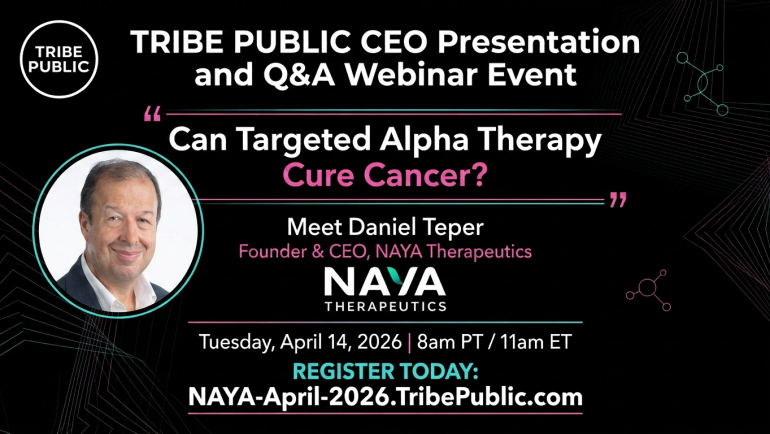
Tribe Public Hosts Exclusive CEO Event: “Can Targeted Alpha Therapy Cure Cancer?”

In the ever-evolving world of oncology innovation, a bold question is being asked: “Can Targeted Alpha Therapy Cure Cancer?” That’s the headline theme of Tribe Public’s next CEO Presentation and Q&A Webinar, scheduled for Tuesday, April 14, 2026, at 8 a.m. PT / 11 a.m. ET.

A 30-Minute Power Session with NAYA Therapeutics CEO

Known for curating short, focused, and insight-rich sessions, Tribe Public’s events draw institutional and retail investors eager to hear directly from leaders redefining the boundaries of medicine. Tomorrow’s agenda features Daniel Teper, Founder and Chief Executive Officer of NAYA Therapeutics, who will deliver a 20-minute presentation followed by a 5–10-minute live Q&A.

Attendees can submit questions in advance to research@tribepublic.com or drop them directly into the Zoom chat during the session — ensuring that even from behind a screen, participation is anything but passive.

Unlocking Cancer’s “Finish Line”

NAYA Therapeutics is at the forefront of biotechnology’s most promising frontier: Targeted Alpha Therapy (TAT). The company’s therapeutic platform harnesses the rare radioisotope Astatine-211 (²¹¹At)—renowned for its potent alpha emissions and short biological half-life—to attack cancer cells with precision while sparing healthy tissue.

Coupled with NK-cell-engaging bifunctional antibodies, NAYA’s approach is designed to deliver deep, durable cures against aggressive cancers such as hepatocellular carcinoma (HCC) and multiple myeloma. Teper’s mission is straightforward yet profound: give patients not just therapy, but closure—the kind that comes when cancer’s fight is truly finished.

Securing the Critical Supply Chain for Astatine-211

In a field where innovation often collides with logistics, NAYA Therapeutics has taken a strategic step that sets it apart: securing a reliable and scalable supply chain for Astatine-211.

This rare isotope—produced in limited quantities through specialized cyclotron facilities—has historically represented a major bottleneck for companies advancing targeted alpha therapy programs. NAYA’s team recognized early that no breakthrough could succeed without dependable access to this essential ingredient.

To address this, the company established long-term partnerships with high-capacity isotope production sites in North America, providing consistent supply for both preclinical and early clinical programs. This proactive move not only de-risks operational execution but also signals to investors that NAYA is building a foundation for sustainable growth—not just scientific headlines.

As CEO Daniel Teper notes, control of the supply chain isn’t merely a logistical win; it’s a strategic moat. By ensuring consistent isotope availability, NAYA positions itself to accelerate clinical timelines and maintain a competitive advantage as the TAT field matures.

Where Wall Street Meets Science

In a biotech market buzzing with radiopharmaceutical momentum, Targeted Alpha Therapystands out as one of the fastest-growing investment themes. With supply stability now secured and a focus on “finish-line” treatments, NAYA is emerging as a key player poised to transform how advanced cancers are treated—and how investors evaluate innovation risk.

Tribe Public’s 30-minute webinar series continues to bridge the gap between Wall Street insight and breakthrough science, offering investors a front-row seat to what could be the next major inflection point in oncology.

How to Join the Conversation

Registration for tomorrow’s event is open at TribePublic.com. By signing up, participants automatically join Tribe Public’s network, receiving exclusive invitations to future CEO presentations and investor forums.

For more information about NAYA Therapeutics and its pioneering work in targeted alpha therapies, visit www.nayatx.com.

Tomorrow’s event may only last 30 minutes—but given the company’s science, foresight, and supply-chain execution, those 30 minutes may reveal a blueprint for how the next generation of cancer cures gets delivered, atom by atom.

April 13, 2026 – Wall Street’s Hormuz Hoedown: How The US Blockade Ended in a Buy-the-Dip Ball -( $AVGO $EPRX $GOVX $INTG $MTWO $NOK $NVDA $OPEN $VISN Rise!)

US stocks finished Monday sharply higher after a powerful intraday reversal, as investors looked past President Trump’s surprise order to blockade the Strait of Hormuz and rotated aggressively back into risk.

Index performance (closing levels)

  • Dow Jones Industrial Average (48,218.25, +.63%): Rebounded from early steep losses to close significantly higher, finishing the day up near the low‑single‑digit percentage range as industrials and financials helped drive a forceful afternoon squeeze.
  • S&P 500 (6,886.24, +1.02%): Ripped from red to green to end approx. 1% higher, with a solid multi‑percent advance that underscored broad‑based dip‑buying and renewed confidence in large‑cap US equities despite the geopolitical shock.
  • Nasdaq Composite (23,183.74, +1.23%): Led the move, closing the session with a strong gain as mega‑cap tech and software names powered a robust risk‑on surge into the bell, reclaiming leadership after the morning’s geopolitically driven selloff.
  • Russell 2000: The small‑cap gauge also finished 1.52% higher to close at 2,670.49, participating in the reversal as risk appetite broadened beyond mega‑caps.

Macro and geopolitics

  • Hormuz blockade: The day began with risk assets under pressure after Trump ordered a US naval blockade of the Strait of Hormuz following failed talks with Iran, briefly raising fears of a major supply‑side oil shock and a wider regional conflict.
  • Market interpretation: As the session progressed, traders increasingly framed the move as a contained escalation rather than an immediate path to war, betting that diplomacy and economic self‑interest would eventually limit disruption and that the underlying US growth story remained intact.

Commodities and rates

  • Oil ($97.99/bbl, +1.47%): Crude spiked on the blockade headlines as markets priced in potential shipping disruptions, but later backed off its intraday extremes as equities recovered and traders reassessed worst‑case scenarios.
  • Gold (4,764.10, -.49%): After benefiting from a safety bid earlier in the episode, gold surrendered part of that premium as the equity rally and improved risk sentiment reduced the urgency for defensive positioning.
  • Yields: The 10-yr Treasury yield drifted lower into the close at 4.29%.

Sector and style moves

  • Tech / growth: Tech was the engine of the reversal, with mega‑cap platforms, chips, and software attracting heavy inflows as investors leaned back into secular growth and AI‑linked stories.
  • Cyclicals and financials: Financials, industrials, and other cyclicals joined the afternoon rally, helped by higher yields and the view that the US economy can absorb a higher‑oil backdrop without immediately sliding toward recession.
  • Energy: Energy stocks rallied alongside crude but ultimately lagged the most explosive parts of tech by the close, as traders weighed windfall‑profit potential against headline‑driven volatility and policy risk.

VP Watchlist Updates

Below is an update‑style snapshot on the VP Watchlist names for the week, focused on recent catalysts, positioning, and narrative rather than precise price moves.

Broadcom (AVGO, $379.75, +2.21%)

Broadcom’s latest AI alliance with Google parent Alphabet Inc. (GOOGL, GOOG) and Anthropic is less a routine chip deal and more a declaration that the quiet power behind the cloud plans to stay loud for the next decade. The three-way pact locks in custom AI silicon and multi‑gigawatt compute capacity that could reshape who really controls the tollbooths on the generative AI superhighway.

Eupraxia Pharmaceuticals (EPRX, $7.18, +4.86%)

Eupraxia Pharmaceuticals Inc. (“Eupraxia” or the “Company”), a clinical-stage biotechnology company leveraging its proprietary Diffusphere™ technology designed to optimize local, controlled drug delivery for applications with significant unmet need, co-hosted a Tribe Public www.TribePublic.com, CEO Presentation & Q&A Webinar event, Wednesday, April 1 titled “Turning EOE Into a Once-a-Year Appointment.” The event featured James A. Helliwell, M.D., Co‑founder and CEO of Eupraxia Pharmaceuticals (NASDAQ: EPRX), who discusses the company’s precision drug‑delivery platform, its approach to Eosinophilic Esophagitis (EoE), and broader pipeline priorities, followed by a focused 5–10 minute Q&A. You may watch it now at this Youtube link.

Eupraxia announced (March 17) positive symptom data from patients in the two highest dose cohorts from its ongoing Phase 1b/2a part of the RESOLVE trial evaluating EP-104GI for the treatment of eosinophilic esophagitis (“EoE”). “We are very pleased to see such a meaningful symptom response at 24 weeks in the highest dose of the Phase 1b/2a portion of the RESOLVE study,” said Dr. James A. Helliwell, Chief Executive Officer of Eupraxia. “We believe this type of response based on a single administration procedure would represent a compellingly different option for EoE patients. Importantly, the response that we are observing across cohorts 4-9 has increased as patients progress through the study through to week 24. We believe this demonstrates the importance of stable, continuous long-term local steroids in tamping down signs of inflammation quickly and acting on fibrosis in the longer term. Also, as previously reported, we continue to be encouraged by the safety profile that we have observed with EP-104GI. Currently, with 31 patients dosed in the Phase 1b/2a study, and over 220 months of follow up, there have been no reported serious adverse events.”

Modular Medical (MODD, $4.49)

  • Modular Medical’s latest regulatory milestone upgrades the narrative: the company has now secured FDA 510(k) clearance for its Pivot tubeless insulin patch pump, moving from “launch‑ready” to “launch‑approved” in the heart of the fast‑growing diabesity market. The FDA has cleared Modular Medical’s Pivot patch pump as a tubeless, removable insulin delivery system, formally validating the device’s design and performance for commercial use in U.S. adults living with diabetes. The clearance converts what had been a Q1 2026 launch “subject to FDA response” into a tangible commercial pathway, giving the company permission to sell into an insulin pump market that has been estimated at roughly 8 billion dollars globally. Pivot is engineered as a simplified, two‑part patch pump with a 3‑milliliter removable reservoir, no need for battery recharging, and the ability to bolus without a dedicated controller, aiming squarely at patients who have stayed on multiple daily injections because traditional pumps felt too complex, cumbersome, or costly. By clearing Pivot, the FDA is effectively endorsing Modular Medical’s attempt to make advanced insulin delivery feel less like adopting a gadget and more like upgrading a daily habit.

The InterGroup Corporation (INTG, $35.10, +2.33%)

  • InterGroup Corporation delivered (Feb. 17) a notably stronger quarter, highlighted by a 20% jump in total revenue to $17.3 million and a 27% surge in hotel revenue as renovated rooms returned to service and travel demand improved. The company swung from a prior-year net loss to $1.0 million in net income, with operating income more than doubling to $2.0 million, underscoring better cost control and improved operating efficiency. Management further enhanced liquidity and sharpened strategic focus by selling a non-core 12‑unit Los Angeles multifamily property, generating a meaningful gain and additional working capital while maintaining stable performance across its real estate portfolio.

Volato Group, Inc. (SOAR) & M2i Global, Inc. (MTWO, +15.71%)

NVIDIA (NVDA, $189.31, +.30%) (NOK, $10.37, +9.62%)

  • On April 13, Vistance Networks (NASDAQ: VISN, $19.30, +1.74%), a global provider of intelligent network solutions, today shared that RUCKUS® Networks and Nokia announced early access availability to a combined solution, allowing customers to accelerate adoption of their integrated Wi-Fi 7 and Fiber Optical Lan Solution.
  • In an AI market obsessed with GPUs and stardust, Nokia (NOK) is quietly reminding investors that none of this magic moves without serious plumbing. While Nvidia (NVDA) prepares to headline its GTC 2026 “Woodstock of AI” showcase, the chip giant has already written a very real check to Nokia, committing a $1 billion investment to help rewire the world’s networks for 5G‑Advanced, 6G, and AI‑native workloads. The message is simple enough: GPUs may be the new rock stars, but networking is the stadium.
  • Nvidia delivered strong fourth-quarter results recently, posting revenue of $68.1 billion, well above analyst expectations. Looking ahead, the company projects $7.8 billion in revenue for the first quarter of 2026, reflecting continued robust demand for its AI chips even amid broader market headwinds.
  • NVIDIA and Nebius Group N.V. (NASDAQ: NBIS) (March 11) announced a strategic partnership to develop and deploy the next generation of hyperscale cloud for the AI market, from AI natives to enterprises. NVIDIA will invest $2 billion in Nebius.

McDonald’s (MCD, $304.51)

Opendoor (OPEN, $4.36, +.93%)

Tesla (TSLA, $348.95)

Elon Musk’s latest Texas-sized ambition is to build his own AI chip empire, and this time the factory floor will sit right next to the robots, rockets, and robotaxis that plan to use it. The Terafab project, a new semiconductor venture linking Tesla (TSLA), SpaceX, and xAI in Austin, aims to churn out custom chips for AI, humanoid robots, and space systems at a scale that makes today’s GPU land rush look like a warm‑up act. Learn more here.

There are open secrets on Wall Street, and then there is SpaceX’s long‑anticipated march toward the public markets, now reportedly via a confidential filing with the SEC that could set up a June debut. For a company that routinely broadcasts rockets into orbit, it is taking a decidedly hush‑hush approach to its paperwork

Serina Therapeutics (NYSE: SER, $1.96)

Serina Therapeutics (NYSE: SER) (www.serinatx.com) seems to have have just traded itself into Wall Street’s good graces, pairing fresh capital with a late-session pop that suggests investors are finally starting to connect the dots between polymer chemistry and portfolio returns. In Huntsville, Alabama, Serina Therapeutics announced definitive agreements for a private placement of common stock and pre-funded warrants that could bring in up to 30 million dollars in gross proceeds. The first 15 million dollar tranche is expected to close on March 20, 2026, with a second tranche of up to 15 million dollars anticipated by April 30, 2026, subject to customary closing conditions.

What makes the deal stand out in a biotech tape crowded with discounts is the pricing: the securities are being sold at about 2.25 dollars per share, a roughly 68 percent premium to Serina’s March 17 closing price, signaling that insiders are willing to pay up for exposure to the company’s clinical agenda. The financing also adds board-level heft, with director Greg Bailey, M.D., stepping into a Co-Chairman role as he leads the investment, a move that effectively puts the capital and the governance on the same optimistic page. Learn more here.

GeoVax Labs (GOVX, $1.28, +4.07%)

The Sources

  1. Yahoo Finance – “Why is S&P 500 and US Stocks Reacting Positively to Trump’s Hormuz Blockade?”
    https://finance.yahoo.com/markets/stocks/articles/why-p-500-us-stocks-154324275.htmlfinance.yahoo
  2. Yahoo Finance – “Stock market today: Dow, S&P 500, Nasdaq edge higher as Trump orders Hormuz blockade against Iran” (live blog)
    https://finance.yahoo.com/news/live/stock-market-today-dow-sp-500-nasdaq-mixed-after-trump-orders-hormuz-blockade-against-iran-145712025.htmlfinance.yahoo
  3. Yahoo Finance – “Dow, S&P 500, Nasdaq futures slide after Iran war talks fail, Trump orders Hormuz blockade”
    https://finance.yahoo.com/news/live/stock-market-today-dow-sp-500-nasdaq-futures-slide-after-iran-war-talks-fail-trump-orders-ho-145712025.htmlfinance.yahoo
  4. Trading Economics – “United States Stock Market Index”
    https://tradingeconomics.com/united-states/stock-markettradingeconomics
  5. CME Group – “April Gold futures reached a record weekly high close”
    https://www.cmegroup.com/videos/2026/02/13/april-gold-futures-reached-a-record-weekly-high-close-2-13-26.htmlcmegroup
  6. FXStreet – “Gold falls to near $4650 as Oil surge, US–Iran tensions hit Fed cuts”
    https://www.fxstreet.com/news/gold-falls-to-near-4-650-as-oil-surge-us-iran-tensions-hit-fed-cuts-202604130001fxstreet
  7. Fortune – “Current price of oil as of April 10, 2026”
    https://fortune.com/article/price-of-oil-04-10-2026/fortune
  8. CNBC – “Market Open: April 13, 2026”
    https://www.cnbc.com/video/2026/04/13/market-open-april-13-2026.htmlcnbc
  9. Wall Street Journal – “S&P 500 Index Price & News – SPX (Historical Prices)”
    https://www.wsj.com/market-data/quotes/index/SPX/historical-priceswsj
  10. MarketWatch – “Russell 2000 Index Overview – RUT”
    https://www.marketwatch.com/investing/index/rutmarketwatch
  11. Barchart – “Russell 2000 Micro Jun ’26 Futures Price (RXM26)”
    https://www.barchart.com/futures/quotes/RXM26barchart

Three Market Villains Walk Into a Year: Guess Who’s Back -( $DIA $SPY $QQQ $VIX )

History may not repeat, but when markets stumble badly it does tend to recycle the same culprits. Over the last century, the ugliest calendar‑year stock market losses have usually traced back to one of three forces: recessions, inflation or interest‑rate shocks, and policy or geopolitical crises. In many downturns, investors only have to deal with one or two of those at a time, which markets can often muddle through with sharp but temporary dislocations. The truly painful episodes are the rarer ones when all three turn up at once and start reinforcing one another rather than offsetting the damage. That is the uncomfortable rhyme with today’s tape: each of those classic triggers is back in view, and they are no longer politely taking turns.

Three triggers, one uneasy backdrop

The first suspect is growth. While economists are still debating whether the US is heading for a formal recession or just a slowdown with a bad attitude, tighter financial conditions are clearly doing some work. Higher borrowing costs, more selective credit, and a cooler funding environment have started to pinch everything from small‑business hiring plans to parts of the consumer and housing complexes. Earnings expectations have held up reasonably well so far, but forward guidance has taken on a more cautious tone, and management teams sound far less certain that demand will stay bulletproof if rates stay elevated.

The second suspect is inflation—and its close cousin, interest‑rate risk. After investors spent much of the past year celebrating the prospect of imminent rate cuts, a string of sticky inflation readings has reminded markets that central banks do not get to declare victory just because everyone is bored of talking about prices. War‑driven energy costs are adding another layer of complication, with oil and refined products periodically spiking as the Iran conflict and broader Middle East tensions rumble on. Higher energy feeds into headline inflation and, more importantly, inflation expectations, forcing policymakers to keep the “higher for longer” option on the table. That is not the backdrop in which valuations get the benefit of the doubt.

The third suspect is policy and geopolitics. The US‑Iran conflict and its spillover effects on global trade routes, shipping insurance, and regional alliances have turned the geopolitical map into a live‑fire risk‑management exercise. Markets can live with bad news; what they hate is the combination of incomplete information and high escalation risk. Each new headline about ceasefires, strikes, or diplomatic flare‑ups pushes traders to re‑price not just energy and defense names, but risk appetite across the board. Layer on election calendars, shifting regulatory regimes, and policy debates over everything from capital requirements to tech antitrust, and “policy risk” starts to look less like a tail event and more like daily weather.

When all three of these forces line up, the result is a kind of cross‑asset stress test in real time. It is not just equities that feel the strain; bonds, gold, and even crypto have shown flashes of discomfort as investors try to hedge, de‑risk, and opportunistically buy the dip—often all in the same week. Correlations that were supposed to provide comfort can suddenly move toward one, and carefully constructed diversification stops working quite as well as the sales pitch suggested, at least temporarily.

Risk management, not surrender

The fact that all three triggers are “on” does not guarantee a deep bear market, but it does argue for more deliberate risk management. This is less a moment for drama than for discipline. For equity investors, that can mean revisiting how much of the portfolio is riding on the most speculative growth stories, particularly those whose valuations were built on a world of near‑free money. Stress‑testing positions against further rate back‑ups, wider credit spreads, or another leg higher in volatility is no longer a theoretical exercise; it is basic hygiene. It also means making sure liquidity needs are covered so that a spell of turbulence does not force sales at the worst possible time.

For diversified allocators, the toolkit is broader but the questions are similar. What role should cash and short‑duration bonds play as shock absorbers if both stocks and longer‑dated bonds come under pressure? Are defensive equity sectors still doing their job, or have they quietly morphed into crowded trades with less protection than advertised? Does the portfolio still reflect a conscious view on risk, or has it drifted into something more accidental over the last decade of falling rates and rising multiples?

The awkward truth is that managing through this kind of backdrop requires a higher tolerance for headline noise than most people find comfortable. But history also suggests that elevated volatility and rising risk premiums have a habit of leaving behind attractive entry points for investors who can tell the difference between cyclical drawdowns and permanent impairment. Periods when everyone suddenly remembers the three classic triggers are often the same periods when strong balance sheets, durable cash flows, and sensible valuations quietly go on sale. Using that window to upgrade quality—rather than simply shrink exposure—can pay off when the pressure eventually eases.

Why it matters

With the three traditional drivers of big market losses—recession risk, inflation and rate anxiety, and geopolitical or policy shocks—all flashing at once, this is a time to tighten risk management and sharpen security selection, not to assume that yesterday’s playbook will work on autopilot. Investors who stay level‑headed, focus on fundamentals, and treat volatility as a tool rather than a verdict will be better positioned if, as history often shows, the triggers eventually fade instead of compound.

Sources

From Frontier Models to Sovereign Minds: CoreWeave, Anthropic, and the Rise of Seven Boson Group -( $CRWV $IBM $META $NVDA )

CoreWeave’s latest surge on Wall Street looks less like a meme-fueled sugar high and more like a carefully plated AI main course, with Anthropic now added as the house special and sovereign-focused players like Seven Boson Group quietly setting the table for what comes next.

CoreWeave’s 13% Jolt: AI Infrastructure Gets a Headliner

CoreWeave shares climbed about 13% after the AI cloud specialist unveiled a multi-year infrastructure deal to power Anthropic’s Claude models at production scale. The agreement positions CoreWeave as a core compute supplier behind one of the most closely watched AI labs, even as Anthropic experiments with its own chip strategy to navigate an ongoing GPU shortage.

Financial terms remain under wraps, which in today’s AI market roughly translates to “large enough to brag about, sensitive enough to redact.” What is clear is that workloads are expected to ramp in phases, leaving room for the contract—and Wall Street expectations—to grow over time.

From Niche Cloud to “Essential Cloud for AI”

CoreWeave has spent the past few years evolving from a niche GPU cloud upstart into what it now brands as “The Essential Cloud for AI.” The company runs a growing network of U.S. data centers, backed by hundreds of thousands of GPUs and roughly 1.3 gigawatts of contracted power—figures that make it look as much like a specialized utility as a traditional software name.

That infrastructure is translating into sizable revenue: CoreWeave generated about 5.13 billion dollars in 2025, up roughly 168% year over year, and is guiding to more than 12 billion dollars in 2026, supported by a contracted backlog north of 66 billion dollars. In other words, this is no longer a story about renting a few spare GPUs by the hour; it is about locking in long-duration, AI-native infrastructure cash flows.

Nine Out of Ten Model Makers Prefer…

With Anthropic now on board, CoreWeave says nine of the world’s top ten AI model providers are using its platform. The roster reads like the AI equivalent of a tech conference keynote schedule: Microsoft, Meta, OpenAI, Mistral, Cohere, IBM, Anthropic, and even Nvidia itself, plus additional capacity that Microsoft can sub-lease to other clients.

Ironically, Anthropic’s own infrastructure map now includes AWS, Google Cloud, Broadcom-powered TPUs, and CoreWeave—an impressive constellation for a company that is simultaneously exploring custom chips in the name of long-term independence. For now, though, Anthropic’s route to AI autonomy still runs through a very crowded data center parking lot.

Meta, OpenAI, and the Art of Diversification

The Anthropic deal did not arrive in a vacuum; it landed less than 24 hours after CoreWeave and Meta expanded their relationship into a 21 billion dollar, multi-year AI infrastructure commitment running through 2032. Earlier this year, CoreWeave also expanded its agreement with OpenAI by as much as 6.5 billion dollars, further thickening the pipeline of contracted workloads.

Until recently, Microsoft made up roughly two-thirds of CoreWeave’s revenue, a concentration risk that tended to make investors sit up straighter in their chairs. By adding marquee customers like Meta, OpenAI, and now Anthropic, the company is attempting a classic Wall Street maneuver: turning “key-man risk” into a platform story before the market finishes its coffee.

The New AI Supply Chain: Chips, Power, and Patience

At the heart of all this sits a simple bottleneck: there are not enough high-end AI chips or power-dense data centers to satisfy current demand. Anthropic’s recent agreement with Google and Broadcom, which includes plans for multi-gigawatt compute capacity and tens of billions of dollars in U.S. infrastructure investment, underscores just how capital-intensive next-generation AI is becoming.

CoreWeave, for its part, recently raised billions in GPU-backed financing, using long-term AI infrastructure contracts—such as its Meta relationship—as collateral, effectively securitizing future AI workloads the way prior eras securitized mortgages. For investors, the question is whether such leverage will look prescient or premature once the AI cycle inevitably trades euphoric narratives for old-fashioned cash-flow math.

Enter Seven Boson Group: Sovereign-Grade AI Infrastructure

While CoreWeave and Anthropic are busy rewriting the script for hyperscale AI infrastructure, Seven Boson Group is quietly carving out a complementary niche: sovereign-grade AI and automated decision-intelligence platforms for nations and large enterprises. The firm describes itself as focused on “sovereign AI,” building systems that keep critical data, models, and infrastructure under tight local control.

Where CoreWeave offers large-scale cloud capacity to frontier model labs, Seven Boson is effectively pitching the “on-shore, locked-door” option for governments and critical institutions that cannot afford to outsource too much sovereignty along with their compute. Its work centers on AI deployments that run in-country or in highly controlled environments, emphasizing security, compliance, and data residency from the start.

Clean Power, Critical Sectors, and Policy-First Design

Seven Boson’s platform is explicitly tied to clean-energy, AI-optimized data centers, making decarbonization part of the core infrastructure thesis rather than a line item in an ESG slide deck. If CoreWeave touts gigawatts of contracted power to feed GPU-hungry models, Seven Boson leans into “green power & compute infrastructure,” aimed at governments and institutions that want AI capacity without compromising energy security.

The group’s sector focus reads like a regulator’s worry list: cyber defense, healthcare, finance, communications, education, and transportation. That puts it squarely in the business of systems regulators label “critical” long before investors label them “high growth”—the sort of deployments where the RFP is written jointly by CIOs, defense ministries, and central banks.

Leadership Tuned to Sovereign-Scale AI

Seven Boson is led by founder and CEO Chet White, who also serves as managing general partner and emphasizes multi-billion-dollar AI infrastructure as part of the group’s mandate. His background spans sovereign-focused AI, healthcare platforms, and capital markets, aligning neatly with the company’s “nation-scale first, everything else second” narrative.

For investors reading the CoreWeave–Anthropic move as just a one-day stock pop, Seven Boson’s positioning hints at a parallel build-out in AI infrastructure: one where the key customer is not the next foundation model lab, but the next government looking to ring-fence its critical decision systems.

From Frontier Labs to Sovereign Labs

Taken together, CoreWeave’s deepening ties to Anthropic and Meta and Seven Boson Group’s sovereign-AI focus sketch a broader AI infrastructure map than any single headline can capture. On one side are frontier model providers racing for scale across multiple clouds; on the other, sovereign platforms making the case that some AI systems should never leave the jurisdiction they serve.

Friday’s rally in CoreWeave thus reflects more than a headline-friendly partnership; it is a vote of confidence that specialized infrastructure providers can convert GPU scarcity into diversified, durable economics while new players like Seven Boson quietly argue that in the age of AI, sovereignty is as much about compute as it is about constitutions. The next phase of the market may hinge on a subtle but consequential question: which layers of the AI stack will be freely traded on Wall Street—and which will be quietly walled off behind sovereign AI strategies that never make it into an earnings call.

The Sources


[1] CoreWeave stock soars 13% on Anthropic deal – Yahoo Finance https://finance.yahoo.com/sectors/technology/article/coreweave-stock-soars-13-on-anthropic-deal-141357680.html
[2] Tech stocks today: CoreWeave climbs 13% on Anthropic deal … https://finance.yahoo.com/sectors/technology/article/tech-stocks-today-coreweave-climbs-13-on-anthropic-deal-tsmc-q1-revenue-soars-35-144220040.html
[3] CoreWeave Announces Multi-Year Agreement With Anthropic https://www.businesswire.com/news/home/20260410890996/en/CoreWeave-Announces-Multi-Year-Agreement-With-Anthropic
[4] CoreWeave signs multi-year Anthropic deal as nine of ten top AI … https://thenextweb.com/news/coreweave-has-agreed-a-multi-year-gpu-cloud-deal-with-anthropic-to-power-claude-at-production-scale-its-second-major-ai-infrastructure-announcement-in-48-hours
[5] CoreWeave adds another AI model provider with Anthropic Claude … https://www.cnbc.com/2026/04/10/coreweave-anthropic-claude-ai-deal.html
[6] About – Seven Boson Group https://sevenbosongroup.com/about/
[7] Seven Boson Group https://sevenbosongroup.com
[8] AI research lab Anthropic announced a new agreement with Google … https://www.instagram.com/p/DW3kXcwjW7p/
[9] Anthropic ups compute deal with Google and Broadcom amid … https://techcrunch.com/2026/04/07/anthropic-compute-deal-google-broadcom-tpus/
[10] Tech stocks today: Meta, CoreWeave agree to $21 billion deal https://finance.yahoo.com/sectors/technology/article/tech-stocks-today-meta-coreweave-agree-to-21-billion-deal-144220717.html
[11] Platform – Seven Boson Group https://sevenbosongroup.com/platform/
[12] Chet White – Founder & CEO, Seven Boson | AI World Lab – LinkedIn https://www.linkedin.com/in/chet-white

April 10, 2026 – From War Jitters to Winning Streaks: Why April’s Market Tape Deserves an Emmy -( $AVGO $MTWO NOK $NVDA $SOAR Rise!)

US stocks logged a second straight winning week in the five days ending Friday, April 10, 2026, as investors digested a hot March CPI print, volatile oil, and fragile U.S.–Iran ceasefire headlines while keeping risk appetite intact.

Index performance

  • The S&P 500 rose a bit more than 3% for the week, notching its strongest back‑to‑back weekly gains since late 2024.
  • The Dow Jones Industrial Average also advanced over 3% on the week, even as it finished Friday down about 0.6% after the CPI release.
  • The Nasdaq Composite gained roughly 4% for the week and closed Friday higher by about 0.4%, extending a powerful multi‑day tech rally.
  • The Russell 2000 slipped about 0.2% on Friday to 2,630.59, but small caps still held onto a solid weekly advance of around 3% in the wake of their strong early‑2026 run.

Inflation, Fed, and bonds

  • March CPI came in at a 0.9% month‑over‑month gain and 3.3% year‑over‑year, the hottest annual reading since 2024 and driven largely by gasoline.
  • Despite the upside surprise versus recent months, markets took the data in stride because it broadly matched expectations and showed limited spillover beyond energy.
  • Treasury yields were choppy but ended the week modestly higher, as traders trimmed the number of 2026 Fed cuts they expect while still leaning toward a soft‑landing narrative.

Oil, geopolitics, and commodities

  • Oil prices were volatile but ultimately fell sharply on the week, with U.S. crude sliding about 13% to the mid‑90s per barrel, its steepest weekly drop since 2020.finance.
  • The pullback reflected hopes that upcoming U.S.–Iran talks in Islamabad and parallel diplomacy involving Israel and Lebanon could stabilize the ceasefire and reopen the Strait of Hormuz.
  • Gold ($4,771/oz.) extended a multi‑week advance as investors maintained defensive hedges against both inflation and geopolitical risk, even as equities rallied.

Sector and thematic moves

  • Technology and communication services once again led the tape, with chipmakers and AI‑linked names benefiting from both lower oil and the prospect of sustained capital spending.
  • Cyclicals such as industrials and materials participated in the advance, aided by improving sentiment around global growth and the possibility of reduced Middle East supply shocks.
  • Energy stocks lagged the broader market as crude’s double‑digit weekly decline pressured recent high‑flyers, even though the underlying geopolitical backdrop remained tense.

Market tone and positioning

  • The overarching narrative shifted from “war rally” to “data‑and‑policy balancing act,” with investors weighing hot inflation against still‑resilient growth and an active diplomatic track in the Middle East.
  • Positioning data and price action suggested a mix of short‑covering, systematic buying, and renewed discretionary interest in large‑cap growth, with small caps and the Russell 2000 consolidating after outsized early‑year gains.markets.
  • Heading into mid‑April, the market sits on improved technical footing but remains highly sensitive to incremental Iran headlines, the next inflation prints, and any Fed guidance that might follow the March CPI surprise.

VP Watchlist Updates

Below is an update‑style snapshot on the VP Watchlist names for the week, focused on recent catalysts, positioning, and narrative rather than precise price moves.

Broadcom (AVGO, $354.91, +8.46% over the last 5-days)

Broadcom’s latest AI alliance with Google parent Alphabet Inc. (GOOGL, GOOG) and Anthropic is less a routine chip deal and more a declaration that the quiet power behind the cloud plans to stay loud for the next decade. The three-way pact locks in custom AI silicon and multi‑gigawatt compute capacity that could reshape who really controls the tollbooths on the generative AI superhighway.

Eupraxia Pharmaceuticals (EPRX, $6.86)

Eupraxia Pharmaceuticals Inc. (“Eupraxia” or the “Company”), a clinical-stage biotechnology company leveraging its proprietary Diffusphere™ technology designed to optimize local, controlled drug delivery for applications with significant unmet need, co-hosted a Tribe Public www.TribePublic.com, CEO Presentation & Q&A Webinar event, Wednesday, April 1 titled “Turning EOE Into a Once-a-Year Appointment.” The event featured James A. Helliwell, M.D., Co‑founder and CEO of Eupraxia Pharmaceuticals (NASDAQ: EPRX), who discusses the company’s precision drug‑delivery platform, its approach to Eosinophilic Esophagitis (EoE), and broader pipeline priorities, followed by a focused 5–10 minute Q&A. You may watch it now at this Youtube link.

Eupraxia announced (March 17) positive symptom data from patients in the two highest dose cohorts from its ongoing Phase 1b/2a part of the RESOLVE trial evaluating EP-104GI for the treatment of eosinophilic esophagitis (“EoE”). “We are very pleased to see such a meaningful symptom response at 24 weeks in the highest dose of the Phase 1b/2a portion of the RESOLVE study,” said Dr. James A. Helliwell, Chief Executive Officer of Eupraxia. “We believe this type of response based on a single administration procedure would represent a compellingly different option for EoE patients. Importantly, the response that we are observing across cohorts 4-9 has increased as patients progress through the study through to week 24. We believe this demonstrates the importance of stable, continuous long-term local steroids in tamping down signs of inflammation quickly and acting on fibrosis in the longer term. Also, as previously reported, we continue to be encouraged by the safety profile that we have observed with EP-104GI. Currently, with 31 patients dosed in the Phase 1b/2a study, and over 220 months of follow up, there have been no reported serious adverse events.”

Modular Medical (MODD, $4.91)

  • Modular Medical’s latest regulatory milestone upgrades the narrative: the company has now secured FDA 510(k) clearance for its Pivot tubeless insulin patch pump, moving from “launch‑ready” to “launch‑approved” in the heart of the fast‑growing diabesity market. The FDA has cleared Modular Medical’s Pivot patch pump as a tubeless, removable insulin delivery system, formally validating the device’s design and performance for commercial use in U.S. adults living with diabetes. The clearance converts what had been a Q1 2026 launch “subject to FDA response” into a tangible commercial pathway, giving the company permission to sell into an insulin pump market that has been estimated at roughly 8 billion dollars globally. Pivot is engineered as a simplified, two‑part patch pump with a 3‑milliliter removable reservoir, no need for battery recharging, and the ability to bolus without a dedicated controller, aiming squarely at patients who have stayed on multiple daily injections because traditional pumps felt too complex, cumbersome, or costly. By clearing Pivot, the FDA is effectively endorsing Modular Medical’s attempt to make advanced insulin delivery feel less like adopting a gadget and more like upgrading a daily habit.

The InterGroup Corporation (INTG, $34.30)

  • InterGroup Corporation delivered (Feb. 17) a notably stronger quarter, highlighted by a 20% jump in total revenue to $17.3 million and a 27% surge in hotel revenue as renovated rooms returned to service and travel demand improved. The company swung from a prior-year net loss to $1.0 million in net income, with operating income more than doubling to $2.0 million, underscoring better cost control and improved operating efficiency. Management further enhanced liquidity and sharpened strategic focus by selling a non-core 12‑unit Los Angeles multifamily property, generating a meaningful gain and additional working capital while maintaining stable performance across its real estate portfolio.

Volato Group, Inc. (SOAR, +19.87%) & M2i Global, Inc. (MTWO, +23.02%) over the last 5-days

  • flyExclusive (NYSE American: FLYX), the vertically integrated private aviation company, announced (March 25) two milestones in its proprietary technology development: the filing of a utility patent application for a novel aircraft schedule optimization architecture, and the availability of Contrails, its Flight Management System, to other Part 135 operators beginning in Q2 2026. Both announcements coincide with the company’s presence at the NBAA Schedulers & Dispatchers Conference 2026 in Cleveland. “We have spent years building flyExclusive into one of the most operationally capable private aviation companies in the country. Contrails is how we make that expertise available to the broader industry—and the intellectual property behind it reflects the depth of investment we have made in solving problems that matter to every serious operator. We believe the right technology, built by people who actually run flights, changes what is possible in this industry. Today we are unable to source lift for nearly 300 trip requests per day. We believe Contrails will allow us to address that demand far more efficiently—both within our own operation and through coordination with other operators—and that represents a material revenue opportunity for flyExclusive and for all participating operators.”
  • Volato Group, Inc. announced (March 10) that it has entered into an amendment to its Aircraft Management Services Agreement with flyExclusive, Inc. (“FLYX”) providing for the sale of certain legacy intellectual property assets. The agreement provides for consideration valued at approximately $1.3 million, payable in FLYX Class A common stock, subject to customary conditions. The assets relate to legacy intellectual property developed during earlier stages of the Company’s technology initiatives and are not part of Volato’s current operating platforms. Volato continues to evaluate opportunities to streamline its asset base and focus resources on strategic priorities, including the continued development of its core software platforms and the pending business combination with M2i Global, Inc.
  • Volato and M2i Global reaffirmed their goal of closing their business combination in the first quarter of 2026, citing steady advancement through SEC review and integration planning as they move toward a combined listing. The deal, originally announced in 2025, will effectively transition Volato from a pure‑play private aviation operator into a diversified platform spanning aviation technology and critical minerals, with M2i shareholders expected to own the majority of the combined entity. Operationally, the partnership is already visible: the two companies recently initiated their first shipment of titanium ore from Western Australia to the United States from Titanium X, underscoring how the critical‑minerals vertical could become a meaningful growth engine as domestic supply‑chain security rises in strategic importance.
  • On Feb. 4, M2i Global,Inc.along with Volato Group, Inc. announced that Titanium X has initiated its first shipment of titanium ore from Western Australia to the U.S. under its collaboration agreement.

NVIDIA (NVDA, $183,91, +6.34%) (NOK, $9.46, +7.26%) over the last 5-days

  • In an AI market obsessed with GPUs and stardust, Nokia (NOK) is quietly reminding investors that none of this magic moves without serious plumbing. While Nvidia (NVDA) prepares to headline its GTC 2026 “Woodstock of AI” showcase, the chip giant has already written a very real check to Nokia, committing a $1 billion investment to help rewire the world’s networks for 5G‑Advanced, 6G, and AI‑native workloads. The message is simple enough: GPUs may be the new rock stars, but networking is the stadium.
  • Nvidia delivered strong fourth-quarter results recently, posting revenue of $68.1 billion, well above analyst expectations. Looking ahead, the company projects $7.8 billion in revenue for the first quarter of 2026, reflecting continued robust demand for its AI chips even amid broader market headwinds.
  • NVIDIA and Nebius Group N.V. (NASDAQ: NBIS) (March 11) announced a strategic partnership to develop and deploy the next generation of hyperscale cloud for the AI market, from AI natives to enterprises. NVIDIA will invest $2 billion in Nebius.

McDonald’s (MCD, $305.68)

  • In the run-up to World Protein Day on 27th February, McDonald’s India (West & South), owned and operated by Westlife Foodworld, is celebrating Protein Week, reinforcing its leadership in nutrition-led innovation. Making protein more accessible, affordable and customizable, Indian consumers can use the McDonald’s app to explore these nutritious offerings and avail of protein burgers starting at just INR 69. Enhancing this convenience, consumers ordering via McDelivery can also enjoy free delivery on the Protein Plus meal range.

Opendoor (OPEN, $4.32)

Tesla (TSLA, $348.95)

Elon Musk’s latest Texas-sized ambition is to build his own AI chip empire, and this time the factory floor will sit right next to the robots, rockets, and robotaxis that plan to use it. The Terafab project, a new semiconductor venture linking Tesla (TSLA), SpaceX, and xAI in Austin, aims to churn out custom chips for AI, humanoid robots, and space systems at a scale that makes today’s GPU land rush look like a warm‑up act. Learn more here.

There are open secrets on Wall Street, and then there is SpaceX’s long‑anticipated march toward the public markets, now reportedly via a confidential filing with the SEC that could set up a June debut. For a company that routinely broadcasts rockets into orbit, it is taking a decidedly hush‑hush approach to its paperwork

Serina Therapeutics (NYSE: SER, $1.98)

Serina Therapeutics (NYSE: SER) (www.serinatx.com) seems to have have just traded itself into Wall Street’s good graces, pairing fresh capital with a late-session pop that suggests investors are finally starting to connect the dots between polymer chemistry and portfolio returns. In Huntsville, Alabama, Serina Therapeutics announced definitive agreements for a private placement of common stock and pre-funded warrants that could bring in up to 30 million dollars in gross proceeds. The first 15 million dollar tranche is expected to close on March 20, 2026, with a second tranche of up to 15 million dollars anticipated by April 30, 2026, subject to customary closing conditions.

What makes the deal stand out in a biotech tape crowded with discounts is the pricing: the securities are being sold at about 2.25 dollars per share, a roughly 68 percent premium to Serina’s March 17 closing price, signaling that insiders are willing to pay up for exposure to the company’s clinical agenda. The financing also adds board-level heft, with director Greg Bailey, M.D., stepping into a Co-Chairman role as he leads the investment, a move that effectively puts the capital and the governance on the same optimistic page. Learn more here.

GeoVax Labs (GOVX, $1.23)

The Sources

Investing.com – Analysis: “Week in Focus: US-Iran Talks, Earnings Season, PPI and Chinese …”
https://www.investing.com/analysis/week-in-focus-usiran-talks-earnings-season-ppi-and-chinese-gdp-200678229

Yahoo Finance – “Stocks post second straight winning week amid fragile US-Iran ceasefire and hot inflation data”
https://finance.yahoo.com/news/live/stock-market-today-stocks-mixed-as-nasdaq-rises-dow-falls-after-march-cpi-data-shows-surging-energy-costs-230420728.html

Yahoo Finance – “Stock Market News for Apr 2, 2026”
https://finance.yahoo.com/markets/stocks/articles/stock-market-news-apr-2-132700382.html

Barchart – “How major US stock indexes fared Thursday 4/2/2026”
https://www.barchart.com/story/news/1124508/how-major-us-stock-indexes-fared-thursday-4-2-2026

The Seattle Times – “How major US stock indexes fared Thursday 4/2/2026”
https://www.seattletimes.com/business/how-major-us-stock-indexes-fared-thursday-4-2-2026

Investopedia – “Markets News, April 2, 2026: Major Indexes Snap 5-Week Skids…”
https://www.investopedia.com/stock-market-today-dow-jones-s-and-p-500-04022026-11941129

TIMGT – “Stock Market Update for the Week Ending in April 2, 2026”
https://www.timgt.com/stock-market-update-for-the-week-ending-in-april-2-2026/

Tallus Wealth Management – “Weekly Market Performance | April 2, 2026”
https://talluswealthmanagement.com/2026/04/02/weekly-market-performance-april-2-2026/

Yahoo Finance – Russell 2000 Index (^RUT) Historical Data
https://finance.yahoo.com/quote/%5ERUT/history/

MarketWatch – Market news archive for April 2, 2026
https://www.marketwatch.com/archive/2026/04/02

Yahoo Finance – CPI-linked markets and news page
https://finance.yahoo.com/quote/%5ECPI/news/

Yahoo Finance – “Stock market today: Dow, S&P 500, Nasdaq rebound to extend winning streak, oil rises ahead of US-Iran talks”
https://finance.yahoo.com/news/live/stock-market-today-dow-sp-500-nasdaq-rebound-to-extend-winning-streak-oil-rises-ahead-of-us-iran-talks-123000000.html

Wall Street Journal – “Stock Market Today: Dow Slips After CPI Report Showed …” (CPI live coverage, April 10, 2026)
https://www.wsj.com/livecoverage/cpi-inflation-data-stock-market-04-10-2026

Wall Street Journal – “Why Markets Are Mostly Calm After March’s Hot Inflation Print”
https://www.wsj.com/livecoverage/cpi-inflation-data-stock-market-04-10-2026/card/9cOjlkLKhyGrukcMKVjd

DTN/Progressive Farmer – “Stocks Waver, Oil Prices Hold Steady Ahead of Planned US-Iran Talks”
https://www.dtnpf.com/agriculture/web/ag/news/world-policy/article/2026/04/10/stocks-waver-oil-prices-hold-steady

CNBC – “Stock market news for April 10, 2026”
https://www.cnbc.com/2026/04/09/stock-market-today-live-updates.html

Wall Street Journal – “Global Markets Cautious Ahead of Weekend U.S.-Iran Negotiations”
https://www.wsj.com/finance/stocks/global-markets-cautious-ahead-of-weekend-u-s-iran-negotiations-42511501

Bloomberg – “US Stock Rally Stalls on Weak Consumer Data; US-Iran Talks Ahead”
https://www.bloomberg.com/news/articles/2026-04-10/us-stocks-seven-day-rally-stalls-ahead-of-cpi-us-iran-talks

Trading Economics – United States Stock Market Index
https://tradingeconomics.com/united-states/stock-market

FRED (St. Louis Fed) – S&P 500 (SP500)
https://fred.stlouisfed.org/series/SP500

The Seattle Times – “How major US stock indexes fared Friday 4/10/2026”
https://www.seattletimes.com/business/how-major-us-stock-indexes-fared-friday-4-10-2026

MarketWatch – Market news archive for April 10, 2026
https://www.marketwatch.com/archive/2026/04/10

Curvo – Russell 2000: historical performance from 2005 to 2026
https://curvo.eu/backtest/en/market-index/russell-2000

FinancialContent / MarketMinute – “Markets Rally on CPI Relief: S&P 500 and Nasdaq Climb as Inflation …”
https://markets.financialcontent.com/article/marketminute-2026-4-10-markets-rally-on-cpi-relief-s-and-p-500-and-nasdaq-climb-as-infl

MarketMinute – “The Great Rotation: Russell 2000 Surges 8.9% as Small-Cap Value …”
https://markets.financialcontent.com/stocks/article/marketminute-2026-3-11-the-great-rotation-russell-2000-surges-89-as-small-ca

LSEG / FTSE Russell – “Russell 2000 Index Quarterly Chartbook – February 2026”
https://www.lseg.com/en/ftse-russell/research/russell-2000-index-quarterly-chartbook

Investing.com – Russell 2000 Historical Data (RUT)
https://www.investing.com/indices/smallcap-2000-historical-data

April 9, 2026 – Relief Rally Pauses Then Moves Modestly Higher At The End of Day -( $AVGO $EPRX $INTG $MCD $MTWO $NOK $NVDA $SOAR $TSLA Rise!)

US stocks were mixed on Thursday, April 9, 2026, as the market’s powerful two‑day rebound met renewed geopolitical jitters and a partial rebound in oil prices.

Indexes and overall tone

  • After Wednesday’s surge, major averages cooled early as traders reassessed the durability of the U.S.–Iran two‑week ceasefire and monitored fresh headlines out of the Middle East.
  • Early-session traded to a modest pullback, with the Dow (48, 185.80, +.58%), S&P 500 (6,824.66, +.62%), and Nasdaq (22, 822.42, +.83%) moving lower, prior to rallying modestly in the second half of the day.
  • The small caps on the Russell 2000 (2,636.31, +.60%) remained positive throughout the session,

Geopolitics, oil, and rates

  • The two‑week ceasefire between the U.S. and Iran showed signs of strain as Iran alleged violations and Israel continued strikes in Lebanon, keeping investors focused on headline risk.
  • Brent and WTI, which had plunged more than 10%–13% on the initial ceasefire relief, rebounded roughly 3% on Thursday, lifting energy shares and reviving inflation worries.
  • The 10‑year Treasury yield was little changed in the U.S., while European yields pushed higher as traders continued to price in the risk that central banks may need to stay tighter for longer.

The Macro

U.S. macro data for the week of April 6–10 has refreshed the growth, inflation, and sentiment backdrop, with markets digesting ISM services and assorted early‑week activity indicators, mid‑week readings tied to orders and Fed communications, and a heavy Thursday slate that included final Q4 GDP revisions, personal income and outlays, the core PCE inflation gauge, and weekly jobless claims. Taken together, the releases painted a picture of late‑2025 growth that is slowing but still positive, with inflation running above the Fed’s long‑run goal and keeping policymakers in a data‑dependent holding pattern rather than clearly teeing up a rapid easing cycle. Looking ahead to Friday, April 10, the focus turns squarely to March’s Consumer Price Index—headline and core CPI alongside real earnings and the monthly budget statement—which is expected to be the week’s pivotal input for rate expectations, risk appetite, and the path of policy into the second half of 2026.

Sector and style moves

  • The market’s leadership continued to tilt away from the mega‑cap tech complex toward more cyclical areas that benefit from easing war fears, including industrials, financials, and select consumer names.
  • Energy stocks caught a bid as crude prices bounced, while rate‑sensitive areas—such as parts of growth tech and long‑duration assets—gave back a slice of Wednesday’s rally.
  • Internationally, Asia‑Pacific and most European indices finished lower, reflecting skepticism about the ceasefire’s durability, even as U.S. equities tried to hold on to recent gains.

Crypto and broader risk sentiment

  • The recent crypto rally, led by bitcoin and ether, slowed as cross‑asset risk appetite cooled alongside equities, though digital assets continued to trade at elevated levels versus earlier in the year. Bitcoin (BTX) was trading at the ~$72.4K level this afternoon.
  • Overall risk sentiment shifted from Tuesday–Wednesday’s relief‑rally euphoria toward a more cautious stance, with investors balancing strong recent index gains against the reality that “markets certainly aren’t done with the Iran war,” as one strategist put it.
  • Gold prices

VP Watchlist Updates

Below is an update‑style snapshot on the VP Watchlist names for the week, focused on recent catalysts, positioning, and narrative rather than precise price moves.

Broadcom (AVGO, $354.91, +1.22%)

Broadcom’s latest AI alliance with Google parent Alphabet Inc. (GOOGL, GOOG) and Anthropic is less a routine chip deal and more a declaration that the quiet power behind the cloud plans to stay loud for the next decade. The three-way pact locks in custom AI silicon and multi‑gigawatt compute capacity that could reshape who really controls the tollbooths on the generative AI superhighway.

Eupraxia Pharmaceuticals (EPRX, $7.08, +2.91%)

Eupraxia Pharmaceuticals Inc. (“Eupraxia” or the “Company”), a clinical-stage biotechnology company leveraging its proprietary Diffusphere™ technology designed to optimize local, controlled drug delivery for applications with significant unmet need, co-hosted a Tribe Public www.TribePublic.com, CEO Presentation & Q&A Webinar event, Wednesday, April 1 titled “Turning EOE Into a Once-a-Year Appointment.” The event featured James A. Helliwell, M.D., Co‑founder and CEO of Eupraxia Pharmaceuticals (NASDAQ: EPRX), who discusses the company’s precision drug‑delivery platform, its approach to Eosinophilic Esophagitis (EoE), and broader pipeline priorities, followed by a focused 5–10 minute Q&A. You may watch it now at this Youtube link.

Eupraxia announced (March 17) positive symptom data from patients in the two highest dose cohorts from its ongoing Phase 1b/2a part of the RESOLVE trial evaluating EP-104GI for the treatment of eosinophilic esophagitis (“EoE”). “We are very pleased to see such a meaningful symptom response at 24 weeks in the highest dose of the Phase 1b/2a portion of the RESOLVE study,” said Dr. James A. Helliwell, Chief Executive Officer of Eupraxia. “We believe this type of response based on a single administration procedure would represent a compellingly different option for EoE patients. Importantly, the response that we are observing across cohorts 4-9 has increased as patients progress through the study through to week 24. We believe this demonstrates the importance of stable, continuous long-term local steroids in tamping down signs of inflammation quickly and acting on fibrosis in the longer term. Also, as previously reported, we continue to be encouraged by the safety profile that we have observed with EP-104GI. Currently, with 31 patients dosed in the Phase 1b/2a study, and over 220 months of follow up, there have been no reported serious adverse events.”

Modular Medical (MODD, $5.02)

  • Modular Medical’s latest regulatory milestone upgrades the narrative: the company has now secured FDA 510(k) clearance for its Pivot tubeless insulin patch pump, moving from “launch‑ready” to “launch‑approved” in the heart of the fast‑growing diabesity market. The FDA has cleared Modular Medical’s Pivot patch pump as a tubeless, removable insulin delivery system, formally validating the device’s design and performance for commercial use in U.S. adults living with diabetes. The clearance converts what had been a Q1 2026 launch “subject to FDA response” into a tangible commercial pathway, giving the company permission to sell into an insulin pump market that has been estimated at roughly 8 billion dollars globally. Pivot is engineered as a simplified, two‑part patch pump with a 3‑milliliter removable reservoir, no need for battery recharging, and the ability to bolus without a dedicated controller, aiming squarely at patients who have stayed on multiple daily injections because traditional pumps felt too complex, cumbersome, or costly. By clearing Pivot, the FDA is effectively endorsing Modular Medical’s attempt to make advanced insulin delivery feel less like adopting a gadget and more like upgrading a daily habit.

The InterGroup Corporation (INTG, $35.05, +.43%)

  • InterGroup Corporation delivered (Feb. 17) a notably stronger quarter, highlighted by a 20% jump in total revenue to $17.3 million and a 27% surge in hotel revenue as renovated rooms returned to service and travel demand improved. The company swung from a prior-year net loss to $1.0 million in net income, with operating income more than doubling to $2.0 million, underscoring better cost control and improved operating efficiency. Management further enhanced liquidity and sharpened strategic focus by selling a non-core 12‑unit Los Angeles multifamily property, generating a meaningful gain and additional working capital while maintaining stable performance across its real estate portfolio.

Volato Group, Inc. (SOAR, +4.74%) & M2i Global, Inc. (MTWO, +25.22%)

  • flyExclusive (NYSE American: FLYX), the vertically integrated private aviation company, announced (March 25) two milestones in its proprietary technology development: the filing of a utility patent application for a novel aircraft schedule optimization architecture, and the availability of Contrails, its Flight Management System, to other Part 135 operators beginning in Q2 2026. Both announcements coincide with the company’s presence at the NBAA Schedulers & Dispatchers Conference 2026 in Cleveland. “We have spent years building flyExclusive into one of the most operationally capable private aviation companies in the country. Contrails is how we make that expertise available to the broader industry—and the intellectual property behind it reflects the depth of investment we have made in solving problems that matter to every serious operator. We believe the right technology, built by people who actually run flights, changes what is possible in this industry. Today we are unable to source lift for nearly 300 trip requests per day. We believe Contrails will allow us to address that demand far more efficiently—both within our own operation and through coordination with other operators—and that represents a material revenue opportunity for flyExclusive and for all participating operators.”
  • Volato Group, Inc. announced (March 10) that it has entered into an amendment to its Aircraft Management Services Agreement with flyExclusive, Inc. (“FLYX”) providing for the sale of certain legacy intellectual property assets. The agreement provides for consideration valued at approximately $1.3 million, payable in FLYX Class A common stock, subject to customary conditions. The assets relate to legacy intellectual property developed during earlier stages of the Company’s technology initiatives and are not part of Volato’s current operating platforms. Volato continues to evaluate opportunities to streamline its asset base and focus resources on strategic priorities, including the continued development of its core software platforms and the pending business combination with M2i Global, Inc.
  • Volato and M2i Global reaffirmed their goal of closing their business combination in the first quarter of 2026, citing steady advancement through SEC review and integration planning as they move toward a combined listing. The deal, originally announced in 2025, will effectively transition Volato from a pure‑play private aviation operator into a diversified platform spanning aviation technology and critical minerals, with M2i shareholders expected to own the majority of the combined entity. Operationally, the partnership is already visible: the two companies recently initiated their first shipment of titanium ore from Western Australia to the United States from Titanium X, underscoring how the critical‑minerals vertical could become a meaningful growth engine as domestic supply‑chain security rises in strategic importance.
  • On Feb. 4, M2i Global,Inc.along with Volato Group, Inc. announced that Titanium X has initiated its first shipment of titanium ore from Western Australia to the U.S. under its collaboration agreement.

NVIDIA (NVDA, $183,91, +1.01%) (NOK, $9.55, +1.17%)

  • In an AI market obsessed with GPUs and stardust, Nokia (NOK) is quietly reminding investors that none of this magic moves without serious plumbing. While Nvidia (NVDA) prepares to headline its GTC 2026 “Woodstock of AI” showcase, the chip giant has already written a very real check to Nokia, committing a $1 billion investment to help rewire the world’s networks for 5G‑Advanced, 6G, and AI‑native workloads. The message is simple enough: GPUs may be the new rock stars, but networking is the stadium.
  • Nvidia delivered strong fourth-quarter results recently, posting revenue of $68.1 billion, well above analyst expectations. Looking ahead, the company projects $7.8 billion in revenue for the first quarter of 2026, reflecting continued robust demand for its AI chips even amid broader market headwinds.
  • NVIDIA and Nebius Group N.V. (NASDAQ: NBIS) (March 11) announced a strategic partnership to develop and deploy the next generation of hyperscale cloud for the AI market, from AI natives to enterprises. NVIDIA will invest $2 billion in Nebius.

McDonald’s (MCD, $309.55, +.83%)

  • In the run-up to World Protein Day on 27th February, McDonald’s India (West & South), owned and operated by Westlife Foodworld, is celebrating Protein Week, reinforcing its leadership in nutrition-led innovation. Making protein more accessible, affordable and customizable, Indian consumers can use the McDonald’s app to explore these nutritious offerings and avail of protein burgers starting at just INR 69. Enhancing this convenience, consumers ordering via McDelivery can also enjoy free delivery on the Protein Plus meal range.

Opendoor (OPEN, $4.31)

Tesla (TSLA, $345.62, +.69%)

Elon Musk’s latest Texas-sized ambition is to build his own AI chip empire, and this time the factory floor will sit right next to the robots, rockets, and robotaxis that plan to use it. The Terafab project, a new semiconductor venture linking Tesla (TSLA), SpaceX, and xAI in Austin, aims to churn out custom chips for AI, humanoid robots, and space systems at a scale that makes today’s GPU land rush look like a warm‑up act. Learn more here.

There are open secrets on Wall Street, and then there is SpaceX’s long‑anticipated march toward the public markets, now reportedly via a confidential filing with the SEC that could set up a June debut. For a company that routinely broadcasts rockets into orbit, it is taking a decidedly hush‑hush approach to its paperwork

Serina Therapeutics (NYSE: SER, $2.00)

Serina Therapeutics (NYSE: SER) (www.serinatx.com) seems to have have just traded itself into Wall Street’s good graces, pairing fresh capital with a late-session pop that suggests investors are finally starting to connect the dots between polymer chemistry and portfolio returns. In Huntsville, Alabama, Serina Therapeutics announced definitive agreements for a private placement of common stock and pre-funded warrants that could bring in up to 30 million dollars in gross proceeds. The first 15 million dollar tranche is expected to close on March 20, 2026, with a second tranche of up to 15 million dollars anticipated by April 30, 2026, subject to customary closing conditions.

What makes the deal stand out in a biotech tape crowded with discounts is the pricing: the securities are being sold at about 2.25 dollars per share, a roughly 68 percent premium to Serina’s March 17 closing price, signaling that insiders are willing to pay up for exposure to the company’s clinical agenda. The financing also adds board-level heft, with director Greg Bailey, M.D., stepping into a Co-Chairman role as he leads the investment, a move that effectively puts the capital and the governance on the same optimistic page. Learn more here.

GeoVax Labs (GOVX, $1.16)

The Sources

Here’s a numbered source list you can drop under the market summary:

  1. Yahoo Finance – “Stock market today: Dow, S&P 500, Nasdaq rebound to extend winning streak; oil rises ahead of US-Iran talks”
    https://finance.yahoo.com/news/live/stock-market-today-dow-sp-500-nasdaq-rebound-to-extend-winning-streak-oil-rises-ahead-of-us-iran-talks-200158758.htmlfinance.yahoo
  2. Investopedia – “Markets News, April 9, 2026: U.S. Indexes End Higher, Oil Pares Gains on Iran Ceasefire Optimism; Dow Turns Positive for Year”
    https://www.investopedia.com/stock-market-today-dow-jones-s-and-p-500-04092026-11946208investopedia
  3. The Wall Street Journal – “Stock Market Today: Dow Gains; Oil Rebounds After Iran Cease-Fire Gets Off to Shaky Start — Live Updates”
    https://www.wsj.com/livecoverage/stock-market-today-dow-sp-500-nasdaq-04-09-2026wsj
  4. TheStreet – “Stock Market Today (Apr. 9, 2026): Nasdaq, Dow rise despite Iran ceasefire hiccups”
    https://www.thestreet.com/latest-news/stock-market-today-apr-9-2026-updatesthestreet
  5. CNBC – “Stocks extend relief rally on hopes that U.S.-Iran ceasefire will stick, Dow turns positive for 2026”
    https://www.cnbc.com/2026/04/08/stock-market-today-live-updates.htmlcnbc
  6. Bloomberg – “Oil Rises After Biggest Drop Since 2020 as Hormuz Stays Blocked”
    https://www.bloomberg.com/news/articles/2026-04-08/latest-oil-market-news-and-analysis-for-april-9bloomberg
  7. CNBC – “Oil rally loses steam after Israel agrees to negotiate with Lebanon”
    https://www.cnbc.com/2026/04/09/oil-prices-today-wti-brent-iran-accuse-us-of-ceasefire-breach.htmlcnbc
  8. MarketWatch – “U.S. stocks end higher as S&P 500, Nasdaq post 4th straight daily gains; Dow ends at 3-week high” (live coverage archive)
    https://www.marketwatch.com/livecoverage/stock-market-today-dow-s-p-500-and-nasdaq-set-for-mixed-start-as-iran-war-stretches-intmarketwatch
  9. MarketWatch – U.S. Economic Calendar
    https://www.marketwatch.com/economy-politics/calendarmarketwatch
  10. BLS – “Schedule of Selected Releases for April 2026”
    https://www.bls.gov/schedule/2026/04_sched.htmbls
  11. “The Week Ahead: Key Economic Events to Watch (6–10 April 2026)”
    https://www.linkedin.com/pulse/week-ahead-key-economic-events-watch-610-april-2026-godocm-slgzflinkedin
  12. FinancialJuice – “Week Ahead: Economic Indicators 6th – 10th April (US)”
    https://features.financialjuice.com/2026/04/03/week-ahead-economic-indicators-6th-10th-april-us/features.financialjuice

Diabesity’s New Plus‑One: FDA Gives Green Light to Modular Medical’s Pivot Patch Pump -( $MODD $LLY $NVO )

Modular Medical’s (NASDAQ: MODD) latest regulatory milestone upgrades the narrative: the company has now secured FDA 510(k) clearance for its Pivot tubeless insulin patch pump, moving from “launch‑ready” to “launch‑approved” in the heart of the fast‑growing diabesity market.

Pivot Patch Pump Gets The Green Light

The FDA has cleared Modular Medical’s Pivot patch pump as a tubeless, removable insulin delivery system, formally validating the device’s design and performance for commercial use in U.S. adults living with diabetes. The clearance converts what had been a Q1 2026 launch “subject to FDA response” into a tangible commercial pathway, giving the company permission to sell into an insulin pump market that has been estimated at roughly 8 billion dollars globally.

Pivot is engineered as a simplified, two‑part patch pump with a 3‑milliliter removable reservoir, no need for battery recharging, and the ability to bolus without a dedicated controller, aiming squarely at patients who have stayed on multiple daily injections because traditional pumps felt too complex, cumbersome, or costly. By clearing Pivot, the FDA is effectively endorsing Modular Medical’s attempt to make advanced insulin delivery feel less like adopting a gadget and more like upgrading a daily habit.

From Validation Lots To Commercial Lots

Ahead of clearance, Modular Medical had already begun producing validation lots of Pivot’s disposable cartridge and infusion set, a move that de‑risked manufacturing and kept the company on schedule for a commercial launch. With FDA 510(k) clearance now in hand, those lines can pivot—pun fully intended—from validation to commercial scale, positioning the company to respond to demand rather than merely theorize about it.

This sequence—regulatory submission, IRB‑approved in‑house insulin‑delivery studies, validation‑lot production, and now clearance—gives Modular a more institutional‑grade story for investors who have seen too many early‑stage medtech names stall between prototype and product. For payers and clinicians, it also signals that the platform is not just novel but operationally supported, with a manufacturing backbone designed for higher volumes rather than artisanal batches.

“Almost‑Pumpers” Meet Diabesity

Pivot’s core addressable market remains the “almost‑pumper” population—an estimated majority of insulin‑dependent adults who still use injections, often because earlier pumps demanded more training, higher upfront costs, or a tolerance for tubing that never quite fit their lifestyle. In targeting this group with a removable, tubeless design and a streamlined user experience, Modular Medical is trying to turn pump adoption from a leap into a step, in a global insulin pump space that some observers see approaching 8 billion dollars and still expanding.

Layered on top of that is the much larger diabesity story, where GLP‑1 therapies from Eli Lilly (LLY) and Novo Nordisk (NVO) are driving unprecedented attention—and capital—to metabolic disease, without erasing the need for precise insulin delivery for type 1 and insulin‑dependent type 2 patients. As more patients enter and stay in care because of weight‑loss drugs and cardiometabolic risk management, a simpler, less intimidating patch pump may find itself benefiting from the same tailwinds that are lifting GLP‑1 prescriptions.

A Device David In A GLP‑1 World

Eli Lilly and Novo Nordisk still command the headlines as GLP‑1 demand shapes expectations for a 190‑billion‑dollar diabesity market over the coming decade, but that pharmaceutical dominance quietly increases the value of infrastructure that makes day‑to‑day disease management more livable. In that ecosystem, Pivot’s FDA clearance turns Modular Medical from a pre‑revenue concept into a device player with a differentiated, regulatory‑blessed product aimed at patients who have been politely declining pump therapy for years.

For investors, the story now reads less like speculative medtech fan fiction and more like a classic Wall Street pairing: blockbuster drug leaders at the top of the diabesity funnel and a newly cleared, simplicity‑first patch pump at the point of care. If Modular executes on manufacturing, reimbursement, and distribution, Pivot’s clearance may prove to be the moment a small‑cap ticker quietly joined the big‑cap diabesity conversation—without needing a single weekly injection to do it.

The Sources


[1] Modular Medical Submits Pivot Tubeless Insulin Patch Pump for … https://finance.yahoo.com/news/modular-medical-submits-pivot-tubeless-140000932.html
[2] Modular Medical Submits Pivot Pump to FDA 510(k), $3B Market https://www.stocktitan.net/news/MODD/modular-medical-submits-pivot-tubeless-insulin-patch-pump-for-fda-jm319p26holo.html
[3] Modular Medical starts production of validation lots for Pivot pump set https://finance.yahoo.com/news/modular-medical-starts-production-validation-135605935.html
[4] Modular Medical starts Pivot insulin pump production – Stock Titan https://www.stocktitan.net/news/MODD/modular-medical-achieves-key-manufacturing-milestone-for-pivot-yrwkh0f2ffnc.html
[5] Modular Medical (MODD) Advances Toward 2026 Launch with … https://www.gurufocus.com/news/8581685/modular-medical-modd-advances-toward-2026-launch-with-production-milestone
[6] Modular Medical Submits Pivot Tubeless Insulin Patch Pump for … https://www.biospace.com/press-releases/modular-medical-submits-pivot-tubeless-insulin-patch-pump-for-fda-510k-clearance
[7] Modular Medical Achieves Key Manufacturing Milestone for Pivot … https://www.biospace.com/press-releases/modular-medical-achieves-key-manufacturing-milestone-for-pivot-tubeless-insulin-patch-pump
[8] Modular Medical hits validation milestone for insulin patch pump https://www.drugdeliverybusiness.com/modular-medical-validation-milestone-pivot/
[9] Modular Medical Achieves Key Manufacturing Milestone for Pivot … https://nationaltoday.com/us/ca/san-diego/news/2026/02/05/modular-medical-achieves-key-manufacturing-milestone-for-pivot-tubeless-insulin-patch-pump/
[10] Modular Medical Advances Manufacturing PLans for Tubeless … https://www.medicaldesigndevelopment.com/topics/devices/news/22960016/modular-medical-advances-manufacturing-plans-for-tubeless-insulin-patch-pump
[11] Modular Medical Receives IRB Approval to Deliver Insulin … https://www.newswire.com/news/modular-medical-receives-irb-approval-to-deliver-insulin-using-pivot-patch-pump
[12] Modular Medical Receives IRB Approval to Deliver Insulin Using … https://finance.yahoo.com/news/modular-medical-receives-irb-approval-133000205.html
[13] Modular Medical Receives IRB Approval for Pivot Patch Pump https://www.stocktitan.net/news/MODD/modular-medical-receives-irb-approval-to-deliver-insulin-using-pivot-2ck6730o6uzy.html
[14] The $190 Billion ‘Diabesity’ Market Is Set to Explode. Lilly and Novo Face These Stock Catalysts. https://www.barrons.com/articles/diabesity-market-set-to-explode-lilly-and-novo-stock-catalysts-cb11db05
[15] The $190 Billion ‘Diabesity’ Market Is Set to Explode. Lilly and Novo … https://www.moomoo.com/news/post/67994026/the-190-billion-diabesity-market-is-set-to-explode-lilly
[16] The $190 Billion ‘Diabesity’ Market Is Set to Explode. Lilly and Novo … https://www.moomoo.com/hans/news/post/67994026/the-190-billion-diabesity-market-is-set-to-explode-lilly
[17] Modular Medical Achieves Key Manufacturing Milestone for Pivot … https://finance.yahoo.com/news/modular-medical-achieves-key-manufacturing-133000481.html
[18] Modular Medical Advances Pivot Tubeless Patch Pump Toward FDA … https://www.towardshealthcare.com/news/modular-medical-pivot-patch-pump
[19] Modular Medical Submits Pivot Tubeless Insulin Patch Pump for FDA 510(k) Clearance https://www.theglobeandmail.com/investing/markets/markets-news/ACCESS%20Newswire/36126048/modular-medical-submits-pivot-tubeless-insulin-patch-pump-for-fda-510k-clearance/
[20] Modular Medical Says its Patch Pump Is Close to Commercial Launch https://www.diabetech.info/p/modular-medical-announces-it-s-insulin-pump-is-close-to-commercial-launch

Your Guide To Staying Informed In The Markets

Subscribe For Free Email Updates Access To Exclusive Research

Vista Partners — © 2026 — Vista Partners LLC (“Vista”) is a Registered Investment Advisor in the State of California. Vista is not licensed as a broker, broker-dealer, market maker, investment banker, or underwriter in any jurisdiction. By viewing this website and all of its pages, you agree to our terms. Read the full disclaimer here