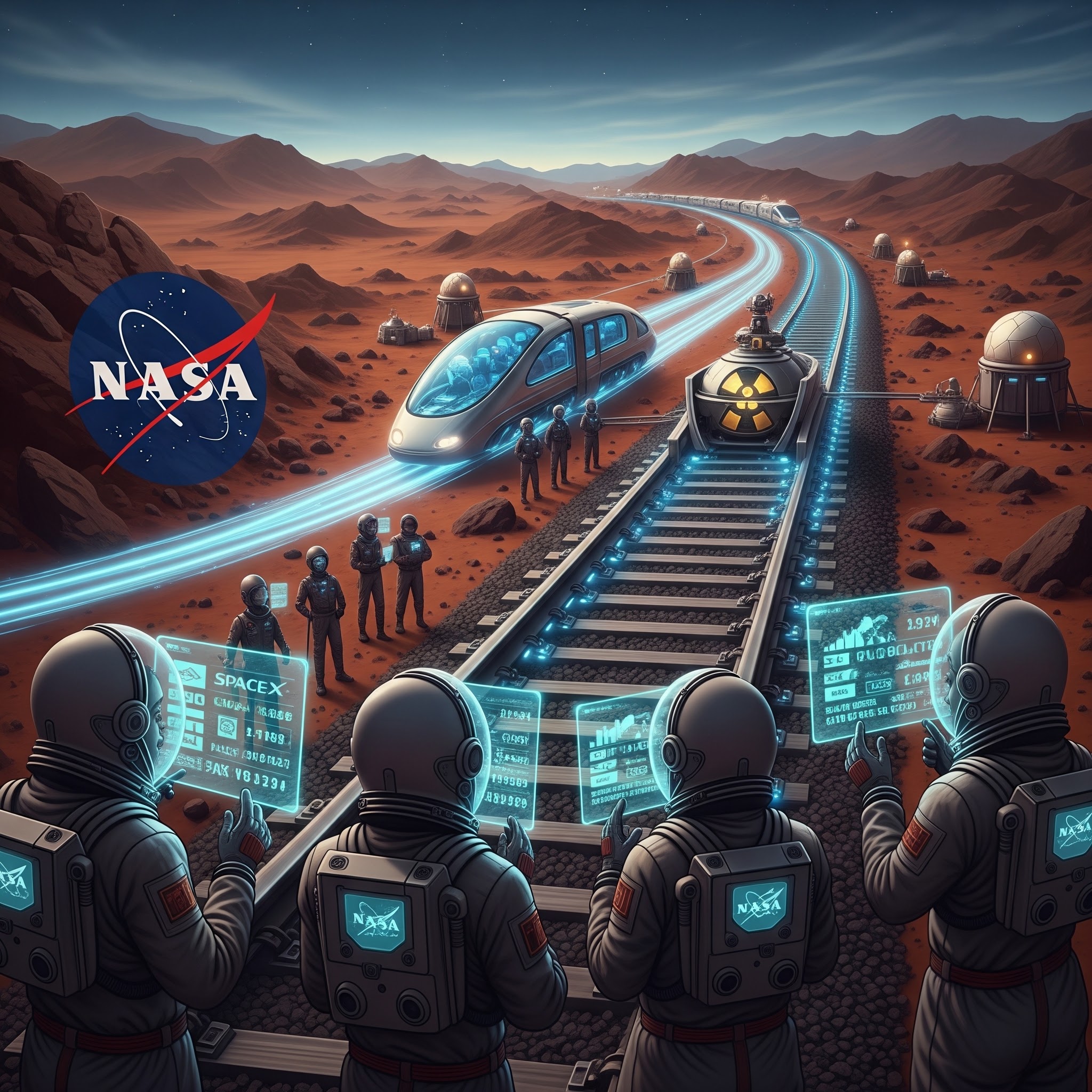
NASA is no longer just launching rockets; it is underwriting what amounts to a nuclear-powered freight line between planets. The agency’s Space Reactor 1 (SR1) program aims to send the world’s first interplanetary nuclear-powered spacecraft to Mars as early as the 2028 launch window, compressing risk, cost, and distance into a single, audacious bet on atomic propulsion.
In an era when investors parse every Federal Reserve syllable and debate whether artificial intelligence can justify its multiples, NASA is quietly building an asset class of its own: reliable, repeatable deep-space logistics. One might call it “infrastructure as a universe.”
From Fireworks to Freight: The Limits of Chemical Rockets
For decades, the standard Mars playbook has looked like a very expensive long-haul flight with no upgrade option. Launch during the narrow planetary alignment that appears once every two years, burn through a heroic amount of chemical fuel, coast for months, and hope the rover—roughly the size of an SUV—sticks the landing on the red planet
SpaceX’s Starship architecture illustrates both the promise and the pain of this model. A single Mars-bound Starship requires not just the largest booster ever built to reach low Earth orbit, but roughly 10 additional booster launches simply to refill its tanks in space. The upside: payload capacity equivalent to about 25 SUV-scale NASA rovers; the downside: a supply chain that makes even the most aggressive oil trader look conservative
Chemical propulsion, in other words, is the financial equivalent of a high-yield bond with a very tight window: big upside, but inflexible, fuel-heavy, and unforgiving.
Enter Space Reactor 1: A Modest Reactor With Immodest Ambitions
NASA’s answer is Space Reactor 1, or SR1, a nuclear-powered spacecraft designed to trade brute force for staying power. Instead of a gigantic, gigawatt-class reactor, SR1 runs on a compact nuclear fission system producing roughly 20 kilowatts of power—closer to a Home Depot backup generator than a Manhattan power plant, but in space, modest can be mighty
The reactor sits at the top of the spacecraft, feeding heat into a closed-loop heat-pipe system. A working fluid cycles through the reactor core, vaporizes, spins a turbine connected to an electric generator, cools back into liquid, and repeats—essentially a tiny, orbital utility that can run for years with no on-site maintenance until its nuclear fuel is spent. A radiation shield, long truss, and titanium radiators separate and cool the rest of the vehicle, protecting electronics the way a good compliance department protects traders from themselves
Why NASA Picked Ion Engines Over “Rocketship on Steroids”
Nuclear propulsion comes in two basic flavors, and NASA has, quite deliberately, chosen the slower, steadier one. Nuclear thermal engines promise roughly five times the efficiency of traditional rockets by heating cryogenic hydrogen directly in a reactor, turning it into exhaust gas without hauling heavy oxidizer.
SR1 instead uses nuclear-electric propulsion, pushing efficiency closer to ten times that of combustion rockets by using the reactor to generate electricity that feeds ion thrusters. Ion engines don’t explode; they persuade. Electricity energizes atoms in a compressed gas, then electromagnetic fields fling those charged particles out the back, creating a tiny but constant thrust.
It is the difference between a drag racer and a freight locomotive: the rocket wins the quarter mile, but the ion thruster wins the continent. Over long durations, that gentle, continuous push adds up to higher terminal speeds using a negligible amount of propellant, precisely the trait you want when your commute is measured in astronomical units, not exits.
The Mars Railroad: How SR1 Turns Deep Space Into a Shipping Lane
In a March 2026 presentation, NASA described SR1 as the first locomotive in a “railroad to Mars,” a metaphor that lands squarely in Wall Street’s wheelhouse. Like freight trains, nuclear-electric spacecraft don’t sprint; they haul heavy cargo efficiently, on predictable timetables, at low marginal cost.wsj+1
SR1 will not sprint to Mars in 45 days as some nuclear-thermal concepts advertise. Instead, it will take about a year to reach the planet, but will do so as the largest vehicle ever dispatched to the Martian system while sipping propellant so sparingly that the fuel bill would make an airline CFO weep with envy. The economic logic is intuitive: once the capital expenditure of a nuclear tug is made, the cost per kilogram of cargo drops sharply over repeated missions.
Investors used to thinking in terms of pipelines, railroads, and shipping lanes may recognize the playbook: build hard-to-replicate infrastructure, spread fixed costs across high throughput, and let the time value of reliability compound.
Recycling Moon Plans Into a Mars Engine
One of the more quietly sophisticated moves in SR1’s design is NASA’s decision to repurpose hardware originally built for a different, now-canceled project. The propulsion module that will accompany the nuclear system was initially developed for the Lunar Gateway, a planned moon-orbiting station in the early Artemis architecture.
When leadership shifted direction and the Gateway concept was shelved, NASA didn’t zero out the investment; it reallocated it. Habitation modules are being reimagined as parts of a lunar base, while the ion-based propulsion unit is being reconfigured as SR1’s workhorse bus—essentially turning a stranded asset into a growth vehicle.
On Wall Street, that’s called capital discipline. In Washington, it’s usually called a miracle.
Skyfall: Three Helicopters, No Lander, and a Real Estate Mission
When SR1 finally reaches Mars orbit, it will not deploy the usual parade of parachutes, retro-rockets, and landing platforms. Instead, it will release an entry capsule dubbed “Skyfall,” which will ride a heat shield into the Martian atmosphere, slow via aerobraking and supersonic parachute, then reveal not a rover, but three helicopter drones.
These aircraft are built on the same basic platform as the Ingenuity helicopter, which was originally intended as a short technology demo but ultimately flew 72 missions over nearly three years. This time the trio will separate at low altitude and fly themselves away from the falling hardware, bypassing the need for complex landing systems like airbags or sky cranes.
Their mandate is straightforward but critical: conduct high-resolution imaging and ground-penetrating radar surveys to identify flat landing zones and subsurface water ice deposits for future human missions. If Mars ever gets a mortgage market, these drones will have written the first appraisal reports.
Lunar Reactor 1 and the Compounding Curve of Atomic Power
SR1 is only the opening act in NASA’s nuclear portfolio. Around 2030, the agency intends to follow up with Lunar Reactor 1, a fission power source tailored to keep a moon base running through the lunar night—a two-week period when solar panels go dark and conventional equipment risks freezing.
By proving small reactors in cislunar space and then scaling up, NASA envisions multi-megawatt systems in the 2030s capable of supporting multi-year human missions to Mars. In financial terms, SR1 is the seed round, Lunar Reactor 1 the Series A, and the eventual Martian power grid the industrial IPO. The through line is a simple thesis: in the long run, energy density is destiny.
Risk, Regulation, and the “Nuclear” Word on the Prospectus
No one in Washington or on Wall Street is naïve about the optics of launching nuclear material into orbit. Nuclear propulsion and power in space remain tightly regulated, with rigorous safety protocols for both launch and on-orbit operations.wsj+1
Yet nuclear technology has powered naval submarines and aircraft carriers safely for decades, and small modular reactors are drawing renewed interest as part of terrestrial decarbonization strategies. In that context, SR1 looks less like a wild science experiment and more like a natural extension of a familiar, if emotionally loaded, technology stack.
Investors have long learned to live with risk profiles that include everything from derivative exposure to cybersecurity threats; radioisotope launch risk may soon simply join the checklist.
Why Markets Should Care: From Exploration to Cash Flows
At first glance, a nuclear-powered Mars freight train seems worlds away from quarterly earnings calls. But the industrial backbone required for SR1 and its successors touches a wide ecosystem: advanced materials, radiation-hardened electronics, precision manufacturing, electric propulsion, robotics, and eventually in-situ resource utilization on other worlds.redcliffetraining+1
As with earlier eras of infrastructure—railroads, telegraphs, undersea cables—the near-term returns may appear uneven, but the second-order effects can be vast. Better, cheaper, more reliable cargo delivery between Earth, the moon, and Mars is the sort of enabling technology that tends to spawn industries no one has a spreadsheet for yet.
In the meantime, NASA’s nuclear freight plan offers something Wall Street quietly craves in a noisy market: a long-duration, high-conviction thesis built not on hype, but on engineering that already works at smaller scale.
The Punchline: In Space, Efficiency Is the Ultimate Blue Chip
The subtle genius of SR1 is not that it promises science-fiction speeds, but that it embraces an almost old-fashioned discipline: move more, spend less, repeat often. In a field famous for spectacular one-off missions, NASA is designing a boringly reliable logistics asset—exactly the kind of thing that keeps both economies and civilizations expanding.
For now, the nuclear railroad to Mars is still laying its first stretch of track. But if the plan holds, future generations may look at chemical-only Mars missions the way modern traders look at paper tickets on an exchange floor: charming, nostalgic, and utterly inefficient.
Learn More Now By Watching This Video
The Sources
- NASA is Launching a Nuclear Rocket to Mars – YouTubeyoutube
- NASA is building the first nuclear reactor‑powered interplanetary spacecraft – MIT Technology Reviewtechnologyreview
- NASA’s ‘1st nuclear powered interplanetary spacecraft’ will send Skyfall helicopters to Mars – Space.comspace
- America Underway in Space on Nuclear Power: SR‑1 Freedom (NASA PDF)nasa
- Space Reactor‑1 Freedom – Wikipediawikipedia
- Nuclear Propulsion Could Help Get Humans to Mars Faster – NASAnasa
- NASA plans to send a nuclear-powered spacecraft to Mars in 2028 – Science.orgscience
- Space Reactor‑1 Freedom – Ex Terra JSC analysisexterrajsc
Stay Updated with Vista Partners
Subscribe to receive market insights, investing ideas, and the latest updates directly in your inbox.