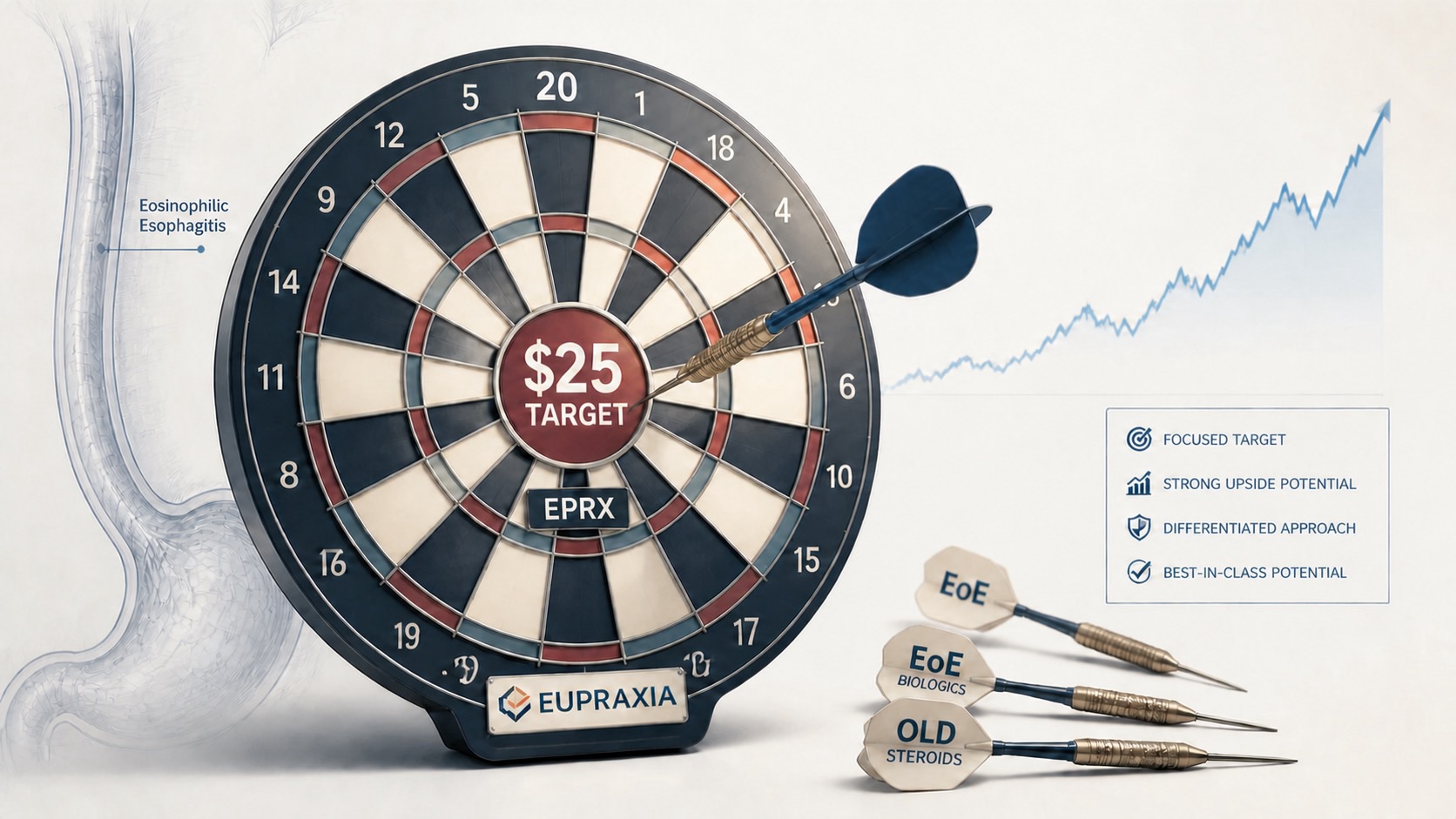
Stifel just initiated coverage during National Eosinophil Awareness Week on Eupraxia Pharmaceuticals (EPRX) with a Buy rating and a 25 dollar price target—roughly four times where the stock changed hands around the report—on the view that a sleepy drug‑delivery story is about to wake up GI and osteoarthritis markets. That bullish stance rests on Diffusphere, a platform that turns a well‑worn steroid into a once‑yearly esophageal tune‑up and, potentially, a franchise that extends across the GI tract, EOE, and into the knee.
A precision platform hiding in plain sight
Eupraxia is a clinical‑stage biotech built around Diffusphere, a polymer‑coated microparticle system designed to keep familiar drugs exactly where physicians want them, and for far longer than standard formulations allow. The platform’s lead embodiment, EP‑104GI, repackages fluticasone propionate—a workhorse steroid that has seen more clinics than most junior residents—into a long‑acting injectable for gastrointestinal disease, starting with eosinophilic esophagitis (EoE).
Unlike conventional extended‑release technologies that can dump drug into the bloodstream or fade too quickly, Diffusphere particles are engineered to sit in the injected tissue and leak fluticasone at a near‑constant rate for up to a year, keeping systemic exposure well below the levels seen with inhaled fluticasone. In Phase 1b/2a, plasma cortisol and glucose curves were reassuringly flat and stayed within normal ranges over 52 weeks, suggesting the esophagus is doing the work while the adrenal glands get the year off.
EoE: a growing market with a compliance problem
EoE has quietly evolved from a rare curiosity into a mainstream GI diagnosis, with Stifel modeling roughly 1 million U.S. patients by 2030 as awareness and endoscopy rates rise. Even after proton pump inhibitors and dietary interventions, about half of this population remains uncontrolled, implying hundreds of thousands of patients who still struggle with dysphagia, pain, and the occasional memorable encounter with a steak lodged mid‑chest.
Therapy has historically oscillated between swallowed steroids and biologics, both effective but limited by either short duration or high cost and chronic administration. Takeda’s (TAK) FDA approved Eohilia, a budesonide oral suspension, delivers 12 weeks of treatment at 2 mg twice daily, achieving histologic remission in just over half of treated patients but with notable rates of oral candidiasis and adrenal suppression in trials. Dupixent—co‑owned and co‑promoted by Sanofi (SNY) and Regeneron Pharmaceuticals (REGN)—has set the high bar on efficacy and durability with weekly injections, including up to 52‑week histologic remission in most patients, but at biologic‑grade pricing, injection‑site reactions, and the expectation of ongoing dosing.
One scope, twenty shots, fifty‑two weeks
Eupraxia’s EP‑104GI proposes a different deal: one endoscopy, 20 submucosal injections spaced like clock‑face coordinates up the esophagus, and potentially a year of local steroid exposure with minimal systemic baggage. In the Phase 1b/2a RESOLVE trial, higher‑dose cohorts (20 injections of 6–8 mg each) delivered a roughly 65 percent mean reduction in the EREFS endoscopic severity score at week 12 for patients with baseline scores above 2, with near‑complete resolution in the top‑dose group.
Those structural gains matched up with histology and symptoms in a way that’s unusual enough to get GI specialists’ attention. Peak eosinophil counts fell by about 70 percent in the highest‑dose cohort by week 36, with around two‑thirds of biopsies crossing the conventional remission threshold of fewer than 6 eosinophils per high‑power field. Clinically, roughly 60 percent of patients across mid‑ to high‑dose cohorts reached remission on the Straumann Dysphagia Instrument and maintained it out to week 52, with higher doses hitting the accepted “remission” change of at least 3 points more quickly.
The safety profile reads like a steroid formulation trying very hard not to behave like a steroid: no meaningful trends in cortisol suppression, no hyperglycemia signal, no oral thrush, and no serious adverse events attributed to EP‑104GI. Most procedure‑related issues were what one would expect when poking an esophagus 20 times with a needle—transient and self‑limited—raising the possibility that the biggest barrier is psychology, not pharmacology.
Competing with Eohilia and Dupixent on time, not molecules
Stacked against the current EoE armamentarium, Eupraxia’s differentiation is less about what’s in the syringe and more about when and where it goes. Eohilia depends on twice‑daily adherence over 12 weeks, exposes the entire esophagus and oropharynx, and needs to be cycled or repeated in a disease that is chronic by nature. Dupixent, from Sanofi and Regeneron, delivers potent systemic IL‑4/IL‑13 blockade and strong histological responses over 24–52 weeks, but requires ongoing subcutaneous injections and carries the usual biologic expense.
EP‑104GI’s pitch is essentially, “treat once, check annually.” The single‑procedure paradigm aligns neatly with what guidelines and payers already want: yearly endoscopic surveillance in symptomatic EoE, with therapy delivered at the same time rather than in a separate chronic regimen that patients might abandon once they feel marginally better. In the mid‑dose and high‑dose cohorts, 9‑ to 12‑month data suggest sustained structural and symptom improvement off a single injection sequence, putting EP‑104GI in its own category on durability even before head‑to‑head comparisons.
From a pure efficacy perspective, Dupixent’s Phase 3 program remains the gold standard, with high rates of patients achieving histologic thresholds at 52 weeks in some regimens. But EP‑104GI’s emerging data show remission rates and eosinophil reductions that are directionally competitive for a localized steroid, particularly at the highest doses—without the systemic immunomodulation. That trade‑off may resonate with patients who are more comfortable experimenting with a high‑tech steroid shot than committing to years of biologic therapy for a condition they didn’t know existed five minutes before their first scope.
Follow the money: why GI docs may quietly cheer
For gastroenterologists, the EP‑104GI model checks several practical boxes that traditional EoE therapy does not. Annual endoscopy is already embedded in practice patterns, and adding a submucosal injection sequence during the same procedure adds 30–40 minutes but opens the door to separate billing for both the scope and drug administration. Stifel notes that existing procedure codes and buy‑and‑bill economics could translate into roughly 30–40 percent higher reimbursement for physicians relative to simply writing a prescription, a change that might make the injection count feel more like a feature than a burden.
More importantly, the “one‑and‑done‑for‑now” approach almost guarantees follow‑up: patients must return for the next annual treatment/endoscopy, rather than drifting away on self‑administered biologics and skipping recommended surveillance once they feel better. That loop is attractive for both quality of care and revenue continuity in EoE, a field where under‑diagnosis and under‑monitoring have been persistent themes even as prevalence rises.
On pricing, Stifel assumes an annual WAC around 45,000 dollars for EP‑104GI in the U.S., between Eohilia’s mid‑five‑figure course and Dupixent’s six‑figure annual cost, which still leaves room for attractive margins while offering payers a year‑long solution at a discount to systemic biologic therapy. With net pricing modeled lower after discounts and a modest royalty to formulation partner Auritec, the firm forecasts probability‑adjusted peak U.S. revenues of about 1.4 billion dollars from EoE alone by 2040, plus incremental contribution from Europe.
Beyond EoE: turning strictures into a second act
If EoE is the opening chapter, benign esophageal strictures are the natural sequel. These fibrotic narrowings often arise from reflux disease, EoE itself, or prior surgery, and they are managed primarily through balloon dilations that are as unsatisfying long term as they sound. Roughly two‑thirds of patients require repeat dilations within a year, creating a cycle of tissue injury and scarring that keeps endoscopy suites busy but does little to reassure patients.
Short‑acting steroid injections are already used in some centers post‑dilation, and meta‑analyses suggest a roughly 55 percent relative reduction in restenosis—but the effect is constrained by the drug’s short half‑life at the lesion site. EP‑104GI’s data in EoE on structural reversal—improved EREFS scores, reductions in histologic fibrosis, and sustained eosinophil control—make long‑acting steroid delivery at stricture sites a conceptually tidy extension.
Stifel models a Phase 2b start in benign esophageal strictures, assigns a conservative 30 percent probability of success at this early stage, and still arrives at roughly 835 million dollars in probability‑adjusted peak sales by 2040 based on about 20 percent penetration of eligible U.S. and EU procedures. Layered on top of EoE, those numbers begin to resemble a “pipeline‑in‑a‑product” story where one carefully tuned formulation supports multiple GI indications with similar procedure‑based workflows.
Platform optionality: knees today, more organs tomorrow
EP‑104GI is not Diffusphere’s only claim on future cash flows. Eupraxia has already run a Phase 2b trial (SPRINGBOARD) of EP‑104IAR, an intra‑articular fluticasone formulation for knee osteoarthritis, which met its primary endpoints and is now parked in the “ready for partnership” bucket for Phase 3. While the osteoarthritis opportunity is sizable, Stifel’s valuation focus remains on the GI franchise, with EP‑104IAR treated more as upside optionality pending a commercial partnership that can shoulder large musculoskeletal trials.
Under the hood, the platform has been tested with a variety of active ingredients—from chemotherapeutics to anti‑infectives—suggesting that Diffusphere could support additional local delivery programs in oncology, infectious disease, or pain if capital and partners line up. Intellectual property protection rests on the altered crystal formulations, methods of use by indication, and manufacturing know‑how, giving Eupraxia multiple levers to defend territory beyond the basic fluticasone patents.
Valuation and what has to go right
Stifel’s 25 dollar target blends a discounted cash‑flow model (15 percent WACC, 1 percent terminal growth) with a sum‑of‑the‑parts analysis that risk‑adjusts the EoE and stricture opportunities to 60 percent and around 25–30 percent probabilities of success, respectively. The math assumes EP‑104GI reaches the EoE market around 2030, eventually treating close to 60,000 U.S. patients annually at 20 percent penetration of the uncontrolled, diagnosed population, and building EU5 sales off a discounted price base.
Cash on the balance sheet—about 139 million dollars with no debt at the time of the initiation—provides runway through near‑term catalysts, but longer‑term development across multiple indications will almost certainly require fresh capital or partnerships. If everything works, Stifel’s DCF and SOTP both cluster in the mid‑20s per share, leaving current levels looking, in their view, like a relatively de‑risked entry point for a drug‑delivery story with real commercial teeth.
Risks: clinical, competitive, and the 20‑needle question
As with any small‑cap biotech, the biggest near‑term risk is binary: the Phase 2b RESOLVE readout in EoE, expected in the fourth quarter of 2026, needs to replicate or exceed Phase 1b/2a signals on histology, endoscopy, and symptoms in a randomized, placebo‑controlled setting. A miss on dose selection, placebo response, or an unexpected safety signal could force a reset of the entire GI narrative, not just delay it.
Competition in EoE is also intensifying faster than the average esophagus can scar. Eohilia from Takeda gives community gastroenterologists an oral steroid they know how to write for, while Dupixent from Sanofi and Regeneron is steadily building real‑world evidence and guideline support as a biologic standard. Any safety surprises, payer pushback on procedure‑plus‑drug economics, or patient resistance to the idea of “20 esophageal injections” could slow Diffusphere’s uptake even if the data are solid.
Finally, platform expansion is optional, not guaranteed. Benign esophageal strictures and Crohn’s‑related strictures are large but complex markets, where trial design, recruitment, and endpoints will matter as much as pharmacology. Osteoarthritis, for its part, lives in a crowded, generic‑friendly world; here, Eupraxia’s success may depend less on the elegance of Diffusphere and more on the quality of any commercial partner willing to write the bigger checks.
World Eosinophilic Esophagitis Day – May 22
The EoE Day Alliance, is proud to launch World Eosinophilic Esophagitis Day (#EoEDay) a global awareness day dedicated to shining a light on Eosinophilic Esophagitis (EoE), a chronic and often underdiagnosed immune condition.
Taking place on May 22, 2026, this important milestone brings together patient organizations from around the world including Austria, Brazil, Spain, the USA, Australia, the UK, Italy, Switzerland, Israel, and Serbia, all working together to:
- Raise awareness of EoE and its symptoms
- Encourage people to seek medical advice for signs like difficulty swallowing or persistent reflux
- Advocate for better care, research, and access to treatment, especially in under-resourced countries
- Promote the Global EoE Patient Care Path that our alliance created together
Life Narrows – An EOE Day Alliance Film (EoE Doesn’t Kill. But Life Narrows)
The Sources
- Stifel initiation report on Eupraxia Pharmaceuticals (EPRX), “Precise Platform with Easy‑to‑Swallow Value Creation,” May 20, 2026.
- Eupraxia Pharmaceuticals – RESOLVE Phase 1b/2a EP‑104GI EoE data (conference/academic poster and related disclosures).eupraxiapharma+1
- Eupraxia Pharmaceuticals press and SEC‑style disclosures summarizing EREFS and other EP‑104GI efficacy data in EoE.prnewswire+1
- Patient‑oriented and trade coverage of EP‑104GI performance in EoE, summarizing trial readouts.patientworthy
- FDA approval information and medical‑society summaries for Eohilia (budesonide oral suspension) in EoE, including efficacy and safety profile.globalgenes+2
- Clinical and real‑world data on Dupixent (dupilumab) in EoE, including long‑term efficacy and safety, as well as sponsor disclosures from Sanofi (SNY) and Regeneron (REGN).gi+3
- Background clinical resources on EoE epidemiology, diagnostic criteria (including EREFS and histologic thresholds), and standard‑of‑care management.libguides.reading+1
- Corporate and event materials describing Eupraxia’s Diffusphere technology, pipeline, and KOL‑focused discussions of EP‑104GI.lapal.medicinespatentpool+1
Stay Updated with Vista Partners
Subscribe to receive market insights, investing ideas, and the latest updates directly in your inbox.