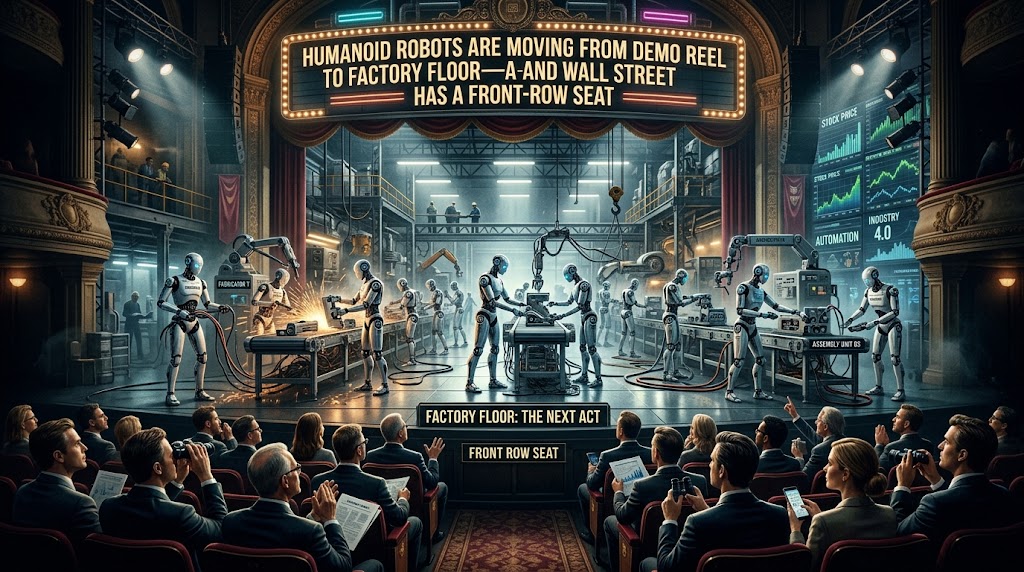
The next major AI trade may not fit inside a data center. It may wear a pair of mechanical hands, work a night shift, and become one of the most consequential buyers of chips, sensors, software and industrial equipment of the decade. A new interview with Figure AI founder and CEO Brett Adcock underscores the central bullish idea: humanoid robotics is progressing from a futuristic concept into an early commercial deployment cycle. The opportunity is real, but so is the engineering difficulty, a combination that tends to separate durable platforms from PowerPoint aristocrats.
The Physical AI Investment Thesis
The first wave of AI monetization has been largely digital: models generate text, code, images and analysis. The emerging wave, often called physical AI, asks those models to perceive a real-world environment, reason through a task and control a machine safely enough to perform useful work. That is the prize Figure AI is pursuing. In the interview, Adcock described a strategy built around vertically integrated humanoid hardware, proprietary AI models, manufacturing scale and commercial deployments. He said Figure plans to progress from thousands of units toward a longer-term goal of one million robots annually ambitious, certainly, but industrial revolutions have rarely been accused of insufficient ambition. The logic is straightforward: factories, warehouses and logistics facilities were designed around human dimensions. A humanoid form can potentially operate in those environments without requiring businesses to rebuild every aisle, workstation and tool around a fixed-purpose machine. That makes the addressable market unusually broad. Rather than displacing every specialty robot, humanoids could fill labor-intensive gaps where automation has historically been uneconomic, inflexible or simply awkward.
Figure AI’s BMW Proof Point
Figure AI remains private, meaning investors cannot purchase Figure stock directly. But its work with BMW Group is a meaningful validation signal for the larger physical-AI theme. BMW’s initial agreement with Figure was structured as a milestone-based effort to identify applications and deploy general-purpose humanoid robots at its Spartanburg, South Carolina facility. The relationship has moved beyond the press-release stage: BMW has said Figure humanoids were used at Spartanburg and later expanded its physical-AI activity, including work around complex logistics sequencing applications. That distinction matters. Investors should not confuse an early deployment with a fully scaled labor replacement program. The current reality is more disciplined and arguably more investable: robots are being tested on discrete, measurable workflows where reliability, uptime, safety and return on investment can be established before fleets expand. In other words, the robot does not need to make dinner, fold laundry and solve the family Wi-Fi problem on day one. It needs to do one valuable job, repeatedly, without becoming the plant manager’s most expensive intern.
NVIDIA Is Building the Robotics Toll Road
If humanoid robots become a significant category, NVIDIA (NASDAQ: NVDA) appears positioned to benefit even if no single robot maker wins the race. NVIDIA has built an embodied-AI stack around its Isaac robotics platform and the GR00T foundation-model initiative. The company’s platform is designed to help developers train, simulate, test and deploy AI-powered humanoids, and NVIDIA has identified Figure AI, Boston Dynamics, Agility Robotics, Apptronik and others among the companies working within its broader robotics ecosystem. The strategic appeal is familiar to semiconductor investors: NVIDIA does not need to wager on one humanoid design. It can supply compute, simulation tooling and the software infrastructure used across a widening field of robot developers. That “arms dealer” role is not a guarantee of returns, competition, pricing and execution always matter, but it is a compelling position in a market where the eventual hardware champions are still being sorted out.
Tesla Has the Manufacturing Wild Card
Tesla (NASDAQ: TSLA) brings a different kind of robotics proposition. Its Optimus program combines AI development with experience in large-scale manufacturing, electric motors, batteries, power electronics and global supply-chain execution. Tesla has said it is installing first-generation Optimus production lines in Fremont in anticipation of volume production, while designing a second-generation line in Texas intended for far larger long-term capacity. The company’s stated production aspirations are enormous, and investors should treat them as targets rather than current output. Still, that is precisely why Tesla belongs in the conversation. If Optimus achieves commercially relevant capability and Tesla can apply its manufacturing playbook, the company could turn robotics from an intriguing option value into a material future business. The challenge is that building a capable humanoid is not merely a scaled-up electric vehicle project. Robots must perceive, reason, grasp, balance and operate safely amid the charming unpredictability of the physical world.
The Less Obvious Beneficiaries
The humanoid trade is broader than a handful of headline-grabbing robot makers. The most investable public exposure may lie in the ecosystem that enables robotics to move from prototypes to dependable industrial assets.
| Company | Ticker | Why it matters |
|---|---|---|
| NVIDIA | NASDAQ: NVDA | AI compute, simulation and Isaac/GR00T robotics platforms for training and deploying physical AI. |
| Tesla | NASDAQ: TSLA | Optimus provides direct humanoid upside, supported by Tesla’s manufacturing, battery and actuator expertise. |
| AMD | NASDAQ: AMD | AMD’s embedded portfolio targets robot perception, reasoning, sensor fusion, motor control and functional safety components that matter when AI must act in milliseconds rather than merely draft an email. |
| Rockwell Automation | NYSE: ROK | Rockwell is integrating NVIDIA robotics technology into OTTO Motors autonomous mobile robots and pairing AI with industrial automation and digital-twin workflows. |
| Amazon | NASDAQ: AMZN | Amazon’s warehouse network is a major proving ground for AI-enabled automation; the company has introduced robots capable of responding to conversational prompts for warehouse tasks. |
| BMW Group | OTC: BMWYY | BMW’s Figure deployments provide a high-profile industrial case study for physical AI, though U.S. investors should recognize that BMWYY is an OTC ADR rather than a U.S.-listed operating company. |
Why the Timing Looks Better
Several ingredients are converging:
- Better AI models are improving robot perception and decision-making.
- Simulation allows developers to generate training data and test policies before a robot reaches a busy factory floor.
- Advances in GPUs, embedded computing, sensors and actuators are bringing more capability into smaller, more power-efficient systems.
- Manufacturers face persistent pressure to improve throughput, resilience and labor productivity.
- Warehouse and factory automation has already laid much of the operational groundwork for the next step.
Amazon’s approach illustrates the transition. The company has expanded the use of AI-enabled warehouse robotics, including mobile machines that interpret natural-language instructions, while continuing to invest heavily in fulfillment infrastructure. Humanoids may eventually take on some tasks that conventional robots handle poorly, but the more immediate opportunity is likely a blended fleet: mobile robots, robotic arms, machine vision, automated storage and selectively deployed humanoids.
The Risks Wall Street Should Respect
The bullish case is not a free lunch, although the robots may eventually be asked to serve one. Figure’s Adcock openly describes the challenge: a commercially useful humanoid must perform end-to-end work for long durations, safely and with minimal intervention. Reliability, cost, energy consumption, maintenance, training data, supply chains and customer integration all remain significant hurdles
Investors should watch for tangible proof rather than cinematic footage:
- Paid commercial deployments, not merely pilots.
- Robot uptime and task-completion rates.
- Cost per productive hour versus human labor and conventional automation.
- Expansion from one task to multiple tasks at customer sites.
- Manufacturing yields, bill-of-materials improvements and service requirements.
- Repeat customer orders and disclosed deployment economics.
The strongest companies will not be those with the flashiest robot walk. They will be those able to turn autonomy into repeatable unit economics.
A Takeaway: Consider Owning the Picks, the Shovels—and the Optionality
Humanoid robotics is still an early-stage investment theme, but the direction of travel is increasingly visible. Figure AI’s BMW work, NVIDIA’s expanding robotics platform, Tesla’s Optimus manufacturing ambitions, Amazon’s warehouse automation push, AMD’s embedded robotics offerings and Rockwell’s industrial AI strategy all point to the same broad conclusion: AI is beginning to leave the screen and enter the workplace. For investors, the sensible bullish framing is not that every humanoid will soon become a household butler. It is that the robotics value chain may become a major new demand engine for AI compute, industrial software, semiconductors, automation equipment and advanced manufacturing. The machine may still be learning to stack boxes. The investment thesis, however, is already learning to walk.
The Sources
- Sourcery with Molly O’Shea: “The $10 Trillion Bet on Humanoid Robots Figure Founder Brett Adcock”
- BMW Group: Advances Physical AI in Production With Figure 03 at Spartanburg
- BMW Group: Humanoid Robots Deployed in Production in Germany
- Figure AI: Commercial Agreement With BMW Manufacturing
- Figure AI: Figure 02 Production Results at BMW
- NVIDIA: Humanoid Robots and Isaac GR00T Platform
- NVIDIA: Project GR00T Foundation Model for Humanoid Robots
- NVIDIA: Isaac GR00T N1 Open Humanoid Robot Foundation Model
- NVIDIA: Isaac GR00T Reference Humanoid Robot Announcement
- AMD: Robotics Computing and Embedded AI Solutions
- Rockwell Automation: Collaboration With NVIDIA for Intelligent Automation and Mobile Robotics
- Amazon: AI-Powered Warehouse Robotics and Automation
- Reuters: Amazon Unveils AI-Powered Warehouse Robot
- BMW Group: First Humanoid Robot Introduced at Plant Leipzig
- Agility Robotics: Industrial Humanoid Automation
Disclosure: This article is for informational and educational purposes only and does not constitute investment advice, a recommendation or an offer to buy or sell any security. Investors should conduct their own due diligence and consider their financial circumstances and risk tolerance before making investment decisions.
Stay Updated with Vista Partners
Subscribe to receive market insights, investing ideas, and the latest updates directly in your inbox.