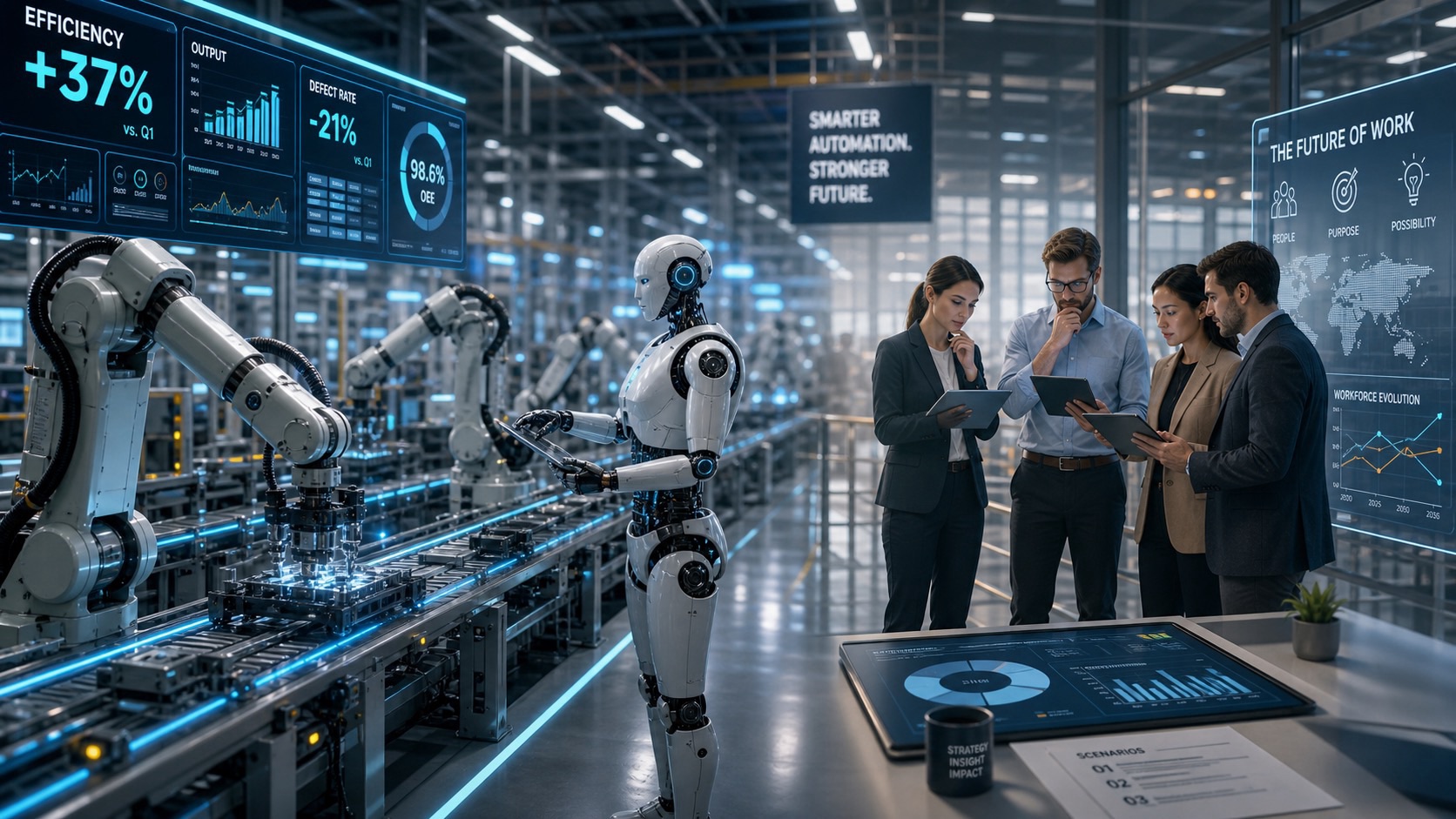
The factory floor used to hum with human rhythm—coffee breaks, chatter, the occasional misplaced wrench. Today, it hums differently. Precision has replaced improvisation, algorithms have replaced instinct, and the newest employee doesn’t require healthcare or sleep.
Welcome to the robotics economy, where machines are no longer just tools but increasingly colleagues—albeit ones that never ask for a raise.
The 2018 documentary Robots: Brave New World captures this inflection point with a steady lens, tracing how robotics and artificial intelligence are reshaping industries from manufacturing to medicine. The central question is no longer whether robots will transform the global economy, but how quickly—and at whose expense.
From Assembly Lines to Operating Rooms
Industrial robots have long dominated automotive plants, executing repetitive tasks with mechanical grace. What’s changed is their expanding resume.
Today’s robots assist surgeons in operating rooms, care for elderly patients in aging societies, and even greet hotel guests with uncanny politeness. In logistics warehouses, fleets of autonomous machines glide across polished floors, fulfilling orders with the quiet efficiency of a well-run hedge fund.
This shift is powered by rapid advances in machine learning, sensor technology, and computing power. Robots are no longer confined to predictable environments; they are adapting, learning, and—at least in narrow domains—making decisions.
One telling example comes from healthcare, where robotic systems now assist in delicate procedures once considered the exclusive domain of highly trained specialists. The pitch is compelling: fewer errors, faster recovery times, and scalable expertise.
The subtext is harder to ignore: if a robot can assist a surgeon today, what might it do tomorrow?
Sophia and the Symbolism of Citizenship
Perhaps the most headline-grabbing moment in the documentary—and in robotics more broadly—was Saudi Arabia granting citizenship to Sophia, a humanoid robot.
On its face, the move was symbolic, even theatrical. But symbolism matters. Granting a robot legal status, however limited, underscores a broader cultural shift: machines are no longer just objects; they are participants in the social and economic fabric.
Sophia’s carefully scripted interactions and expressive design highlight how far human-machine interfaces have come. Yet behind the novelty lies a serious implication: as robots become more integrated into daily life, society will need to grapple with questions that once belonged to science fiction—rights, responsibilities, and the definition of “work.”
The Productivity Boom—and Its Discontents
From a market perspective, the robotics revolution looks like a classic productivity story. Companies deploy automation to reduce costs, increase output, and improve margins. Investors, unsurprisingly, tend to approve.
Global spending on robotics and automation technologies continues to climb, fueled by labor shortages, rising wages, and the relentless pursuit of efficiency. In sectors like manufacturing and logistics, automation is less a strategic choice than a competitive necessity.
But productivity gains have a way of redistributing benefits unevenly.
The documentary highlights a growing tension: while companies become more efficient, workers in routine or manual roles face displacement. Unlike previous industrial revolutions, which created new categories of employment even as they destroyed old ones, the current wave of automation threatens to outpace the labor market’s ability to adapt.
In economic terms, this raises a familiar but unresolved question: will new jobs emerge quickly enough—and at scale—to absorb those left behind?
A Labor Market in Transition
History offers some reassurance. The mechanization of agriculture, the rise of computers, and the internet all disrupted labor markets before ultimately expanding them.
Yet the speed and scope of today’s technological change are different. Robots don’t just replace physical labor; increasingly, they encroach on cognitive tasks as well.
Consider customer service chatbots, automated financial analysis tools, or AI-driven diagnostics. These systems don’t eliminate entire professions overnight, but they chip away at tasks that once required human judgment.
The result is a labor market that is not collapsing, but fragmenting. High-skill roles that complement technology tend to flourish, while middle-skill, routine jobs face pressure.
For workers, the implication is clear: adaptability is no longer optional.
The Investment Case for Automation
For investors, the robotics revolution presents a familiar narrative dressed in new hardware: follow the productivity gains.
Companies that design, manufacture, and deploy robotics systems sit at the center of this transformation. Semiconductor firms, AI software providers, and advanced manufacturing companies all stand to benefit from the expanding ecosystem.
At the same time, industries that successfully integrate automation—logistics, healthcare, and even agriculture—may see margin expansion and competitive advantages.
An illustrative example: a logistics company that deploys warehouse robotics can process more orders with fewer errors and lower labor costs. Multiply that efficiency across a global network, and the impact on profitability becomes difficult to ignore.
The caveat, of course, is valuation. As with any technological wave, enthusiasm can outpace fundamentals—at least in the short term.
Society’s Catch-Up Problem
If there is a central tension in Robots: Brave New World, it is this: technology is accelerating faster than society’s ability to absorb its consequences.
Education systems, labor policies, and social safety nets were not designed for a world in which machines can learn and adapt. Policymakers face the challenge of fostering innovation while mitigating disruption—a balancing act that rarely produces elegant solutions.
Ideas such as reskilling programs, universal basic income, and reduced workweeks have entered the conversation, though consensus remains elusive.
What is clear is that the future of work will not be decided solely by engineers or executives. It will also depend on how governments, institutions, and individuals respond to the shifting landscape.
The Human Edge
For all the advances in robotics, one theme quietly persists: machines excel at optimization, but humans still define purpose.
Creativity, empathy, and complex social interaction remain difficult to automate. While robots can assist, augment, and occasionally outperform humans in specific tasks, they do not (yet) replicate the full spectrum of human capability.
In that sense, the robotics revolution may be less about replacement and more about redefinition.
The workplace of the future is unlikely to be fully automated or fully human. It will be hybrid—part silicon, part instinct—where the competitive edge belongs to those who can work alongside machines rather than compete against them.
And if that sounds like a negotiation, it is. The difference is that this time, one side doesn’t need a coffee break.
Learn More By Watching This Video
The Sources
- International Federation of Robotics – “Top 5 Global Robotics Trends 2026”ifr
https://ifr.org/ifr-press-releases/news/top-5-global-robotics-trends-2026ifr - CDMC Machine – “Manufacturing Tech & Robotics Trends for 2026”cdmcmachine
https://cdmcmachine.com/manufacturing-tech-robotics-trends-for-2026/cdmcmachine - Industrialised Construction – “Robotics expert forecasts three trends that will transform manufacturing in 2026”industrialisedconstruction
https://www.industrialisedconstruction.co.uk/2026/02/06/robotics-expert-forecasts-three-trends-that-will-transform-manufacturingindustrialisedconstruction - FANUC / LinkedIn – “2026 Robotics Predictions: AI, Automation, and Industry”linkedin
https://www.linkedin.com/posts/etiennelacroix_robotics-manufacturing-industrialautomation-activity-7414296021138259968-In2Alinkedin - FANUC Europe (Facebook) – “Top 5 Robotics Trends to Watch in 2026”facebook
https://www.facebook.com/FanucEurope/posts/top-5-robotics-trends-to-watch-in-2026the-robotics-industry-is-evolving-fast-andfacebook - Wall Street Journal – “No, AI Robots Won’t Take All Our Jobs”wsj
https://www.wsj.com/opinion/no-ai-robots-wont-take-all-our-jobs-employment-productivity-innovation-41068792wsj - Xorbix – “AI Adoption in the U.S. Manufacturing 2025: Which Industries Are Ahead?”xorbix
https://xorbix.com/insights/ai-adoption-in-the-u-s-manufacturing-2025-which-industries-are-ahead/xorbix - Alascom – “Robotics in 2026: The 5 trends that will change the way we produce and work”alascom
https://www.alascom.it/en/latest-news/robotics-in-2026-the-5-trends-that-will-change-the-way-we-produce-and-work-and-how-to-prepare-today/alascom - Deloitte / Wall Street Journal – “Using AI to Augment, Not Just Automate”deloitte.wsj
https://deloitte.wsj.com/cmo/using-ai-to-augment-not-just-automate-e11e01f9deloitte.wsj - Yahoo Finance – “AI-Powered Manufacturing in the U.S. Set for $6.08 Billion”finance.yahoo
https://finance.yahoo.com/news/ai-powered-manufacturing-u-set-123000389.htmlfinance.yahoo - JR Automation – “2026 Key Trends in Automation Shaping the Future of Manufacturing”jrautomation
https://www.jrautomation.com/blog/2026-key-trends-in-automation-shaping-the-future-of-manufacturingjrautomation - Wall Street Journal – “AI Is Starting to Threaten White-Collar Jobs. Few Industries Are Immune.”wsj
https://www.wsj.com/lifestyle/careers/ai-is-starting-to-threaten-white-collar-jobs-few-industries-are-immune-9cdbcb90wsj - International Federation of Robotics – “U.S. Companies Invest Heavily in Robots”ifr
https://ifr.org/ifr-press-releases/news/u.s-companies-invest-heavily-in-robotsifr - Forvis Mazars – “Manufacturing Modernization: Four Trends to Watch in 2026”forvismazars
https://www.forvismazars.us/forsights/2026/02/manufacturing-modernization-four-trends-to-watch-in-2026forvismazars - Wall Street Journal – “We’re Planning for the Wrong AI Job Disruption”wsj
https://www.wsj.com/opinion/were-planning-for-the-wrong-ai-job-disruption-2264d219wsj
Stay Updated with Vista Partners
Subscribe to receive market insights, investing ideas, and the latest updates directly in your inbox.