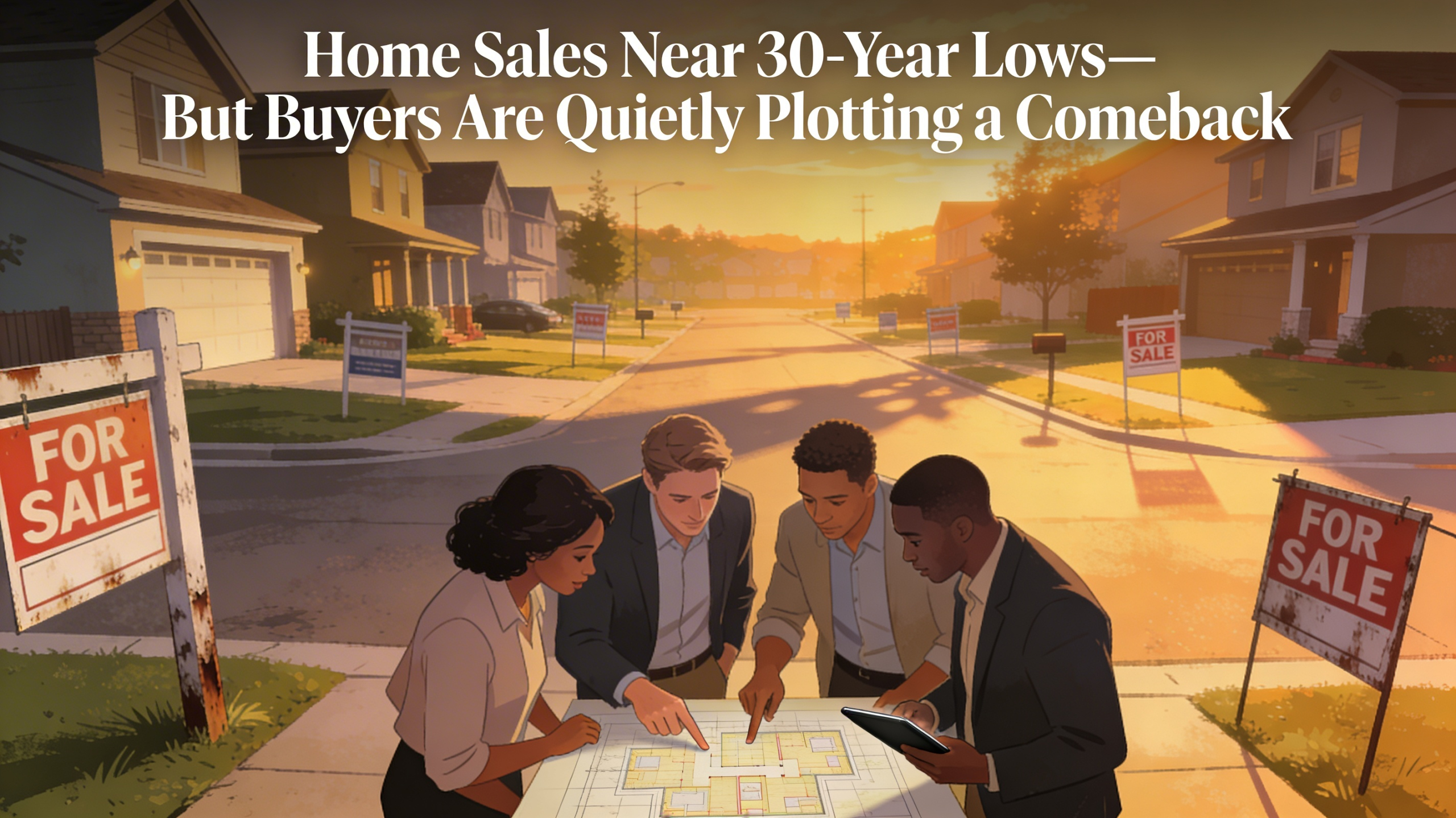
US existing-home sales may be slumping toward historic lows, but the housing market is quietly laying the groundwork for a surprisingly upbeat spring—provided buyers, sellers, and the Federal Reserve can stick to the same script.
Home Sales Skid, But Not Off the Road
Existing-home sales have been hovering in a narrow, subdued range, with annualized volumes stuck millions of units below the pre-pandemic era. Inventory remains thin by historical standards, with roughly 1.29 million units on the market—only about 3.8 months’ supply, shy of the 5–6 months that usually signals a balanced market. Year-over-year, sales are still down, underscoring how far demand has retreated in the face of higher borrowing costs and sticker-shock prices.
Yet even this slowdown has a silver lining: fewer frenzied bidding wars, a bit more time to think, and a housing market that resembles an actual market rather than a game show. For buyers who spent 2021 losing to all-cash offers by Tuesday morning, “near 30‑year lows” in activity sounds less like a crisis and more like a second chance.
Mortgage Rates: From Punishing To Merely Unpleasant
The headline villain of the housing story—mortgage rates—has started softening its method, if not its message. The average 30‑year fixed rate has drifted a bit lower than a year ago, landing near the low‑6% range, down from the peak levels that froze many would‑be movers in place. That easing, combined with moderating home-price growth, has nudged major affordability gauges higher for eight straight months, reaching their best reading since early 2022.
Housing economists note that wage growth is now outpacing home-price gains by several percentage points, a rare and welcome reversal for households who watched prices sprint away from paychecks in recent years. In market terms, the cost of waiting is no longer obviously worse than the cost of jumping in, which helps explain why buyers are tiptoeing—if not stampeding—back into open houses.
Affordability Inches Back From the Brink
By traditional measures, the affordability picture is still challenging but no longer apocalyptic. The National Association of Realtors’ Housing Affordability Index has climbed into the mid‑110s, up notably from just above 100 a year earlier and marking its highest level since March 2022. That improvement reflects a three‑way compromise: slightly softer mortgage rates, slower home-price appreciation, and steady income gains.
First-time buyers, long relegated to the sidelines, are beginning to reappear in meaningful numbers as those dynamics converge. Their return matters: when entry-level demand revives, it can unlock the whole ladder, giving move‑up sellers a reason to list and helping thaw what has been an unusually frozen resale market.
Inventory: The Market’s Missing Puzzle Piece
If there is a single statistic keeping housing from a more vigorous recovery, it’s supply. Despite recent gains, the number of homes for sale remains well below pre‑COVID norms, with current listings still translating into less than four months’ worth of demand at recent sales rates. Many existing owners are “golden handcuffed” to sub‑4% mortgages, treating their rates less like financing and more like heirlooms..
This constraint has curious side effects. Higher-priced properties—especially those north of the million‑dollar mark—are seeing relatively stronger activity, while sales at the lower end have dropped sharply, reflecting both constrained starter inventory and the sharper impact of higher rates on budget‑sensitive buyers. For would‑be sellers, it creates a strategic dilemma: list now into a supply-starved market with fewer competing homes, or wait and hope for lower rates but more competition later.
A Cautious Spring, With Upside
Leading indicators suggest the market is quietly shifting from “stalled” to “stabilizing.” Pending home sales—contracts signed but not yet closed—have ticked higher, signaling that February’s modest lift in existing-home transactions may not be a one‑off. Realtors report more foot traffic, more inquiries, and just enough urgency to remind buyers that “wait and see” is not the same as “wait forever.”nar+4
The outlook now hinges on whether rates can remain contained and inventory can grind higher without derailing prices. If that balance holds, 2026’s housing narrative may read less like a bust and more like an extended intermission—one where buyers regain leverage, sellers rediscover realism, and everyone gets a moment to read the fine print before signing.
The Sources
- National Association of Realtors – “NAR Existing-Home Sales Report Shows 1.7% Increase in February”
https://www.nar.realtor/newsroom/nar-existing-home-sales-report-shows-1-7-increase-in-february[nar] - Yahoo Finance – “US existing home sales unexpectedly increase in February”
https://finance.yahoo.com/news/us-existing-home-sales-unexpectedly-140129355.html[finance.yahoo] - CNBC – “February home sales see small rebound, but supply growth is ‘sluggish’”
https://www.cnbc.com/2026/03/10/february-home-sales-see-small-rebound-but-supply-growth-is-sluggish.html[cnbc] - Yahoo Finance – “Home sales improved in February, but higher mortgage rates threaten that progress”
https://finance.yahoo.com/news/home-sales-improved-in-february-but-higher-mortgage-rates-threaten-that-progress-143720136.html[finance.yahoo] - Yahoo Finance – “US pending home sales unexpectedly rebound in February on lower mortgage rates”
https://finance.yahoo.com/news/us-pending-home-sales-unexpectedly-140109769.html[finance.yahoo] - National Association of Realtors – “NAR Pending Home Sales Report Shows 1.8% Increase in February”
https://www.nar.realtor/newsroom/nar-pending-home-sales-report-shows-1-8-increase-in-february[nar] - CPAPracticeAdvisor – “Existing-Home Sales Increased 1.7% in February”
https://www.cpapracticeadvisor.com/2026/03/13/existing-home-sales-increased-1-7-in-february/179844/[cpapracticeadvisor] - Longbridge / PortAI summary – “February home sales see small rebound, but supply growth is ‘sluggish’”
https://longbridge.com/en/news/278581363[longbridge]