Eupraxia Pharmaceuticals (NASDAQ: EPRX) may still wear the “clinical-stage” name tag, but its stock has been behaving like it already found a seat at the grown‑ups’ table on Wall Street. Over the past year, shares have climbed roughly 160%, far outpacing the SPDR S&P Biotech ETF (XBI), which delivered gains in the mid‑30% range through 2025. At a recent price of 8.35 dollars and a 433.7 million dollar market cap, Cantor Fitzgerald’s 19 dollar price target implies investors are only halfway through this particular endoscopy.
The optimism centers on EP‑104GI, an extended‑release formulation of fluticasone propionate designed specifically for eosinophilic esophagitis (EoE), a chronic inflammatory condition that has outgrown its “orphan” reputation as awareness and diagnosis accelerate. With no revenue yet and annual EPS still comfortably in the red, Eupraxia is essentially asking investors to underwrite a thesis: that better drug delivery into the esophageal wall can rewrite the treatment algorithm for a progressive, fibrostenotic disease.
Why EoE Needs More Than a Swallowed Prayer
EoE has evolved from a rare curiosity into a mainstream diagnosis in GI clinics, and its biology is not shy about reminding physicians that inflammation is only half the story. Many patients progress to fibrostenosis—rings, narrowings, and strictures—turning the esophagus into something closer to a stubborn bendy straw than a compliant food tube. Sanofi’s (SNY) Dupixent has earned its place as a foundational biologic with clear anti‑inflammatory benefits, but it does not directly remodel fibrostenotic disease in the way steroids can.
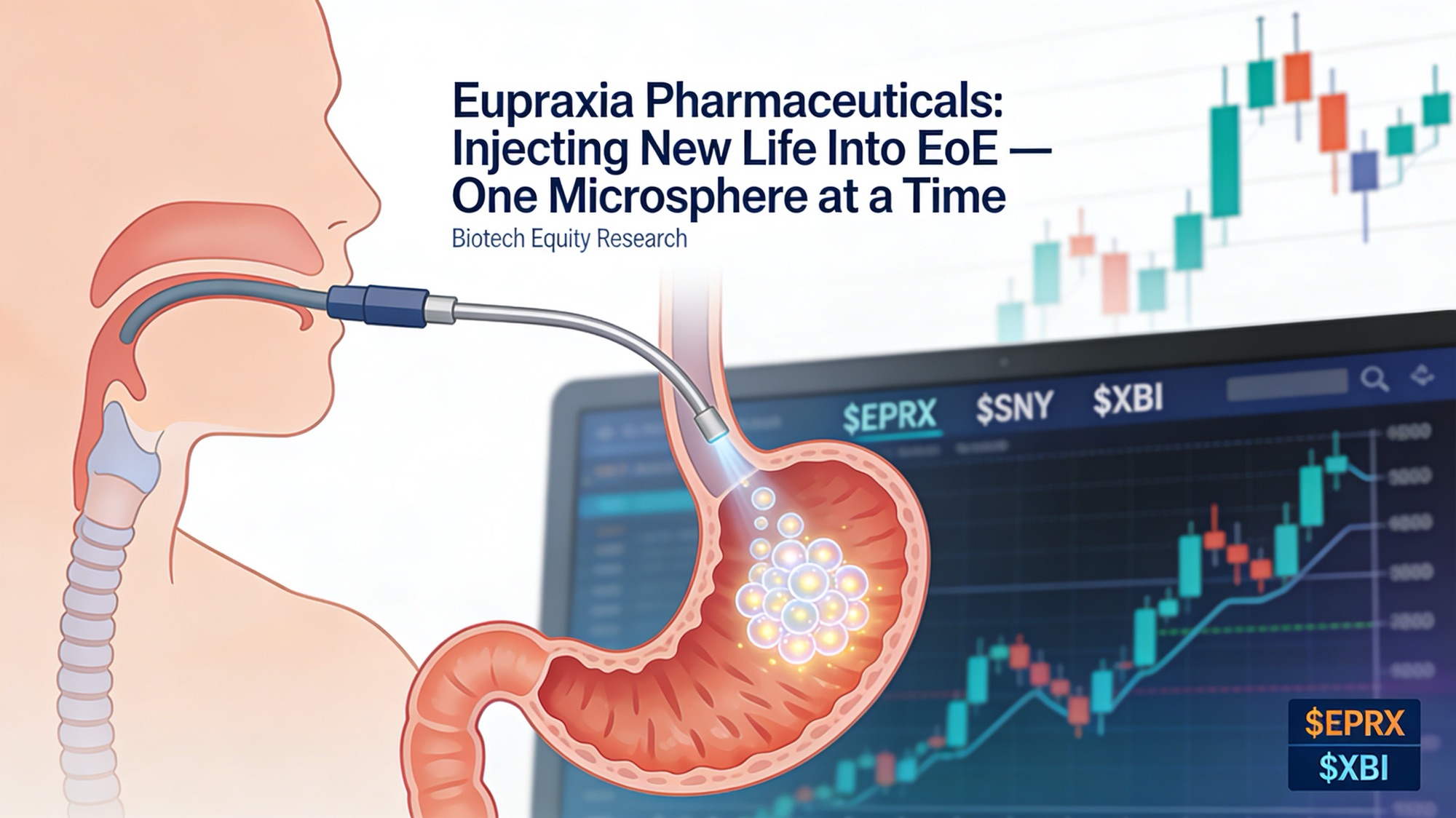
The problem, as Eupraxia frames it, is not steroid pharmacology but delivery. Swallowed topical steroids simply struggle to achieve sustained, high‑enough exposure in the deeper esophageal tissue where fibrosis lives, especially in patients whose anatomy is already distorted by strictures. EP‑104GI attempts to solve this by sidestepping the lumen entirely, placing the drug precisely into the esophageal wall via submucosal injections during endoscopy. It is a simple idea with an elegant twist: if you cannot trust the esophagus to cooperate with gravity and swallowing, you can always come at it from the side.
EP‑104GI: Turning Endoscopy Time Into Therapeutic Time
EP‑104GI uses Eupraxia’s DiffuSphere platform, a microsphere technology in which pure drug crystals are wrapped in a thin polymer shell to control release over months rather than weeks. Instead of a sharp peak followed by a trough—standard fare for many conventional formulations—DiffuSphere is designed to offer a flatter pharmacokinetic profile, maintaining therapeutic levels in local tissue while minimizing systemic exposure. Clinical data across programs suggest a single administration can deliver fluticasone for at least six months in indications such as EoE and osteoarthritis of the knee.
In the RESOLVE Phase 1b/2a trial in adults with active, histologically confirmed EoE, EP‑104GI has shown encouraging early signals. Interim data have included reductions in peak eosinophil counts, improvements in histologic scores (EoEHSS), and meaningful drops in symptom metrics such as the Straumann Dysphagia Index, with mean PEC reductions reported in the 55–67% range at 12 weeks in certain cohorts. Importantly, administration as injections into the esophageal wall has been feasible and generally well tolerated, with investigators noting a safety profile consistent with localized steroid exposure.
For 2026, Eupraxia has guided to a sequence of catalysts that could move the story from proof‑of‑concept toward registration‑quality evidence. Phase 1b/2a updates in the second quarter are expected to showcase six‑month clinical data at the highest doses, while additional histology readouts—including those matching the Phase 2b dose levels—are expected around the third quarter. Because placebo effects on histology in EoE are typically modest, management believes these mid‑stage data could meaningfully foreshadow what the randomized, placebo‑controlled Phase 2b trial—slated to read out in the second half of 2026—may ultimately show.
Target Patient: From PPI Fatigue to Fibrostenotic Rescue
Eupraxia envisions EP‑104GI fitting into multiple segments of the EoE market, reflecting where current standards leave clinical gaps. Proton pump inhibitors are expected to remain first‑line therapy, but non‑responders are often left to navigate a sequence of swallowed steroids and biologics, with varying tolerability and adherence. EP‑104GI could be used post‑Dupixent for patients with residual disease, or even in Dupixent‑naive patients in whom fibrosis and strictures dominate the clinical picture.
In practice, the company expects a subset of PPI non‑responders to either bypass swallowed steroids entirely or use them briefly as a bridge before moving to endoscopically delivered EP‑104GI. That is particularly compelling for patients already undergoing annual surveillance endoscopies to track disease progression, where adding an injection procedure turns a diagnostic encounter into a therapeutic one without an additional trip to the hospital. As one gastroenterologist on Eupraxia’s advisory board has suggested, depth of delivery may prove just as important as dose; getting fluticasone into deeper tissue layers may aid esophageal remodeling beyond what topical approaches can achieve.
Follow the Economics: ASCs, CPT Codes, and the Joy of Buy‑and‑Bill
The clinical narrative is only half the script; the other half is economics, and here Eupraxia is careful to cast gastroenterologists and ambulatory surgical centers (ASCs) in supportive roles. Endoscopy in the U.S. is increasingly concentrated in physician‑owned ASCs, where maximizing procedure slots per day can matter as much as the pathology. EP‑104GI fits neatly into that ecosystem: it is administered during a procedure physicians already perform, using an infrastructure they already control.
Reimbursement mechanics may further sweeten the pitch. Eupraxia points to an existing CPT code for a single submucosal injection that averages about 250 dollars under Medicare; physicians could plausibly bill two to four injections per case, translating into an incremental 500 to 1,000 dollars per procedure on top of existing facility and professional fees. Because EP‑104GI is expected to be reimbursed under a buy‑and‑bill model, physicians may benefit not only from procedural add‑ons but also from margin on the drug itself, assuming payors cooperate.
Early payor research, according to management, suggests potential annual pricing in the 40,000 to 60,000 dollar range without onerous step‑edit requirements, with more than 60,000 dollars per year likely requiring prior failure on swallowed steroids. For a progressive, procedure‑intensive disease affecting a growing, often commercially insured population, that pricing profile could be competitive with biologic benchmarks while leaning on the unique value proposition of fibrosis‑modifying steroid delivery. In Wall Street shorthand, if the data deliver, the coding already exists and the spreadsheet knows how to handle buy‑and‑bill.
Valuation: Discounting Today’s Losses, Pricing Tomorrow’s Microspheres
Cantor values Eupraxia using a probability‑adjusted discounted cash flow model, projecting cash flows through 2035 with a 12% discount rate and a zero percent terminal growth assumption. That exercise yields an implied equity value of roughly 1.4 billion dollars—including cash—supporting the 12‑month price target of 19 dollars per share versus the current 8.35 dollars quote. The model bakes in estimated cash and share count as of the end of the third quarter of 2026, a time frame that should capture the impact of the Phase 2b readout and any near‑term financing.
On that front, Eupraxia has flagged a substantial block of deeply in‑the‑money warrants that are either expiring or being exercised in the near term, potentially bringing in 30 to 40 million dollars in additional capital. While warrant overhang can pressure a stock in the short run, Cantor frames that as a feature rather than a bug—a temporary liquidity event that, if it knocks the share price, might offer patient investors an entry point into what it labels one of its top picks for 2026. Meanwhile, external validation of the DiffuSphere technology from programs such as EP‑104IAR in knee osteoarthritis—where a Phase 2b trial met its primary endpoint with durable pain control and favorable metabolic safety—adds a second, orthopedically inclined leg to the valuation stool.
Risks: From Esophageal Ambition to Regulatory Reality
For all its elegance, the investment case still comes with standard biotech footnotes printed in bold. Eupraxia is pre‑commercial, which means clinical trial outcomes, not quarterly revenue beats, drive the story; failure to reproduce early RESOLVE signals at scale, or safety surprises as doses escalate and cohorts expand, could materially impair the thesis. Regulators will demand robust, reproducible data spanning clinical symptoms, histology, and safety in both Phase 2b and eventual registrational programs, and the bar in EoE is rising as more agents enter the field.
Commercial risk is equally real. EoE already boasts approved therapies across both steroids and biologics, and Dupixent in particular has the advantage of entrenched prescriber familiarity. Convincing clinicians to alter well‑worn treatment patterns in favor of an injection‑based implant will require not just data, but also user‑friendly procedure logistics and clear reimbursement; a misstep on any of those fronts could slow uptake. Finally, with no recurring revenue base today, Eupraxia will likely need additional partnerships or financings to carry EP‑104GI through late‑stage development and initial commercialization, exposing current shareholders to potential dilution if capital markets become less forgiving.
For now, though, Wall Street appears willing to reserve a front‑row seat in the endoscopy suite. If DiffuSphere delivers on its promise—delivering the right steroid to the right layer of tissue for the right duration—Eupraxia’s esophagus‑centric strategy may prove to be more than just a clever twist on an old drug. It might be the rare biotech story where microspheres, not macroeconomics, do most of the talking.
Sources
[1] file-1.pdf https://ppl-ai-file-upload.s3.amazonaws.com/web/direct-files/attachments/24996935/1c2aad4b-cd9f-4f75-940a-3e38c6ca9f81/file-1.pdf
[2] Eupraxia’s DiffuSphere™ Technology Demonstrates Targeted Drug … https://www.prnewswire.com/news-releases/eupraxias-diffusphere-technology-demonstrates-targeted-drug-release-while-minimizing-systemic-exposure-for-a-period-of-more-than-six-months-302311140.html
[3] Pipeline Prospector 2025 highlights: FDA approves pill version of … https://www.pharmacompass.com/pipeline-prospector-blog/pipeline-prospector-2025-highlights-fda-approves-pill-version-of-novo-s-wegovy-biomarin-acquires-amicus-for-us-4-8-bn
[4] A Trial to Evaluate EP-104GI in Adults With Eosinophilic Esophagitis … https://clinicaltrials.gov/study/NCT05608681
[5] Eupraxia Pharma Reports RESOLVE Trial Data on EP-104GI for … https://synapse.patsnap.com/article/eupraxia-pharma-reports-resolve-trial-data-on-ep-104gi-for-eosinophilic-esophagitis
[6] [PDF] Initial Results from RESOLVE, a Phase 1b/2a Dose-Escalation … https://www.eupraxiapharmaceuticals.com/wp-content/uploads/2025/08/2024_09_10_ISDE-2024-EoE-poster_FINAL.pdf
[7] [PDF] Results from RESOLVE, An Ongoing Phase 1b/2a Study of EP … https://eupraxiapharma.com/wp-content/uploads/2025/09/UEG2025-RESOLVE-w36-090925-FINAL.pdf
[8] A Trial to Evaluate EP-104GI in Adults With Eosinophilic Esophagitis … https://ctv.veeva.com/study/a-trial-evaluating-ep-104iar-in-adults-with-eosinophilic-esophagitis
[9] Eupraxia Pharmaceuticals Virtual KOL Event on EP-104GI Clinical … https://lifescievents.com/event/eupraxia/
[10] Eupraxia Pharmaceuticals Initiates Phase 3 Development Program … https://firstwordpharma.com/story/5823820
[11] Eupraxia Begins Phase 2b EP-104GI Trial for Eosinophilic Esophagitis https://synapse.patsnap.com/article/eupraxia-begins-phase-2b-ep-104gi-trial-for-eosinophilic-esophagitis
[12] Eupraxia Pharmaceuticals Announces Positive Data in Ongoing … https://www.bctechnology.com/news/2025/11/3/Eupraxia-Pharmaceuticals-Announces-Positive-Data-in-Ongoing-RESOLVE-Trial-in-Eosinophilic-Esophagitis-and-and-Plans-for-Expansion.cfm
[13] Diffusphere Intraarticular Injectable Technology – LAPaL https://lapal.medicinespatentpool.org/technology/diffusphere-intraarticular-injectable-technology
[14] XBiotech Vs Eupraxia Pharmaceuticals: Which is a Better Buy? AI … https://danelfin.com/stocks/XBIT-xbiotech-vs-EPRX-eupraxia-pharmaceuticals-compare
[15] Forecast – XBIT Stock Price Prediction – Intellectia AI https://intellectia.ai/stock/XBIT/forecast
[16] Eupraxia Pharmaceuticals Announces Positive Data from Fifth … https://www.prnewswire.com/news-releases/eupraxia-pharmaceuticals-announces-positive-data-from-fifth-cohort-of-resolve-phase-1b2a-trial-of-ep-104gi-for-treatment-of-eosinophilic-esophagitis-302303421.html