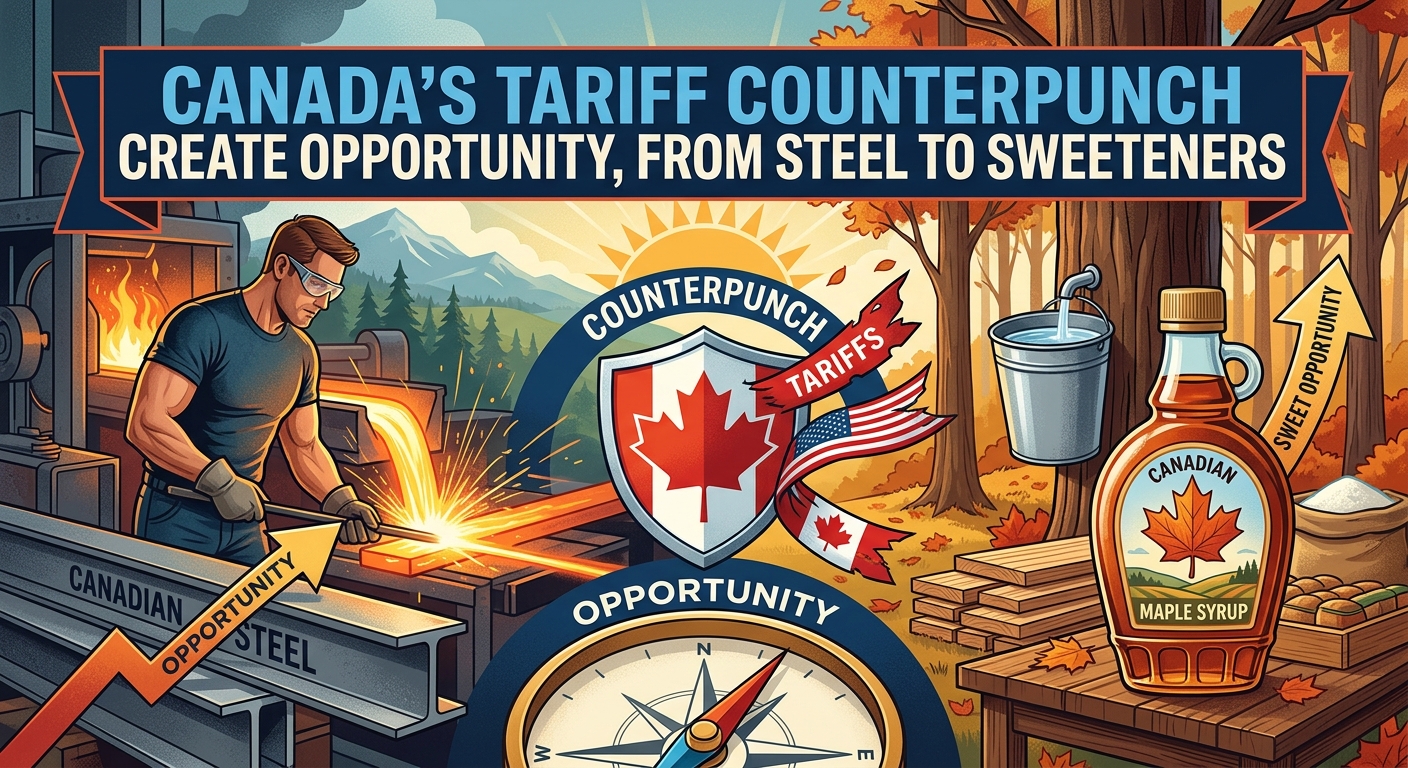
Canada’s planned tariff response to the Trump administration raises the temperature in North American trade, but it may also accelerate a practical outcome markets tend to favor: serious negotiations. For investors, the near-term message is less “sell everything with a border crossing” and more “follow the bottlenecks, the exemptions and the companies built to withstand political weather.” Canada is set to impose tariffs ranging from 15% to 50% on hundreds of U.S. products, including a planned increase to a 50% duty from 25% on many U.S. steel products. Consumer categories such as motorcycles, cosmetics and cheese are also in the crosshairs. Ottawa is targeting roughly the same dollar value as the approximately $20 billion in Canadian goods that became subject to new U.S. tariffs on Aug. 22.
A Negotiation With Better Lighting
Prime Minister Mark Carney’s strategy is a calculated escalation: make the economic costs visible enough that both governments have a sharper incentive to return to the table. The Canadian government has said it is seeking a “durable” deal, not a permanent tariff museum; the distinction matters to investors assessing whether today’s headline risk becomes tomorrow’s commercial architecture. There is already a powerful motive for de-escalation. The U.S. and Canada operate one of the world’s most integrated industrial relationships, particularly in autos, metals, aerospace, agriculture and consumer goods. Canada’s countermeasures are expected to be felt especially by exporters in manufacturing-heavy states such as Michigan and Ohio—precisely the kind of regional pressure that can turn trade rhetoric into renewed diplomacy. That does not make the dispute painless. Oxford Economics estimates that the combined effects of U.S. tariffs, Canadian retaliation and related federal support could reduce Canadian output by about 0.3% relative to its baseline forecast. But tariff episodes have a habit of producing a fairly fast business lesson: supply chains can be rearranged, but not without invoices, delays and several meetings that could have been emails.
The Bullish Read: Resilience Has Value
The positive investment case is not that tariffs are intrinsically good economics. It is that they reveal which businesses have pricing power, localized supply, diversified procurement and products customers cannot casually replace. Three market implications stand out:
- Domestic and regional suppliers may gain negotiating leverage. Companies that can substitute for tariff-hit imports, particularly in metals, industrial inputs and food processing, could see demand shift closer to home.
- North American manufacturing may become more valuable, not less. The U.S. and Canada remain deeply connected through production networks. Even President Trump’s criticism of Bombardier Inc. (TSX: BBD.B) underscores that reality: the company has more than 2,800 U.S.-based suppliers, including Texas-made wings, Iowa avionics and Indiana-made engines for its Global 7500 aircraft. A trade clash may be loud, but the underlying supply chain is practically bilingual.
- A negotiated truce could become a relief catalyst. Markets often re-rate companies when uncertainty falls. If Washington and Ottawa regain a path to an agreement, particularly one preserving competitiveness for Canadian autos, steel and aluminum—the companies most discounted for tariff exposure could see an outsized recovery. Carney has reiterated that Canada is prepared to make a deal when the U.S. is ready.
For many, that favors selectivity over blanket pessimism. Businesses with domestic capacity, long-term contracts, multiple sourcing options and premium brands may be able to protect margins far better than the tariff headlines imply.
Steel, Autos and Aerospace Remain the Pressure Points
Metals are at the center of the latest escalation. Canada’s higher tariffs on many U.S. steel products are designed to counter U.S. measures, while the Trump administration has also discussed potentially raising tariffs on Canadian autos and auto parts to 50%, although the report notes that formal implementation remains unclear. That ambiguity can be uncomfortable, but it also creates an incentive for both sides to compromise before the new measures become embedded in purchasing contracts, factory schedules and consumer prices. Companies and sectors investors may monitor include:
| Company / sector | Ticker | Why it matters |
|---|---|---|
| Bombardier Inc. | TSX: BBD.B | A visible example of cross-border aerospace interdependence, with a large U.S. supplier base. |
| Canadian steel producers | TSX: STLC; TSX: AIF | Potential beneficiaries of domestic preference, though also exposed to industrial-demand and policy volatility. |
| U.S. automakers | NYSE: GM; NYSE: F | Highly integrated continental supply chains make rules, exemptions and parts tariffs central to margins. |
| Auto suppliers | NYSE: MGA; NASDAQ: APTV | Magna International Inc. (NYSE: MGA) and Aptiv PLC (NASDAQ: APTV) illustrate the supply-chain sensitivity of North American vehicle production. |
| Sugar and maple-products processor | TSX: RSI; OTC: RSGUF | Rogers Sugar Inc. operates in sugar and maple products, making it a more direct public-market name to watch for consumer-sweetener and input-cost implications. |
These are watch-list candidates, not a substitute for investment analysis. The tariff equation changes quickly, and company-specific exposure depends on where goods are made, how products are classified, the availability of exemptions and whether a company can pass higher costs through to customers.
Maple Syrup: A Sticky Price Question
For U.S. shoppers, the impact on maple syrup prices depends chiefly on whether the United States applies or expands a tariff specifically covering Canadian maple syrup and related maple products. Canada’s announced retaliation targets U.S. imports into Canada; on its own, that action does not directly impose an extra duty on Canadian maple syrup sold to American consumers.Still, maple syrup sits in an unusually concentrated market. Canada exported maple products to 69 countries in 2025, and 64.2% of its maple-product exports went to the United States. Quebec producers manage production volumes and maintain a strategic reserve specifically intended to smooth supply and price swings caused by the natural variability of annual harvests. The recent supply picture is more reassuring than alarming:
- Canadian maple-syrup production totaled 18.9 million gallons in 2025, down 5.1% from the 2024 record but still the second-highest production year on record.
- Quebec produced 17.0 million gallons, down 5.9% from 2024.
- Quebec accounts for roughly 90% of Canadian output and about 72% of world maple-syrup production, giving its reserve system unusual importance in cushioning global supply.
What consumers may see
Base case: modest or no immediate shelf-price change. If maple syrup remains outside new U.S. tariff coverage, the Quebec reserve and historically large 2025 crop should help prevent a sudden shortage-driven spike. The most likely price pressures would come indirectly, from packaging, transportation, labor, financing or a weaker Canadian dollar, rather than from Canada’s retaliatory tariffs themselves.
Bull case for supply stability: the reserve does its job. Quebec’s strategic maple reserve exists precisely because maple trees have yet to adopt quarterly guidance. Strong inventory management can moderate the price volatility associated with weather-sensitive harvests.
Risk case: maple becomes a named tariff target. If the U.S. were to place a broad 50% tariff on Canadian maple products, importers and retailers would likely pass at least part of that cost along. Given Canada’s dominance in supply and the United States’ reliance on Canadian product, U.S. retail prices could climb materially, particularly for pure, premium-grade syrup. The exact increase would vary by brand, retailer, inventory already in warehouses and the tariff classification involved.
A Takeaway
Canada’s response creates a volatile news cycle, but it also makes a settlement more economically attractive for both sides. That is the bull case: political brinkmanship may eventually force a more durable acknowledgment that North America’s factories, farms and aerospace supply chains are too entwined to treat the border as a simple toll booth. Many should watch for signs of a renewed U.S.-Canada negotiating calendar, product-specific exemptions, implementation details around proposed auto and parts tariffs, and any indication that maple syrup is explicitly included in future U.S. tariff actions. Until then, the strongest opportunities may lie with companies that can sell local supply, preserve margin through pricing power and prosper when uncertainty finally gives way to paperwork, trade diplomacy’s preferred form of cardio.
The Sources
- Bloomberg “Canada Set to Hit Back at Trump Tariffs, Risking Wider Trade War”
Read the Bloomberg article - Agriculture and Agri-Food Canada “Statistical Overview of the Canadian Maple Industry, 2025”
Read the Government of Canada report - Statistics Canada “The Daily: Maple Products, 2025”
Read Statistics Canada’s maple-products release - CTV News “Inside the World’s Maple Syrup Strategic Reserve”
Read the CTV News article - Weiss Ratings Rogers Sugar Inc. (OTC: RSGUF) Company Overview
View the Rogers Sugar profile - Rogers Sugar Inc. (TSX: RSI) Investor Relations
Visit Rogers Sugar investor relations - Bombardier Inc. (TSX: BBD.B) Investor Relations
Visit Bombardier investor relations - Magna International Inc. (NYSE: MGA) Investor Relations
Visit Magna investor relations - Aptiv PLC (NASDAQ: APTV) Investor Relations
Visit Aptiv investor relations - General Motors Co. (NYSE: GM) Investor Relations
Visit General Motors investor relations - Ford Motor Co. (NYSE: F) Investor Relations
Visit Ford investor relations
Stay Updated with Vista Partners
Subscribe to receive market insights, investing ideas, and the latest updates directly in your inbox.